
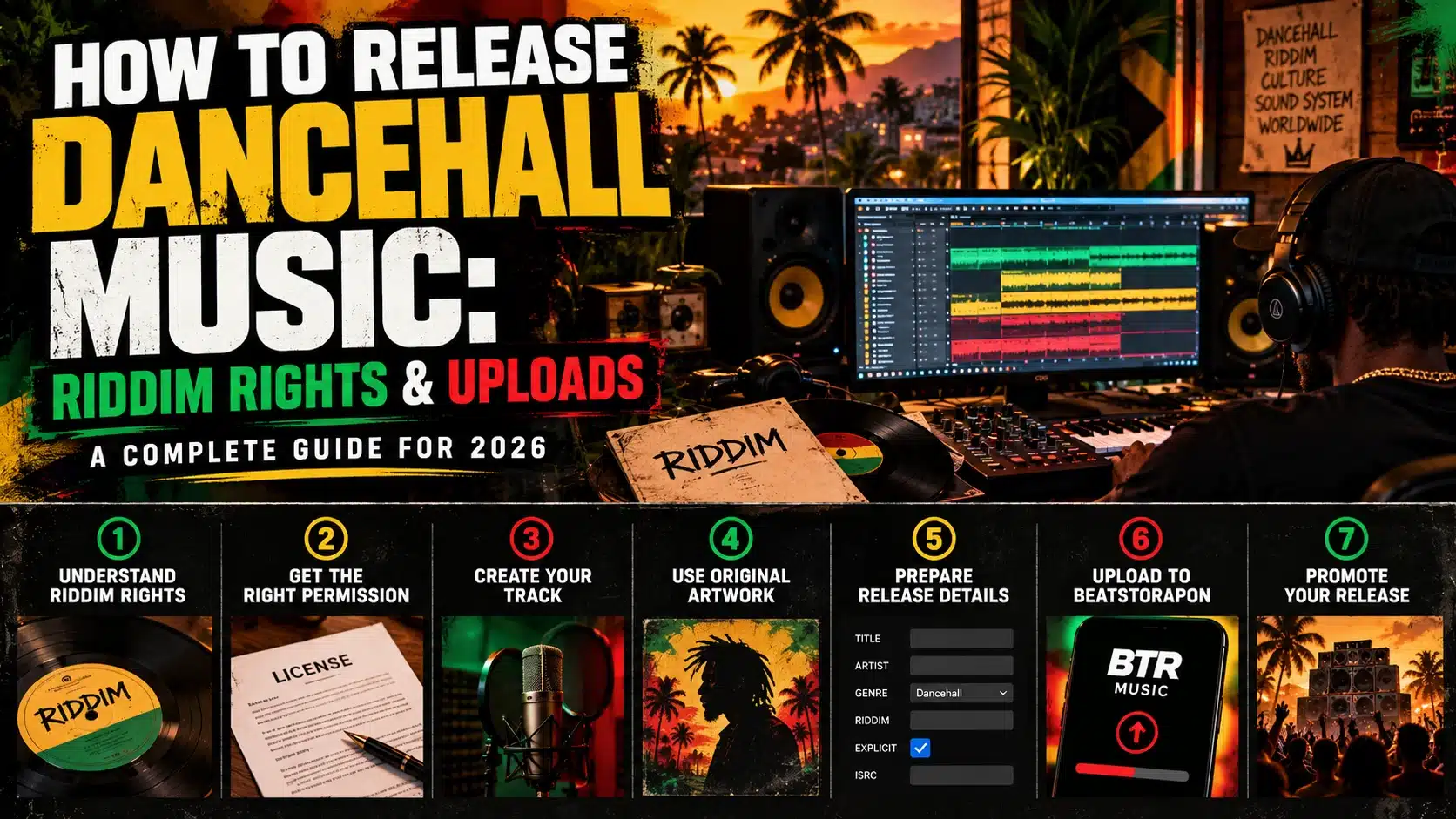
The riddim is ready. The producer sends over the instrumental, you spend two nights recording the vocals, and by Friday you’ve got a dancehall track that sounds like it belongs on a proper sound system.
The hook works. The bass hits. You’ve already sent a preview to three friends, and somebody wants to play it at a party this weekend.
Now you’re ready to upload the song.
There’s just one question nobody asked in the studio.
Who actually has the right to release this recording?
It’s a question that can turn a promising dancehall release into an avoidable headache. You might own your lyrics and vocal performance without owning the riddim. You might have permission to record over an instrumental without having a clear agreement covering public streaming. And even when everybody agrees that the song should come out, nobody may have discussed producer credits, ownership or revenue splits.
None of this means independent dancehall artists need a record label to publish music. They don’t. It means a good release requires more than a finished audio file.
If your master, artwork and permissions are ready, you can upload your dancehall music free on BeatsToRapOn and begin building an artist catalogue. A free artist account currently supports up to ten total track uploads, with eligible published music able to reach listeners through BTR Music.
But before uploading, let’s deal with the details that distinguish a properly prepared dancehall release from a recording that creates problems after it goes live.
One Riddim. Five Artists. Five Different Songs.
Imagine a dancehall producer creates an instrumental called Midnight Pressure Riddim.
Five vocalists hear it.
The first records a club anthem. The second writes a romantic song. The third creates a harder deejay performance. Another records a conscious track, and the fifth turns the instrumental into a melodic dancehall crossover.
The producer has supplied the same musical foundation, but each vocalist has created a different performance and potentially contributed a different original composition.
This is part of what makes riddim culture so distinctive.
In Jamaican dancehall, a riddim can become the foundation for multiple recordings by different artists. Producers, selectors, sound systems and vocalists all contribute to how those versions circulate and develop an audience.
That practice has deep roots in Jamaican music, where instrumental versions, sound-system exclusives and artist interpretations helped establish a musical culture built around both repetition and reinvention.
But there is an important difference between a riddim being available for several artists to voice and every artist automatically receiving unrestricted rights to publish their version.
The actual permissions depend on ownership, licences and agreements.
What Rights Do You Need?
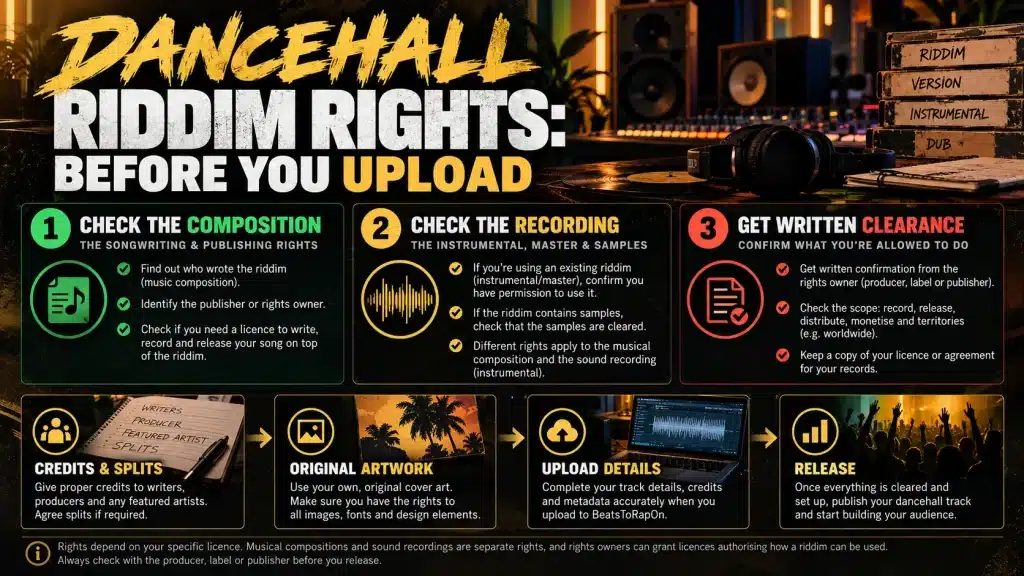
A finished dancehall release may involve several overlapping interests.
| Recording element | What to establish before release |
|---|---|
| Instrumental riddim | Who owns or controls it, and whether your use is authorised |
| Original lyrics and melody | Who wrote them and how songwriting ownership is allocated |
| Finished master recording | Who owns or controls the recording being uploaded |
| Featured vocalists | Whether their contributions and release permissions are agreed |
| Samples or interpolations | Whether necessary third-party rights are cleared |
| Cover artwork | Whether you can legally reproduce and publish the image |
These rights can belong to different people. The Jamaica Intellectual Property Office explains how copyright can apply to musical works, lyrics, sound recordings and other protected material, and how owners may authorise particular uses through licensing.
The lesson for independent artists is straightforward: confirm that you are authorised to publish the complete recording, not merely perform your contribution to it.
“The Producer Sent Me the Beat” Is Not a Complete Release Agreement
You’ve probably heard a version of this conversation.
The vocalist asks whether the producer is happy with the song.
The producer says yes.
Everybody loves the recording.
Then the artist uploads it.
Months later, one party asks who authorised monetisation, who owns the master or why a producer credit is missing.
These situations aren’t always caused by bad intentions. Sometimes the people involved simply never clarified what they agreed to.
Five Questions to Ask the Riddim Producer
Before releasing a song built around someone else’s instrumental, establish:
- Can I publish this recording? Confirm that the producer or relevant rightsholders authorise the intended release.
- Which uses are permitted? Does the agreement cover online streaming, downloads, promotional videos and other intended uses?
- Who owns the master? Establish ownership or control of the final sound recording.
- How should contributors be credited and compensated? Agree on applicable credits, songwriting interests, master interests and payments.
- Are there restrictions? Check for exclusivity, territory, duration, additional permissions or other conditions.
For an independently produced recording, some of these answers may be simple. When several contributors or third-party recordings are involved, the agreements may be more complex.
Berklee’s explanation of songwriting and sound-recording ownership is a useful reference for understanding why composition rights and master rights need to be considered separately.
A Practical Release-Permission Record
A simple written release record can prevent confusion.
It could identify the song title, riddim name, credited artists, producer, contributors, parties controlling the relevant rights, permitted uses and agreed ownership or payment arrangements.
The precise wording and legal requirements depend on the project and jurisdiction. Significant commercial releases may justify professional legal advice.
The objective isn’t to bury every creative collaboration in paperwork.
It’s to make sure everybody knows what is being released and on what terms.
Your Dubplate Is Not Necessarily Your Streaming Single
Dancehall’s relationship with sound-system culture introduces another important distinction: the difference between a recording made for a specific purpose and a recording intended for general public release.
A dubplate might contain a custom vocal, exclusive lyrics or a personalised performance recorded for a particular selector or sound system.
That exclusivity can be part of its value.
But permission to use a recording within a specific sound-system context does not necessarily establish the rights required for unlimited public streaming.
Likewise, a riddim producer may authorise an artist to record a version while placing conditions on wider distribution.
Before Uploading a Dubplate or Special Version
Check whether the release involves an exclusive performance, a producer-owned instrumental, third-party audio or other restrictions.
If you want the recording to become a permanent public single, make sure its existing agreements permit that use.
The same principle applies to remixes, alternate mixes and acoustic versions: a new edit does not automatically eliminate rights associated with the original material.
If you’re preparing a full recorded DJ session instead of a standalone song, use the separate Dancehall & Reggae DJ Mix Upload Guide and confirm the necessary permissions for the included recordings.
The key distinction is between being able to play a recording and having permission to publish it through a music platform.
Dancehall Has a Real Audience on BTR. Here’s What the Platform Data Shows.
There’s a commercial reason to take the publishing process seriously.
Dancehall isn’t merely a secondary category inside a hip-hop-oriented music platform. The genre has demonstrated meaningful activity on BeatsToRapOn itself.
In BTR’s published Independent Music Streaming Statistics 2026 report, Dancehall recorded approximately 615,000 cumulative plays across 571 tracks through July 22, 2026.
The same report identified a Dancehall recording, How I Like IT by isaiah, as the platform’s most-played individual track at the reporting cutoff, with 27,427 recorded plays.
Those figures describe historical first-party platform activity. They aren’t current live totals, Google search volumes, royalty-qualified stream counts or a prediction of how a new release will perform.
But they provide something valuable: evidence from the actual platform where an independent artist may be considering publishing.
For an artist evaluating whether to create a BTR catalogue, that is more relevant than a generic statement claiming that dancehall is popular around the world.
The BTR listener ecosystem already contains dancehall releases and measurable engagement. The next challenge is preparing and presenting your own music well enough to participate, without assuming any particular result is guaranteed.
Which Dancehall Category Should You Upload To?
Dancehall has never been one fixed production style.
The genre has changed enormously since its emergence from Jamaican reggae and sound-system culture, and contemporary artists frequently combine dancehall influences with Afrobeats, R&B, hip-hop and electronic production.
The right upload classification depends on the actual recording.
For example, a vocal-led modern dancehall single may belong in a different category from a roots-influenced recording or a pop-oriented crossover.
Choose the Closest Musical Fit
| Musical direction | Relevant BTR page |
|---|---|
| General dancehall | Upload Dancehall |
| Contemporary dancehall | Upload Modern Dancehall |
| Bashment-influenced release | Upload Bashment |
| Pop-oriented dancehall | Upload Dancehall Pop |
| Afro-Dancehall crossover | Upload Afro-Dancehall |
| Reggae-focused song | Upload Reggae |
These are artist-upload guidance pages. The choices available in the current BTR workspace determine the classification you should select when submitting.
Avoid selecting several unrelated genres purely to reach more people.
Accurate metadata gives listeners a clearer understanding of the sound and makes your catalogue easier to organise.
For listening context, explore the BTR Dancehall Music Catalogue, which provides a separate destination for browsing the music itself.
Your Vocal Must Survive the Bassline
Dancehall is built for rhythmic impact, but a powerful riddim is not an excuse for an unintelligible vocal.
A track can sound enormous through a studio monitor and still become difficult to understand when played on a phone.
The problem is often more noticeable in vocal-led recordings where the bassline, percussion and lead performance occupy competing spaces.
Before uploading, test the actual final master.
Start by listening at a modest volume. Can you understand the lead vocal without concentrating? Do the consonants disappear when the bass enters? Are supporting vocals and ad-libs masking important words?
Next, listen through ordinary headphones and a phone speaker.
The low frequencies may behave differently across devices, but the song should retain its main rhythmic and vocal identity.
The Vocal-Only Comparison
If you still have access to the original session, play the lead vocal without the instrumental.
Then restore the riddim.
Listen for words that become difficult to understand once the complete arrangement returns.
Sometimes the solution is vocal processing. In other cases, reducing an instrumental layer, changing a percussion accent or adjusting the arrangement can create more space.
Do not assume that making the vocal louder is always the correct answer.
For broader guidance, BTR provides How to Mix a Song and an AI Vocal Cleaner for supported preparation workflows.
Check the Export, Not Just the Studio Project
Your release file should be the finished version you’ve actually reviewed.
Listen through the entire export, including the introduction and final seconds. Check for damaged audio, unwanted silence, missing instruments or abrupt endings.
Use a high-quality format accepted by the BTR uploader and retain your original master separately.
The applicable file requirements are available through the artist workspace and the BTR Music Upload Requirements Guide.
Your Artwork Should Represent the Artist, Not Just the Genre
Dancehall has a recognisable visual culture, with connections to street dance, sound-system events, fashion, Jamaican popular culture and local communities.
That creates enormous scope for distinctive release artwork.
But using the same generic imagery for every track doesn’t help audiences remember the person who made the music.
A recognisable artist image, consistent stage name and original artwork can make an independent release feel like part of a real catalogue rather than an isolated audio upload.
Prepare Artwork That Works at Thumbnail Size
For BTR, a high-quality square cover of at least 1000 × 1000 pixels is a practical target.
Use a photograph, illustration or graphic composition you own or have permission to publish.
Check the design at a small thumbnail size. Make sure important elements remain recognisable and that any text isn’t so small it becomes unreadable.
A default image isn’t a substitute for a properly presented release.
BTR considers profile completeness and artwork when determining eligibility for certain main discovery experiences.
Before uploading, review the Album Artwork Requirements Guide.
How to Upload Your Dancehall Song on BeatsToRapOn
Once your recording, rights, artwork and metadata are ready, you can move into the actual publishing process.
BeatsToRapOn is the artist-facing platform, where you create and manage your public artist identity and release catalogue.
BTR Music is the connected listener app, where approved and eligible recordings can become available.
You don’t need to create an unrelated artist catalogue separately for BTR Music.
The Release Workflow
1. Open the Dancehall Upload Page
Visit Upload Dancehall Music Free.
Create an artist account or sign in to your existing workspace.
A free BeatsToRapOn artist account currently supports up to ten total track uploads. Artists requiring larger catalogues can review Artist Pro, which provides unlimited uploads and additional features.
2. Complete Your Artist Profile
Use your consistent stage name, a recognisable profile image and a meaningful biography.
Your profile should help a listener identify the person or group behind the recording.
3. Prepare the Finished Audio and Artwork
Select your final reviewed recording.
Make sure the required instrumental, vocal, sample and collaboration permissions are in place.
Prepare the original square cover.
4. Enter the Release Information
Add the public track title, accurate artist and contributor credits, artwork and the closest available genre classification.
If your recording is a specific version or remix, describe it accurately without making unsupported claims about ownership.
5. Submit for Review
Complete the upload through the artist workspace.
Submitting a file does not automatically make the recording public. The relevant approval and publishing process must be completed.
Review timing can vary, so check the status shown in your workspace rather than announcing an unconfirmed publication time.
6. Verify the Public Release
Once the track is approved and published, open its public page.
Check that the audio plays correctly, the artwork displays properly, and the artist identity and title are accurate.
7. Share the Actual Track URL
Use the approved public release link in your promotional content.
That gives interested listeners a direct destination for the complete recording and a way to explore your artist catalogue.
Does Uploading to BTR Put the Song on Spotify?
No.
BeatsToRapOn is a direct-upload artist platform connected to BTR Music. Publishing a song there does not automatically distribute it to Spotify, Apple Music or other external digital streaming services.
Those require a separate distributor or other authorised delivery arrangement.
For an explanation of the difference, read How to Upload Music to BTR Music and How to Upload Music Online.
Stop Announcing the Song Before There’s Somewhere to Hear It
A common release mistake is generating interest before the recording has completed its publishing process.
You post the artwork.
Share a studio preview.
Tell everybody that the new dancehall single is available.
But when listeners try to find the full song, there’s no working public destination.
If you haven’t completed the approval and publication steps, the announcement is premature.
A more practical approach is to prepare promotional content while the recording is under review, then share the public listening link once you’ve verified it.
Make the Preview Sound Like the Actual Song
Choose a short section that represents the recording.
For vocal-led dancehall, that might be a strong lyrical phrase, rhythmic delivery or chorus.
For a more instrumental production, it could be a distinctive bassline or percussion passage.
The preview should create a genuine expectation of what the listener will hear when opening the full track.
Avoid promoting an unfinished mix that sounds radically different from the final recording without making that distinction clear.
Give the Artist a Recognisable Identity
Use the same stage name and cover artwork across your public track page and promotional content.
Keep the release destination simple.
Instead of giving fans several unrelated links with no clear purpose, direct them to the finished recording and your artist profile.
You can use the BTR AI Music Promo Maker to explore supported music-related visual content.
The strongest creative idea is often specific to the song, not another generic club graphic.
What Happens After Your Dancehall Track Goes Live?
Publishing is an important milestone, but it isn’t the end of the artist’s work.
Your public release becomes part of your catalogue, where listeners can identify the artist and explore related recordings.
Approved tracks that meet the relevant content, profile, artwork and mobile eligibility requirements may also be available through BTR Music.
Some artists may participate in applicable charts and discovery features, but those are based on the platform’s rules and audience activity.
A new upload is not guaranteed a chart position or a particular number of streams.
You can explore the BTR Dancehall Power Charts to understand the platform’s on-site ranking experience.
Can Dancehall Artists Earn Money From BTR?
Eligible artists may earn through qualifying streaming activity and supported direct-to-fan features, subject to BTR’s rules and Payment Terms.
These products can include Superfans, Tips, Backers and Shoutouts where eligibility requirements are satisfied.
However, a recorded play does not necessarily qualify as a payable stream, and an upload alone does not create guaranteed income.
For a broader look at artist monetisation, read How to Make Money From Music Fans.
The more useful initial objective is to publish a professionally presented recording and give genuine listeners a clear way to discover your music.
Before Uploading: The Dancehall Release Audit
Run through this checklist before submitting your song.
| Requirement | What to verify |
|---|---|
| Riddim rights | Permission to publish and use the instrumental as intended |
| Vocal rights | Permissions for all featured or sampled performances |
| Composition | Songwriting credits and ownership arrangements documented |
| Master recording | Parties with ownership or control identified |
| Audio quality | Final master tested through different playback devices |
| Cover artwork | Original or properly licensed square artwork |
| Artist profile | Consistent name, genuine image and completed biography |
| Genre classification | Correct Dancehall or available subgenre |
| Metadata | Accurate public title, credits and version information |
| Publishing status | Track reviewed and publicly available before promotion |
The purpose is not to make releasing music unnecessarily complicated.
It’s to prevent avoidable problems that can undermine an otherwise excellent recording.
Questions Dancehall Artists Ask Before Releasing Music
Can I upload a dancehall song recorded on someone else’s riddim?
Yes, if you have the necessary rights or permission to publish the recording. The conditions depend on the riddim, its owners and the relevant agreements. Permission to record or perform a version does not automatically establish unrestricted streaming rights.
Can multiple artists release songs on the same riddim?
Yes. Shared riddims are a long-standing part of Jamaican musical culture. Each release still needs to comply with its applicable rights and licensing arrangements.
Do I need a record label to release dancehall?
No. Independent artists can publish original recordings without a traditional label agreement, provided they have the necessary permissions and follow the publishing platform’s requirements.
Where can I release dancehall music for free?
BeatsToRapOn currently provides up to ten total track uploads through a free artist account. You can start with the Dancehall Music Upload Page.
Can I upload bashment and modern dancehall?
Yes, subject to the applicable content and publishing requirements. Choose the closest accurate available genre classification. BTR also has dedicated upload guidance for bashment and modern dancehall.
Can I upload a dancehall instrumental without vocals?
Yes, provided you own or are authorised to publish the recording and select an appropriate available genre or instrumental category.
Will my track appear in BTR Music immediately?
Not necessarily. The track must complete the relevant review and publishing steps, and mobile availability depends on applicable eligibility requirements. Check the artist workspace for status.
Can I publish my song on BTR and Spotify?
Publishing on BTR does not itself distribute music to Spotify. You can pursue separate distribution arrangements when you hold the appropriate rights and comply with the terms of each service.
How do I promote a new dancehall single?
Start with a publicly available recording, distinctive artwork and a completed artist profile. Create an authentic excerpt that demonstrates the song’s character, contact relevant audiences and share the working public release link.
Who owns the song when I upload it?
You retain the rights you lawfully own, subject to the platform’s applicable terms. Ownership of the lyrics, composition, riddim and finished sound recording may involve different contributors or rightsholders. Resolve those arrangements before publishing.
A Dancehall Release Should Be More Than a File Someone Sent Around
Dancehall has always been shaped by the relationship between artists, producers, selectors, sound systems and audiences.
A riddim becomes something new when a vocalist gives it a distinctive performance. A recording takes on another life when selectors begin playing it and listeners recognise the artist behind the song.
Digital publishing provides a further opportunity to make that recording available beyond its original studio or local community.
But the fundamentals remain important.
The music needs a clear identity.
The producer and other contributors deserve accurate recognition.
The artist must have the necessary rights.
The master should represent the finished recording, and the public release should give listeners somewhere reliable to hear it.
You don’t need a traditional record-label agreement to begin building that catalogue.
You need a completed song, a properly prepared release and a platform that supports the next step.
Upload Dancehall Music Free on BeatsToRapOn →
Create your artist profile, upload up to ten tracks free and publish your original dancehall recordings for eligible discovery within the BeatsToRapOn and BTR Music ecosystem.
You recorded the song. Make sure you’re ready to release it.