
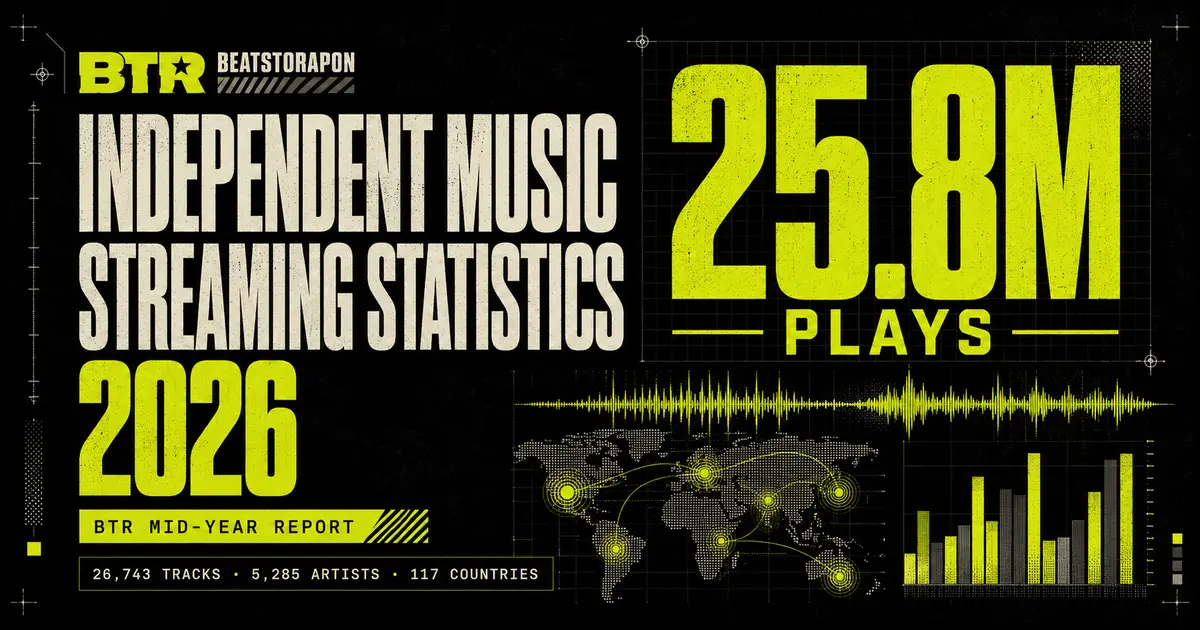
Original research · 14 January 2025 → 22 July 2026
Independent music
streaming statistics
2026.
Eighteen months in, the numbers stopped whispering. BeatsToRapOn analyzed first-party activity across 26,743 tracks, 5,285 independent artists and 117 countries. The result is a rare view of how hip-hop, Afrobeats, instrumentals and adjacent genres are actually uploaded, discovered, played and shared outside the major streaming-platform datasets.
Source: aggregated BeatsToRapOn first-party platform records. Methodology and definitions appear below.
What the
catalogue moved.
These cumulative independent music streaming statistics cover the period from BeatsToRapOn’s first upload on 14 January 2025 through 22 July 2026. The figures come from the platform’s own aggregated records—not projections, surveys or estimates.
92.7% of published tracks received at least one play. That matters because upload volume alone cannot show whether a discovery platform is functioning. A large catalogue can still be a graveyard. On BeatsToRapOn, nearly every track has found an ear.
Among tracks with at least one play, the median reached 802 plays and the mean reached 1,041. The limited gap between those measures suggests that activity is distributed through the middle of the catalogue instead of being created by one isolated viral outlier.
two seconds,
for roughly 18 months.
The platform recorded 49.3 million views and 25.8 million plays. Using the underlying unrounded totals, 52.3% of recorded views converted into plays—a useful first-party benchmark for independent music discovery.
The catalogue
is compounding.
By 22 July 2026, artists had uploaded more dated tracks during 2026 than during all of 2025.
The dated catalogue ended 2025 at 10,446 tracks. By 22 July 2026 it had reached 23,420, with 12,974 dated uploads added during 2026. The first half of 2026 produced 11,429 uploads—almost exactly three times the 3,806 uploads recorded during the first half of 2025.
Hip-hop is the
house. The rooms
are expanding.
Hip-Hop / Rap leads BeatsToRapOn with 10.28 million plays—approximately equal to the next four categories combined. Instrumentals rank second by plays, while Afrobeats holds the second-largest track catalogue.
hardest-working
tracks in the dataset.
Instrumentals generated approximately 1,529 plays per track—the highest rate among the leading genres and roughly 50% above the Hip-Hop / Rap average. The pattern reflects the platform’s original use case: producers upload beats and artists repeatedly audition them for writing, freestyling and recording.
Within Hip-Hop / Rap, the most-played classifications include New School Hip Hop, Underground Hip Hop, East Coast, Old School Hip Hop and Boom Bap. Afropop leads several of the fastest-growing Afrobeats classifications, while Trap Soul connects rap and contemporary R&B listening.
The catalogue is 20.1% explicit. Its median tempo is 100 BPM, and the largest tempo band is 80–100 BPM—a range heavily represented across modern rap, Afrobeats and R&B production.
A US base.
An African
growth engine.
Among 18,706 tracks carrying a country-of-origin tag, the United States remains the largest individual market. The combined African catalogue, however, now represents 49% of geo-tagged tracks and artists from African countries generate 43.1% of plays.
The significance is commercial as well as cultural. Afrobeats and Amapiano generated more than 3.3 million combined plays. Nigeria and South Africa are already the platform’s second- and third-largest country catalogues, suggesting that independent African music is not a peripheral segment of the dataset—it is one of its principal growth engines.
The ten records
that led
the catalogue.
The cumulative top ten spans Dancehall, Afrobeats, R&B and Hip-Hop / Rap. That variety matters: a Dancehall release holds the number-one position on a platform whose largest catalogue is Hip-Hop / Rap.
| Rank | Track and artist | Genre | Plays | Likes |
|---|---|---|---|---|
| 01 | How I Like ITisaiah | Dancehall | 27,427 | 2,936 |
| 02 | John boyjohnogunlana | Hip-Hop / Rap | 17,719 | 2,091 |
| 03 | HLI track beatshli | Hip-Hop / Rap | 14,088 | 1,689 |
| 04 | Holi beatshli | Hip-Hop / Rap | 13,794 | 1,658 |
| 05 | Summer Logiconlyrhesexy | R&B & Soul | 13,760 | 1,662 |
| 06 | Midnight Staticonlyrhesexy | R&B & Soul | 13,640 | 1,597 |
| 07 | TIMEmalegeadc | Afrobeats | 13,574 | 1,566 |
| 08 | Davy Dacy — One Stepdavydacy | Dancehall | 13,414 | 1,602 |
| 09 | HLI trackhli | Hip-Hop / Rap | 13,394 | 1,584 |
| 10 | Mai Mai Ta85skwad | Hip-Hop / Rap | 13,065 | 1,496 |
How I Like IT
“How I Like IT” leads all three of the report’s principal track-level measures: plays, likes and downloads. Its position offers clear evidence that listeners are moving across genre boundaries rather than remaining inside the platform’s largest Hip-Hop / Rap catalogue.
The engine
room.
Across 5,285 artists, the leading accounts reveal two different catalogue strategies: publishing at very high volume and earning more plays from a smaller body of work.
| Rank | Artist | Plays | Tracks | Approx. plays per track |
|---|---|---|---|---|
| 01 | brentindavis | 939K | 943 | 996 |
| 02 | rapperrickyt | 912K | 717 | 1,272 |
| 03 | darksynthax | 800K | 1,297 | 617 |
| 04 | gasboy-vibes | 650K | 589 | 1,104 |
| 05 | nyizm2026djparadox | 367K | 275 | 1,335 |
| 06 | bangazbyboon | 353K | 163 | 2,166 |
| 07 | reemdagreat | 328K | 130 | 2,523 |
| 08 | kloverfreshproduction | 312K | 199 | 1,568 |
| 09 | crystal789 | 279K | 91 | 3,066 |
| 10 | roseblossom7s | 277K | 186 | 1,489 |
The catalogue builders: darksynthax has 1,297 tracks—the deepest catalogue among the top ten. brentindavis and rapperrickyt each exceed 700 tracks while approaching one million plays. Their results demonstrate how a large, consistently published catalogue can compound discovery over time.
The efficient catalogues: crystal789 entered the top ten with 91 tracks, averaging approximately 3,066 plays per upload. reemdagreat and bangazbyboon also produced more than 2,000 plays per track from smaller catalogues. The dataset therefore shows that both publishing frequency and per-release performance can create meaningful reach.
Reach is loud.
Distribution is
the signal.
Cumulative totals show scale. Ratios show whether listeners act after discovery. These first-party benchmarks help explain how attention moves through the catalogue.
A recorded 18.6% share-to-play ratio means shares were equivalent to almost one in five plays. A share is not necessarily a unique person or an external referral, but the ratio demonstrates a substantial distribution loop within the platform’s measured activity.
hold 34.3% of plays.
The remaining 65.7%
forms a measurable
long tail.
The top 1% of tracks account for 7.2% of plays. On this dataset, listening is therefore not concentrated exclusively in a small group of releases. Combined with the finding that 92.7% of tracks received a play, the distribution indicates that a substantial portion of the catalogue participates in discovery.
The 52.3% browse-to-listen rate provides another useful benchmark: more than half of recorded views became plays. Because platform definitions vary, this figure should be compared over time within BeatsToRapOn rather than treated as directly equivalent to a metric reported by another service.
First-party data.
Defined and
downloadable.
This report is designed to be cited by journalists, researchers, music-business educators, artists and analysts. The limitations below are part of the result, not fine print.
Scope and definitions
- Reporting window: 14 January 2025 through 22 July 2026. Unless identified as monthly or H1, figures are cumulative through the extraction date.
- Source: aggregated first-party BeatsToRapOn platform records. No third-party survey panel, modeled market estimate or external streaming-service data is included.
- Published catalogue: the headline count covers 26,743 published tracks. The monthly growth series covers 23,420 tracks with a usable recorded upload date, explaining the difference between the two totals.
- Country analysis: geography results cover 18,706 tracks carrying a country-of-origin tag. Untagged tracks are excluded from country shares and rankings.
- Genre analysis: each track is counted under its primary BeatsToRapOn genre classification. Cross-genre influence is discussed editorially but not double-counted in the ranking.
- Plays: a play is a platform playback event in this report. It is not necessarily a royalty-qualified mobile stream and should not be treated as directly equivalent to a paid stream reported by Spotify, Apple Music or another DSP.
- Views, likes, shares and downloads: these are first-party platform interaction counts. Ratios use the underlying internal totals and may differ slightly from calculations made with the rounded headline numbers shown on the page.
- Privacy: only aggregated catalogue, genre, country, track and artist performance statistics are published. The downloadable file contains no private listener-level records.
- Review policy: the article retains the same canonical URL when updated. Material revisions should change the visible “last reviewed” date and Dataset schema dateModified.
BeatsToRapOn (2026), “Independent Music Streaming Statistics 2026: BTR Mid-Year Report,” data through 22 July 2026, https://beatstorapon.com/blog/independent-music-streaming-statistics-2026/
Second half.
Catalogue growth is accelerating, the long tail remains active and artists from African countries are approaching half of measured platform activity. The priorities for the second half of 2026 follow directly from the data.
Turn record months into a durable baseline. May and June 2026 delivered consecutive upload records. Sustainable growth means improving discovery, moderation and artist support alongside volume—not simply chasing a higher upload total.
Design for the geographic reality. Nigeria and South Africa are the second- and third-largest country catalogues. African artists generate 43.1% of recorded plays, while Afrobeats and Amapiano exceed 3.3 million combined plays. Product and discovery systems should reflect that center of gravity.
Protect distributed discovery. The finding that 92.7% of tracks have been played and the top 1% controls only 7.2% of plays is strategically important. As the catalogue grows, preserving participation across the long tail is more valuable than manufacturing a small number of platform-wide winners.
were the warm-up.
This is where the
catalogue learns
to run.
Independent music
statistics FAQ.
What are the headline independent music streaming statistics for 2026?
Through July 22, 2026, BeatsToRapOn recorded 26,743 published tracks, 5,285 artists, 25.8 million plays, 49.3 million views, 2.5 million likes, 4.8 million shares and 634,000 downloads across a catalogue representing 117 countries.
How quickly is the independent music catalogue growing?
The dated catalogue received 3,806 uploads during H1 2025 and 11,429 during H1 2026, representing approximately three-times year-over-year growth across the comparable six-month periods. May and June 2026 were the largest complete months, with 2,841 and 2,970 uploads.
What is the most-played music genre on BeatsToRapOn?
Hip-Hop / Rap is the most-played category with 10.28 million plays across 10,091 tracks. Instrumentals rank second with 3 million plays, followed by Afrobeats with 2.69 million, Trap with 2.38 million and R&B & Soul with 2.26 million.
Which music genre gets the most plays per track?
Among the leading genres in this dataset, Instrumentals have the highest average at approximately 1,529 plays per track. That is roughly 50% higher than the Hip-Hop / Rap average.
Which countries contribute the most independent music?
The United States has the largest country-tagged catalogue with 6,678 tracks, followed by Nigeria with 4,175, South Africa with 3,736 and the Philippines with 1,482. Artists from African countries collectively represent 49% of the geo-tagged catalogue.
How much BeatsToRapOn listening comes from African artists?
Tracks attributed to artists from African countries generated 43.1% of cumulative platform plays in the reporting dataset. Afrobeats and Amapiano together generated more than 3.3 million plays.
Does a play in this report mean a royalty-qualified stream?
No. A play is a BeatsToRapOn platform playback event for the purposes of this research. It is not necessarily a payout-qualified mobile stream and should not be compared directly with a paid stream reported by another digital music service.
How widely are plays distributed across the catalogue?
The top 10% of tracks account for 34.3% of plays, while the top 1% account for 7.2%. In addition, 92.7% of published tracks received at least one play, indicating measurable discovery across the long tail.
Can journalists and researchers cite this report?
Yes. Cite BeatsToRapOn as the source, name the report, state that the data runs through July 22, 2026 and link to the canonical report URL. A downloadable CSV is provided for analysis and verification.