
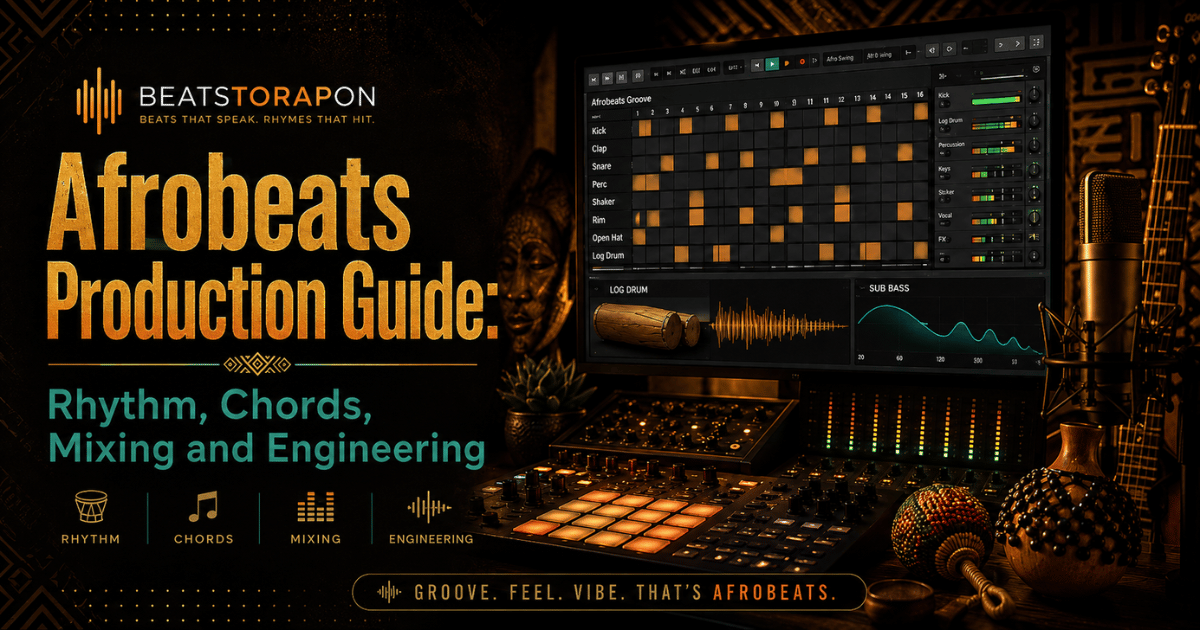
Afrobeats is not just a tempo, a drum loop, or a global pop tag. It is a modern production language built from West African rhythmic systems, diaspora club culture, commercial songwriting, digital sound design, and detailed audio engineering. For producers, artists, DJs, and engineers working in Afrobeats music, the difference between a track that merely imitates the sound and one that moves properly often comes down to rhythm, swing, low-end discipline, vocal space, and cultural accuracy. The same matters for listeners following the Afrobeats charts, where the strongest records usually balance deep groove with clear songwriting and mix translation.
To execute high-level music production within the Afrobeats space, it is fundamentally necessary to delineate the genre from its historical predecessor, Afrobeat. While the nomenclature is nearly identical, differing only by a single pluralizing consonant, the stylistic, cultural, and structural differences are profound and dictate entirely different production methodologies. Afrobeat and Afrobeats are distinct musical categories. Afrobeat, pioneered in the 1970s by Nigerian multi-instrumentalist Fela Kuti and legendary drummer Tony Allen, is a genre characterized by live, expansive analog instrumentation, highly complex polyrhythms, deep jazz and funk influences, and overtly political lyrical content. It relies heavily on organic studio recordings, extended track lengths that often exceed ten minutes, and the raw, unquantized synergy of a massive live band playing in the same room, as outlined in production-oriented explanations such as guides to producing Afrobeat music.
The Etymology, Cultural Distinction, and Evolution of Afrobeats
Conversely, “Afrobeats” is not a singular traditional genre, but rather a contemporary, commercially driven umbrella descriptor used to categorize the amalgamation of West African pop music styles that surged out of Nigeria, Ghana, and the United Kingdom diaspora in the late 1990s through the 2010s. The term itself is a Western construct; it was popularized and arguably coined by London-based DJ Abrantee as a pragmatic means to package, present, and market this emerging, electronic-leaning African sound to British dancefloors and international radio stations. This contemporary iteration merges traditional African rhythmic frameworks, such as highlife, jùjú, hiplife, fuji, kpanlogo, and ndombolo, with modern Western commercial genres including R&B, dancehall, hip-hop, soca, and electronic dance music, as described in historical summaries of Afrobeats.
The homogenization of these distinct regional styles under a single moniker has not been without controversy. Yeni Kuti, the daughter of Fela Kuti, has publicly expressed distaste for the term “Afrobeats,” arguing that it creates historical confusion; she advocates for more accurate regional descriptors such as “Nigerian pop,” “Naija Afropop,” or simply “Nigerian Afropop”. Similarly, Reggie Rockstone, a pioneering figure in Ghanaian hiplife, has noted the conflicted feelings among artists regarding the homogenization of their specific cultural outputs under a broad, externally imposed label. As a result, many top-tier artists have begun to define their own sub-genres to reclaim their unique sonic identities. Burna Boy, for example, refers to his specific blend of dancehall, R&B, and African rhythms as “Afrofusion,” reflecting the genre’s inherent elasticity, while artists like Wizkid, Davido, Rema, and Tiwa Savage continue to push the boundaries of what the broader Afrobeats label can encapsulate. These distinctions are also discussed in explanations of the difference between Afrobeat and Afrobeats.
Thematic elements in modern Afrobeats pivot sharply away from the fierce socio-political commentary of its predecessor. Instead, the lyrical content focuses heavily on themes of romance, interpersonal relationships, personal financial success, lifestyle, and celebration. Sonically, it is defined by a 4/4 time signature layered with a traditional 3–2 or 2–3 clave rhythm, prominent synthesized basslines, highly syncopated drum programming, and vocal performances delivered in a fluid blend of West African accented English, local Pidgin dialects, and indigenous languages such as Yoruba or Twi. These characteristics sit inside the broader commercial evolution described in Afrobeats genre histories and discussions of Afrobeats as a contemporary pop framework.
Rhythmic Anatomy: The Percussive Engine and Syncopated Grooves
The absolute heartbeat of Afrobeats production lies in its percussion. The genre relies on a unique kinetic energy achieved through highly syncopated rhythms, interlocking percussive layers, and off-grid micro-timing that demands physical movement from the listener. While Western pop and EDM often rely on rigid, mechanized sequencing, Afrobeats percussion must feel alive, elastic, and deeply rooted in acoustic drumming traditions.
The 16-Step Grid and Core Drum Framework
The foundation of an Afrobeats groove is typically built upon a 16-step grid within a Digital Audio Workstation (DAW) such as FL Studio, Logic Pro X, Ableton Live, or even mobile platforms like BandLab, as shown in tutorials on producing an Afrobeat song from scratch. Within this grid, the producer establishes a dialogue between the kick drum and the snare or rimshot that propels the rhythm forward, a framework also described in Afrobeats drum pattern resources. Unlike traditional house music, which relies on a static “four-on-the-floor” kick pattern hitting squarely on beats 1, 2, 3, and 4, Afrobeats kicks are heavily syncopated, striking on off-beats to create a rolling, buoyant feel that pulls the listener off balance before resolving. This distinction is reflected in broader guides to basic drum patterns across genres.
The fundamental Afrobeats drum pattern acts as a malleable core from which infinite variations can be derived. Producers typically deploy variations of this core sequence by distributing notes across kicks, snares, wooden rimshots, and auxiliary percussion like congas and bongos. To ensure authentic production, producers often rely on specialized sample packs and MIDI collections, such as the Unison Dancehall & Afrobeats MIDI Drum Collection, Ataya Afropiano packs, or Splice Sessions curated by veteran producers like Iss 814, which provide the foundational hits and loops required for the genre. These workflows are represented in Dancehall and Afrobeats MIDI drum collections and Splice’s tutorial on how to make Afrobeat music with Iss 814.
Core Drum Pattern Variations
- Core Afrobeats Base: Kick drum placement commonly falls on beats 1, 2.5, and 4, with snare or rimshot placement around beats 1.75 and 3.5. This establishes the standard, globally recognized Afrobeats bounce. It is highly syncopated and rolling, as described in Afrobeats drum pattern breakdowns.
- Dancehall / Afro-Swing: Kick drum placement often falls on beats 1 and 2.75, with snare placement on beats 2 and 4. This introduces a slower, Caribbean-adjacent sway common in Afro-swing and Alté productions, a relationship also visible in Afrobeat drum pattern tutorials.
- Four-on-the-Floor Hybrid: Kick drum placement falls on beats 1, 2, 3, and 4, with syncopated snare placement on the “and” of 2 and 4. This merges Western house music drive with African syncopation and is ideal for high-energy, club-ready tracks, consistent with drum pattern education across dance genres.
- Highlife Infusion: Kick placement becomes sparse and unpredictable, with complex cross-stick polyrhythms. This borrows from Nigerian and Ghanaian highlife and requires realistic velocities, as reflected in tutorials covering multiple Afrobeat drum patterns.
- Reggaeton Crossover: Kick drum placement may fall on beats 1, 2.5, 3, and 4.5, with snare or rimshot hits around 1.75, 2.75, 3.75, and 4.75. This produces a driving, Latin-infused rhythm known as “Dem Bow,” frequently hybridized with Afrobeats percussion in modern crossover production.
To achieve authenticity, the kick drum must possess a round, warm sub-frequency presence combined with a distinct, punchy mid-range transient, often referred to as a “woody” characteristic. This sound-design priority is discussed in Amapiano-oriented production guidance such as Output’s plugins for Amapiano production. Snare drums are frequently eschewed entirely in favor of wooden rimshots, claves, or cross-sticks, giving the track an organic, acoustic texture that cuts through a mix without overpowering the vocals. The tempo of these productions typically ranges from a relaxed 85 BPM for sultry, R&B-infused tracks, up to 128 BPM for high-energy, dance-oriented records, as reflected in Afrobeats production guidance from Splice.
Sub-Saharan Swing and Off-Grid Programming
The defining characteristic of Afrobeats percussion, and arguably the most difficult element for novice producers to master, is its “swing” or groove. This metric variation prevents the music from feeling sterile, robotic, and over-quantized. Swing involves deliberately moving specific percussive hits, most often the weaker 16th notes, slightly off the strict mathematical grid of the DAW timeline, as explained in Attack Magazine’s guide to going off grid and adding swing.
By delaying specific notes by mere milliseconds, producers introduce a humanizing element that mimics the subtle, natural imperfections of a live percussionist playing in a room. A swing setting of 52% in a DAW offers a barely perceptible delay that adds a subliminal “feel” to a hi-hat pattern. However, pushing the swing parameter to 64% or even 73% results in a pronounced, shuffling groove that is absolutely typical of West African shakers and complex hi-hat programming. In sophisticated DAWs like Ableton Live, utilizing the Global Groove Amount or applying specific groove templates extracted from live audio recordings shifts the entire MIDI grid dynamically. This advanced feature allows the MIDI notes to sound heavily off-grid and humanized while visually remaining locked to the piano roll, vastly simplifying the programming process. This approach connects with log-drum and DAW workflow explanations such as Amapiano log drum tutorials for Ableton and Logic.
Shakers play a hyper-critical role in filling the sonic space between the syncopated kick and rimshot hits, acting as the rhythmic glue of the track. A highly effective shaker loop cannot simply be drawn in at maximum volume; it relies on alternating MIDI velocities, accenting the downbeats heavily while softening the upbeats, paired with the aforementioned swing processing to create a breathing, cyclical momentum. Adding traditional West African instruments like the talking drum, shekere, or udu further enhances the polyrhythmic complexity, grounding modern digital tracks in ancient acoustic traditions. These shaker and percussion practices are reflected in Afrobeat shaker programming tutorials and broader drumming guidance such as ideas for developing Afrobeat drumming.
Drum Fills, Rolls, and Transitional Dynamics
To maintain listener engagement over a standard three-to-four-minute commercial arrangement, static drum loops must be periodically interrupted by dynamic drum fills and rolls. These percussive transitions act as sonic signposts, typically occurring at the end of four-bar or eight-bar phrases, signaling to the listener that a new structural section, such as a chorus or breakdown, is approaching. This type of transition work is covered in beginner Afrobeats drum tutorials such as Afrobeats drums with free FLP examples and Afrobeats drum pattern resources.
Creating effective Afrobeat drum fills involves programming rapid, stuttering successions of toms, snares, rimshots, and kicks. The psychological impact of a fill relies heavily on manipulating MIDI velocity to create a swelling effect, where the volume of the percussive hits gradually increases leading up to the final downbeat of the next section. Furthermore, replacing the final snares of a sequence with a syncopated tom fill bridges the gap between verse and chorus, transferring kinetic energy efficiently. Many producers utilize dedicated packs, such as the “Ravers Sample Pack” or specialized Afrobeat fill kits, which provide pre-swung, mixed drum rolls that can be dragged directly into the project timeline. These concepts appear in tutorials on Afrobeat drum fills and rolls, Afrobeat drum rolls in FL Studio, and how to make an Afrobeat.
The Amapiano Convergence: Log Drums and Sub-Bass Engineering
In recent years, the global integration of Amapiano, a deep house and kwaito-derived subgenre originating in South Africa, has heavily influenced the trajectory of Afrobeats production. The most defining characteristic of this convergence is the ubiquitous use of the “log drum”. In the context of electronic music, the log drum is not a traditional acoustic instrument but rather a synthesized, highly tuned, woody, percussive bass patch that carries the entirety of the melodic movement within the sub-frequency spectrum. This is central to Amapiano production discussions such as Output’s overview of plugins for Amapiano.
Designing a professional log drum from scratch requires a deep understanding of synthesizer envelopes. The sound must blend a round, organic, percussive attack with a controlled, heavy sub-bass decay. Producers frequently achieve this by layering a pure sine wave sub-bass with a short, percussive transient sample such as a woodblock, conga slap, or muted rimshot. Advanced synthesis techniques, such as frequency modulation (FM) synthesis within native DAW plugins like FL Studio’s Sytrus or DX10, are often utilized to craft this complex tone. For instance, one proven sound design recipe involves setting up Operator 2 to modulate the frequency of Operator 1, while applying negative feedback to Operator 2, and meticulously tweaking the ADSR envelope points to yield the signature “rolling” or “trilling” bass texture that defines the genre. Similar synthesis ideas appear in producer discussions of Afrobeats rolling bass sound design.
To streamline workflow, many producers rely on dedicated third-party Virtual Studio Technology (VST) plugins designed specifically for the African diaspora sound. Plugins such as the Jebjosh Log Drum VST, Afroplug’s Log Drums X, and the Output One ecosystem provide instant access to playable, mix-ready log drums. Output’s Co-Producer AI tool, for example, allows producers to use descriptive text prompts such as “woody percussive bass” to instantly generate royalty-free log drum variations that perfectly match the tempo and key of their existing DAW session. These workflows are represented in Afroplug’s Log Drums X and Output’s Amapiano plugin guide.
When processing log drums, thermal saturation and multi-stage distortion plugins, such as Output Thermal or Soundtoys Decapitator, are considered mandatory. These saturation tools add vital warmth, grit, and upper harmonic presence, allowing the deep sub-bass notes to remain audible and punchy when the track is played on smaller consumer speakers or smartphone arrays. Crucially, audio engineers must employ sophisticated band-splitting or dynamic EQ techniques when applying this distortion. By targeting the saturation exclusively to the mid and upper harmonics, the extreme low-end below 100Hz remains perfectly clean, un-distorted, and firmly in mono, preventing a muddy, undefined mix. This low-end discipline is also consistent with guidance from Amapiano production plugin workflows.
Harmonic Architecture, Diatonic Progressions, and Instrumentation
While complex rhythm is the driving physical force of Afrobeats, the harmonic and melodic structures provide the crucial emotional context. The genre borrows heavily from jazz, global R&B, highlife, and gospel traditions, utilizing both major and minor diatonic scales to evoke feelings ranging from exuberant, high-energy celebration to melancholic, introspective longing. These harmonic tendencies are explored in resources on popular chord progressions for Afrobeat songs.
Essential Chord Progressions and Scale Theory
Afrobeats chord progressions are predominantly built on diatonic scales, utilizing basic triads alongside complex extended chords such as 7ths, 9ths, and 11ths to provide jazzy, soulful, and sophisticated textures. By understanding basic music theory, a producer can build chords off specific degrees of a scale. In C Major, for example, C is the I chord, D minor is the ii chord, and F is the IV chord. Certain chord combinations are ubiquitous across the genre, serving as the harmonic backbone for countless commercial successes from artists like Davido, Wizkid, and Burna Boy, as reflected in Afrobeat chord progression guides.
Common Afrobeats Chord Progressions
- I – IV – V: In C Major, this is C Major – F Major – G Major, or Do – Fa – Soh in solfa representation. Known extensively as the “Makosa” or highlife progression, this is the most widely used progression in Nigerian pop, providing an uplifting, triumphant, and fully resolved sound.
- I – ii – V – IV: In C Major, this is C Major – D minor – G Major – F Major, or Do – Re – Soh – Fa. Favored by veteran producers like Don Jazzy and Masterkraft, the inclusion of the minor second creates a smooth, continuous loop ideal for long storytelling verses.
- I – IV – V – IV: In C Major, this is C Major – F Major – G Major – F Major, or Do – Fa – Soh – Fa. It features a distinct, cyclical resolution back to the subdominant chord before repeating, creating a swaying, hypnotic, and unresolved cycle.
- I – IV – vi – V: In C Major, this is C Major – F Major – A minor – G Major, or Do – Fa – La – Soh. A global pop staple, the inclusion of the minor sixth chord introduces a subtle emotional depth, effectively bridging African pop with global R&B.
The timbres and virtual instruments used to play these progressions vary widely depending on the sub-genre, but typically include warm electric pianos, vintage Rhodes emulations, marimbas, kalimbas, and lush, modulated synthesizer pads. Importantly, these chords are rarely played as static, sustained blocks of sound; rather, they are rhythmically chopped, heavily syncopated, or played as rapid, off-beat stabs that interlock intricately with the percussion grid. These textures are commonly demonstrated in Afrobeats production guidance such as Splice’s Afrobeats production tutorial.
Synthesizing Authentic Guitar Melodies
Live, acoustic, and electric guitars are a foundational cornerstone of modern Afrobeats melodies, heavily popularized by the signature sounds of artists like Wizkid, Fireboy DML, Rema, and Ayra Starr. Because not all producers have access to professional session guitarists, the ability to program highly realistic MIDI guitars using Virtual Studio Technology plugins is a critical, highly sought-after skill. This is reflected in tutorials on turning simple chord progressions into Afrobeats guitar melodies and making realistic guitar Afro beats in FL Studio.
To avoid a synthetic, robotic, and cheap-sounding tone, producers must eschew basic stock synthesizers in favor of advanced, multi-sampled Kontakt libraries or dedicated plugins such as Ample Sound Guitars or Ilya Efimov acoustic libraries. These premium libraries include the built-in acoustic articulations necessary for realism. However, the plugin alone is insufficient; the key to authentic MIDI guitar programming lies in the producer’s ability to replicate the physical constraints and performance nuances of a real human guitar player. This requires meticulous MIDI editing, a point reinforced in producer discussions on making MIDI guitars sound realistic.
- Velocity Humanization: No two string plucks are ever struck by a human with mathematically identical force. Randomizing or painstakingly adjusting individual MIDI note velocities mimics the natural dynamic variations of human fingers or a plectrum striking the strings.
- Legato, Hammer-ons, and Pull-offs: Utilizing specific MIDI “keyswitches”, meaning notes triggered outside the playable range of the instrument that change its behavior, within the VST allows the producer to command the software to trigger legato transitions, hammer-ons, and pull-offs between notes. This simulates the fluid sliding of fingers up and down the fretboard, bridging the gap between discrete MIDI notes.
- Timing Inaccuracies and Strum Emulation: Quantizing guitar melodies perfectly to the 16th-note grid immediately destroys the groove and exposes the instrument as a software emulation. Notes must be nudged slightly off-grid. Furthermore, when programming chords, a real guitarist cannot strike all six strings at the exact same millisecond; therefore, MIDI chords must be slightly “arpeggiated” or staggered to simulate the downward or upward motion of a strum, a technique often discussed in realistic MIDI guitar programming discussions.
Structural Composition and Arrangement Dynamics
Arranging an Afrobeats track is a masterclass in tension, release, and listener psychology. The process is heavily dependent on the gradual addition and subtraction of sonic elements to keep the ear engaged without overwhelming the vocal performance. Modern commercial Afrobeats tracks typically clock in between two and a half to three and a half minutes, necessitating a concise, highly dynamic structural architecture. These arrangement ideas appear in tutorials on arranging beats for placement and Output’s Amapiano production guidance.
The arrangement philosophy closely mirrors the flow of Afro-house and commercial electronic music. A standard, highly effective track architecture involves the following sections, consistent with arrangement practices in Afro-house production workflows:
- Intro, 0:00 – 0:15: Establishes the harmonic context, key, and basic rhythmic groove. This section often utilizes light percussion, a sweeping ambient pad, or a signature filtered melodic loop to draw the listener in immediately.
- Verse: The instrumental energy is stripped back significantly to leave a wide, uncluttered frequency range for the vocalist to establish the narrative. The heavy log bassline and primary kick drum may be subdued, filtered, or entirely absent during the initial bars, creating a sense of anticipation.
- Pre-Chorus / Build-Up: Reintroduces rhythmic drive. Producers utilize snare rolls, ascending pitch risers, and increasing harmonic complexity to signal an impending shift in energy.
- Chorus / Drop: The dynamic zenith of the track. The full percussive groove, syncopated kicks, heavy log drum or sub-bass, complex swung shakers, and primary earworm melodies, play in absolute unison to create maximum impact.
- Breakdown / Bridge: Following the intense energy of the second chorus, the track is abruptly pulled back. Heavy drums are muted, leaving only atmospheric elements, lush pads, or a solo instrument like an electric guitar or saxophone. This section provides necessary acoustic relief for the listener’s ears and builds massive tension and anticipation for the final, explosive drop.
- Outro: Elements are gradually systematically removed, resolving the harmonic progression to the root note and allowing the track to fade organically or end with a decisive percussive hit.
As noted in production masterclasses by industry veterans, successful arrangement does not necessarily require introducing entirely new instruments for every single 8-bar section; rather, it is fundamentally about “moving energy”. Muting the bassline for four bars, stripping a dense drum loop down to a solitary rimshot, or introducing a sweeping low-pass filter effect over the entire instrumental mix can fundamentally alter the listener’s emotional perception of the exact same basic loop. This principle is central to beat arrangement tutorials for placement.
Audio Engineering: Mixing and Mastering the Afrobeats Sound
The mixdown and mastering process in Afrobeats is defined by the pursuit of absolute clarity, percussive punch, and expansive spatial depth. Given the dense, interlocking nature of the rhythmic and melodic elements, audio engineers must employ surgical equalization and compression techniques to prevent frequency masking and ensure the vocals remain the undeniable focal point of the record.
Low-End Management and Sidechain Processing
The interaction between the syncopated kick drum and the bassline, whether a log drum, an 808, or a live bass guitar, presents the most critical technical challenge in Afrobeats mixing. Because both elements occupy the exact same sub-bass and low-frequency spectrum, roughly 20Hz to 100Hz, they will physically clash, causing destructive phase cancellation or harmonic masking if left unmanaged. This low-end challenge is consistent with Amapiano log drum production guidance.
To achieve a pristine, club-ready low end, engineers employ the following strict workflow protocols:
- Surgical High-Pass Filtering: Every single element in the mix except the primary kick drum and the bass instrument must be high-pass filtered at approximately 150Hz. By aggressively removing unnecessary low-frequency rumble and proximity effect from vocals, guitars, synthesizers, and especially reverbs, massive amounts of digital headroom are instantly freed up. This un-chokes the overall mix and allows the true low-end instruments to breathe and punch without interference. Similar low-end clearing approaches are discussed in music production discussions about mixing low end.
- Fundamental Frequency Allocation: The mix engineer must make a definitive decision regarding which instrument commands the deepest sub-frequencies. Using surgical EQ, one might boost the kick drum at 60Hz while simultaneously carving out a narrow notch in the bassline at that exact same frequency, and vice versa at 100Hz, ensuring they fit together like puzzle pieces.
- Sidechain Ducking Compression: To further prevent low-frequency collision, the bassline is routed through a compressor that is triggered exclusively by the transient of the kick drum. Utilizing tools like FL Studio’s Peak Controller or a dedicated sidechain routing plugin, the volume of the bass rapidly “ducks”, or reduces, for the exact millisecond the kick hits, creating a brief pocket of space for the kick’s transient to punch through before the bass volume instantly recovers. This technique not only cleans the mix technically but heavily contributes to the pumping, rhythmic bounce that makes the genre so danceable. The same core technique is explained in Audient’s beginner’s guide to sidechaining, tutorials on sidechain settings for harder-hitting beats, and producer discussions of sidechaining low-end frequencies only.
- Mid/Side EQ and Stereo Width Control: Low frequencies contain extensive acoustic energy but zero directional information for the human ear. Therefore, all audio information below 100Hz–150Hz must be processed through a mid/side equalizer such as FabFilter Pro-Q 3 and collapsed into absolute mono. This guarantees maximum punch and ensures the track translates perfectly to large, mono-summed club PA systems without losing bass energy.
Vocal Chain Architecture and Processing
Afrobeats vocal production strongly favors a hyper-clean, intimate, and harmonically rich tone that borrows heavily from contemporary R&B and pop. The vocal must cut through a dense wall of syncopated percussion without ever sounding harsh, sibilant, or fatiguing to the listener. This vocal priority appears in tutorials on mixing Afrobeat vocals like Wizkid. Achieving this requires a meticulously structured digital signal processing chain.
The standard, professional Afrobeats lead vocal chain follows a highly specific order of operations, as demonstrated in tutorials on mixing Afro Beat vocals in FL Studio:
- Pitch Correction: Antares Auto-Tune Pro, or similar algorithmic correction software, is applied first in the chain, usually with a moderate to fast retune speed. This ensures melodic precision and imparts the subtle, stylized pitch quantization that is characteristic of the modern Afrobeats and pop sound.
- Subtractive Equalization: Parametric digital EQs are used to surgically high-pass low-end rumble, notch out muddy room resonances typically found around 200-400Hz, and reduce harsh, nasal mid-frequencies before any compression is applied.
- Dynamic Control, Serial Compression: A two-stage compression approach is highly favored. An initial, fast-acting compressor catches errant, aggressive transient peaks, followed immediately by an optical or vintage-modeled compressor, such as an emulation of the Avalon VT-737, El Rey, or Universal Audio hardware, to gently level the overall vocal performance and add pleasing analog warmth, saturation, and coloration.
- De-Essing: Sibilance, meaning the harsh, piercing “s” and “t” consonants, is heavily tamed using a dedicated de-esser to prevent high-frequency fatigue, especially when the track is played at high volumes.
- Additive Equalization and Shaping: A secondary, analog-modeled EQ, such as an SSL Channel Strip or Slate Digital Virtual Mix Rack, is applied to broadly boost the “air” frequencies, 10kHz and above, providing the vocal with a bright, expensive, and breathy sheen. Tools like Baby Audio’s Smooth Operator or Soothe2 may be applied to suppress dynamic resonances that emerge after boosting, as reflected in broader vocal effect workflows such as step-by-step Afrobeat vocal mixing guides.
- Multiband Compression: Plugins like the Waves C4 are utilized to dynamically control the low-mid frequencies in real-time, keeping the vocal firmly anchored in the mix and preventing it from sounding thin or weak during softer, lower-register passages.
Spatial Design and the “Crowd Choir” Effect
Time-based effects, such as reverb and delay, are utilized not directly on the vocal channel as inserts, but rather routed as auxiliary sends. This parallel processing architecture allows the dry, upfront vocal to retain its sharp intelligibility and transient punch while simultaneously sitting in a lush, three-dimensional acoustic space. Delay throws, utilizing ping-pong delays that bounce from the left to the right speaker, are manually automated by the producer to catch only the last word of a vocal phrase. This repeats the word across the stereo field, keeping the track sonically interesting and maintaining momentum during vocal pauses. These approaches are consistent with Afrobeat vocal mixing tutorials and vocal mixing demonstrations for Afrobeats.
One of the most defining modern vocal production techniques in contemporary Afrobeats is the “Crowd Choir Effect,” heavily popularized by chart-topping artists like Asake, Seyi Vibez, and Fridayy. This technique transforms a single solo vocalist recording in a bedroom studio into what sounds like a massive, stadium-sized choir. It is demonstrated in tutorials on crowd vocal effects like Asake.
Constructing this highly requested effect is an intensive, multi-layered recording and mixing process. The producer records the lead vocalist performing the exact same background harmony line multiple times, often upwards of 8 to 16 distinct takes. Crucially, the vocalist is directed to sing each take with a slightly different timbre, tonal approach, distance from the microphone, or accent to simulate different human beings. These approaches are reflected in resources such as crowd choir recording and mixing templates and guides to creating a choir from one voice. These layers are then grouped to a single bus and processed aggressively:
- Extreme Spatial Panning: The vocal layers are fanned out evenly across the extreme left and right sides of the stereo field. This creates an immensely wide sonic image while leaving the center channel perfectly clear for the lead vocal and kick drum.
- Formant Shifting and Micro-Detuning: Advanced vocal processing plugins are used to alter the formants, the perceived physical throat and head size of the singer, of the various background layers. Pitching the formants of some takes up makes them sound like female sopranos, while pitching others down simulates male baritones. Slight micro-detuning ensures the voices do not perfectly phase-align, perfectly mimicking the natural, glorious chorusing effect of a real, imperfect human group. This technique connects with crowd vocal tutorials such as mixing crowd vocals in an Asake and Fridayy style.
- Massive Spatial Wash: The grouped choir is heavily saturated with long-tail reverbs such as Valhalla Vintage Verb and wide, sprawling delays, pushing the entire group to the physical back of the virtual room. This creates an overwhelming, spiritual, and epic atmosphere that contrasts incredibly powerfully with the dry, rhythmic verses. Similar processing is reflected in Afrobeat vocal mixing templates and crowd vocal effect tutorials.
DJ Integration and Live Translation
Ultimately, Afrobeats is dance music, and the final mix must cater to the DJs who will break the record in clubs. As noted by working DJs, mixing Afrobeats presents unique challenges compared to standard techno or house. Because the genre relies so heavily on off-grid swing and live acoustic drumming elements, the beats sway and fluctuate, making rigid beatmatching difficult. Furthermore, the dense instrumentation and lack of long, empty intro/outro sections mean DJs cannot rely on slow, multi-minute crossfades. Instead, DJs often rely on quick “echo out” techniques, subtle EQ fading, or rapid drop-mixing. Audio engineers must keep this in mind during the mastering phase, ensuring the track possesses clear, punchy transients and high dynamic range, avoiding over-compression that would turn the complex polyrhythms into an unmixable wall of sound. These practical DJ concerns are reflected in working-DJ discussions on mixing Afrobeat and African funk.
Advanced Workflow Methodologies and the Producer’s Mindset
Beyond mastering technical parameters and software tools, achieving top-tier status in the highly competitive Afrobeats production landscape requires a specific psychological, interpersonal, and professional workflow. Industry luminaries and veteran producers like Sarz, Kel-P, and Juls have explicitly outlined the intangible skills necessary for true mastery. These ideas appear across producer-focused resources such as Sarz’s five skills for music producers, interviews with Kel-P on production and singing, and broader songwriting discussions such as JUELZ on songwriting in bass music.
Technical proficiency behind a computer screen must be paired with deep music theory comprehension. Understanding scales, intervals, and harmonic movement allows a producer to quickly translate the melodies they hear in their head directly onto the MIDI keyboard, effectively circumventing creative blocks and impressing artists with rapid execution. Grammy-winning producer Kel-P notes that a producer’s workflow is heavily augmented by a fundamental understanding of vocal performance. Because Kel-P started his career in a singing group before transitioning to production, he understands that the beat must always serve the song; experiencing the recording process intimately allows the producer to consciously leave the necessary frequency gaps and rhythmic pockets for the artist’s vocals to occupy, preventing the beat from becoming overcrowded and unusable. This perspective is discussed in Kel-P’s interview with The Guardian Nigeria.
Furthermore, extreme patience and relentless consistency are paramount to surviving the industry. High-level studio sessions often involve intense collaboration, requiring the producer to manage the psychological environment of the room, navigate differing artistic visions without ego, and painstakingly refine minute elements, such as kick and bass phase relationships or vocal tuning, long after the initial burst of inspiration has faded. Finally, sustained success requires serious self-investment in high-quality software, premium sample libraries, acoustic treatment, and, crucially, a fundamental understanding of the music business, publishing rights, and legalities. This ensures that the creative output translates into a protected, sustainable, and lucrative career. The professional and interpersonal side of production is reinforced in Sarz’s producer skill framework and realistic production discussions around investing in better tools and programming technique.
Conclusion: Afrobeats Production Is Groove, Discipline, and Translation
Afrobeats production cannot be reduced to a stock drum loop, a log drum preset, or a guitar melody over a tropical chord progression. The genre’s sound depends on a precise balance: syncopated rhythmic anatomy, off-grid swing, harmonic warmth, controlled low-end engineering, clean vocal architecture, spatial vocal design, and arrangements that move energy without overcrowding the artist.
The strongest Afrobeats records preserve the human feel of West African rhythmic traditions while using modern digital workflows with technical control. The producer’s job is not only to make the track bounce, but to make it translate: from headphones to phones, from studio monitors to club systems, from local scenes to global dancefloors.