
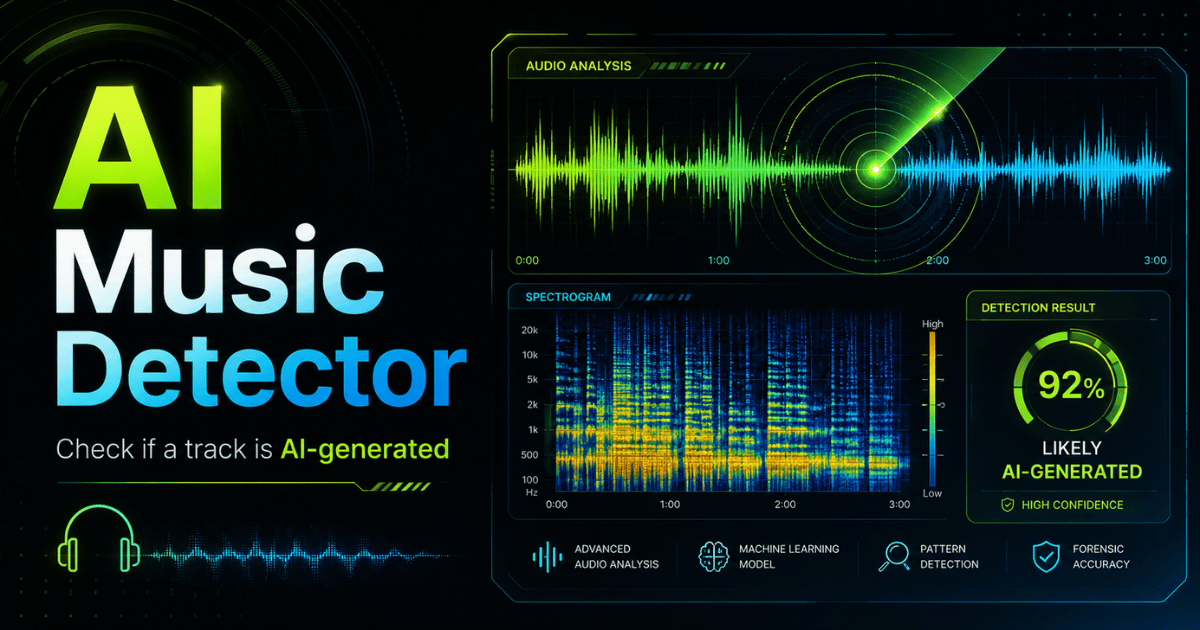
Short answer: To check if a song is AI generated, upload the best-quality version of the audio to an AI music detector, then review the resulting algorithmic output alongside vocal clues, file metadata, spectrogram patterns, rhythmic consistency, artist history, provenance records, and platform release context. No technical detector can independently prove authorship or copyright infringement, but a layered, forensic-style analysis can reliably demonstrate whether a song contains strong synthetic generation signals.
AI-generated music has moved from novelty to mainstream commercial distribution, creating complex new challenges for artists, record labels, streaming platforms, playlist curators, rights holders, and global listeners. Modern generative systems can synthesize full compositions complete with hyper-realistic vocals, nuanced arrangements, and genre-specific production choices, making casual human listening unreliable as a primary detection method. Current empirical reporting suggests that 97% of everyday listeners cannot accurately distinguish AI-generated music from authentic human-made recordings, according to Deezer’s reporting on AI-generated music uploads and listener recognition.
This article outlines a comprehensive, layered approach to checking whether a song may be AI-generated. It examines acoustic-pattern detection, deepfake vocal artifacts, Fourier-based spectrogram analysis, phase behavior, metadata provenance signals, artist-context review, TrackOrigin-style authorship verification, and the mathematical limits of current detector accuracy. The central conclusion is that AI music detection should always be treated as a probabilistic screening process rather than infallible legal proof of authorship.
AI music detection is no longer a niche technical problem reserved for academic researchers. It is now a critical, practical issue for artists, labels, playlist curators, distributors, fans, music competitions, sync-licensing teams, publishers, and global streaming platforms. The scale of synthetic audio entering the digital supply chain is unprecedented. By mid-2026, leading Digital Service Providers reported extreme saturation; platforms such as Deezer documented an influx of nearly 75,000 fully synthetic tracks every single day, indicating that fully AI-generated music accounted for more than 44% of all new tracks delivered to their ingestion pipelines daily, as reported by Music Business Worldwide’s coverage of Deezer’s AI upload data.
Because modern tools generate audio that mimics the emotional resonance of human performers, a single acoustic clue is rarely enough to verify synthetic origins. A track can sound artificial because it was entirely generated by a diffusion model, but it can also sound highly artificial because it has been heavily mastered, processed with extreme auto-tune, rigidly quantized on a digital grid, or built entirely from commercial sample packs. Therefore, a proper authenticity check requires a multi-layered approach combining algorithmic scanning, human listening, metadata inspection, spectrogram review, provenance verification, and contextual platform history.
Table of Contents
- Section 1: What AI-generated music means now — definitions and synthetic typologies.
- Section 2: Why detecting AI music is difficult — post-production obfuscation and false signals.
- Section 3: The fastest way to check if a song is AI-generated — immediate screening protocols.
- Section 4: Step 1: Run the track through an AI music detector — acoustic and mathematical signal analysis.
- Section 5: Step 2: Listen for synthetic vocal clues — deepfake physiological anomalies.
- Section 6: Step 3: Check for Suno, Udio and Riffusion-style artifacts — model-specific architectural signatures.
- Section 7: Step 4: Look for unnatural arrangement and structure — macro-structural attention window failures.
- Section 8: Step 5: Inspect rhythm, timing and quantization — inter-beat interval variance analysis.
- Section 9: Step 6: Analyze the spectrogram — deconvolution layers and fractal checkerboards.
- Section 10: Step 7: Check metadata and provenance signals — C2PA, SynthID, TrackOrigin and durable credentials.
- Section 11: Step 8: Compare artist history and release context — behavioral DSP signals and burst-uploading.
- Section 12: Step 9: Use stem separation for deeper review — cross-correlation and phase-locking analysis.
- Section 13: Step 10: Understand false positives — genres and human workflows that trigger AI flags.
- Section 14: Step 11: Understand false negatives — adversarial evasion and audio downsampling.
- Section 15: What an AI music detector can and cannot prove — the limits of algorithmic certainty.
- Section 16: AI music detection for artists — protecting independent catalogs.
- Section 17: AI music detection for labels and A&R — triage and submission screening.
- Section 18: AI music detection for playlist curators — moderating algorithmic and editorial ecosystems.
- Section 19: AI music detection for distributors and platforms — DSP fraud mitigation and royalty protection.
- Section 20: AI music detection for fans and journalists — journalistic ethics in viral track verification.
- Section 21: AI detection, copyright and ownership — 2026 legal landscape and global lawsuits.
- Section 22: AI watermarking, C2PA and provenance — the EU AI Act and cryptographic metadata.
- Section 23: The future of AI music detection — zero-shot detection and ensemble frameworks.
- Section 24: Practical checklist — step-by-step verification process.
- Section 25: Final recommendation — layered analysis conclusions.
What Does “AI-Generated Music” Actually Mean?
To conduct an accurate forensic review, the terminology surrounding synthetic audio must be precisely defined. The question “was this song made by AI?” is often too broad for practical application. A more accurate analytical question is: “Which specific elements of this sound recording may be AI-generated, and how much of the final master depends on that synthetic contribution?”
Treating all artificial intelligence applications in music production as identical leads to flawed detection outcomes. The spectrum of generative and assistive tools in 2026 is highly compartmentalized.
Typology of AI Music
- End-to-end text-to-music: Full tracks generated from a text prompt, including generated vocals, instrumentation, and arrangement. Examples include Suno and Udio. Detection complexity is moderate because the architecture can leave persistent mathematical signatures across all frequencies.
- AI-generated vocals or voice clones: Synthetic vocals placed over human-played or human-programmed instrumentation, often using voice models. Detection complexity is high because vocals must be isolated from the human instrumental bed before analysis can occur.
- Human and AI hybrid tracks: Human-written lyrics performed by an AI voice, or human-made beats arranged with generative MIDI sketch tools. Detection complexity is high because the blending of organic and synthetic elements masks statistical anomalies.
- AI-assisted post-production: Human-made tracks utilizing algorithmic mastering, mixing, or stem-cleaning tools. Detection complexity is low. These are not considered fully AI-generated music, though they may introduce minor artifacts.
- Pure instrumental generation: Generative instrumental loops or sound design elements incorporated into a human DAW project. Detection complexity is very high because background synthetic elements are often heavily masked by foreground human performance.
Analysts must identify what is being tested. A song that was fully generated by an autonomous neural network leaves entirely different forensic traces than a human-made song that merely utilized an algorithmic equalizer. If it becomes necessary to separate vocals, drum transients, or chordal instruments before checking a track for specific anomalies, the recommended procedure is to use an AI stem splitter to isolate the elements prior to analysis.
Why AI Music Detection Is Harder Than It Looks
The forensic identification of synthetic media is locked in an adversarial arms race. Detection is inherently difficult because generative models are improving rapidly, progressively smoothing out the obvious metallic artifacts that characterized earlier iterations of text-to-music systems, as discussed in technical guidance on detecting AI-generated music. Simultaneously, human producers actively utilize synthetic-sounding tools to achieve modern commercial aesthetics, drastically narrowing the acoustic divide between man and machine.
For example, digital tools such as extreme pitch-correction, vocoders, and heavy multi-band compression can easily mimic the plastic, flattened textures of an AI voice clone. Furthermore, the mastering process, which applies heavy digital limiting to achieve commercial loudness, can hide or aggressively exaggerate underlying structural patterns, confounding detection algorithms.
File degradation introduces another major hurdle. The lossy compression algorithms utilized by the MP3 format, as well as the aggressive re-encoding pipelines native to social media platforms like TikTok and YouTube, strip away critical high-frequency data. Because many AI detectors rely on analyzing microscopic artifacts in the upper spectral envelope, degraded audio files frequently result in inconclusive readings. Additionally, human-made subgenres like hyperpop, industrial electronic, and drill rely heavily on quantized drum grids and commercial loop packs that mathematically resemble the repetitive, locked-grid outputs of a generative algorithm.
A Detector Should Reduce Uncertainty, Not Pretend to Eliminate It
Given these overlapping complexities, AI music detection must be viewed strictly through a probabilistic lens. The algorithmic result serves as a screening signal, not a courtroom-level conclusion. A robust detection protocol reduces uncertainty and helps analysts prioritize human review; it does not replace contextual analysis, contractual documentation, DSP behavioral data, provenance verification, or expert human judgment.
The Fastest Way to Check If a Song Is AI Generated
When confronted with a suspicious audio file, the fastest foundational step is to computationally scan the track, subsequently reviewing the algorithmic result alongside independent listening notes. A dedicated computational model can scan for complex synthetic audio patterns, such as phase coherence anomalies and micro-temporal deviations, vastly faster and more accurately than a human can manually inspect the file’s waveform. The most reliable verifications consistently merge this computational score with external, human-driven context.
To begin, analysts can use the AI song checker or the BeatsToRapOn AI music detector to establish an initial probability-style signal.
Pre-Upload Verification Checklist
- Source the highest-resolution format available, such as WAV or FLAC: Lossless formats preserve the 16kHz+ frequency range where convolutional artifacts frequently reside.
- Use the original digital upload rather than a social media rip: Social platforms downsample audio, stripping phase data and high-frequency spectral markers.
- Analyze the full song rather than a short 15-second preview: Macro-structural analysis requires extended context to measure long-term temporal dependencies.
- Strictly avoid screen recordings: Screen captures introduce hardware-level audio compression and system-level noise floors.
- Avoid low-quality MP3s if a superior file format exists: MP3 compression artifacts share acoustic similarities with diffusion-model degradation.
Step 1: Use an AI Music Detector
An algorithmic scan serves as the critical first pass in modern forensic audio analysis. It processes signals that fall outside the parameters of human audiology. By processing the audio file through specialized neural networks trained on vast datasets of both authentic and synthetic media, the software identifies imperceptible mathematical signatures.
A high AI signal does not automatically confirm financial fraud or copyright infringement, just as a low AI signal does not provide an absolute guarantee of human authorship. The result dictates where the analyst should focus the next layer of review.
How to Interpret Detector Signals
- High spectral artifacts: This may suggest possible synthetic generation. Analyst caution: heavy digital compression can artificially distort high frequencies.
- Vocal flatness: This may suggest possible AI generation or a voice clone. Analyst caution: pitch-correction software such as Auto-tune triggers similar statistical clues.
- Low phase entropy: This may suggest a possible synthetic stereo field. Analyst caution: certain electronic subgenres are intentionally phase-controlled.
- Rigid temporal rhythm: This may suggest AI or grid-based generation. Analyst caution: the majority of modern DAW-produced pop music is hyper-quantized.
- Stripped metadata clue: This may suggest provenance signal tampering. Analyst caution: legitimate distributors often strip metadata during the ingestion process.
Advanced detectors specifically target Mel-Frequency Cepstral Coefficients. MFCCs represent the spectral envelope of a sound in a manner that correlates with human perception. Detection systems extract MFCCs, alongside Linear Frequency Cepstral Coefficients, and analyze them through separate neural network streams. AI-generated audio displays highly atypical MFCC distributions compared to organic recordings, particularly in the higher coefficients that represent fine spectral details, as discussed in research on AI-generated music detection and its challenges.
Step 2: Listen for AI Vocal and Deepfake Clues
Following the algorithmic scan, analysts must conduct a targeted auditory review of the vocal performance. Deepfake audio systems and text-to-speech voice clones consistently struggle to accurately model the physical mechanics of the human respiratory system, vocal cords, and the resonant cavities of the throat and mouth.
Organic singing is punctuated by natural biological necessities: breath placement, saliva sounds, glottal stops, and shifting resonance based on mouth shape. AI vocal generators often place breaths in physically impossible locations, such as directly in the middle of a continuous phoneme, or they string together rapid, lung-emptying phrases without introducing a corresponding inhalation gasp.
Other profound clues include overly smooth, unnatural transitions between distinct words, and emotional deliveries that remain entirely static regardless of the lyrical context. Pronunciation and regional accents may drift inconsistently; a vocal model might sing one verse with a distinct Southern American drawl and the subsequent chorus with British vowel rounding. Furthermore, synthesized vocals often lack authentic room tone, the microscopic reverberation of a physical acoustic space, resulting in a vocal that sounds surgically isolated, yet paradoxically hazy.
It is crucial to remember that complex vocal chains utilized by mixing engineers, including de-essers, dynamic equalizers, and saturation plugins, can strip away human imperfections, resulting in a false-positive auditory assessment. If the vocal is buried within a dense instrumental arrangement, analysts must isolate vocals or run the file through an AI vocal remover or stem splitter to conduct a clean acoustic evaluation.
Step 3: Check for Suno, Udio and Riffusion-Style Patterns
Commercial AI music generators dominate the market, and their distinct underlying architectures leave recognizable, persistent audio patterns. Understanding the differences between platforms like Suno and Udio provides analysts with highly specific acoustic targets, as outlined in Authio’s discussion of Suno and Udio detection patterns.
Suno operates primarily using a diffusion-based architecture that natively samples audio at 32kHz, which it then mathematically upsamples to the standard commercial rate of 44.1kHz for final output. This processing pipeline creates a hard spectral cutoff precisely at 16kHz. Unlike organic acoustic recordings, which feature a smooth, gradual frequency rolloff into the upper limits of human hearing, Suno outputs hit a distinct visual wall at this frequency. Furthermore, the Suno diffusion process introduces a highly characteristic digital haze, a distinct, persistent noise pattern residing in the 8-16kHz range that auditory analysts often describe as a metallic high-frequency shimmer.
Udio, conversely, utilizes a different generative approach grounded in a transformer architecture. Because transformer models process audio data in fixed-length attention windows, Udio outputs often exhibit periodic spectral patterns that align with the model’s underlying window size. Additionally, Udio often generates instrumentals exhibiting unnaturally clean separation between frequency bands, resulting in stereo audio that features phase relationships that are far too consistent to be physically captured by a microphone array.
Can You Detect a Suno Song by Listening?
Detection by listening is possible, but not highly reliable. While experienced audio engineers can occasionally identify the 16kHz cutoff and the pervasive metallic diffusion haze, as discussed in audio engineering discussion of Suno-style mix artifacts, human listening remains subjective. Generative tracks often feature overly polished, emotionally generic vocals stacked atop genre clichés. Therefore, subjective listening must always be paired with technical checks.
Can You Detect a Udio Song by Listening?
Listening for Udio artifacts involves searching for unnatural periodic structures and synthetic textures, particularly within complex arrangements like orchestral hits or crowd ambience. However, if a human producer imports a Udio output into a DAW, edits the waveform, and processes it through analog hardware emulations, the acoustic tells are significantly diminished. When manual identification falters, analysts should rely on the AI music detector to generate a computational probability score.
Step 4: Study the Song Structure
Macro-structural analysis evaluates the long-term temporal dependencies of a composition. Current large language models and transformer-based audio generators operate within specific context windows. While they excel at creating a convincing 10-second loop, they frequently struggle to maintain thematic and structural cohesion over a three-minute timeline, a challenge explored in SONICS research on identifying counterfeit songs.
AI-generated songs frequently betray their origins through structural anomalies. Sections often arrive too neatly, lacking the organic build-up or anticipatory drum fills characteristic of human arrangements. Hooks may repeat identically without organic development, dynamic shifts, or instrumental variation. Bridges, which in human songwriting typically serve to introduce a novel chord progression or emotional pivot, often lack musical purpose in generated tracks, feeling like random assemblages of previous motifs. Lyrics may abruptly change topic without warning, and the overall energetic arc of the track feels mathematically assembled rather than emotionally contiguous.
Human-made music naturally contains performance imperfections, intentional asymmetry, and arrangement decisions deeply tied to the emotional weight of the lyrics. Generative models hide their structural weaknesses by heavily utilizing swells of synthetic reverb, generic noise beds, or abrupt drop-outs to mask transition points. However, because contemporary commercial pop music is inherently formulaic, structural rigidity alone is never absolute proof of synthetic origin.
Step 5: Inspect Rhythm, Timing and Groove
Rhythmic analysis provides an objective measurement of a track’s temporal authenticity. Human musicians, even seasoned studio session players, naturally introduce micro-timing variations into their performances, pushing or pulling slightly against the established tempo grid. This micro-deviation creates what listeners intuitively recognize as groove.
Conversely, autonomous AI music generators calculate audio fundamentally based on mathematical grids, snapping transients and percussive impacts to impossibly perfect subdivisions. Forensic detection systems measure the inter-beat interval variance across the drum bus, vocal timing, and harmonic rhythm. When the variance of the inter-beat interval approaches absolute zero across multiple simultaneous instrumental stems, the mathematical likelihood of synthetic generation increases. Analysts should actively listen for perfectly locked transients, an over-consistent drum swing that repeats without deviation, mechanical drum fills, and rhythmic gestures that fail to evolve over time.
Caution is heavily advised during this stage. Modern DAW-produced music, specifically genres like trap, drill, EDM, techno, and hyperpop, relies almost entirely on digital step-sequencers and strict quantization algorithms. Rigid timing does not automatically indicate an end-to-end generative AI model. Rhythm must be treated as a supporting signal. Using a song key and BPM finder helps establish the absolute grid of the track, allowing analysts to manually observe where micro-deviations do or do not exist.
Step 6: Look at the Spectrogram
Spectrogram analysis is the most definitive manual forensic technique available for audio verification. A spectrogram translates an audio signal into a visual graph, demonstrating how frequency intensity changes over time. This visualization reveals mathematical patterns that are entirely invisible to casual listening.
Recent academic research identifies why AI models leave these visual traces. Neural audio generators such as Encodec, DAC, and Musika utilize deconvolution layers to upsample compressed latent data back into audible waveforms. Mathematically, a strided deconvolution operates by inserting zeros between data points and subsequently running a convolutional kernel over them. This process inherently periodizes the spectra of the hidden layers, which systematically produces spectral peaks at highly predictable frequency intervals, as explained in Fourier-based research on AI music artifacts and the related ResearchGate version of the Fourier explanation.
Crucially, these peaks manifest on a spectrogram as grid-like checkerboard artifacts. Because this phenomenon is tied directly to the upsampling architecture of the deconvolution model, these artifacts are cloned in a fractal-like recursive pattern across the frequency spectrum, regardless of the training data or the specific model weights used.
Analysts reviewing a spectrogram should isolate the high-frequency ranges to search for fractal checkerboarding, unusual high-frequency haze, artificial rolloffs such as Suno’s 16kHz wall, and overly smooth vocal harmonics that lack the chaotic noise naturally produced by a human larynx.
What Spectrogram Clues Are Not Proof?
While powerful, spectrogram anomalies can be triggered by standard audio manipulation. Digital compression, extreme mastering limits, aggressive noise reduction, standard MP3 encoding, and commercial vocal isolation algorithms will alter the visual spectrogram, frequently introducing block-like artifacts that resemble synthetic deconvolution. Analysts should use AI mastering tools carefully to understand how commercial loudness algorithms alter the high-frequency visual representation of human-made tracks.
Step 7: Check Metadata, Watermarks and Provenance Signals
As acoustic detection becomes more difficult, the music industry is shifting toward cryptographic provenance signals. Analyzing file metadata offers insight into the file’s origin, provided the data has not been maliciously stripped or altered by intermediary platforms.
What Is C2PA?
The Coalition for Content Provenance and Authenticity is a global standard designed to establish verifiable origins for digital content. A C2PA Content Credential attaches cryptographically signed metadata directly to the audio asset. This manifest documents authorship, the specific software used in creation, licensing rights, and whether generative AI was utilized in the production pipeline, according to the C2PA Content Credentials explainer and the C2PA technical specification. Because standard metadata can be easily erased by basic online tools, C2PA defines durable credentials that combine a hard cryptographic binding with soft audio watermarking, ensuring the credential can be discovered even if the asset is decoupled from its original file container.
What Is SynthID?
SynthID is Google DeepMind’s proprietary technology for watermarking AI-generated content, utilized heavily within the Lyria music generation model. For audio, SynthID converts the generated acoustic signal into a visual spectrogram, embeds an imperceptible mathematical watermark into the visual representation, and subsequently converts it back into an audio waveform, as described by Google DeepMind’s SynthID documentation. This method is designed to keep the watermark inaudible to human listeners while remaining resilient against common evasion tactics, including MP3 compression, adding white noise, or altering the track’s playback speed.
Where TrackOrigin Fits Into the State-of-the-Art Workflow
Detection asks whether a finished audio file contains synthetic signals. Provenance asks a different question: can the human creative origin of the finished master be verified before the file enters feeds, catalogues, disputes, and synthetic noise? This is where TrackOrigin’s verified human-made music standard becomes relevant.
TrackOrigin’s TO-1.0 process is built around upload, declaration, live authorship demonstration, and verification. The artist uploads a finished master in WAV, FLAC or AIFF; declares their role, tools, collaborators, AI use and session context; demonstrates authorship live by singing, humming, playing, explaining, showing project context or answering track-specific prompts; and receives an Origin Seal if the verification is successful. The deliverable includes a public certificate page, a signed JSON manifest, an embed badge, an audio fingerprint bound to the finished master, witnessed session logs, liveness checks, AI disclosure, and a tamper-evident revocable status.
This does not replace acoustic AI detection. It adds a different layer: evidence of human relationship to the work. In a mature verification workflow, the strongest process is not “listen and guess” or “trust one detector score.” It is a layered chain: detector output, spectrogram evidence, metadata review, watermark checks, artist context, stem-level inspection, and, where available, signed human-origin provenance such as TrackOrigin’s Origin Seal.
Metadata and provenance credentials provide an excellent supporting layer, but they are never enough by themselves. Social media platforms and standard upload pipelines frequently strip or alter metadata. Digimarc’s discussion of C2PA 2.1 and digital watermarks highlights the industry push toward stronger content credentials, but analyzing the audio signal itself remains necessary when credentials are missing, stripped, incomplete, or unsupported.
Step 8: Compare the Song Against the Artist’s History
For platform operators, DSPs, and record labels, contextual behavioral analysis is just as critical as technical audio forensics. Fraud-prevention algorithms on platforms like Spotify and Apple Music cross-reference acoustic signals with historical user engagement data, according to Chartlex’s overview of the AI music detection stack used by platforms and distributors.
When analyzing a suspicious file, reviewers must investigate the surrounding context:
- Does the artist possess a verifiable history of previous, legitimate releases?
- Does the vocal identity on the new track match older, known human performances within the catalog?
- Is there an unexplained, radical shift in genre or production quality?
- Are there corresponding songwriter credits registered with legitimate Performing Rights Organizations?
- Can the creator produce DAW session files, MIDI data, or tracking stems to prove authorship?
- Does the track demonstrate suspicious burst-upload behavior, such as uploading 50 tracks in a single batch?
- Does the track suffer from anomalous engagement metrics, such as high stream volumes with a near-zero save-to-stream ratio?
Contextual history does not independently prove AI generation, but it provides the critical framework required to determine whether an algorithmic detector’s probability score is practically plausible.
Step 9: Separate the Vocal and Instrumental for Deeper Analysis
Because generative models often output a heavily compressed, fully mixed two-track stereo file, deep forensic analysis requires stem separation. By breaking the composition down into its constituent parts, lead vocal, backing vocals, drum transients, bass frequencies, and the instrumental bed, analysts can observe how these separate tracks interact mathematically.
Organic recordings feature dynamic, physical acoustic interactions between stems, even when recorded in separate booths, due to slight bleed and human mixing dynamics. AI-generated tracks, conversely, often display either zero correlation, suggesting a disconnected, multi-pass generation process, or hyper-lock, where the mathematical phase of the stems is locked in a manner physically impossible within a live recording environment.
Stem separation allows an analyst to isolate the vocal to check for cloned deepfake artifacts, inspect the isolated drum bus for impossible inter-beat interval quantization, and listen closely for the presence of a fake room tone that vanishes the moment the vocal stops. Analysts can use AI stem separation or vocal and instrumental separation workflows to execute this granular inspection.
Why Human Music Can Be Mistaken for AI Music
Maintaining platform trust requires a thorough understanding of false positives. A computational detector should never penalize a human artist simply because their production methodology is pristine, heavily synthesized, or digitally aggressive.
False positives routinely occur when authentic human music utilizes heavy auto-tune, hardware vocoders, synthesized virtual instruments, and loop-based commercial sample packs. Aggressive mastering and extreme digital limiting can flatten dynamics, while algorithmic noise-reduction tools can create a vacuum-like silence that models frequently interpret as synthetic generation.
Specific genres consistently trigger higher baseline synthetic scores. Trap, drill, EDM, hyperpop, cloud rap, and industrial experimental music heavily rely on the exact digital textures and strict quantization grids that AI generators are trained to mimic. A human producer utilizing a MIDI chord generator alongside a drum step-sequencer is making human choices, but the final exported audio will lack the organic phase entropy expected from an acoustic recording.
Why AI Music Can Avoid Detection
Conversely, false negatives occur when fully synthetic audio successfully evades algorithmic classification. AI music detection is an evolving, adversarial discipline. Generative models update their architectures frequently, meaning a detector trained on 2024 outputs may fail to identify the subtle architectural shifts in a 2026 model release, as discussed in the arXiv version of AI-generated music detection research.
Evasion tactics implemented by human operators include heavily editing the generated audio within a DAW, replacing synthetic vocals with human performances, processing the generated stems through analog hardware emulations to introduce organic noise floors, and deliberately resampling the audio, such as dropping a Suno track to 22.05 kHz, to mask the tell-tale 16kHz spectral cutoffs. Because human intervention reduces the density of statistical anomalies, the best approach is a layered review, not blind trust in one algorithmic score.
What an AI Music Detector Can and Cannot Prove
To maintain forensic integrity, operators must understand the absolute limits of computational detection. An algorithmic scanner provides a probability signal; it answers the question, “Should this file be subjected to further human investigation?” It must never be treated as a final legal ruling or definitive proof of fraudulent intent.
- Was this song possibly AI-generated? A detector can answer this as a probability signal. The appropriate analytical approach is to combine the detector score with contextual review.
- Was this legally infringing? A detector cannot answer this. It requires exhaustive legal and rights-chain analysis.
- Who owns the copyright to the song? A detector cannot answer this. It requires contractual analysis and metadata claims.
- Was a specific human vocal cloned? A detector can sometimes provide an anomaly signal. The appropriate approach requires direct comparison against known vocal reference files.
- Was Suno or Udio specifically used? A detector can sometimes identify spectral pattern signals. It is not always definitive due to cross-platform architectural similarities.
- Is this audio file 100% human-made? A detector cannot prove this absolutely. A low AI signal is a baseline, not absolute proof of human origin.
Why Artists Should Check Their Own Music
Independent musicians frequently collaborate with remote producers, vocalists, and digital marketplaces. By incorporating detection protocols into their workflow, artists protect their catalogs from contamination.
Artists use detection algorithms to screen purchased instrumental beats and collaborator submissions, ensuring they are not inadvertently distributing uncopyrightable synthetic audio masquerading as human production. Furthermore, because aggressive vocal processing can trigger false positives, artists use detectors to test their own heavily processed stems, avoiding accidental AI flags during the distributor ingestion process. Documenting release quality control maintains the artist’s digital integrity. Once authenticity is verified, artists frequently choose to master the track online to finalize the asset for distribution.
For artists who want evidence beyond detection, TrackOrigin-style provenance can document the finished master before distribution. This matters because a clean detector score says little about who made the work, while a signed provenance record can connect the audio hash, declaration, verification process, and public certificate to the specific master.
AI Music Detection for Labels and A&R Teams
For record labels and Artist & Repertoire representatives, the massive influx of undifferentiated synthetic audio requires highly efficient triage protocols. A&R teams operate on the front lines of catalog acquisition, utilizing detection pipelines to rapidly screen viral social media tracks, anonymous demo submissions, and sync-licensing pitches.
A practical enterprise workflow involves immediate triage: receiving the submission, verifying the artist’s historical context, and running the file through an AI music detector. If a high synthetic probability is flagged, the team systematically reviews the isolated vocal and instrumental stems separately. If suspicions remain unresolved, the label requests DAW session evidence or original tracking stems. Labels are heavily cautioned against rejecting artists solely based on an automated flag; detection is an escalation tool designed to mitigate voice impersonation risks and artist identity fraud.
AI Music Detection for Playlist Curators
Independent and editorial playlist curators moderate vital ecosystems of digital discovery. In 2026, these ecosystems are under continuous pressure from AI spam, fake artist profiles, and mass-generated functional audio, such as sleep music, white noise, and lo-fi beats, designed to passively harvest royalty pools.
Curators combat playlist trust issues by using detection tools to scan suspicious, low-effort submissions. The practical workflow involves checking the artist profile for coordinated burst-uploading behavior, listening for structural rigidities, and running the audio through a detector to add a quantifiable quality-control layer to the curation pipeline.
AI Music Detection for Distributors and Platforms
At the enterprise infrastructure level, distributors and global platforms rely on massive, multi-layered detection stacks. Streaming fraud, heavily subsidized by AI generation, has been estimated to drain significant money from legitimate industry payout pools, though exact figures depend on methodology and source assumptions.
The industry implements a heavily guarded technical detection stack:
- Layer 1 — Distributor screening: Major distributors such as DistroKid, TuneCore, and Amuse enforce AI policies and can use acoustic analysis at upload time to flag high-confidence AI tracks before they reach DSPs. Failed upload data may be shared across industry working groups to prevent cross-platform resubmission.
- Layer 2 — DSP platform detection: Platforms such as Spotify use anomaly-detection systems to track behavioral signals, including listen-time uniformity, geographic clustering, and device fingerprinting. Apple Music has been reported to rely on acoustic signal analysis and transparency-style tagging for AI-assisted audio.
- Layer 3 — Third-party vendors: Detection vendors such as Beatdapp manage cross-platform anomaly detection, while Pex operates content-fingerprinting workflows to catch unauthorized AI-cloned catalog re-uploads, as described by Pex’s distributor use-case material.
Platform detection is specifically designed around risk scoring and human review queues, not automatic punishment. Platforms looking to integrate automated moderation logic frequently use an AI music detection API or join the developer waitlist for enterprise access.
AI Music Detection for Fans, Bloggers and Journalists
Fans, music bloggers, and journalists increasingly function as open-source intelligence analysts. When a highly anticipated leaked track appears online, or when a viral song claims to feature a famous artist who subsequently denies involvement, detection algorithms provide a much-needed grounding metric.
However, severe journalistic ethics apply when using these tools. Public accusations of fraud can irreversibly damage an artist’s career. Journalists must never accuse an artist publicly based on a single detector result. Ethical reporting demands the use of careful, qualified language: stating that a track may be AI-generated, shows AI-like signals, requires further verification, or that the algorithmic output is not conclusive.
AI Music Detection, Copyright and Ownership
Disclaimer: This section does not constitute legal advice. For disputes involving ownership, infringement, or impersonation, operators must speak to a qualified lawyer or rights professional.
The intersection of generative AI, copyright, and digital ownership is currently the subject of massive global litigation. AI detection identifies synthetic acoustic properties; it does not determine legal copyright ownership.
As of 2026, the music industry is navigating historic legal battles. Major labels, including Universal, Sony, and Warner, launched coordinated lawsuits against AI generators like Suno and Udio. While some entities pursued settlements or licensed AI ecosystems, litigation has continued around whether training generative models on copyrighted files without a license is infringement or fair use. Additionally, major music publishers have pursued litigation against AI companies over allegedly scraped lyric compositions used to train large language models, as reported in industry legal coverage.
Jurisdictions worldwide are defining these boundaries. In Australia, legal analysis has emphasized that copyright protection is tied to human authorship and independent human intellectual effort, as discussed by Clayton Utz’s analysis of artificial intelligence and Australia’s copyright law regime. In late 2025, APRA AMCOS reported that the Australian Government ruled out a copyright exception for AI platforms, with creator concerns around consent, credit and compensation central to the debate, according to APRA AMCOS’s AI and music update.
A track can be heavily AI-generated and still involve copyrightable human choices, just as a human-made song can contain AI-assisted elements. A detector result flags synthetic presence; it requires complex legal analysis to prove infringement.
Watermarking, C2PA and Provenance: The Next Layer of AI Music Detection
The global regulatory framework is forcing a rapid evolution in detection methodology. The EU AI Act, which transitions into full enforceability in August 2026, requires transparency obligations for certain AI-generated or AI-manipulated content. In music, this pushes detection beyond acoustic classification into watermarking, metadata and provenance systems.
Future verification relies on a three-tiered approach:
- Audio signal detection: Analyzing the acoustic sound itself for mathematical anomalies, including spectrogram deconvolution patterns.
- Watermark detection: Scanning for specific embedded soft-bindings added by AI systems, such as Google SynthID.
- Provenance and content credentials: Reading verifiable cryptographic metadata regarding file creation and edits, including C2PA and human-origin standards such as TrackOrigin.
Provenance helps establish a chain of custody for digital media, but only when it is present, supported, and intact. Because many standard digital files will not carry these credentials, and because social platforms routinely strip metadata during upload, native audio analysis remains strictly necessary.
The state-of-the-art workflow is therefore not one tool. It is a layered trust stack: upload the best file, run an AI music detector, inspect the vocal and instrumental stems, examine the spectrogram, check metadata and watermarks, review artist context, and use signed human-origin provenance where available.
The Future of AI Music Detection
As generative architectures expand, forensic detection will pivot from generalized scanning toward highly specific, zero-shot detection frameworks. Academic tools like MusicDET highlight this future by modeling real-music distributions in the time-frequency energy domain. By evaluating the likelihood of an input sample existing under the learned real-music distribution, these systems can detect out-of-distribution synthetic signals from entirely unseen, future generative models, according to MusicDET research on zero-shot AI-generated music detection.
The future of detection will likely involve massive detector ensembles, where multiple neural networks analyze distinct vectors such as MFCCs, inter-beat interval variance, and spectral peaks simultaneously. This will be combined with watermark-aware systems, robust C2PA content credentials, TrackOrigin-style authorship verification, rights-holder databases, and platform-level upload screening. Ultimately, AI music detection will not function as a single magic button. It will persist as a dynamic, layered trust system requiring algorithmic power, verifiable provenance, behavioral analytics, and human review.
Checklist: How to Check If a Song Is AI Generated
- 1. File preparation: Upload the best-quality, lossless version of the song, such as WAV or FLAC. The analytical goal is to preserve high-frequency spectral data for deconvolution analysis.
- 2. Algorithmic scan: Run the file through an AI music detector. The analytical goal is to establish a baseline computational probability score.
- 3. Vocal inspection: Check the isolated vocal for synthetic clues. The analytical goal is to identify unnatural breath placement and plastic textures.
- 4. Structural review: Listen for unnatural arrangements and transitions. The analytical goal is to identify macro-structural attention-window failures.
- 5. Rhythmic analysis: Inspect groove, swing, and timing. The analytical goal is to look for hyper-quantized inter-beat interval variance.
- 6. Visual analysis: Review the audio spectrogram if available. The analytical goal is to identify 16kHz cutoffs and fractal checkerboard artifacts.
- 7. Provenance check: Inspect metadata, watermarks and provenance signals. The analytical goal is to look for intact C2PA credentials, SynthID markers, TrackOrigin certificates, signed manifests, or other durable origin evidence.
- 8. Contextual review: Compare the song against the artist’s history. The analytical goal is to flag burst-uploads or sudden shifts in vocal identity.
- 9. Granular isolation: Separate stems if further review is required. The analytical goal is to analyze cross-correlation and phase-locking between tracks.
- 10. Final assessment: Treat the result as a probability signal. The analytical goal is to escalate for human or legal review where necessary and never treat the detector result as legal proof.
To execute the critical first pass of this checklist, analysts should begin by using the BeatsToRapOn AI music detector.
The Best Way to Check If a Song Is AI Generated
Checking whether a song is AI-generated is never about finding one definitive, magic clue. Modern AI music can sound exceptionally polished, emotionally resonant, and commercially convincing. Simultaneously, entirely authentic human-made music can sound incredibly synthetic due to extreme auto-tune, commercial sample packs, rigid digital quantization, aggressive mastering limits, and precise digital editing.
The most reliable approach is deeply layered and strictly forensic. Analysts must run the track through an AI music detector to establish a statistical baseline, meticulously review the vocal and instrumental details for acoustic anomalies, check the spectrogram for mathematical deconvolution artifacts, verify any available metadata provenance, and compare the technical data against the artist’s historical context and platform release behavior.
Where available, signed human-origin provenance should be added to the workflow. TrackOrigin’s model shows why this matters: a detector can suggest whether a file contains synthetic signals, but a live authorship verification and signed manifest can help document the human relationship to the finished master before a dispute starts.
By treating the final result as a probability signal rather than a final judgment, the industry can protect human artists while maintaining digital platform integrity. If an audio file requires immediate verification, the optimal workflow is to upload the track to the BeatsToRapOn AI music detector and review the probability-style forensic breakdown.
FAQ: Checking If a Song Is AI Generated
How can I check if a song is AI generated?
To properly evaluate an audio file, the track should be uploaded to an AI music detector to generate an initial computational baseline. This algorithmic result must then be reviewed alongside a manual inspection of vocal physiological clues, file metadata, spectrogram patterns, rhythmic consistency, provenance signals, and the artist’s historical context. Combining computational probability with expert human analysis yields the most accurate forensic screening result.
Can an AI music detector detect Suno songs?
Yes, a competent detector can screen for acoustic and structural patterns commonly associated with Suno-style AI generation. These patterns frequently include specific upsampling artifacts and a pervasive high-frequency digital haze. However, because generative models are updated frequently, the output should always be treated as probabilistic rather than an absolute confirmation of the specific platform used.
Can an AI music detector detect Udio songs?
Detectors are designed to look for synthetic audio patterns that frequently appear in Udio-style transformer generations, especially anomalous phase coherence, periodic structural patterns, and synthetic vocal textures. However, if a human producer imports a Udio file into a digital audio workstation and applies significant post-processing or analog hardware emulation, the identifying artifacts may become much harder to detect computationally.
Can AI music detection prove copyright infringement?
No. An algorithmic detector can only flag possible synthetic generation based on acoustic, temporal, and mathematical anomalies present within the audio file. Copyright infringement is a legal designation that requires exhaustive contractual analysis, rights-chain verification, and legal review by qualified intellectual property professionals.
Can AI mastering make a song look AI-generated?
In standard scenarios, algorithmic mastering alone should not cause a human-performed song to appear fully AI-generated. However, heavy digital processing, extreme loudness limiting, synthetic vocal equalization, and the digital artifacts introduced by stem separation tools can severely distort the high-frequency spectrum, occasionally triggering false positive detection signals within the classifier.
Are AI music detectors accurate?
They function as useful, mathematically grounded screening tools. However, their absolute accuracy depends heavily on the quality of the uploaded file, the breadth of the model’s training coverage, the presence of MP3 compression, and whether the song is a fully end-to-end synthetic generation or a complex hybrid mix of human and AI elements.
Can metadata prove a song was made by AI?
Metadata and advanced cryptographic credentials, such as the C2PA standard, can provide highly reliable supporting evidence regarding an audio file’s origin. However, metadata is never enough by itself to definitively prove generation because it can be maliciously stripped, edited, or completely removed by standard social media platforms during the ingestion process.
Can TrackOrigin prove a song is human-made?
TrackOrigin is designed to verify the human creative origin of a finished master through upload, declaration, live authorship demonstration, signed manifest, certificate page, and Origin Seal. It is a provenance layer, not a replacement for acoustic detection. The strongest workflow uses both: AI detection to examine the file’s synthetic signals, and provenance verification to document the human relationship to the work.
Can a human-made song be falsely flagged as AI?
Yes. When human producers utilize heavy pitch-correction, hardware vocoders, commercial loop sample packs, stem processing algorithms, aggressive noise reduction, and the hyper-quantized drum programming standard in modern EDM or trap music, they create mathematical signals that can resemble the outputs of generative AI models.
Can AI-generated music avoid detection?
Yes. The forensic landscape is highly adversarial. AI-generated music may be heavily edited by human producers, mastered through analog outboard gear, re-recorded to introduce organic room tone, stem-processed, or intentionally downsampled and re-encoded to obscure or destroy the delicate high-frequency spectral artifacts that detectors rely upon.
What file type is best for AI music detection?
The highest-quality original file available should always be used for forensic testing. A lossless format, such as WAV or FLAC, retains the critical high-frequency spectral data and phase relationships required for accurate algorithmic analysis, making it vastly superior to a compressed social media rip or a low-bitrate MP3.