
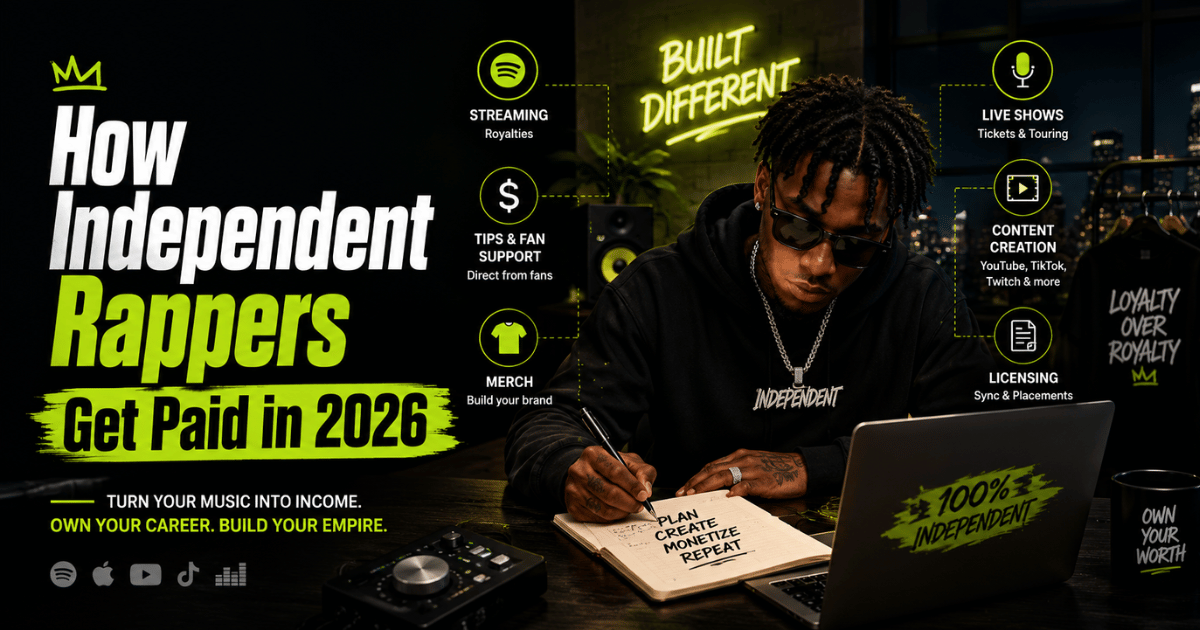
Independent rappers no longer survive from one income source. Streaming matters, but it is only one part of the modern rapper revenue stack. In 2026, artists need a mix of platform payouts, direct fan support, content monetisation, merch, shows, licensing, and smart promotion. The most successful independent artists are not just releasing songs. They are building comprehensive economic systems around their music.
The purpose of this article is to explain every major way independent rappers can get paid in 2026, what business infrastructure to set up first, what catastrophic administrative mistakes to avoid, and how artists can prepare for the emerging era of fan-powered earnings through innovative mobile platforms like BeatsToRapOn. The contemporary music industry has fragmented, and understanding the complete monetization architecture is the only way for independent creators to build sustainable, long-term careers.
Why Streams Alone Are Not Enough
Streaming is useful, but it is not a complete business model
Global recorded music revenue reached a staggering $31 billion in 2025, with digital streaming accounting for more than 67% of that total figure, according to Winamp’s report on independent artists in 2026. Furthermore, independent market players—encompassing indie labels and self-releasing artists—now command over 40% of this global market share, generating more than 70% of all new releases worldwide, according to the same independent music industry analysis.
However, beneath these massive macroeconomic indicators lies a stark financial reality for the individual creator. Streaming helps with initial algorithmic discovery. Streaming can build necessary social proof, signalling to promoters and industry gatekeepers that an artist has momentum. Yet, streaming payouts depend entirely on enormous, sustained volume. Because the supply of new music vastly outpaces consumer listening hours, the revenue pool is highly diluted, as outlined in Winamp’s independent artist report. Survey data from the 2025 independent music industry reveals that only 13.3% of independent artists live exclusively from their music, while 77.8% earn less than $15,000 annually from their creative output, according to the same report. Most independent artists do not have enough streams to rely on streaming income alone. To survive and scale, a strong artist business needs multiple, diversified income sources that capture higher margins.
The real goal is turning attention into owned fan value
A listener is not automatically a fan. In an era driven by passive, algorithmic curation, a listener may stream a track multiple times without ever learning the artist’s name. A fan, by contrast, is an active participant in the artist’s ecosystem: someone who follows profiles, saves tracks to personal libraries, sends direct messages, buys physical merchandise, tips during live streams, shares content organically, attends live shows, or financially supports the artist’s broader creative vision.
Independent rappers need systems that systematically move people from casual listening to active support. Passive streaming attention must be actively converted into owned audience data, such as email lists, mobile numbers, and direct community memberships. When an artist controls the relationship with their audience, they dictate the terms of their own monetization, insulating themselves from sudden algorithmic shifts or platform policy changes.
The 2026 artist mindset
The question for independent creators is no longer “How do I get streams?” The better question is “How do I turn listeners into repeat fans who support my career?” This fundamental paradigm shift moves the focus from chasing fractional pennies generated by digital service providers to cultivating high-value, direct-to-consumer relationships that yield sustainable dollars.
The Main Ways Independent Rappers Get Paid in 2026
1. Streaming payouts
Streaming payouts form the baseline of the modern recorded music economy, generated across Digital Service Providers (DSPs) such as Spotify, Apple Music, YouTube Music, Amazon Music, and Deezer. Payments usually flow through distributors, labels, or rights holders before eventually reaching the independent rapper.
Streaming income depends on rights ownership, distributor terms, region, platform, and listener activity. The financial mechanics vary significantly by platform. For instance, Spotify pays an average of $0.003 to $0.005 per stream in 2026, with premium-tier listeners generating three to four times more revenue per stream than ad-supported users, according to Winamp’s independent artist report. However, Spotify recently implemented a strict minimum threshold: tracks must secure at least 1,000 streams within a rolling 12-month period to qualify for the recorded music royalty pool. Tracks falling beneath this threshold earn zero royalties—a policy that successfully redirected approximately $40 million annually from low-engagement “noise” uploads toward legitimate artists, according to Chartlex’s Spotify pay-per-stream analysis.
Conversely, platforms like Deezer have pioneered an Artist-Centric Payment System (ACPS). Under Deezer’s artist remuneration model, artists who achieve more than 1,000 listens per month from at least 500 unique users receive a “double boost,” wherein their streams are weighted twice as heavily in the royalty calculation pool. Additionally, streams generated from organic fan searches are financially rewarded at a higher rate than passive algorithmic plays, according to Deezer’s explanation of artist compensation.
To successfully capture streaming payouts for independent artists, artists need clean metadata, correct splits, and proper distribution setup.
Practical advice for securing streaming revenue:
- Register songs properly with performing rights organizations.
- Keep immaculate ownership records of all master recordings and compositions.
- Use split sheets to legally divide royalty percentages prior to release.
- Do not upload music without knowing exactly who owns the beat, lyrics, master, and publishing.
To ensure administrative clarity, creators must utilize a producer split sheet template to formalize ownership percentages and prevent future financial disputes.
2. Direct fan tips
Tips let fans support artists directly, circumventing the traditional micro-penny streaming model. Direct-to-fan sales and digital tipping represent a rapidly expanding sector of independent artist monetization in 2026, offering higher profit margins and immediate liquidity, according to Lyra’s guide to independent artist monetization in 2026.
Tips work best when the artist has a clear, authentic fan relationship. Fans are exponentially more likely to tip when there is a story, a moment, a milestone, or a personal connection attached to the request, according to Lyra’s artist monetization guide.
Examples of effective tipping calls-to-action include:
- “Support the next release”
- “Help fund the next video”
- “Back the artist early”
- “Tip if this track hit you”
Within the evolving BeatsToRapOn (BTR) ecosystem, direct fan support is positioned as part of the future mobile artist economy. Platforms are building tools to allow frictionless micro-transactions directly within the listening interface. Artists should prepare their communities for these integrations, utilizing careful phrasing such as “support where supported” or “tip as platform features become available.”
3. Paid shoutouts and custom fan moments
Shoutouts can become a direct creator income stream that capitalizes on deep parasocial relationships. Fans may pay for birthday messages, motivational clips, personalised DJ drops, or artist acknowledgements. For independent rappers, this model works best when the artist has distinct personality traits and intense fan loyalty.
However, artists must strictly prioritize safety and quality. Artists should define clear, uncompromising boundaries regarding the type of content they are willing to produce. Platforms facilitating these transactions should review or moderate paid custom content to ensure adherence to safety guidelines. No artist should accept unsafe, abusive, defamatory, or inappropriate requests.
From a product perspective, shoutouts can become part of a mobile-first fan monetisation model. As independent artists integrate with BTR and similar applications, maintaining wording that aligns with precise product capabilities and payment terms ensures both the creator and the consumer share clear expectations regarding fulfillment.
4. Merch
Merch turns a sonic identity into high-margin physical revenue. Merchandise works best when fans connect deeply with the artist’s aesthetic world, not just a single viral song. Simple merch can include shirts, hats, stickers, posters, lyric designs, limited drops, and signed physical items.
The 2026 merchandise landscape has evolved significantly. Consumers have moved past basic logos printed on cheap, uncomfortable blanks. Fans actively seek high-quality, vintage-inspired aesthetics, such as boxy fits, drop shoulders, and garment-dyed fabrics, according to Hypebot’s musician guide to merch margins. By investing slightly more in premium blanks, independent rappers can command premium retail prices, treating their apparel like exclusive streetwear drops rather than standard promotional items, according to the same merch margins guide. Similarly, the physical music market has seen a surge in limited edition “color-in-color” or “splatter” vinyl variants, which cost marginally more to produce but sell as high-value collector’s items, according to Hypebot’s analysis.
Practical advice for merchandise operations:
- Start small with limited runs to avoid trapping capital in unsold inventory.
- Validate demand before bulk ordering by teasing designs to the audience.
- Use pre-orders where possible to guarantee sales before initiating production.
- Tie merch directly to a song, a live show, a cultural movement, or a highly anticipated release campaign.
For a comprehensive guide to product sourcing and design logistics, artists should review a dedicated merch kit for independent rappers.
5. Live shows and paid performances
Despite the dominance of digital consumption, live shows are still one of the strongest ways to monetise real fans. Independent rappers can earn substantial revenue acting as openers for established acts, playing local showcases, headlining club nights, securing private events, booking college shows, performing at local festivals, and eventually hosting their own ticketed headline shows.
The live music sector is robust, with global live music revenues projected to exceed $35 billion by the end of 2026, according to Winamp’s independent artist report. In major cultural hubs, grassroots venues remain the proving ground for independent talent. For instance, in Sydney, Australia, the post-lockout law era has seen a resurgence of underground hip-hop events at venues like The Underground Sydney and Manning Bar, which routinely host local talent. Furthermore, massive festival properties like Rolling Loud Australia provide aspirational routing goals for independent artists seeking to elevate their live market value.
Practical advice for live performance monetization:
- Build a tight, high-energy short live set designed to convert crowds.
- Meticulously track crowd response to optimize future setlists.
- Record high-quality performance clips to leverage for digital content.
- Use local proof of ticket sales to book better, higher-paying shows.
Artists seeking to optimize their stage presence and booking strategies should consult resources detailing how to get paid for rap shows, master the ultimate rap stage presence and live performance guide, and learn how to promote your first hip-hop show.
6. Music promotion services
A highly lucrative secondary revenue stream exists in the business-to-business (B2B) sector. Some artists earn steady income by selling specialized services to other artists, according to PressedFresh Collective’s guide to independent artist income streams. Independent rappers and producers who have successfully navigated the digital landscape possess valuable knowledge that peers are willing to purchase.
Examples of monetizable skills include:
- playlist pitching
- social promo and advertising campaign management
- beat reviews and sonic critiques
- cover art graphic design
- mixing and mastering advice
- hook writing and vocal arranging
- feature verses
- content creation
- music video editing
BeatsToRapOn has distinct marketplace positioning around artist services and promotion, as shown on the BeatsToRapOn artist ecosystem. This article can point readers toward the strategic advantage of monetising practical skills, not just recorded songs. Offering freelance services provides vital cash flow while an artist builds their primary fanbase. To explore this avenue, independent creators should read about music promotion services and understand why selling music promotion services on BeatsToRapOn accelerates industry networking.
7. Features, hooks and songwriting
Rappers can earn significant upfront capital from paid features. Writers can earn from providing hooks, verses, toplines, and underlying song ideas to other performers. Pricing in this sector is highly variable and depends entirely on market demand, lyric quality, audience size, and professionalism.
While top-tier mainstream artists charge between $100,000 and $350,000 for a single feature verse, according to XXL’s reporting on rapper verse costs, independent rappers operate on a sliding scale. Emerging artists may charge a baseline fee of $100 to cover studio time, while mid-tier independent acts with strong followings can command fees ranging from $1,000 to $50,000 depending on their algorithmic reach and social engagement, according to Our Generation Music’s feature pricing analysis.
Practical advice for feature transactions:
- Always use formal written agreements.
- Explicitly define usage rights before recording audio.
- Clarify whether the buyer gets commercial master rights, a percentage of the underlying publishing, or both.
- Do not rely on casual social media DMs alone for serious financial work.
8. Licensing and sync
Music can be licensed for lucrative placements in video games, feature films, television ads, creator content, podcasts, cinematic trailers, and short-form video, according to PressedFresh Collective’s guide to independent artist revenue. Sync is harder to access due to fierce industry competition, but the financial payouts are immensely valuable.
The most critical factor in securing a sync placement is ensuring clean rights. If the artist does not unconditionally own or control the beat, any underlying audio sample, the master sound recording, or the musical publishing, sync opportunities will immediately fall apart during the legal clearance phase, as explained in Ditto Music’s split sheet guide. For example, uncleared samples require independent artists to secure both a master use license from the original recording owner and a composition license from the original publisher—a process that is notoriously expensive and legally perilous, according to the same rights and split sheet guide.
Furthermore, human-made and provenance-verified music may become significantly more important to music supervisors as AI-generated music floods the market, as discussed in TrackOrigin’s video on human-made music verification. Buyers require absolute certainty regarding a track’s origin. Utilizing rigorous music metadata standards and ensuring the audio is recognized as verified human-made music via cryptographic authorship protocols provides a massive competitive advantage in the sync licensing space.
9. YouTube and short-form content revenue
YouTube can pay artists directly through AdSense revenue once a channel becomes eligible for the YouTube Partner Program. However, formats like Shorts, TikTok, Instagram Reels, and similar platforms are often more useful as top-of-funnel discovery funnels than as direct, high-yield income sources. The real money usually comes after the viral attention is successfully redirected into owned channels, converting passing scrollers into dedicated fans, consistent streams, merch buyers, show attendees, or direct supporters.
In 2026, TikTok officially replaced its Creator Fund with the Creator Rewards Program, according to Miraflow’s TikTok monetization guide. This updated monetization structure explicitly prioritizes high-quality, original content. To qualify, creators must be 18 years old, possess at least 10,000 followers, achieve 100,000 views within the preceding 30 days, and produce original videos that exceed one minute in length, according to the same TikTok Creator Rewards analysis. The algorithm now heavily rewards play duration, search value, and audience retention over mere volume, according to Miraflow.
Practical advice for short-form content generation:
- Post high-energy performance clips.
- Post narrative song stories explaining creative inspiration.
- Post authentic, raw recording moments.
- Post genuine fan reactions.
- Post behind-the-scenes content detailing the reality of independent artistry.
- Continually push people toward owned profiles, mailing lists, and primary artist pages.
Understanding the mechanics of the TikTok algorithm in 2026 and studying an ultimate YouTube music algorithm guide are prerequisites for modern digital success.
How Mobile App Monetisation Changes the Artist Model
Music apps are shifting from passive streaming to active fan support
Traditional streaming is mostly a passive experience. A fan listens, the platform’s algorithm calculates a fractional payout based on complex market-share formulas, and the artist may eventually get paid through a third-party distributor months after the stream occurred.
The industry is currently undergoing a structural transformation. Mobile-first fan platforms can add significantly more active monetisation vectors directly into the listening interface. These next-generation ecosystems integrate:
- direct financial tips
- paid personalized shoutouts
- paid fan actions and micro-transactions
- enhanced artist discovery algorithms
- mechanisms for direct financial support
- gated, premium fan messaging
- profile-based monetisation subscriptions
- interactive in-app music engagement
Why artist eligibility matters
To maintain the economic integrity of these advanced platforms, not every upload should automatically earn revenue. Platforms need stringent standards to prevent digital spam, streaming fraud, low-quality algorithmic uploads, fake engagement, intellectual property rights abuse, and incomplete, untrustworthy artist profiles.
Platform eligibility parameters typically include:
- an approved, professionally mastered track
- real, high-resolution cover art
- precise genre and category tags selected
- a fully complete artist profile with biography and imagery
- accepted and verified payout terms
- compliant content adhering to safety guidelines
- no active streaming fraud flags
- absolutely no pending copyright or rights ownership disputes
BTR artist readiness checklist
To prepare for monetization on the BeatsToRapOn mobile application, independent rappers must proactively audit their digital presence. Use this as a practical checklist:
- Upload only approved, finished tracks.
- Add proper, correctly formatted cover art.
- Choose the precise correct genre and subgenre.
- Complete your artist bio with narrative context.
- Use a real, high-quality artist or profile image.
- Accept payout terms immediately when available.
- Set up a supported and verified payout method.
- Strictly avoid utilizing fake streams, automated bots, click farms, or repeated self-streaming schemes.
- Promote tracks organically to real fans, not fake traffic providers.
What Makes a Stream Eligible for Payment?
A payable stream is not just a play button click
Platforms usually need highly sophisticated algorithmic rules to decide whether a stream is real, meaningful, and eligible for financial compensation. A short accidental tap or a robotic loop should not be treated the same as a real, intentional listen by a human fan.
The backend factors that dictate stream eligibility include:
- a minimum listening duration, typically exceeding 30 continuous seconds
- active playback behaviors, such as volume changes and playlist additions
- user and device legitimacy, including filtering out blacklisted IP addresses
- rigorous, real-time fraud checks
- the specific track approval status
- the artist’s overall platform eligibility
- the explicit acceptance of payout terms
- ensuring the content is still available and has not been subjected to a DMCA takedown
- specific regional or overarching platform compliance rules
Why fraud checks protect real artists
Fraud checks are not there to punish independent artists. They exist to protect the finite royalty payout pool from automated bots, fake premium accounts, massive loop farms, and statistical manipulation. Because DSP payouts operate on a pro-rata system, every dollar siphoned by a fraudulent streaming farm is a dollar directly stolen from legitimate creators, as explained in Deezer’s support page on the Artist-Centric Payment Model.
The severity of streaming fraud was recently highlighted in a landmark 2024 United States Department of Justice indictment, wherein an individual was prosecuted for federal wire fraud after generating billions of fake streams using AI-generated music and automated bot networks, diverting millions of dollars in royalties from deserving rights holders, according to the United States Department of Justice.
Common fraud examples include:
- highly coordinated stream farms
- repeated self-streaming loops
- the mass creation of fake user accounts
- automated bot traffic scripts
- abnormal, statistically impossible replay patterns
- suspicious device or IP address clusters operating from data centers
- paid fake engagement services masquerading as “marketing agencies”, as discussed in Trolley’s analysis of music streaming fraud
Why fake promotion can cost artists money
Engaging with illegitimate promotion services that promise guaranteed stream counts is catastrophic for an independent artist’s business. Fake promotion can lead to:
- permanently withheld royalty payouts
- unceremoniously removed tracks from global platforms
- severely damaged algorithmic trust, preventing future organic discovery
- banned or suspended distributor accounts
- completely lost credibility among industry peers
- a thoroughly wasted marketing budget
Independent creators must educate themselves on how to avoid pay-to-play rap shows and entirely reject the temptation of purchasing fake digital metrics.
How to Prepare Your Music to Earn
Step 1: Finish the track properly
A track must be sonically competitive before it enters the commercial market. Monetization requires professional presentation. This includes:
- Strong writing and lyrical structure
- Clean, isolated recording free of background noise
- A proper vocal mix that sits correctly within the instrumental
- A professional master adhering to streaming loudness standards
- Correct, lossless export formats, such as WAV or FLAC
- Absolutely no stolen or unleased beats
- No uncleared vocal or instrumental samples
Artists must understand how to mix and master rap vocals and implement specific rap mastering settings to ensure their audio translates flawlessly across all consumer devices.
Step 2: Clean up rights and splits
Administrative ambiguity destroys monetization. Before uploading, the following questions must be answered and documented:
- Who specifically made the beat?
- Who wrote the lyrics and vocal melodies?
- Who legally owns the master recording?
- Who controls the underlying publishing composition?
- Are there any third-party samples embedded in the track?
- Is there a signed, legally binding producer agreement?
- Is there a formal feature artist agreement?
Utilizing a producer split sheet to document these percentages ensures that revenue distribution proceeds without legal obstruction, as supported by Ditto Music’s split sheet guide.
Step 3: Set up artist metadata
Metadata is the digital identification system that routes global royalties. The music industry relies on complex Digital Data Exchange (DDEX) XML standards to transmit this information, according to the DDEX Knowledge Base. If metadata is flawed, payments fail. Artists must carefully input:
- The precise Artist name
- The accurate Track title
- The primary Genre
- The specific Subgenre
- High-resolution Cover art
- The intended Release date
- The ISRC (International Standard Recording Code), which identifies the specific audio recording, as explained by Dark Escapes Publishing & Music
- Comprehensive linear Credits
- An Explicit lyric label where applicable
- Official Publisher and writer info where relevant, including the ISWC (International Standard Musical Work Code) for the composition, as explained by Dark Escapes Publishing & Music
Strict adherence to music metadata standards is a non-negotiable requirement for professional artists.
Step 4: Build the artist profile
A blank profile makes fans significantly less likely to trust the artist or invest their time. Furthermore, platforms require clean, structured data to drive recommendation algorithms.
Profile essentials include:
- A high-resolution, real artist image
- A short, compelling narrative bio
- Verified social links
- A layout positioning the best tracks first
- A clear, undeniable genre identity
- An actively updated catalog of recent releases
- No default, system-generated placeholders
Step 5: Promote to real fans
Rented algorithmic attention must be converted into owned audience infrastructure.
- Use engaging short-form content.
- Use dynamic live performance clips.
- Use authentic behind-the-scenes footage.
- Use clear, direct fan CTAs, such as follow, save, and tip.
- Systematically build repeat engagement through consistency.
- Do not, under any circumstances, buy fake traffic.
Independent artists should deploy a holistic artist growth strategy, master the independent artist growth loop, and utilize physical marketing assets like free track share cards to bridge real-world networking with digital consumption.
The Independent Rapper Revenue Stack
To visualize the diversified architecture of the 2026 music business, the following list details the primary mechanisms of the independent rapper revenue stack.
- Streaming payouts: Best for long-term catalogue income. Difficulty: Medium. Requires immense volume, strict rights setup, and clearing 1,000-stream minimums.
- Tips: Best for loyal fan support. Difficulty: Low-Medium. Works best when cultivated alongside transparent, real fan relationships.
- Shoutouts: Best for personality-driven artists. Difficulty: Medium. Needs deep fan trust, strict personal boundaries, and reliable fulfilment.
- Merch: Best for artists with strong visual identity. Difficulty: Medium. Start with small drops, such as vintage tees and tote bags, to avoid inventory risk.
- Live shows: Best for local fanbase and performance artists. Difficulty: Medium-High. Requires refined stage skills and local proof of draw for advanced booking.
- Features: Best for skilled rappers with high demand. Difficulty: Medium. Always use written terms and explicitly define master vs. publishing rights.
- Promo services: Best for artists with strong B2B marketing skill. Difficulty: Medium. Excellent side revenue utilizing existing industry knowledge.
- Sync/licensing: Best for clean rights and strong thematic songs. Difficulty: High. Extremely valuable but highly competitive; requires absolute copyright clarity.
- YouTube/content: Best for consistent visual creators. Difficulty: Medium. Primary driver of discovery; yields secondary ad revenue via Creator Rewards.
Common Mistakes That Stop Rappers From Getting Paid
Mistake 1: Releasing music without clear rights
Unclear ownership creates immediate payment disputes and insurmountable licensing problems. Without signed split sheets, royalties are trapped in administrative escrow.
Mistake 2: Using stolen beats or uncleared samples
Downloading unleased beats or utilizing uncleared samples blocks monetisation, triggers automated platform takedowns, and exposes the artist to severe copyright infringement lawsuits, as explained in Ditto Music’s split sheet and rights guide.
Mistake 3: Ignoring metadata
Bad, incomplete, or misspelled metadata causes permanently lost royalties, global misattribution, and extensive backend administrative problems.
Mistake 4: Depending only on streams
Even rapid, exponential streaming growth must be structurally supported by merch, live shows, direct fan support, and active direct monetisation to build a sustainable living, according to PressedFresh Collective’s guide to independent artist income.
Mistake 5: Buying fake engagement
Fake traffic is not a fanbase. It damages royalty payouts, destroys platform algorithmic trust, triggers fraud investigations, and permanently ruins an artist’s professional reputation, as shown by the United States Department of Justice streaming fraud case.
Mistake 6: Having an incomplete profile
Fans require narrative context. Platforms require clean, structured data. A blank profile severely weakens both algorithmic discovery and monetisation eligibility.
Mistake 7: Not reading payment terms
Financial literacy is a professional requirement. Artists should completely understand platform payout timing, administrative deductions, eligibility thresholds, backend fraud checks, minimum payment thresholds, refund rules, and supported payout methods. Always review platform payment terms before expecting compensation.
How BeatsToRapOn Fits Into the 2026 Artist Earnings Model
BTR is built around artist discovery, fan engagement and monetisation
BeatsToRapOn represents the evolution of the independent music ecosystem. The platform seamlessly integrates artist profiles, algorithmic music discovery, and deep fan engagement tools into a singular architecture, as described on the BeatsToRapOn artist ecosystem. As BTR directs its focus toward its mobile app launch, the infrastructure is heavily optimized for a mobile-first fan interaction paradigm.
The platform provides an advanced suite of AI production tools—such as stem splitting, vocal cleaning, and mastering—alongside a robust promotion marketplace where artists can buy and sell vital B2B services, according to BeatsToRapOn. Crucially, BTR integrates the TrackOrigin human-made verification protocol, establishing a cryptographic boundary between algorithmic tools and undeniable human authorship, as explained in BTR’s TrackOrigin overview.
BTR is not just about uploading music
BeatsToRapOn is designed for independent artists who want more than passive, zero-context song uploads. The platform connects music discovery, fully fleshed-out artist profiles, dynamic fan engagement mechanics, promotion tools, and emerging mobile monetisation into one cohesive ecosystem.
A central component of this ecosystem is the TrackOrigin protocol. In a market flooded with fully AI-generated audio, listeners and sync agencies demand proof of human origin, as discussed in TrackOrigin’s human-made music verification video. TrackOrigin computes a unique cryptographic SHA-256 hash of an uploaded master file, acting as a tamper-evident digital fingerprint, according to BTR’s explanation of TrackOrigin cryptographic authorship. The artist then participates in a secure, 60-to-120-second live video session, performing fragments of the composition, according to the same TrackOrigin provenance article. Parallel verification engines analyze acoustic, behavioral, visual, linguistic, and cryptographic vectors to achieve a mathematical “state of convergence,” definitively proving human authorship, according to BTR’s TrackOrigin cryptographic authorship article. Once verified, a dynamic cryptographic seal appears on the BTR mobile player, surfacing live authorship verification at the exact moment of audio consumption, according to the same TrackOrigin article.
What artists should do now
To prepare for the mobile launch and maximize their earning potential, independent rappers must complete the following checklist:
- Complete your comprehensive artist profile.
- Upload your absolute strongest, sonically competitive tracks.
- Add authentic, high-resolution real artwork.
- Choose your precise primary genre and subgenre.
- Add your compelling narrative bio.
- Prepare and verify your payout details when platform features become available.
- Use TrackOrigin if cryptographic provenance matters to your specific release strategy. The first 15 track verifications are free, according to BTR’s TrackOrigin article.
- Aggressively promote your BTR profile to your existing audience before the mobile app audience grows exponentially.
30-Day Action Plan to Start Earning as an Independent Rapper
To transition from passive uploading to active monetisation, independent artists must execute a structured, month-long optimization sprint.
Week 1: Fix your foundation
The primary objective is auditing and securing the underlying business infrastructure. Tasks:
- Clean up your official artist name and standardize your visual profile across all DSPs.
- Pick your absolute best 3–5 tracks to act as commercial lead singles.
- Check and upgrade your cover art to meet high-resolution standards.
- Confirm all rights ownership and execute signed split sheets with all producers and featured artists.
- Add missing ISRC, ISWC, and publisher metadata to all distribution portals.
Week 2: Build your fan funnel
The objective is converting passive digital attention into owned audience traffic. Tasks:
- Create high-retention short-form content extracted from each lead track.
- Make 5–10 distinct video clips focusing on narrative storytelling, adhering to TikTok’s Creator Rewards guidelines over one minute in length, as described in Miraflow’s TikTok monetization guide.
- Post raw, authentic performance or in-studio recording content.
- Add clear, undeniable CTAs to follow, listen, tip, or send a direct message.
- Start systematically collecting fan contacts, such as email lists or SMS numbers, where possible.
Week 3: Add monetisation layers
The objective is activating secondary and tertiary income streams beyond basic streaming royalties. Tasks:
- Plan a small, low-risk merch idea, such as a limited run of premium tote bags or vintage-wash tees.
- Package and offer a B2B feature verse or hook-writing service to industry peers.
- Prepare a paid custom shoutout concept with clearly defined safety boundaries, if relevant to your brand.
- Pitch dynamic live sets to local grassroots venues and regional promoters.
- Create a simple, clearly priced promo package if you possess existing audience reach and marketing expertise.
Week 4: Promote and measure
The objective is deploying the assets and analyzing the resulting data to inform future strategies. Tasks:
- Focus all marketing capital and organic effort to push one specific lead track.
- Meticulously track which short-form clips perform best algorithmically.
- Track the conversion rate of profile visits across all platforms.
- Track the volume and sentiment of direct fan messages.
- Track critical algorithmic indicators: saves, shares, and high-retention comments.
- Double down immediately on the specific content format that creates real, verifiable human engagement rather than vanity metrics.
Final Checklist: Are You Ready to Get Paid From Your Music?
Before expecting to generate sustainable revenue, an independent rapper must be able to affirmatively check every item on this list:
- I unconditionally own or legally control the commercial rights to my music. Status: [ ]
- I know exactly who gets paid and what percentage from each individual song. Status: [ ]
- I possess formally signed split sheets or written lease agreements for every track. Status: [ ]
- My primary digital artist profile is 100% complete across all platforms. Status: [ ]
- All of my distributed tracks possess proper, high-resolution cover art. Status: [ ]
- All of my tracks are accurately categorised by precise primary and sub-genres. Status: [ ]
- My music is correctly uploaded to the right platforms with flawless metadata. Status: [ ]
- I have mapped out a concrete, actionable fan engagement and marketing plan. Status: [ ]
- I am strictly abstaining from the use of fake bot streams or fraudulent promo services. Status: [ ]
- I completely understand the specific platform payout terms before expecting payment. Status: [ ]
- I have successfully established at least two active revenue streams beyond basic streaming. Status: [ ]
FAQ
How do independent rappers get paid?
Independent rappers get paid through a highly diversified ecosystem including fractional streaming royalties, direct fan support, ticketed live shows, high-margin merch sales, paid B2B features, sync licensing placements, offering freelance promotion services, executing paid fan tips and shoutouts, and leveraging active platform-based monetisation structures.
Can rappers make money without a record label?
Yes. Independent rappers can earn substantial income without a major label provided they retain control of their master and publishing rights, distribute their music properly with perfect metadata, build authentic relationships with real fans, and aggressively utilize multiple, diverse revenue streams.
Do rappers get paid every time someone streams their song?
Not always in a simple one-play-one-payment way. Streaming payouts are highly complex and depend on the specific platform’s royalty pool model, the artist’s underlying rights ownership, the terms dictated by their distributor, the listener’s subscription tier and geographic region, and platform-specific eligibility rules—such as minimum streaming thresholds and the successful clearance of backend fraud checks.
What is the best way for a new rapper to make money?
The best early path for a rising independent artist is usually a strategic mix of direct fan support, performing at local grassroots shows, selling featured verses, launching low-risk merch drops, offering B2B industry services, and executing consistent short-form content promotion. Passive streaming royalties should economically support the business infrastructure, not serve as the sole foundational income source.
Why does artist profile quality matter?
Profile quality directly affects consumer trust, algorithmic discovery, fan conversion rates, and basic platform monetisation eligibility. A comprehensively complete profile with real, high-resolution images, an updated bio, accurate genre tagging, and approved, professional music gives both fans and platform algorithms significantly more confidence to invest attention and capital.
Can fake streams help rappers get paid?
No. Fake streams are economically destructive. Purchasing bot traffic can permanently damage an artist’s professional reputation, trigger deep algorithmic fraud checks, block impending royalty payouts, result in the removal of catalogs from major DSPs, and severely reduce overarching platform trust.
How can rappers prepare for mobile app monetisation?
They should comprehensively complete their digital artist profile, upload only approved and professionally mixed tracks, add proper high-resolution artwork, accurately select genres, strictly avoid all fake engagement, accept platform payout terms immediately when available, and systematically build real, interactive fan activity around their catalog.
Ready to build more than streams? Create your BeatsToRapOn artist profile, upload your absolute best tracks, complete your profile infrastructure, and prepare your music for the next wave of fan-powered artist monetisation.