
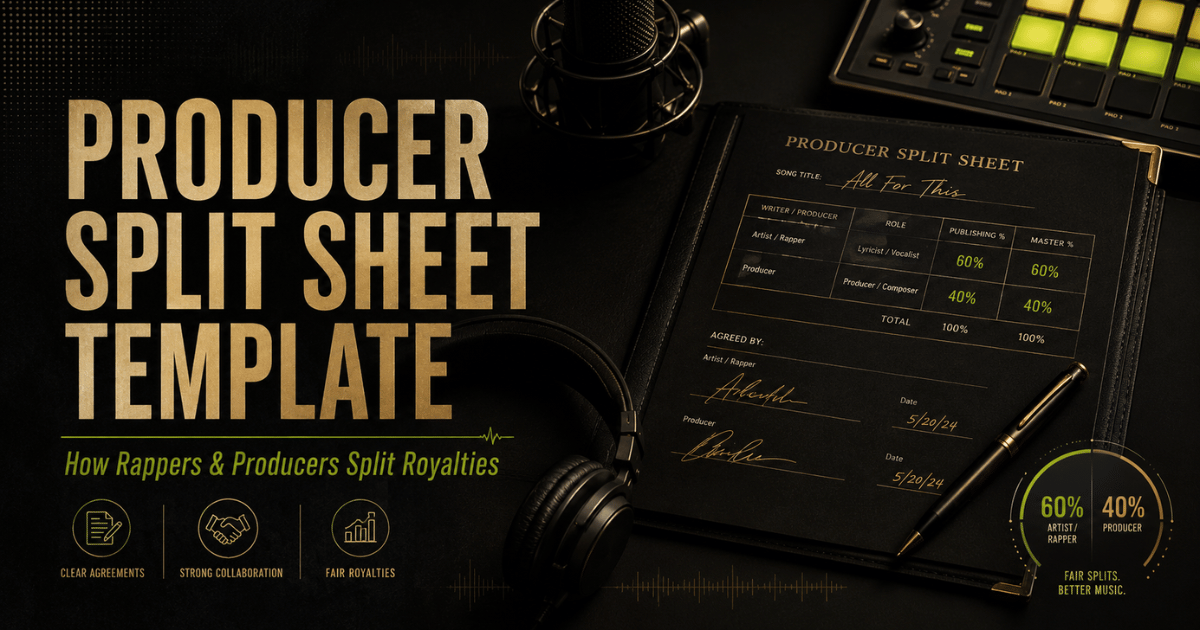
In contemporary hip-hop, trap, drill, and rhythm and blues (R&B), songs are often made fast. Independent rappers, beatmakers, songwriters, and producers can conceptualize, record, mix, master, and distribute tracks within days. That speed creates opportunity, but it also hides a commercial reality: a finished audio file is not merely consumable digital media. It is a multi-layered bundle of intellectual property rights.
When creators upload a track without properly documenting who owns what, they risk frozen royalties, copyright takedowns, and damaged creative relationships. A producer split sheet is one of the simplest and most effective mechanisms for rappers, producers, and songwriters to prevent royalty disputes before a song is released to the public.
In genres where leased beats, exclusive instrumental licenses, remote vocal features, and multi-producer arrangements consistently overlap, a clear written record of ownership protects everyone involved. This document becomes the foundation for downstream distribution metadata, publishing registration, royalty collection, and future synchronization licensing. If a creator intends to build an artist profile and scale their career, understanding and executing a rapper producer split sheet is a non-negotiable administrative duty.
The Theoretical Framework of Music Copyright
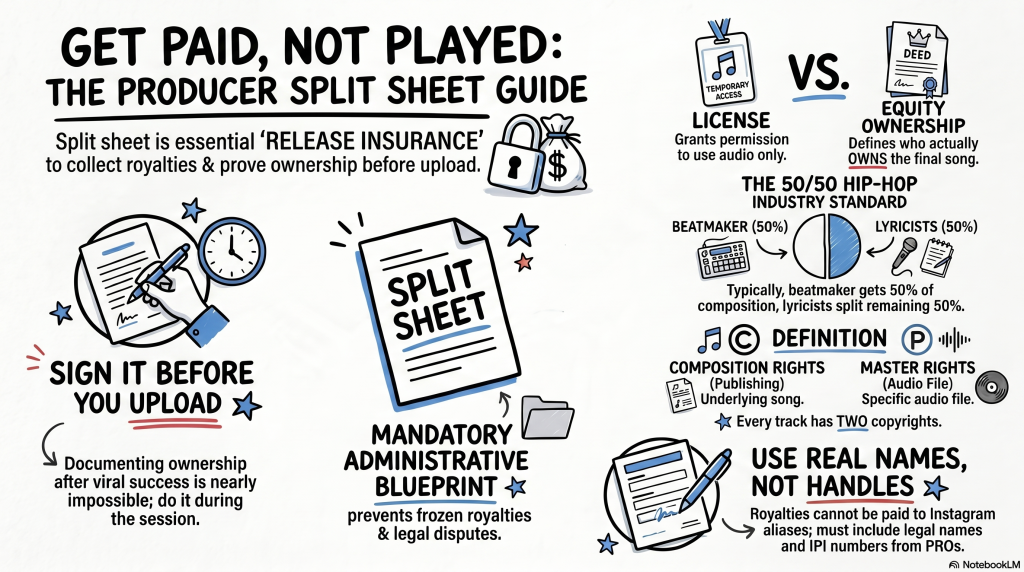
To understand the mechanics of a music split sheet template, it is essential to establish the foundational duality of music copyright. Every recorded track contains two legally distinct copyrights that generate separate streams of revenue, as explained in Ari Herstand’s breakdown of royalty splits. Understanding this division is the first step in avoiding the systemic failures that often plague independent releases.
The Musical Composition
The first copyright is the musical composition, often referred to as the “publishing” side of the track. The composition covers the underlying melody, lyrical content, chord progressions, and structural arrangement of the song. This copyright is owned by the songwriters and producers who actively composed the music.
The composition exists independently of any specific recording. If another artist covers the song using different instruments, a different tempo, and a different vocal performance, the original songwriters and producers still own the underlying composition copyright and are entitled to the resulting publishing royalties.
The Sound Recording
The second copyright is the sound recording, commonly referred to as the “master.” The master represents the specific, finalized audio file prepared for commercial distribution and uploaded to digital service providers (DSPs) such as Spotify, Apple Music, YouTube, TikTok, SoundCloud, or BTR.
Ownership of the master typically belongs to the entity that financed the recording process. For independent, do-it-yourself (DIY) artists, this is usually the artist themselves. For signed artists, it is typically the record label, as explained in Orphiq’s guide to producer royalties.
An effective split sheet addresses the intersection of these two copyrights. It documents the exact percentage of the composition each contributor owns, and it can also outline any financial interests the producer may have in the master recording, such as back-end producer points.
Music Copyright Structure
- Copyright type: Musical Work Common industry term: Composition / Publishing What it protects: Lyrics, melody, chords, beat structure Primary owners: Songwriters, producers, publishers Revenue sources: Performance royalties, mechanicals, sync fees.
- Copyright type: Sound Recording Common industry term: Master What it protects: The specific recorded audio file Primary owners: Recording artist, record label, master owner Revenue sources: Streaming payouts, physical sales, digital radio.
Defining the Producer Split Sheet
A producer split sheet is a standardized written record detailing the specific individuals who contributed to the creation of a song and the exact percentage of intellectual property they own or revenue they are entitled to receive, as outlined in Ditto Music’s music split sheet guide.
While a split sheet is not a substitute for a comprehensive, multi-page artist producer agreement template drafted by legal counsel, it operates as a highly effective, legally recognizable memorandum of understanding between collaborators, as reflected in Songtrust’s songwriter split sheet template.
The document is designed to strip away ambiguity from creative sessions. It records the song title, the legal names of all contributors, their respective roles, their performance rights organization (PRO) affiliations, and the precise mathematical division of the composition. Crucially, the total percentage of ownership documented on the split sheet must always equal exactly one hundred percent, a requirement also emphasized in The Vocal Market’s split sheet guide for producers.
It is necessary to draw a strict distinction between what a split sheet is and what it is not. A producer split sheet is not automatically the same as a beat license. It is not a publishing administration agreement. It does not transfer copyright to a record label, nor does it serve as a distribution contract. Furthermore, it is not a work-for-hire agreement unless specific language is added to explicitly state that a contributor is forfeiting their copyright in exchange for a flat fee.
Rather, the split sheet is the fundamental blueprint that informs all downstream contracts and registrations. When a track begins generating revenue, this document is the authoritative source of truth that dictates how capital is dispersed among the independent rappers, beatmakers, and top-line writers involved.
Why Rappers and Producers Need a Split Sheet Before Release
The structural dynamics of modern hip-hop creation make pre-release split documentation an absolute necessity. Collaboration in this space is highly fragmented and often asynchronous. A beatmaker might upload an instrumental to an online beat marketplace, an independent rapper might lease that beat, record vocals in a home studio, and then hire a third party to write and perform a melodic hook. Because these transactions often occur digitally, the collaborators may never occupy the same physical space.
Releasing a track under these conditions without properly preparing to split royalties with a producer invites severe operational risks. If a track begins gaining algorithmic momentum on a platform like TikTok, the absence of documented splits can lead to immediate financial paralysis. Distributors may withhold royalty payouts if conflicting claims are submitted by the artist and producer, as noted in Chartlex’s 2026 guide to split sheets for musicians.
Performing Rights Organizations may place the song in dispute status, freezing all performance royalties until the writers resolve their conflict, a risk discussed in ASCAP’s guidance on songwriting splits. Furthermore, if a producer feels they have not been adequately credited or compensated according to initial expectations, they possess the legal leverage to issue a Digital Millennium Copyright Act (DMCA) takedown notice. Such an action can erase the song from streaming platforms, destroy algorithmic momentum, and sever its connection to curated playlists.
Emotional detachment during the creative process is critical for long-term success. Studio environments are built on creative synergy and mutual respect, but business arrangements must be handled objectively. Collaborators often delay discussing ownership percentages because they fear disrupting the creative atmosphere or appearing overly corporate.
However, executing a split sheet before the session concludes, or certainly before the decision to prepare your song for release is finalized, prevents minor misunderstandings from escalating into intractable legal disputes later. A split sheet should be viewed not as bureaucratic friction, but as essential release insurance.
Producer Splits vs. Beat Licenses
A pervasive source of confusion among independent artists is the conflation of beat licensing and producer split sheets. Purchasing a beat online does not automatically resolve copyright ownership or negate the need for a split sheet. The search intent behind “beat licensing vs split sheet” reveals a fundamental misunderstanding of intellectual property utility versus equity.
A beat license is a contractual agreement that grants an artist permission to use an instrumental for a specific purpose, usually subject to strict commercial limitations, as explained in Songtrust’s guide to producer contracts. The license defines the parameters of exploitation: how many audio streams the song is allowed to accrue, how many physical copies or digital downloads can be sold, whether the song can be performed live for profit, and whether the artist is permitted to broadcast the track on terrestrial radio.
Conversely, a split sheet documents the actual ownership of the newly created derivative work, meaning the finished song, and how the publishing royalties generated by that song will be divided among the creators.
An artist who leases a beat often operates under the false assumption that paying the initial lease fee means buying the song outright and controlling one hundred percent of the publishing. Beatmakers can also incorrectly assume that selling a beat automatically entitles them to a specific share of the master royalties without ever negotiating those terms. Both assumptions are legally flawed.
The beat license governs the utility of the audio, operating much like a landlord renting a property to a tenant. The split sheet governs the equity of the composition. Therefore, even if an artist holds a valid beat license, they still require a split sheet to clearly define how the publishing royalties will be divided when the song is registered with a PRO.
Beat License Agreement vs. Producer Split Sheet
- Primary function: A beat license grants the artist permission to use the producer’s instrumental under specific constraints. A producer split sheet documents the agreed-upon ownership percentages and royalty divisions of the final song.
- Typical signatories: A beat license is executed between the beat seller, or licensor, and the recording artist, or licensee. A split sheet is signed by all contributors, including artists, producers, hook writers, and co-writers.
- Key terms covered: A beat license covers usage limits, stream caps, exclusivity, term length, territory, and upfront fees. A split sheet covers publishing splits, PRO affiliations, IPI numbers, and master royalty points.
- Legal scope: A beat license governs the right to exploit a specific piece of audio, the instrumental. A split sheet governs the intellectual property rights and revenue flow of the underlying composition.
Exclusive Beats vs. Non-Exclusive Beats
The type of beat license acquired heavily influences the final split sheet negotiations and the expectations of both rapper and producer. Digital beat marketplaces fundamentally operate on two primary licensing models: non-exclusive leases and exclusive licenses, as explained by UnitedMasters’ guide to selecting a beat license. Understanding the distinction is vital for accurately completing a rapper producer split sheet.
Non-Exclusive Beat Leases
A non-exclusive lease allows the producer to rent the exact same instrumental to multiple different artists simultaneously. This model is highly cost-effective for independent rappers seeking to test material or build a catalog on a limited budget, a point also reflected in Mayu Beatz’s beginner guide to beat licensing.
However, non-exclusive leases are encumbered by strict commercial ceilings. A standard non-exclusive lease might cap digital streams at a specific threshold, such as 500,000 streams, and strictly prohibit the artist from registering the final track with YouTube Content ID or other audio fingerprinting services, as described in Wisseloord Studios’ explanation of exclusive and non-exclusive beats.
Registering a non-exclusively leased beat with Content ID is a critical error, as it will inevitably trigger false copyright strikes against other independent artists who legitimately leased the exact same instrumental from the producer. When drafting a split sheet for a song using a non-exclusive beat, the producer almost always retains their full share of the composition, and the artist’s ability to collect master royalties is strictly capped by the lease terms.
Exclusive Beat Licenses
An exclusive license dictates that the producer will no longer sell or lease the instrumental to any other party from the moment the agreement is executed. This grants the purchasing artist freedom to exploit the track without worrying about stream caps, sales limits, or subsequent Content ID conflicts.
However, purchasing an exclusive license does not automatically mean the producer has surrendered their publishing rights. Unless the agreement is explicitly structured as a total copyright buyout or a customized work-for-hire agreement, which strips the creator of their intellectual property rights entirely in exchange for a premium flat fee, the producer still maintains their legal claim to the composition.
Therefore, even when an artist decides to find rap beats and purchases one exclusively, a split sheet is still required to define exactly how the publishing revenue will be shared when the track is broadcast, streamed, or synchronized with visual media.
Does the Producer Own 50% of the Song?
A frequently debated topic within the music industry is whether a producer is automatically entitled to fifty percent of the publishing copyright. The technical legal answer is that no split is entirely automatic. Copyright ownership depends on the specific contributions of the individuals and the written agreements they strike.
However, industry standards and default expectations vary significantly by genre. In hip-hop, trap, drill, and R&B, the producer is often the sole architect of the instrumental track. They program the drums, compose the melodies, design the basslines, and arrange the structural progression of the beat long before an artist hears it.
Because this instrumental forms the entire musical foundation of the composition, it is a widely accepted industry standard for the primary beatmaker to receive 50% of the composition copyright. The remaining 50% of the publishing is then divided among the top-liners: the vocalists, rappers, and hook writers who contribute lyrics and vocal melodies.
This 50/50 division between the music, or beat, and the words, or lyrics, provides a clean, equitable baseline for negotiations. However, deviations from this standard are common based on actual material contributions.
- If a beatmaker supplies a basic drum loop but another producer in the room writes all the chord progressions, synthesizers, and melodies, the 50% producer share must be divided between them based on their respective efforts.
- If a rapper purchases a beat but completely alters the tempo, chops the audio, and heavily rearranges the structure alongside an in-house studio engineer, the publishing splits may be renegotiated to reflect that additional collaborative effort.
- Conversely, mix engineers and mastering engineers are generally compensated via flat fees and do not receive songwriting splits, as their work is considered a technical enhancement of the sound recording rather than a compositional creation.
It is useful to contrast the hip-hop standard with the operational norms of other genres. In Nashville’s country music industry, the prevailing philosophy is “one word, one third.” This dictates that any individual present in the songwriting room receives an equal percentage of the publishing, regardless of whether they wrote a single lyric or simply offered conceptual feedback, acknowledging that collaborative energy shapes the final product.
In rock music, bands often split publishing equally among all members to preserve group harmony, even if only one member wrote the actual chords. Because hip-hop production is highly modular and remote, the 50% baseline for the instrumental remains the most reliable starting point for split sheet documentation, but it must always be formalized in writing.
Publishing Splits vs. Master Royalties vs. Producer Points
To construct a robust producer split sheet, creators must understand the mechanical separation between publishing splits, master royalties, and producer points. Conflating these three distinct revenue streams is a primary reason independent artists fail to pay collaborators accurately and end up in litigation. Understanding producer royalties explained at a granular level is essential.
Publishing Splits: The Composition
Publishing splits represent ownership of the underlying song. When a track is played on terrestrial radio, streamed on interactive digital platforms, performed live in a venue, or broadcast in a retail environment, it generates performance and mechanical royalties.
These royalties are collected by Performing Rights Organizations (PROs) such as ASCAP, BMI, and APRA AMCOS, as well as mechanical licensing collectives like The MLC in the United States. Publishing revenue is completely insulated from the costs associated with recording the master. Once the song begins generating money, the PROs and publishers pay songwriters and producers directly based on the exact percentages listed on the split sheet, taking their payment right off the top.
Master Royalties: The Sound Recording
Master royalties are generated by the commercial exploitation of the finalized audio file. When a user streams a song on Spotify, Apple Music, or YouTube, the platform pays a master streaming royalty to the digital distributor, such as DistroKid, TuneCore, CD Baby, Amuse, or Symphonic, a category covered in Dynamoi’s 2026 ranking of music distribution services.
The distributor then funnels that capital to the master owner, which is typically the independent artist or the record label. Because creating a master recording involves significant financial risk, such as paying for studio time, purchasing exclusive beat licenses, paying mix engineers, and funding marketing campaigns, the master owner is usually entitled to keep all master royalties until those initial costs are fully recouped.
Producer Points
Producer points are a specific, negotiated percentage of the master royalties awarded to a producer in addition to their publishing share. “Points” is industry terminology for percentage points. Three points equals 3% of the master royalties.
The allocation of producer points varies significantly based on the producer’s leverage, track record, and the nature of the deal. In a major label ecosystem, developing producers typically command 3 to 4 points, established hitmakers command 4 to 5 points, and superstar producers can negotiate upward of 10 points, as discussed in Elizabeth Records’ guide to fair producer royalty percentages.
Crucially, in a record label deal, these points are subtracted from the artist’s share, not the label’s share. If an artist receives a 20% royalty rate from their label and the producer takes 4 points, the producer receives 4%, and the artist is left with a net of 16%.
For independent artists financing their own releases, points operate slightly differently. Independent producers often charge an upfront production fee to cover their immediate time and labor. Depending on the negotiation, this upfront fee may be treated as a recoupable advance. If a producer charges a $2,000 upfront fee and negotiates a 20% backend cut, meaning 20 points on the independent master, the producer will not receive any backend master royalties until their 20% share has organically generated $2,000, thereby recouping the advance. This recoupment mechanism must be explicitly defined in the split sheet or the accompanying producer agreement template.
Compensation Type Comparison
- Publishing split: Revenue comes from PROs and mechanical collectives. It is collected by songwriters, producers, and publishers. It is not subject to artist recoupment because it is paid directly off the top by collection societies.
- Master royalties: Revenue comes from DSPs via digital distributors. It is collected by the independent artist, record label, or master owner. The master owner initiates the recoupment of expenses.
- Producer points: Revenue comes from DSPs via digital distributors. It is collected by the producer. It is often subject to recoupment of production advances and recording costs.
Common Hip-Hop Split Examples
Abstract copyright theory is best understood through practical application. The following scenarios illustrate how split sheets are routinely structured in the hip-hop ecosystem. These are not default legal mandates, but established baseline examples creators can use to model their own negotiations.
Scenario A: The Direct Collaboration — Rapper + Producer Only
A producer creates an original beat from scratch. An independent rapper hears the instrumental, writes all the verses and the chorus, and records the vocals. No other writers are involved.
Composition split: 50% to the producer and 50% to the rapper.
Master split: If the rapper paid a flat upfront fee for the producer’s services without negotiating backend points, the rapper retains 100% of the master royalties. If the producer deferred their upfront fee to help the artist, they might negotiate a 20% to 50% share of the master royalties as compensation for taking on financial risk.
Scenario B: The Complex Arrangement — Rapper + Producer + Hook Writer
A producer provides the instrumental. Rapper A writes and performs two verses. However, the artist feels the song lacks commercial appeal and brings in an external songwriter to compose and sing a melodic chorus, or hook.
Composition split: The producer retains their 50% foundational share for the instrumental. The remaining 50% is divided between the lyricists based on contribution. Rapper A might take 30% for the verses, while the hook writer takes 20% for the chorus. Alternatively, to avoid arguments over whose contribution is more valuable, the three collaborators may divide the entire composition equally in thirds, at 33.3% each, to preserve harmony.
Scenario C: Two Rappers + Producer
A producer makes a beat. Rapper A writes verse one and the hook. Rapper B is brought in as a featured artist and writes verse two.
Composition split: Producer 50%. Rapper A 30% for verse and hook. Rapper B 20% for verse two. The exact percentages depend heavily on the length and impact of the respective verses, which must be discussed and documented.
Scenario D: The Leased Beat
An artist licenses a beat non-exclusively for $30 from an online marketplace. The producer’s standard lease terms stipulate they retain full composition rights.
Composition split: 50% producer and 50% artist.
Master split: The artist collects the master streaming revenue via their distributor, but only up to the specific streaming cap dictated by the lease, such as 100,000 streams. The artist has no authority to grant sync licenses for television or film without the producer’s explicit authorization and negotiation.
Scenario E: The Exclusive Beat Purchase
An artist pays a premium fee for the exclusive use of an instrumental.
Composition split: Unless the exclusive license explicitly contains work-for-hire language transferring the copyright entirely, the producer generally retains their 50% publishing share.
Master split: The artist retains 100% of the master royalties and is free to exploit the track without streaming caps, though they must still accurately report the producer’s publishing share.
What Should Be Included in a Producer Split Sheet?
To function effectively as a downstream administrative tool, a producer split sheet must contain granular, highly specific metadata. Vague documentation inevitably results in rejected registrations, misdirected funds, and lost revenue. A professionally drafted split sheet leaves no room for creative interpretation.
The document must clearly identify the song title and any alternate working titles that may be used during the registration process. It is absolutely imperative that the full legal names of all contributors are recorded. Using a stage name, artist moniker, or Instagram handle on a copyright document is a systemic error. PROs and mechanical collectives distribute capital to verified legal entities and bank accounts, not aliases.
The most critical identifiers on the split sheet are the PRO affiliations and the IPI/CAE numbers. An IPI, or Interested Parties Information number, or CAE number, is a unique nine-to-eleven digit global identifier assigned to a songwriter or publisher by their respective PRO, such as ASCAP, BMI, SESAC, APRA AMCOS, or PRS. This number operates as the routing code that ensures global performance royalties find the correct bank account. If a collaborator does not know their IPI number, they must log into their PRO portal and locate it before the split sheet is executed.
The split sheet must clearly delineate the precise publishing percentage allocated to each individual. It should also document publisher information. For independent writers who are not signed to a major publishing house or administration company, this field may list their personal vanity publishing company or simply note that they are self-published.
Finally, the document should capture any agreements regarding master royalty percentages, producer points, recoupment status, and the presence of any third-party samples. It must be dated and signed by all contributors. Digital signatures facilitated through platforms like DocuSign, HelloSign, or integrated music business software are legally binding and represent the modern industry standard.
Free Producer Split Sheet Template
Before you upload your next track, make sure your credits, splits, and ownership are completely clear. Implementing a standardized split sheet protocol is one of the most effective ways to professionalize your independent music career. Below is a comprehensive structure for a music split sheet template that can be copied into a Google Doc, saved as a PDF checklist, or used as a direct companion to your distribution workflow.
Song Information
- Song Title:
- Alternate/Working Title, if any:
- Recording Artist:
- Primary Producer:
- Intended Release Date:
- Digital Distributor:
- ISRC, if generated:
- UPC, if generated:
Contributor Information
Duplicate this section for each contributor.
- Full Legal Name:
- Stage Name / Alias:
- Role in Creation, such as Producer, Lyricist, Melody Writer:
- Email Address:
- Phone Number:
- PRO Affiliation, such as ASCAP, BMI, PRS, APRA:
- IPI/CAE Number:
- Publisher Name, or “Self-Published”:
- Publishing Split Percentage, with total across all contributors equalling 100%:
- Master Royalty Percentage, if agreed upon:
- Producer Points, if applicable:
Agreement Notes and Clearances
- Beat License Type, such as Exclusive, Non-Exclusive Lease, or Original Collaboration:
- Upfront Producer Fee Paid:
- Recoupment Terms, including whether the upfront fee is recoupable against points:
- Third-Party Sample Usage, listing any uncleared samples used in the beat:
- Stems Delivered, Yes/No:
- Work-for-Hire Status, including whether this agreement transfers copyright entirely:
- TrackOrigin/HumanMade Verification Reference, if applicable:
- Additional Terms:
Signatures
- Contributor Signature:
- Date of Execution:
- Digital Confirmation Method, if signed electronically:
Actionable next steps: Download the producer split sheet template, secure the signatures of all collaborators, and prepare your song for release with confidence. Once the paperwork is secure, creators can master a song online, separate vocals from music for dynamic remixing, and upload the track directly to their chosen distributor or BTR to begin monetizing their intellectual property.
Mistakes That Get Artists and Producers Paid Late
Even when artists are conceptually aware of split sheets, administrative negligence and procedural errors frequently lead to delayed, misdirected, or permanently frozen payments. If the paperwork is unclear, money almost always gets delayed, disputed, or misdirected. The following mistakes are the most common systemic failures in the independent hip-hop sector.
Uploading Before Splits Are Agreed
The most devastating operational error is uploading a track to a digital distributor before the splits have been formally discussed and documented. When a song is distributed with incomplete or assumed metadata, it enters the global royalty ecosystem missing critical routing information. Attempting to fix metadata after a song has been ingested by Spotify and Apple Music is a slow, bureaucratic process that halts revenue flow.
Assuming a Beat Lease Equals Full Ownership
Purchasing a $50 non-exclusive beat lease does not grant the artist 100% ownership of the publishing. Artists who register the song with their PRO claiming 100% ownership while ignoring the producer will eventually trigger a copyright dispute when the producer registers their rightful share.
Leaving Contributors Out of Metadata
Failing to include auxiliary contributors is a major liability. If a session musician contributed a critical melodic guitar riff, or a friend in the studio wrote a single line of the chorus, they have a legal claim to the composition. If they later realize the song is generating significant revenue and file a claim with a PRO, the entire royalty stream can be placed in dispute. Anyone who contributed to the lyrics or melody must be documented on the split sheet, or they must sign a work-for-hire agreement.
Not Collecting Legal Names and IPI Details
Submitting a split sheet that lists contributors by their Instagram handles, such as “@BeatMaker99,” renders the document useless for PRO registration. Performance royalties cannot be routed without full legal names and IPI numbers.
Confusing Publishing with Master Royalties
Artists frequently promise producers “50% of the song” without clarifying whether they mean 50% of the publishing composition or 50% of the master streaming royalties. This linguistic imprecision leads to arguments when the first streaming checks arrive.
Not Documenting Uncleared Samples
If a producer uses an uncleared sample from an old soul record to make a beat and fails to disclose this on the split sheet, the artist absorbs major legal liability. If the original copyright holder discovers the sample, they will demand a large percentage of the publishing, completely destroying the agreed-upon splits between the rapper and the producer.
Forgetting to Update Splits After a Remix or Feature
If an artist decides to promote their music by adding a high-profile featured artist to a remix, the original split sheet must be amended. The new featured artist will require a percentage of the composition, which must be mathematically subtracted from the original contributors’ shares.
Improper ASCAP Registration: The Vanity Publisher Error
Failing to properly structure ASCAP registrations is a specific, recurring issue for independent creators. When an independent writer registers with ASCAP, the PRO automatically splits the performance revenue into a 50% writer’s share and a 50% publisher’s share. If the independent writer does not proactively register a vanity publishing company, such as an LLC or DBA, to collect the publisher’s share, they will effectively forfeit half of their performance royalties.
How to Register the Song After Splits Are Agreed
A completed split sheet is not a passive document to be filed away. It is the active administrative blueprint used to trigger the global royalty pipeline. Once the split sheet is signed, the data must be accurately inputted into multiple disparate industry systems to ensure total monetization. The split sheet must become the absolute source of truth for every downstream registration.
Step One: Distribution Metadata
The first step is distribution metadata. When the independent artist uploads the master file to a digital aggregator, they must use the split sheet to configure the backend payment splits. Modern distributors like DistroKid, TuneCore, CD Baby, Symphonic, and Amuse allow the artist to input the email addresses of producers and collaborators, automatically routing the agreed-upon master royalties directly to their respective bank accounts.
It is important to note the economic differences between these platforms. For instance, Symphonic and TuneCore offer free split routing for non-members, while platforms like Amuse may charge fees if the collaborator is not subscribed to their service, as discussed in Identity Music’s comparison of music distributors.
Step Two: PRO Registration
The second step is PRO registration. Every individual listed on the split sheet must independently register their specific percentage of the composition with their respective PRO. For example, in Australia, members use the APRA AMCOS portal to submit work registrations, listing co-writers, roles, and exact percentage splits, as detailed in APRA AMCOS guidance on how to register a song.
If the metadata submitted by the artist matches the metadata submitted by the producer, the PRO confirms the registration and begins collecting performance royalties from radio stations, streaming services, and live venues.
Step Three: Mechanical Royalty Registration
The third step is mechanical royalty registration. In the United States, mechanical royalties generated by interactive streams are collected by The Mechanical Licensing Collective, or The MLC. Independent songwriters must register their splits with The MLC, or use a publishing administrator like Songtrust or Sentric to do it on their behalf, to ensure these mechanicals are collected.
Step Four: Neighbouring Rights and Digital Performance Royalties
The fourth step involves neighbouring rights and digital performance royalties. In the United States, SoundExchange collects royalties for the public performance of the sound recording on non-interactive digital radio platforms like SiriusXM and Pandora. In Australia and the UK, this function is managed by PPCA and PPL, respectively.
For a producer to collect their agreed-upon share of master performance royalties from these organizations, the primary artist must issue a formal Letter of Direction referencing the terms outlined in the split sheet, authorizing the society to pay the producer directly.
What If You Already Released Without a Split Sheet?
In the fast-paced, highly reactive hip-hop environment, tracks are routinely uploaded to SoundCloud, YouTube, or DSPs before any paperwork is finalized. If a song begins generating traction without a split sheet, immediate remediation is required to prevent financial blockages. If money is already being earned, disputes can become exponentially harder to resolve as egos and financial expectations inflate.
To resolve a post-release administrative void, the primary artist must immediately initiate contact with all contributors, including beatmakers, hook writers, and featured vocalists. A clear, unemotional dialogue must be established to retroactively confirm who did what. During this phase, it is vital to review the original beat license terms to determine whether the instrumental was leased non-exclusively or sold exclusively, as this heavily influences the baseline expectations.
Once a verbal or email agreement is reached regarding the publishing and master percentages, a retroactive split sheet must be drafted, dated, and signed by all parties. Subsequently, the artist must log into their digital distributor dashboard and update the royalty splitting configurations to match the newly signed document.
Furthermore, if the track has already been registered with a PRO, the registration must be formally amended to reflect the newly agreed-upon reality. Failure to execute these retroactive steps swiftly increases the probability of frozen royalties, as uncredited contributors may resort to filing legal disputes if they feel they are being intentionally excluded from a lucrative revenue stream.
When You Need a Real Lawyer
While a standard template is an incredibly useful tool for simple documentation and routine independent releases, it has limits. It is essential to understand when to transition from a DIY administrative approach to retaining professional legal counsel. A template is not a substitute for a bespoke legal strategy.
A music attorney should be retained when the song is generating serious, life-changing money, or when a major record label expresses interest in acquiring the master or signing the artist. In these instances, the informal agreements of a split sheet must be codified into long-form producer agreements, incorporating complex language regarding audits, warranties, and indemnifications.
Furthermore, any track that uses uncleared third-party audio samples requires rigorous legal oversight. A split sheet cannot clear a sample. It merely documents ownership of the new work. If a producer used a sample from a 1970s soul record to construct the beat, the original copyright owners of that soul record will eventually demand a percentage of the new composition. Attorneys are necessary to negotiate these complex sample clearances and formally reallocate the publishing splits.
Legal counsel should also be retained immediately if an exclusive beat deal is unclear and multiple artists are claiming ownership, if a producer is claiming full ownership of the master after release, if a lucrative sync licensing opportunity arises for film or television, if a contributor is requesting specific work-for-hire language, or if a DMCA takedown or formal dispute has already been initiated.
Disclaimer: This article is for educational and informational purposes only and does not constitute formal legal advice. Creators should always consult with a qualified attorney regarding their specific contractual needs.
Emerging Paradigms: AI, TrackOrigin, and HumanMade Verification
As the music industry progresses rapidly into 2026, the proliferation of AI-generated audio has altered the concept of music provenance and copyright administration. The traditional producer split sheet assumes implicitly that all listed contributors are human beings. However, with DSP catalogues and discovery feeds flooding with fully AI-generated and AI-assisted tracks, a new layer of verification is becoming mandatory for independent artists seeking to protect their equity, prove their authenticity, and maintain their connection with audiences.
Platforms like BeatsToRapOn (BTR) have integrated advanced provenance protocols, notably the TrackOrigin standard, to address this crisis of authenticity, as discussed in TrackOrigin, BTR, and the New Standard for Human-Made Music and BTR’s article on TrackOrigin verification for human-made music. TrackOrigin serves as a portable proof layer that sits between the finished audio file and the global distribution network. It uses C2PA supply chain standards to help prove that a track was created, performed, produced, or meaningfully directed by a human rather than a generative algorithm.
When artists complete the verification process through TrackOrigin, they receive a unique cryptographic certificate number. By pasting this number into their BTR workspace, a HumanMade badge is appended to the track’s metadata, visible on the web and within the fan-facing mobile app. This certification acts as an auxiliary document to the traditional split sheet. If a dispute arises regarding composition ownership, or if a platform questions the legitimacy of the copyright, TrackOrigin certification provides proof of human creation, fortifying the claims made on the split sheet.
While this verification is optional and does not penalize hybrid or AI-assisted music in terms of algorithmic discovery, it provides an additional layer of trust. For independent hip-hop producers and rappers whose value proposition relies on authentic cultural expression, using TrackOrigin verification and referencing it on the split sheet helps align financial rights with creative identity. If creators want to future-proof their catalog, they should verify their HumanMade music before their next major release.
Producer Split Sheet FAQ
What is a producer split sheet?
A producer split sheet is a standardized document that records the legal names of all individuals who contributed to a song and defines the exact percentage of the composition or master royalties they own. It serves as the baseline record for all future publishing and royalty registrations.
Do rappers need a split sheet before releasing music?
Yes. Releasing music without a split sheet greatly increases the risk of delayed royalties, PRO registration conflicts, and copyright takedowns. Documenting splits before release ensures that distribution metadata is accurate and collaborators are paid efficiently without friction.
Does buying or licensing a beat mean I own the song?
Not necessarily. Buying a beat license grants permission to use the instrumental under specific conditions, such as stream limits or format restrictions. It does not automatically transfer the producer’s publishing rights or composition ownership. A split sheet is still required to define who owns the underlying composition.
Does a producer automatically get 50% of the song?
No split is legally automatic. However, in hip-hop, trap, drill, and R&B, it is a widely accepted industry standard for the producer who created the foundational instrumental to receive 50% of the composition, or publishing, leaving the remaining 50% for the vocalists, lyricists, and hook writers. This is always subject to negotiation based on actual contribution.
Is a split sheet the same thing as a beat license?
No. A beat license is a contract granting the artist the right to exploit the producer’s instrumental for commercial use. A split sheet is an ownership document confirming the equity percentages of the final, collaborative derivative work.
Can I release a song without a split sheet?
You can physically upload a song without one, but doing so drastically increases the risk of legal disputes, delayed royalty payments, and metadata problems that can stall career momentum.
What happens if a song goes viral and there is no split sheet?
If a track goes viral without documentation, collaborators may enter intense disputes over ownership, causing PROs and digital distributors to freeze royalty payouts until the conflict is resolved legally. In severe cases, uncredited contributors may issue DMCA takedowns, removing the viral track from DSPs entirely.
Should producer points be on the split sheet?
Yes. If producer points, meaning a percentage of the master royalties, are part of the agreement, they should be explicitly detailed on the split sheet alongside any recoupment terms.
Should featured artists be on the split sheet?
Yes. If a featured artist wrote lyrics, vocal hooks, melodies, or contributed to the composition in any material way, they must be documented on the split sheet and allocated a percentage of the publishing.
What are IPI and CAE numbers, and why are they necessary?
An IPI, or Interested Parties Information number, or CAE number, is a unique global identification code assigned to songwriters and publishers by their Performing Rights Organization, such as ASCAP, BMI, PRS, or APRA AMCOS. It is necessary to include these on a split sheet to ensure that performance royalties are routed to the correct individuals accurately.
Should I use a lawyer?
Use a lawyer for serious commercial releases, major label deals, tracks involving uncleared third-party samples, unclear exclusive beat contracts, complex synchronization licensing, or if any formal legal dispute over ownership has commenced.
Strategic Conclusions and Next Steps
The architecture of the modern music industry is fundamentally reliant on precise metadata, clear chains of title, and proactive administration. For independent hip-hop artists, rappers, songwriters, and producers, the speed of digital creation must be matched by equal rigor in business documentation. The producer split sheet is not merely a bureaucratic formality. It is the critical nexus where creative effort is translated into verifiable, monetizable intellectual property.
Relying on implicit assumptions, social media direct messages, or the false security of a non-exclusive beat lease is an administrative failure that routinely results in lost capital and fractured relationships. By enforcing a strict protocol where a split sheet is fully executed prior to distribution, creators insulate their catalog from the friction of copyright disputes. Furthermore, as the industry evolves to require advanced provenance verification through platforms like TrackOrigin, the necessity of clear, unassailable documentation will only intensify.
If a track has more than one contributor, the split must be agreed upon before release. The earlier the split is documented, the easier it is to distribute, register, promote, monetize, and protect the song. Build your artist profile on a foundation of operational excellence. Download the producer split sheet template, formalize your collaborations, verify your authenticity, and prepare your song for release to the global market with confidence.
Note: this article is not legal advice.