
For independent rap, trap, drill, Afrobeats, R&B, Dancehall, and hip-hop artists, live shows and events are no longer just promotion. In 2026, they are one of the clearest ways to turn local demand into revenue, audience data, professional footage, merch sales, and stronger booking leverage.
Why Live Shows Still Matter: The Grassroots Revenue Revolution
In 2026, the global live music sector has established itself as the most reliable, high-margin revenue engine for independent urban artists. Guidance on pricing live performances shows why artists need to understand performance fees, costs, and margins before accepting bookings. While digital streaming platforms provide unprecedented global reach, the direct monetization of recorded music has yielded diminishing financial returns for developing acts due to extreme supply saturation. Independent artist booking guidance points toward grassroots live booking as a practical mechanism to fund an independent music career.
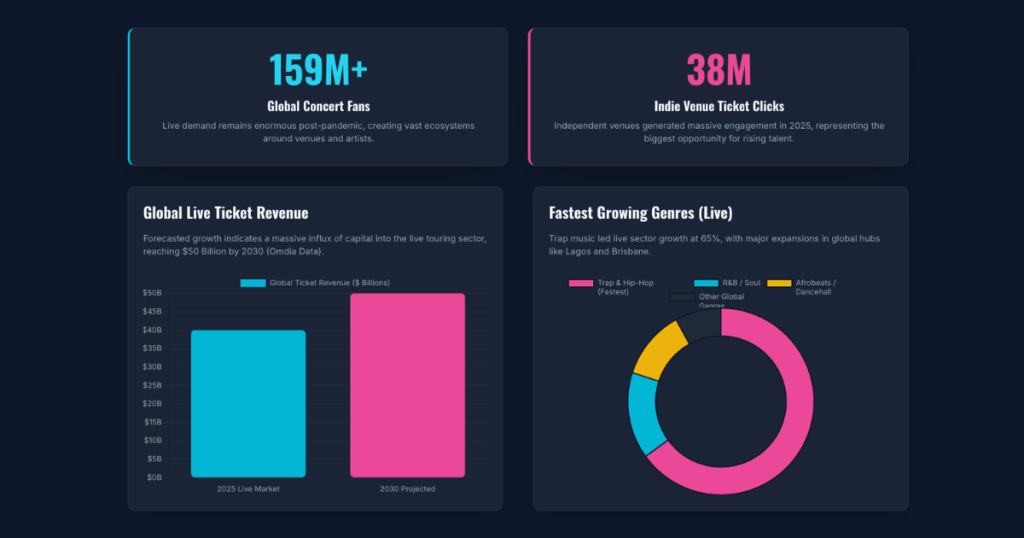
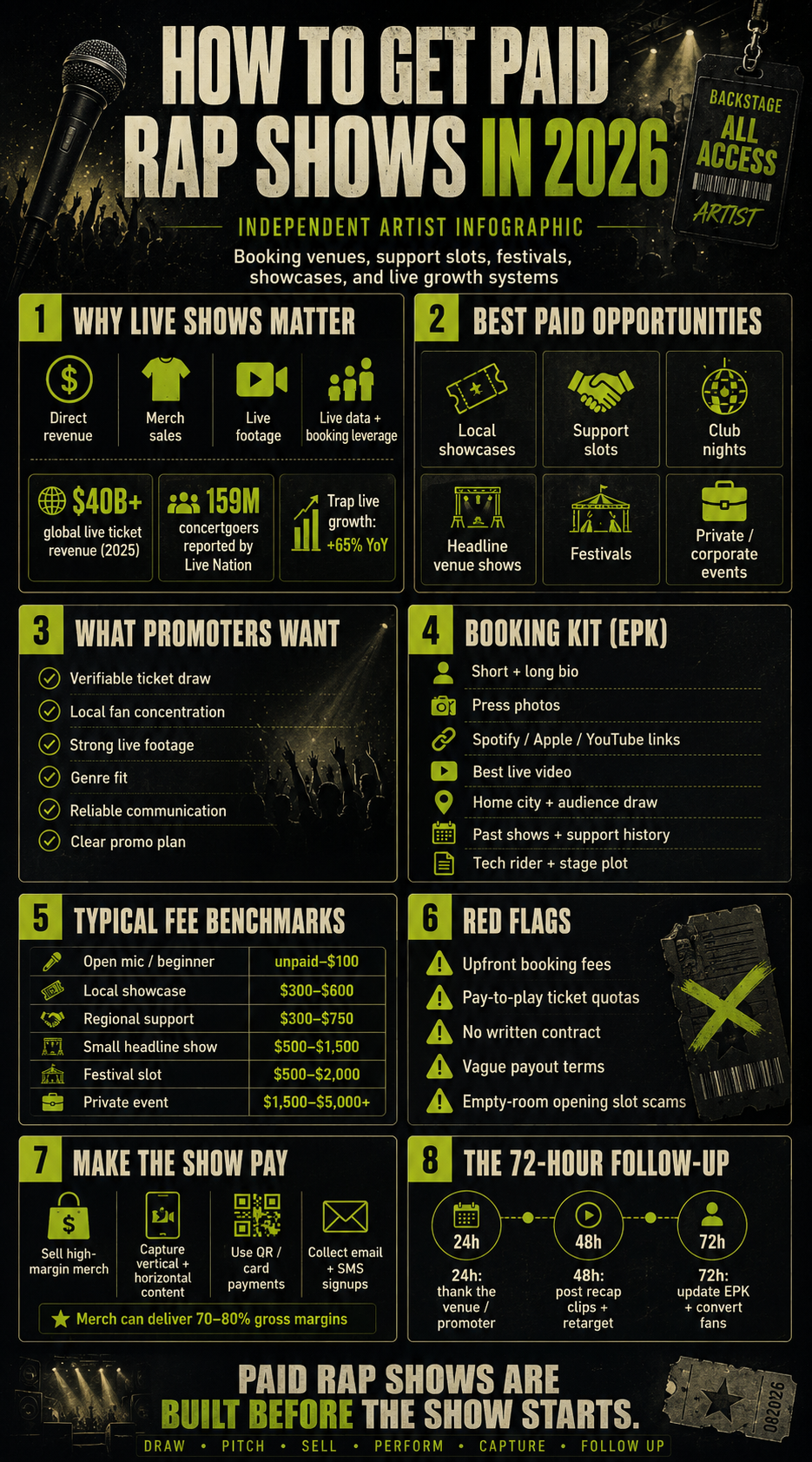
The global live music industry has entered a phase of robust, structural growth. Market intelligence firm Omdia reported that global live music ticket sales revenue surpassed $40 billion in 2025, representing a stabilized year-on-year growth rate of 2.5% following the post-pandemic recovery era, according to coverage of Omdia’s live music market forecast. This trajectory is forecast to reach $50 billion by 2030, with paid attendance across key markets projected to exceed 500 million by 2027, according to Omdia’s market outlook. Simon Dyson, Senior Principal Analyst for Music and Digital Audio at Omdia, noted that the demand for shared experiences continues to outpace supply, with major artist tours selling out faster than ever.
Live Nation further substantiated this demand by reporting a record 159 million concertgoers across 55,000 events in 2025, driven heavily by international expansion and regional genre growth, according to Live Nation Entertainment’s full-year 2025 results.
For independent artists in Hip-Hop, Rap, Trap, Drill, Afrobeats, R&B, and Dancehall, this expanding market presents a major geographic and cultural opportunity. BTR’s guide to finding and booking hip-hop, trap, and R&B gigs frames live performance as a key route for urban music artists building real-world demand. Trap emerged as the fastest-growing live genre, surging 65% year-over-year, according to Bandsintown’s High Notes coverage. This growth was catalyzed by the rise of fusion subgenres, such as phonk, Latin trap, and experimental blends incorporating amapiano and jazz.
Furthermore, data from Bandsintown’s 100 million-fan ecosystem highlighted that cities like Lagos, Accra, and Brisbane are gaining live music fans faster than traditional hubs, reflecting the globalization of urban live scenes. Independent venues represent a major piece of this puzzle; the report states that Axios reported Bandsintown data showing that indie venues generated 38 million ticket clicks and 2 million RSVPs in 2025, proving there is a thriving local ecosystem for rising talent.
To capture this capital and understand how to get paid rap shows, independent artists must transition away from streaming-only business models. Venues act as physical filters of real demand; promoters do not evaluate streaming numbers in isolation but demand empirical proof of a hard-ticket draw, a point reinforced by booking-agent guidance on what artists need before professional representation. Live shows must be approached not merely as promotional events, but as high-conversion environments where live performance footage is captured, audience databases are built, and high-margin physical merchandise is sold.
Types of Performance Opportunities: A Taxonomy of the Urban Live Market
Navigating the live market requires a precise understanding of the distinct performance types available to independent urban artists. Understanding how to get gigs as a rapper requires identifying which opportunities match an artist’s current career stage.
- Open Mics: Typically unpaid, entry-level platforms. These serve as environments to test unreleased material, refine stage presence, and network with local producers, engineers, and DJs.
- Local Showcases: Curated multi-artist bills that focus on specific regional scenes. These often operate on low fees or ticket-split models, offering a platform to perform in front of other artists’ fan bases.
- Support Slots: Opening for touring regional, national, or international acts at mid-size music venues. These are high-value opportunities to inherit highly targeted, genre-specific audiences.
- Club Nights: Late-night, DJ-centric events. Performances are typically short, high-energy sets of 10 to 15 minutes, where the primary objective is to engage the dancefloor and collaborate with club DJs.
- DJ Events: Hosted appearances or curated sets where artists perform tracks directly in coordination with a specific DJ’s tour or residency.
- Cyphers: Highly visible, often video-recorded or live-streamed vocal performances. While rarely paid directly, they serve as high-conversion digital marketing assets to attract talent buyers.
- Battle Rap Events: Highly structured lyricism tournaments. These events feature dedicated, high-paying structures for established performers and offer intense community engagement.
- Campus Shows: Concerts booked by college activities boards or student unions. These shows feature robust institutional budgets and offer premium, fixed-fee payouts.
- Community Festivals: Free, public, city-funded outdoor events. These are highly effective for building local awareness across diverse demographics.
- Regional Festivals: Mid-tier, genre-focused boutique festivals that actively book rising independent talent.
- Touring Support Slots: National or international multi-city tour package options. While guarantees are frequently low, these tours allow artists to build a national footprint and maximize merchandise sales.
- Headline Venue Shows: Hard-ticket events at small to mid-size venues where the artist is the main draw and retains control over the box office split.
- Private Events: Weddings, corporate functions, and private celebrations. These clients pay high, fixed flat-fee guarantees because they budget from overall event expenditures rather than box office receipts.
- Brand-Sponsored Events: Activations funded by corporate brands seeking direct cultural alignment with urban music audiences.
How Artists Get Booked: Pathways to the Stage
Securing gigs systematically requires utilizing professional booking pathways. Independent urban artists must move away from aimlessly sending direct messages to promoters and instead leverage structured industry channels. Independent artist booking advice emphasizes the value of professional, targeted outreach instead of vague promoter messaging.
The following pathways show how urban artists secure paid performance opportunities in 2026.
- Direct Venue Booking: Best for small headline shows and release parties. Operational effort is high. Monetization potential is high because the artist can control the door or ticket split. The access strategy is to pitch directly to the venue’s house talent buyer.
- Promoter Relationships: Best for local showcases and support slots. Operational effort is medium. Monetization potential is medium through fixed fees or small splits. The access strategy is to attend local events, build authentic rapport, and deliver value.
- Event Listing Platforms: Best for grassroots showcases and local gigs. Operational effort is low. Monetization potential is low to medium. The access strategy is to use platforms like BeatsToRapOn’s gig-finding platform or Opnr to match location and genre.
- Open Mic and Showcase Nights: Best for early-stage artists and networking. Operational effort is low. Monetization potential is none to low. The access strategy is to register early, perform consistent sets, and network with host DJs.
- Festival Applications: Best for emerging artists with live proof. Operational effort is high. Monetization potential is high through fixed performance guarantees. The access strategy is to apply through official portals, such as SXSW or Bigsound, with a curated EPK.
- DJ Relationships: Best for club nights, Afrobeats nights, and dancehall nights. Operational effort is medium. Monetization potential is medium through performance fee splits. The access strategy is to service clean, high-quality audio tracks directly to working DJs.
- Other Artists and Support Swaps: Best for expanding into new regional markets. Operational effort is medium. Monetization potential is medium through split door deals. The access strategy is to co-headline or open for acts with similar draws in neighboring cities.
- Booking Agents: Best for artists with consistent, proven draw. Operational effort is high. Monetization potential is maximum through sustained touring models. The access strategy is to pitch a formalized market history report to agents.
What Promoters Actually Look For: Decrypting Promoter Psychology
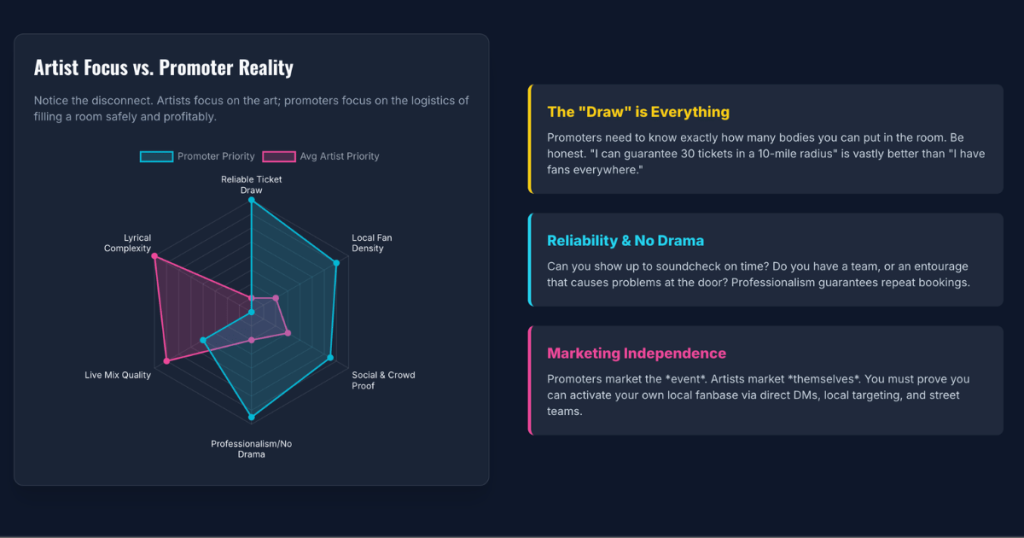
Promoters and talent buyers operate under strict risk-mitigation models. When evaluating independent artists, particularly in urban genres like hip-hop and trap, they prioritize empirical data over subjective artistic merit. Understanding how to get booked for shows requires aligning your pitch with their primary business objectives.
- Verifiable Ticket Draw: Promoters require empirical proof of “butts in seats”. An artist who can guarantee a draw of 50 to 100 ticket-buying fans in a local market holds immediate negotiating leverage.
- Geographic Concentration of Fans: Talent buyers analyze regional audience density. Artists should present localized streaming data, such as Spotify for Artists and Bandsintown data, to prove that their digital audience matches the physical location of the venue.
- Genre Curation Fit: Promoters curate lineups based on stylistic cohesion. A trap artist fits best on a bill with complementary trap, drill, or phonk acts, whereas mixing incompatible subgenres reduces audience retention.
- High-Quality Live Footage: Promoters seek high-definition performance videos that document stage control and audience engagement. Low-resolution smartphone clips recorded in empty rehearsal spaces are immediate grounds for rejection.
- Professional Reliability: Punctuality, prompt contract execution, clean communication, and adherence to soundcheck times signal that an artist operates as a business partner rather than an amateur.
- Cooperative Promotion Strategy: Promoters expect artists to actively market the event. An artist must demonstrate a structured promotional timeline, including geotargeted ads, direct messaging campaigns, and mailing list activations.
- Cohesive Team Structure: Having a designated manager, DJ, or booking contact signals that the artist’s career is structured professionally, reducing the promoter’s perceived risk of day-of-show complications.
Artist Booking Kit: Structuring a High-Conversion EPK
An Electronic Press Kit, or EPK, is a professional sales document designed to be reviewed by a busy talent buyer or venue manager in under two minutes. EPK guidance for independent musicians makes clear that essential information must be presented cleanly, without information overload.
The booking kit must contain the following core assets:
- Artist Biography, Short and Long: Written in the third person. The short bio, around 50 to 75 words, is optimized for quick reading and copy-pasting into venue listings. The long bio, around 200 to 300 words, outlines performance milestones and genre context.
- High-Quality Press Photos: Professionally shot promo images reflecting the artist’s visual brand. Provide web-optimized formats for digital listings and high-resolution links for print media.
- Prominent Music Links: Embed players from Spotify, Apple Music, and YouTube near the top of the kit so the buyer does not have to scroll or leave the page to listen.
- Live Performance Footage: Clear video showing active crowd engagement, stage control, and vocal clarity. This is the single most persuasive tool for booking agents.
- Verified Target Demographics and Location: Clear tags indicating the artist’s home city, core genre, and estimated draw.
- Performance and Support History: A chronological listing of notable music venues played, previous ticket counts, and high-profile support slots.
- Clean Branding Assets: High-resolution logo files with transparent backgrounds and contact email addresses clearly highlighted.
Technical Rider and Stage Plot
To establish immediate professionalism, the booking kit must include a clear technical rider and stage plot. Technical rider guidance explains why these documents answer sound engineers’ questions in advance and minimize soundcheck friction.
A standard 2026 Rap/Urban stage input list and stage requirements must be structured as follows:
- Input Channel 01: DJ Main Left. Input type or microphone preference: Radial ProDI / Stereo Line Input. Stand type: N/A. Stage position: Upstage Center, DJ Riser. Notes: Sourced directly from DJ Mixer.
- Input Channel 02: DJ Main Right. Input type or microphone preference: Radial ProDI / Stereo Line Input. Stand type: N/A. Stage position: Upstage Center, DJ Riser. Notes: Sourced directly from DJ Mixer.
- Input Channel 03: DJ Monitor Send. Input type or microphone preference: XLR Male, Balanced Output. Stand type: N/A. Stage position: Upstage Center, DJ Riser. Notes: Booth monitor for local DJ.
- Input Channel 04: Lead Vocal. Input type or microphone preference: Shure Beta 58 / Shure UR4D Wireless. Stand type: Straight Round Base. Stage position: Downstage Center. Notes: Main artist wireless handheld.
- Input Channel 05: Backing Vocal. Input type or microphone preference: Shure SM58 / Wireless Handheld. Stand type: Boom Stand. Stage position: Downstage Left / Right. Notes: Hypeman or backing artist.
- Input Channel 06: Spare Vocal. Input type or microphone preference: Shure SM58, wired. Stand type: Straight Stand. Stage position: Upstage Center, at DJ Booth. Notes: Reserved for guest features.
Booking Email Templates: Professional Outreach Sequences
These standardized email outreach templates are optimized to provide immediate value to buyers, keeping communications concise and professional.
Template 1: Asking a Venue for a Headline Show
Subject: Booking Inquiry: [Artist Name] – Headline Date –
Dear,
On behalf of the booking office for [Artist Name], this correspondence is sent to inquire about booking a headline performance at [Venue Name] in [City] for.
[Artist Name] is an independent artist based in [City] with a localized draw of [Number] fans in the surrounding market, supported by [Number] monthly Spotify streams. The musical style is highly compatible with previous bookings at [Venue Name] such as [Comparable Artist Name 1] and [Comparable Artist Name 2].
Key Performance Details:
- Proposed Dates: ,, or.
- Expected Local Ticket Draw: [Verifiable number of tickets expected to sell, e.g., 100-120 tickets].
- Electronic Press Kit: EPK.
- High-Quality Live Footage: Live footage.
The technical rider and stage plot are fully adaptable to your house PA specs. This office is prepared to execute contract terms promptly upon approval.
Thank you for your time and consideration.
Best regards,
[Manager Name / Agency Name]
[Contact Email]
[Contact Phone Number]
Template 2: Asking a Promoter for a Support Slot
Subject: Support Slot Submission: [Artist Name] opening for [Headlining Act] at [Venue Name] –
Dear [Promoter Name],
This inquiry is sent on behalf of [Artist Name] regarding the upcoming performance of [Headliner Name] at [Venue Name] on.
[Artist Name] is a regional artist whose target demographic directly aligns with the headlining act’s audience. [Artist Name] has a proven local track record, having recently performed at [Notable Local Venue] where [Number] tickets were moved.
Why [Artist Name] is a highly compatible fit for this lineup:
- Direct genre alignment with [Headliner Name].
- A highly active local social media following of [Number] on Instagram, with geo-targeted outreach ready to activate for this date.
- A polished, road-ready 20-minute opening set that requires zero complex changeover time, using DJ and Wireless Lead Mic.
Performance Proof and EPK: [Insert Hyperlink]
This office is prepared to accept a standard flat support buyout or structured ticket split.
Thank you for reviewing this submission.
Respectfully,
[Manager Name / Agency Name]
[Contact Email]
Template 3: Applying to a Festival Lineup
Subject: Festival Lineup Submission: [Artist Name] – [Festival Name]
Dear [Festival Programming Committee],
This official submission is entered on behalf of [Artist Name] for consideration for the lineup of [Festival Name].
[Artist Name] is an independent artist whose recent career growth is highlighted by the following key data points:
- Monthly Spotify Listeners: [Number, e.g., 45,000].
- Verifiable Live Draw: Played on, attracting [Number] attendees.
- Strongest Live Video: [Insert Hyperlink to High-Quality Live Performance Video]
- Full EPK: [Insert Hyperlink for Photos, Bio, Live Audio]
[Artist Name]’s high-energy live show would fit seamlessly on the of [Festival Name]. The team is fully self-contained and prepared to handle all cross-border visa and logistical arrangements.
Thank you for your review of [Artist Name]’s work.
Best regards,
[Manager Name / Agency Name]
[Contact Email]
Template 4: Asking to Join a Showcase
Subject: Performance Submission: [Artist Name] for on
Dear,
This inquiry is sent to secure a performance slot for [Artist Name] at the upcoming scheduled at [Venue Name] on.
[Artist Name] is a local artist who has been actively building a fanbase within the [City] underground scene. The artist’s sound matches the exact curation aesthetic of.
Key Highlights:
- Recent Single: , currently holding [Number] streams on SoundCloud/Spotify.
- Promotional Commitment: Ready to actively cross-promote via [Artist Name]’s email list of [Number] subscribers and run local geo-targeted social media posts.
- Audio and Live Footage: [Insert Hyperlink to Music/Live Video]
We are highly interested in joining the official lineup and are ready to finalize technical requirements immediately.
Thank you,
[Manager Name]
[Contact Email]
Template 5: Following Up After No Response
Subject: Re: Booking Inquiry: [Artist Name] – Headline Date –
Dear,
This brief follow-up is sent regarding the booking inquiry for [Artist Name] sent on.
Knowing that your booking schedule is highly demanding, this office wants to confirm if there is any availability for [Artist Name] on the proposed dates, or if a supporting slot on a compatible bill has opened.
For your convenience, the artist’s quick-review EPK link is here: [Insert Hyperlink]
We appreciate your consideration and look forward to your response.
Sincerely,
[Manager Name]
[Contact Email]
Template 6: Thanking Promoter After the Show
Subject: Thank You from the [Artist Name] Team – [Venue Name] Show on
Dear [Venue Manager / Promoter Name],
On behalf of [Artist Name] and the entire touring crew, this note is sent to express sincere gratitude for the hospitality and professional coordination at [Venue Name] last night.
The house sound crew, production team, and security staff made the performance seamless. The crowd energy was exceptional, resulting in a highly successful night of.
This office has published high-quality recap footage across all social channels, tagging [Venue Name / Promoter Handle] to ensure continued local momentum.
Thank you once again for your professionalism.
Warm regards,
[Manager Name]
[Contact Email]
Template 7: Asking for Repeat Bookings
Subject: Re-booking Inquiry: [Artist Name] returning to [Venue Name / Market]
Dear,
Following the highly successful, near-capacity performance of [Artist Name] at [Venue Name] on, this office is routing a return tour leg and is looking to secure a date for.
Since the last performance, [Artist Name] has experienced substantial local growth in the market, with a [Percentage, e.g., 25%] increase in local Spotify listeners and active mailing list subscriptions.
We propose returning on either or with an upgraded promotional strategy targeting a draw of [Verifiable target, e.g., 150-180 ticket buyers].
Please let us know if either of these dates is viable to initiate negotiations.
Best regards,
[Manager Name]
[Contact Email]
How to Avoid Bad Opportunities: Navigating Industry Scams
The independent music tier is heavily targeted by predatory event operators who seek to exploit emerging artists’ desperation to perform live. To protect their time, talent, and capital, urban artists must maintain a highly vigilant vetting process and refuse any gig that exhibits the following systemic red flags.
- Upfront Administrative or Booking Fees: No legitimate talent buyer or promoter will ever charge an artist an upfront fee to perform at a show. If an event operator demands payment to “confirm the slot,” it is definitively a scam.
- The Major Artist Opening Slot Scam: Predatory promoters routinely rent out venues, book a major headliner, and then sell off 5-minute opening slots to local independent acts for high fees, such as $1,500. The promoter claims the artist will easily recoup the fee through merchandise sales or ticket resale. In reality, the promoter pockets the fee, schedules the independent artist to perform at 7:00 PM when the venue is completely empty, and leaves the artist with zero financial return and zero exposure.
- Unbalanced Pay-to-Play Ticket Quotas: Many promoters drop a “ticket quota bomb” after an artist expresses interest in a show, requiring them to sell a block of 30 to 50 tickets to secure a spot or determine their set length. If the artist fails to sell the quota, they are contractually obligated to pay the financial difference to the venue or face removal from the bill. This structure transfers 100% of the financial risk of promoting the show onto the independent artist, while the promoter assumes zero risk and pockets all the bar revenue and ticket fees.
- Absence of Written Contracts: Performing without a signed, fully executed performance agreement is a major risk. Unsigned bookings leave the artist vulnerable to last-minute cancellations, non-payment, unannounced venue changes, and lack of soundcheck access.
- No Clear Set Time, Payout Terms, or Venue Confirmation: Gigs booked without a locked-in set duration, a verified venue confirmation email, or explicitly stated payout terms, such as “we’ll settle up at the end of the night,” are structural indicators of predatory operations.
How Much Artists Can Charge: Financial Models and Performance Fee Benchmarks
To build a sustainable touring business, independent rap artists must transition from accepting random, arbitrary offers to implementing a rigorous, structured pricing model.
The Cost-Plus Framework
Before quoting a rate to a venue or promoter, the artist must calculate their financial floor, which is the exact sum of all baseline physical and operational expenses required to execute the performance. Accepting any rate below this floor guarantees a net financial loss.
The typical baseline floor expenditures for a solo act run from $45 to $230, while a 4-piece self-crewed band faces baseline costs between $660 and $1,920 per show. Once the operational floor is established, the artist adds their desired net profit target, allowing room for negotiation by always quoting above the baseline.
Career Stage Rate Benchmarks
While individual markets and genre niches vary, independent urban artists typically secure fixed performance guarantees based on their verified ticket draw.
- Beginner / Open Mic: Typical draw: 15 to 40 ticket buyers. Solo act guarantee range: unpaid to $100. Full band guarantee range: $400 to $800. Back-end deal structure: simple door or ticket split, or unpaid showcase.
- Local Showcase / Following: Typical draw: 50 to 100 ticket buyers. Solo act guarantee range: $300 to $600. Full band guarantee range: $800 to $2,000. Back-end deal structure: guarantee versus split, often 80/20 in the artist’s favor.
- Regional Support Slot: Typical draw: 100 to 250 ticket buyers. Solo act guarantee range: $300 to $750. Full band guarantee range: $750 to $1,500. Back-end deal structure: 2026 standard support buyout flat rates.
- Small Headline Show: Typical draw: 150 to 500 ticket buyers. Solo act guarantee range: $500 to $1,500. Full band guarantee range: $2,000 to $5,000. Back-end deal structure: guarantee plus 80% back-end bonus above threshold.
- Private Event / Corporate: Typical draw: N/A, closed event. Solo act guarantee range: $1,500 to $5,000. Full band guarantee range: $5,000 to $15,000+. Back-end deal structure: flat fee paid 50% upfront and 50% day of show.
- Festival Slot, Boutique: Typical draw: multi-act festival. Solo act guarantee range: $500 to $2,000. Full band guarantee range: $2,000 to $5,000. Back-end deal structure: negotiated flat performance guarantees.
- National Touring Support: Typical draw: national tour package. Solo act guarantee range: $750 to $1,500. Full band guarantee range: $1,500 to $3,500. Back-end deal structure: nightly buyout flat rates, highly merch-dependent.
How to Sell Tickets: The Independent Ticket Sales Architecture
To successfully command guaranteed payouts and establish leverage with venues, independent urban artists must implement professional ticket-selling systems.
Technical Optimization
An artist’s official website should serve as the primary hub for search engine optimization. Bandzoogle’s guidance on selling more tickets as an independent artist emphasizes the need for a clear online ticketing path. The site host must implement proper structured Google Event schema so that any upcoming show date displays as an interactive carousel directly on the search engine results page.
A MusicEvent structured data example should include the event type, artist and show name, start date, venue name, venue address, offer URL, ticket price, currency, and ticket availability. The report’s example uses an Artist Name Live at Oxford Art Factory event on 2026-10-15T20:00:00+10:00, with Oxford Art Factory listed at 38-46 Oxford St, Darlinghurst, NSW, 2010, AU, a ticket price of 25.00 AUD, and an in-stock ticket offer.
Specialized Ticketing Solutions
Generic corporate ticketing portals treat music showcases like business seminars, introducing high friction and unnecessary service fees. Independent acts should utilize mobile-first, culture-focused ticketing platforms like BeatsToRapOn’s event ticketing platform, which features Stripe-powered checkout, instant ticket delivery with QR code check-ins, and direct, built-in communication pipelines to promoters and local performers.
Targeted Social Advertising
Rather than wasting ad spend on broad demographics, artists must run highly targeted Instagram, Meta, and TikTok ad campaigns. The targeting profile should focus strictly on individuals residing within a 25-mile radius of the venue who actively listen to 3 to 5 highly similar artists within the specific sub-genre.
The ad creative must feature an engaging, high-energy 15-second live performance clip of the track’s strongest hook, stopping users from scrolling within the first 2 seconds. On-screen text must communicate the city, date, venue, and a clear call-to-action directing viewers to a single, mobile-optimized ticketing landing page.
Geo-Targeting Ad Strategy: Venue Location to 25-Mile Radius to Interest targeting, paired with ad creative built around a 15-second hook drop video.
Collaborative Marketing and Early Urgency
Artists should actively collaborate with their local support acts. Joint promotional videos, rehearsal room live-streams, and co-branded flyers create shared promotional incentives and cross-pollinate local fanbases. Furthermore, ticket sales are accelerated by executing a tiered pricing model, such as “Early-Bird” tickets representing a 20% discount, transitioning to standard pre-sale pricing, and concluding with a higher “Day-of-Show” door price to create urgent buying decisions.
How to Maximise the Show: Live Content Capture Playbook
A live performance is a highly valuable content-generation event. Artists must deploy a dedicated content team member to capture high-impact vertical and horizontal media assets.
- Vertical Video Formats: 9:16 formats optimized for TikTok, Reels, and Shorts serve as discovery engines to feed social media algorithms. The content team should focus on capturing the artist’s high-energy stage entrance, the crowd’s reaction at the drop of the main hook, synchronized fan chants, and intimate, behind-the-scenes green room or backstage moments. Capturing a vertical clip of the artist jumping into the crowd or interacting directly with individual fans creates high organic sharing.
- Horizontal Video Formats: 16:9 high-definition formats are the core assets required to pitch future promoters and booking agents. The team must capture a continuous, multi-camera shoot of the entire performance, recording high-fidelity soundboard audio directly from the front-of-house mixing console. This raw footage is subsequently edited into a sleek 60-second live recap or tour teaser, highlighting the density of the crowd, the professional stage setup, and the artist’s stage presence.
Merch Strategy: High-Margin Monetization
Merchandise sales are frequently the primary driver of tour profitability, yielding gross margins of 70% to 80% when executed strategically, according to touring economics guidance for indie artists.
- Tote Bag Margin Example: Cost of goods sold: $4.00. Sale price: $20.00. Gross margin: 80%.
- T-Shirt Margin Example: Cost of goods sold: $8.50. Sale price: $30.00. Gross margin: 71.6%.
The top-performing merchandise items for independent urban music shows in 2026 are structured as follows:
- Tour-Specific T-Shirts, $25 to $35: Heavyweight cotton fabric, 6 oz+, in classic black, white, or earth tones. Crucially, shirts that feature the official tour name, dates, and cities on the back perform significantly better than generic artist logo shirts, as they serve as exclusive, wearable memories of the event.
- Limited Vinyl LPs, $25 to $40: Colored vinyl pressings of 200 to 500 copies featuring unique, hand-numbered gatefold art and direct digital download codes. Offering signed copies at the merchandise table instantly boosts perceived value without increasing production costs.
- Canvas Tote Bags, $15 to $20: Practical, gender-neutral, one-size-fits-all items made from 12 oz+ canvas. Totes cost only $3 to $5 to produce, making them a high-margin sleeper hit. They can be sold individually or bundled with a vinyl LP at a slight discount.
- Embroidered Headwear, $20 to $30: Structured trucker hats or dad caps for summer runs, and classic solid-color beanies featuring a small embroidered logo or patch for fall/winter runs.
- Impulse Low-Ticket Items, $2 to $12: Die-cut vinyl stickers and enamel pins positioned front and center on the display table. These provide entry-level purchase options for fans who want to support the artist but cannot afford a higher-priced item.
Operational Best Practices for Merch Table Setup
The merchandise table must be positioned in a highly visible, well-lit area near the main exit, ensuring every fan passes it upon entering and exiting the venue. The table must never operate on a cash-only basis; the merch operator should utilize mobile card readers, such as Square, Shopify, or Stripe, and prominently display a high-resolution QR code pointing to digital payment options.
Furthermore, during the booking negotiation, the manager must actively review the venue commission clause. While major festivals charge a standard merchandise commission, typically 10% to 25%, independent artists performing at grassroots venues should negotiate a 100% merch keep or limit the house commission to 10%, a principle consistent with festival conduct guidance for emerging and independent artists.
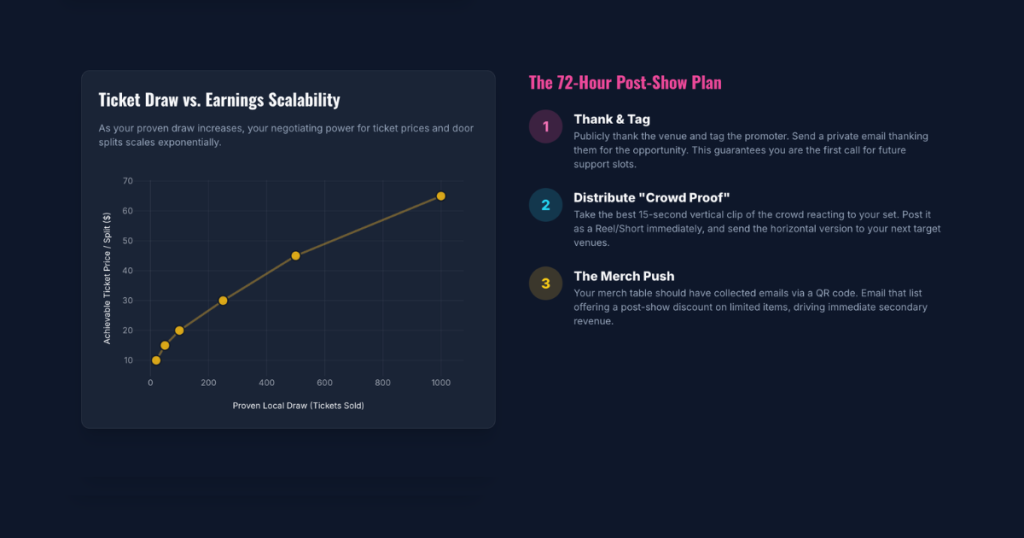
Post-Show Growth Plan: The 72-Hour Conversion Workflow
The booking cycle does not end when the stage lights are cut. To compound each performance into long-term career momentum, the artist’s team must execute a precise 72-hour operational workflow.
- Within 24 Hours – Relationship Reinforcement: The manager must send a personalized, professional thank-you email directly to the venue manager, talent buyer, and promoter, acknowledging the staff’s coordination and reinforcing positive relations. All post-show settlements should be balanced, documented, and compiled into the artist’s Master Market History Report.
- Within 48 Hours – Algorithmic Retargeting: Publish the best vertical recap video across TikTok, Reels, and Shorts, tagging the venue, the local support acts, and the promoter to capitalize on localized algorithm buzz. Run a highly targeted digital retargeting campaign, sending a direct email or SMS broadcast to all ticket buyers captured via the booking platform.
- Within 72 Hours – Funnel Optimization: Convert temporary live attention into permanent owned community members. Send a direct call-to-action to the captured mailing list, offering an exclusive unreleased audio download or early access to upcoming merchandise in exchange for fan reviews or feedback. Update the master EPK with any fresh live photos, updated draw metrics, and notable fan testimonials to prepare for the next round of venue pitches.
Conclusion: Paid Rap Shows Are Built Before the Show Starts
In 2026, learning how to get paid rap shows is not just about asking for a slot. It is about proving local demand, packaging the artist professionally, protecting the deal with written terms, selling tickets with precision, capturing the show as a media asset, and converting the crowd after the night ends.
The strongest independent artists treat every live date as a business unit. The venue gets proof of draw. The promoter gets reduced risk. The fans get a real-world experience. The artist gets revenue, footage, data, merch sales, and stronger leverage for the next booking.