
You’ve uploaded your latest track to SoundCloud. The artwork looks right, the song plays, and you’ve shared the link with everyone who helped make it.
A few people listen. Someone leaves a comment. Another artist reposts it. You start working on the next track.
But there’s a question worth asking before your catalogue gets any bigger.
Is SoundCloud the only place you want people to find your music?
Not because there’s something inherently wrong with SoundCloud. For many independent musicians, it remains a valuable place to share recordings, connect with other artists and introduce unfinished or newly released material to listeners.
The issue is treating one upload as your entire release strategy.
A SoundCloud link can be useful, but it doesn’t automatically create a presence on other music platforms. A private YouTube Music upload won’t release your song publicly. A Bandcamp storefront serves a different purpose from a streaming app, and uploading through a distributor is different again.
If you’re looking for SoundCloud alternatives in 2026, the most important question isn’t which website has the longest feature list.
It’s what you want to happen after someone presses play.
Do you want more places for listeners to discover your recordings? Somewhere to sell downloads? A dedicated artist profile? A platform that supports DJ mixes? Or another public music catalogue that doesn’t require a record-label agreement?
Those are different goals, and the right upload destination depends on which one matters to you.
If you’re ready to give your next release another public home, BeatsToRapOn lets independent artists upload music free, with up to ten total tracks on its free account and eligible releases connected to the BTR Music listener app.
But it’s worth understanding the alternatives before deciding where your music belongs.
SoundCloud Is a Platform. It Isn’t Your Entire Release Strategy.
SoundCloud’s appeal is straightforward. You can upload original audio, create a track page, share a link and participate in a music community that has helped many independent artists reach their earliest listeners.
The platform advertises 180 minutes of free uploads, with different allowances and tools available through its subscription tiers. It also supports features such as waveform comments, reposts, private links and embedding audio on external websites.
Those tools make it useful for several different stages of an artist’s career.
You might upload a demo to collect feedback, publish a finished song or share a private recording with someone you hope to collaborate with.
The problem isn’t the upload itself. It’s assuming that publishing on SoundCloud automatically puts your music everywhere else.
It doesn’t.
Your SoundCloud track isn’t automatically a public release on Bandcamp, Audiomack, BTR Music or Spotify. Each destination has its own submission process, metadata, rules and listening experience.
That doesn’t mean you should abandon SoundCloud.
It means your next move might be adding another destination rather than replacing the one you already use.
The Real Question: What Are You Missing?
Think about your latest release.
If someone likes it, can they easily find your artist profile and explore your other tracks? Can they listen through the music app they already use? Is there a clear way to support your work? And does the platform fit the kind of music you actually create?
If the answer is yes, SoundCloud may already be doing what you need.
If the answer is no, adding a complementary upload platform might solve a specific problem.
For an artist releasing hip-hop, trap, R&B, Afrobeats or electronic music, a second music destination could provide a different discovery experience and a separate place to build an artist catalogue.
For somebody selling complete albums and merchandise, a storefront could be more important.
A DJ uploading long mixes may need an entirely different service from a vocalist publishing three-minute singles.
This is why comparing music platforms solely by their free upload allowance misses the bigger picture.
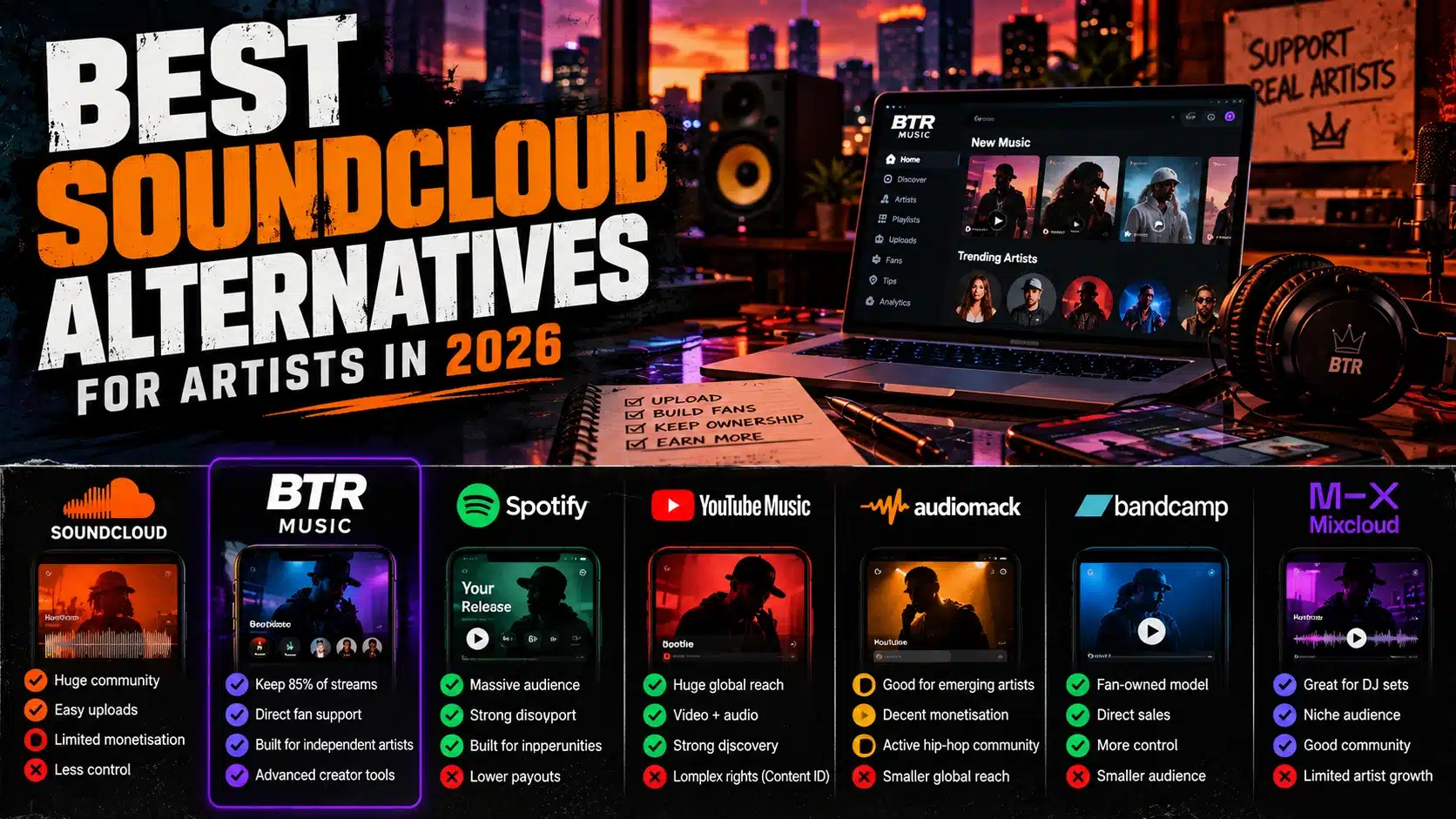
Six SoundCloud Alternatives Worth Considering in 2026
The following platforms serve different purposes. They are not interchangeable, and none can guarantee an audience.
| Platform | Free upload offering | Main purpose |
|---|---|---|
| BeatsToRapOn / BTR Music | Up to 10 total tracks | Direct music publishing, artist profiles and connected streaming |
| Audiomack | Unlimited music uploads | Music sharing, discovery and mobile listening |
| Bandcamp | Free artist account; fees on sales | Selling music, merchandise and supporting artist storefronts |
| Audius | Unlimited tracks; 2 GB per-file limit | Direct music sharing within the Audius ecosystem |
| Mixcloud | 10 published shows and 10 published tracks on Basic | DJ shows, mixes and longer-form audio |
| SoundCloud | Advertises 180 minutes of free uploads | Music sharing, feedback and creator communities |
These offerings are based on the platforms’ published documentation in October 2026. Features, limits and fees may change, so check the current service terms before uploading.
The table helps with the initial comparison, but it doesn’t tell you which platform is right for your music. For that, you need to understand how each one works.
1. BeatsToRapOn and BTR Music: When You Want Another Public Home for Your Songs
Most independent artists don’t need another private folder containing their recordings.
They need somewhere listeners can actually hear the music, identify the artist and find the next release.
That’s the problem BeatsToRapOn is designed to address.
BeatsToRapOn is the artist-facing publishing platform. Musicians create their profiles, manage recordings, upload original tracks and maintain their catalogue through an artist workspace.
BTR Music is the connected listener-facing platform, available through its supported iPhone and Android apps.
Approved, public and eligible recordings can become available to BTR Music listeners without requiring the artist to upload the same track through a second BTR account.
This is a different proposition from simply uploading audio to a file-sharing service.
What Happens When You Upload Music to BTR?
You begin by creating an artist account and completing your public identity. That includes your artist name, profile image and biography.
You then open the track workspace, select your finished audio recording and add the relevant release information.
A proper track title, original artwork, accurate genre and contributor credits help establish the recording as part of a catalogue rather than an anonymous file.
The track goes through the applicable review and approval process. Once it’s approved and published, the public release page becomes a listening destination you can share.
Eligible published music can also be available through BTR Music.
The free artist account currently supports up to ten total tracks. Artists who need a larger catalogue can explore Artist Pro, which offers unlimited uploads and additional artist tools.
Why Would a SoundCloud Artist Add BTR?
Consider a producer with eight completed tracks already published on SoundCloud.
Those releases have their SoundCloud URLs, comments and existing listening history.
The producer doesn’t have to delete them to publish the same original recordings elsewhere, provided the artist controls the necessary rights and there are no relevant exclusivity restrictions.
They can build a separate BTR catalogue, giving listeners another public destination.
That’s the practical opportunity.
Instead of sending every fan to one service, the artist can establish a presence in another music ecosystem while preserving existing SoundCloud activity.
BTR also provides supported direct-to-fan products and qualifying streaming earnings for eligible artists, subject to its terms. These are opportunities rather than guaranteed payments.
Where BTR Is Not the Right Solution
If your only goal is automatic delivery to Spotify, Apple Music and other external streaming services, a BTR direct upload is not a substitute for a music distributor.
BeatsToRapOn publishes into its own ecosystem. External DSP delivery requires separate distribution arrangements.
And if you need to upload more than ten total tracks without a subscription, another platform’s free allowance may better match that requirement.
Best for: Independent artists who want a public music catalogue, connected listener app, recognisable artist identity and another direct-upload destination.
Start here: Upload Music Free on BeatsToRapOn.
2. Audiomack: When You Want Free Unlimited Music Uploads
Audiomack is one of the clearest direct-upload alternatives to SoundCloud.
The platform allows artists to upload music themselves and presents recordings through its website and mobile listening apps.
According to Audiomack’s official creator documentation, artists can upload unlimited songs, albums and other supported audio content for free.
That’s an important difference for musicians who produce frequently.
If you’re releasing several demos every week, building a large instrumental catalogue or maintaining numerous versions of your own original recordings, a track-count or upload-duration limit can become inconvenient.
Audiomack’s unlimited free upload offering addresses that particular constraint.
The platform also provides creator analytics and a mobile creator app. Eligible artists may be able to participate in its monetisation programme under the relevant rules.
What Audiomack Doesn’t Automatically Solve
Unlimited uploads don’t mean unlimited listeners.
Your music still needs accurate metadata, an appropriate presentation and promotion to relevant audiences.
Monetisation is also separate from simply being allowed to upload. Artists must meet the programme’s eligibility requirements rather than assuming every stream automatically produces a payment.
Audiomack is particularly worth evaluating if you make music associated with its active audience communities, including hip-hop and Afrobeats.
But the best way to assess its usefulness is to publish an eligible original track, test the public listening experience and observe whether your existing audience actually uses it.
Best for: Artists who want unlimited free direct uploads and an established music-sharing environment.
Official platform: Audiomack for Creators.
3. Bandcamp: When You Want Fans to Buy Your Music
Bandcamp approaches independent music from a different angle.
Rather than concentrating exclusively on getting another stream, the platform helps artists publish music and offer it for sale.
That makes it particularly relevant for musicians who create albums, EPs, collections, physical releases or merchandise.
Artist accounts are free, but Bandcamp takes a share of applicable sales.
As of October 2026, its published fees include 15% on digital items and 10% on physical merchandise, plus separate payment processing fees. Its digital revenue share can fall to 10% when the artist reaches the specified sales threshold.
Those are business-model differences worth understanding before comparing platforms.
When Bandcamp Makes More Sense Than SoundCloud
Imagine you’ve produced a twelve-track instrumental album.
Some listeners simply want to stream it. Others may want to purchase the recordings, download higher-quality files or support the project through a direct transaction.
Bandcamp provides an artist-storefront experience designed around those kinds of relationships.
A SoundCloud track page serves a different role.
Neither approach is automatically superior.
They address different listener behaviours.
For artists building a catalogue, it may make sense to keep streaming destinations while also offering particular projects for sale.
Don’t Upload an MP3 Expecting Bandcamp to Treat It Like Every Other Music Site
Bandcamp’s audio preparation requirements differ from those of some direct-upload streaming platforms.
It expects suitable lossless audio files for music submissions, so check its accepted formats before preparing a release.
That is one reason keeping a high-quality original master is useful: it gives you flexibility when publishing on different platforms.
For a detailed cross-platform checklist, read Music Upload Requirements: Audio Formats and Cover Art.
Best for: Artists who want to sell digital music, albums and merchandise through a dedicated storefront.
Official platform: Bandcamp for Artists.
4. Audius: When You Want an Additional Direct-Upload Music Community
Audius is another platform where artists can upload and share music directly.
Its official help documentation states that there is no track-count limit for creator uploads, with a current maximum file size of 2 GB per upload.
That makes it relevant to producers who want another public music destination without managing a small free-track allowance.
The main question is whether the listening community and platform experience suit your particular music.
A service can provide generous storage and still be a poor fit for an artist’s audience.
Before moving a substantial catalogue, try the actual workflow with one finished track.
Create a profile, upload the recording, review its public presentation and share it with a few existing listeners.
Notice whether the platform helps people identify your music and whether the listener experience works as expected.
You don’t need to make a permanent decision based on a feature comparison table.
Best for: Artists interested in additional direct publishing and a music community beyond the largest established upload services.
Official platform: Audius.
5. Mixcloud: When Your Music Is a DJ Set, Not Just a Single
A producer uploading a three-minute song has different needs from a DJ publishing a two-hour club mix.
That distinction matters because long-form recorded mixes may include numerous third-party tracks and different rights considerations.
Mixcloud has built much of its offering around DJ shows, radio-style programming and longer audio sessions.
According to its official publishing-limit documentation, Basic creators can currently have ten published shows and ten published tracks, with paid plans offering broader creator features.
For a DJ who regularly publishes recorded sets, Mixcloud is therefore worth investigating.
Should You Upload DJ Mixes to BTR Instead?
BeatsToRapOn also supports full-length DJ mixes through a dedicated upload route.
That means the choice is not necessarily between a standalone song platform and a service dedicated exclusively to mixes.
However, DJ mixes have different publishing and monetisation rules from original individual songs.
BTR’s current guidance distinguishes DJ mixes containing third-party music and excludes unlicensed mixes from streaming and direct-fan payouts. Artists must follow applicable rights and platform requirements.
A DJ should not assume that because a service accepts an uploaded mix, every included recording is cleared for every commercial use.
Read the Full-Length DJ Mix Upload Guide before submitting a recorded set.
Best for: DJs, radio-show creators and musicians working primarily with long-form recorded sessions.
Official platform: Mixcloud.
6. YouTube: Useful for Music Promotion, but Don’t Confuse It With YouTube Music Uploads
YouTube is another place independent artists can publish original music-related content.
You might create an official music video, visualiser, live performance or other supported video format and publish it on your channel.
That gives people a public video destination.
However, there’s an important difference between publishing a video to YouTube and uploading an audio file into your personal YouTube Music library.
Personal YouTube Music Uploads Are Not Public Artist Releases
YouTube Music allows users to upload personal audio files into their own libraries.
According to Google’s official documentation, these uploads can only be played by the account holder. Other YouTube Music listeners cannot access those personal uploads as publicly published artist recordings.
This is a common source of confusion when artists search for ways to upload music online.
A private library feature is not the same as a public music release.
If you want formal distribution of recordings to YouTube Music and other external DSP catalogues, you need to follow the relevant authorised delivery process.
Where YouTube Fits Into an Independent Release
Imagine you’ve published your song on BTR.
You could then create a short performance video, behind-the-scenes recording clip or properly licensed visualiser for YouTube.
The video might introduce someone to your work, while the BTR release page provides another destination to hear the recording and explore your catalogue.
The two services can complement one another without pretending they do exactly the same job.
Best for: Public music videos, performances, visualisers and promotional content.
Official platform: YouTube.
What About Spotify and Apple Music?
Neither should be presented as an ordinary direct-upload alternative to SoundCloud.
For conventional audio-music releases, Spotify requires delivery through a label or music distributor. Spotify’s artist documentation explicitly describes distributors as the route for getting recordings onto the service.
Apple Music also relies on approved delivery relationships for music-catalogue distribution.
The distinction is important because artists often search for “upload music” when they actually mean “deliver my song to Spotify.”
Those searches represent a different task.
If Spotify is your primary destination, start with How to Upload Music to Spotify and compare distribution services.
If you want another direct-upload listening destination in addition to those services, BTR is worth considering separately.
A music distributor and a direct-upload platform can both be part of an independent release strategy. One doesn’t automatically replace the other.
Don’t Choose Your Music Platform Solely by How Many Tracks It Lets You Upload
Free limits make useful comparison points, but they can also distract from the purpose of publishing music.
Suppose one platform offers unlimited uploads while another supports ten tracks on its free account.
The unlimited option may be attractive if you’re producing a hundred instrumentals.
But if you’ve only completed three songs, storage capacity may not be your most important problem.
You may instead need a complete artist profile, accurate credits, consistent artwork and a way to introduce the recordings to listeners.
The value of a platform depends partly on the job you need it to perform.
Three Artists, Three Different Decisions
The beat producer: Has seventy short instrumentals and wants to publish frequently. An unlimited direct-upload platform could be an excellent fit, especially for testing new work with listeners.
The independent singer: Has four finished singles and wants to build a recognisable public catalogue. The quality of the artist profile, listener experience and release presentation may matter more than a very large upload allowance.
The DJ: Records weekly two-hour sets featuring music from other artists. The service’s approach to long-form shows, rights and mix management may be the deciding factor.
None of those artists has the same requirements.
The mistake is choosing a platform because it advertises the biggest number rather than because it helps you publish the kind of music you actually create.
Should You Delete Your SoundCloud Tracks Before Uploading Elsewhere?
Usually, you don’t need to delete your existing recordings simply because you want to publish them through another service.
However, check the agreements that apply to your music.
If you’ve signed an exclusive licensing deal or agreed to other restrictions, those conditions may affect where and how a recording can be published.
For independently owned original music without relevant exclusivity restrictions, maintaining multiple authorised public destinations can be a practical strategy.
Don’t Expect Your Existing Stats to Move
Uploading the same recording to a different platform typically creates a new release entry within that service.
The SoundCloud comments, reposts and listening statistics associated with the existing upload don’t automatically transfer to your new track page.
Treat the additional upload as a separate public destination.
Keep the release title, artist name and artwork consistent where appropriate, and make sure the metadata accurately identifies the recording.
If you create a new version or remaster, identify it properly rather than implying it’s the same file when it isn’t.
Keep Your Existing Links Working
If people already use your SoundCloud links, consider leaving those releases available while you develop your additional catalogue.
You don’t need to remove a working listening destination to create another one.
For a young independent artist, the more useful objective is often giving people clear, reliable places to find the music.
How to Publish Your Next Song on BTR Without Leaving SoundCloud
Suppose your next single is finished and you’re ready to introduce it to listeners through another music platform.
Here’s a practical release workflow.
Prepare the Recording
Choose the final version of the song and listen to it from beginning to end.
Check the opening, ending, mix, master and any samples or featured performances. Make sure you have the necessary rights to publish the recording.
Retain your original audio export and any supporting licence documents.
Prepare the Artwork and Identity
Use a consistent artist name and a distinctive square cover image that represents your recording.
Prepare a meaningful artist biography and public profile image.
Custom artwork and profile completeness also matter for certain BTR discovery eligibility requirements.
For more detail, read Album Artwork Requirements.
Upload Through BeatsToRapOn
Visit Upload Music Online Free and create a free artist account, or sign in if you’ve already registered.
Open the track workspace, submit your finished audio and complete the requested title, genre, credits and artwork information.
BTR’s free account currently supports up to ten total track uploads.
Submit the track for the applicable review process.
A successful upload doesn’t necessarily mean the song has become public, so check its status before announcing it.
Check the Release From a Listener’s Perspective
Once approved and published, open the public page on a device where you’re not signed into the artist workspace.
Make sure the recording plays properly, the artwork displays correctly and the artist name matches your release information.
Approved and eligible tracks can also become available through the connected BTR Music app.
Keep Your SoundCloud Link and Add Your New Destination
Your SoundCloud recording can continue serving its existing audience, provided your rights and agreements allow it.
The BTR page gives the song another public home.
You can then direct interested listeners to the destination that suits the particular announcement or audience.
For a detailed walkthrough of the BTR-specific process, read How to Upload Music to BTR Music.
The Mistake to Avoid: Uploading Everywhere but Building Nothing
It’s tempting to believe that putting a recording on six music platforms automatically creates six audiences.
It doesn’t.
You could publish the same song through several services and still struggle to reach people who genuinely care about your music.
The reason is simple: an upload creates availability, not automatic attention.
A stronger approach is to build a recognisable artist identity across the places you choose to publish.
Use the same stage name where possible. Keep your credits accurate. Make your artwork distinctive and consistent. Give your releases real titles and descriptions that help people understand the music.
Then promote the work itself.
Show how the recording developed. Share a live performance. Demonstrate an unusual instrumental sound or explain the story behind a lyric.
Those creative choices give listeners something worth paying attention to.
Don’t Send Fans to a Broken or Private Link
Before publishing promotional posts, test your public music links.
A SoundCloud private link, an unapproved BTR track and a personal YouTube Music upload do not necessarily provide the same access to listeners.
Make sure the destination is public and available to the intended audience.
The last thing you want is someone becoming interested in your music and finding a page they cannot play.
Don’t Mistake Artist Monetisation for Guaranteed Income
Different platforms offer different ways to earn money.
Some focus on music sales, some provide eligible streaming programmes, and some support direct payments or fan relationships.
But free uploading doesn’t guarantee revenue.
On BTR, qualifying streaming earnings and supported fan products follow their own eligibility rules. Artists need to satisfy the relevant requirements rather than assuming every uploaded track or play automatically generates a payment.
For more about these possibilities, read How to Make Money From Music Fans.
SoundCloud Alternatives: Frequently Asked Questions
What is the best free SoundCloud alternative for artists?
It depends on your objective. Audiomack and Audius provide unlimited direct music uploads under their published policies. BeatsToRapOn offers up to ten free track uploads with artist profiles and eligible BTR Music availability. Bandcamp is particularly useful for music sales, while Mixcloud is relevant to DJ shows.
Where can I upload music besides SoundCloud?
Independent artists can upload original music to direct-publication platforms such as BeatsToRapOn, Audiomack and Audius, subject to each service’s requirements. Bandcamp offers an artist storefront, while other destinations serve different purposes.
Is there a SoundCloud alternative with unlimited free uploads?
Audiomack advertises unlimited music uploads, and Audius currently states that it has no limit on the number of tracks artists can upload. Check their current file-size, content and account policies before preparing a large catalogue.
Can I upload my music to BeatsToRapOn for free?
Yes. A free BeatsToRapOn artist account currently supports up to ten total track uploads. You can start uploading music here.
Can I keep my music on SoundCloud and publish it on BTR?
Generally, yes, if you hold the necessary rights and no relevant exclusivity agreement prevents it. Publishing to BTR creates a separate public release in its own ecosystem rather than transferring your SoundCloud statistics.
Does uploading to BeatsToRapOn put my music on Spotify?
No. BTR is a direct-upload artist platform connected to BTR Music. Conventional Spotify audio delivery requires an authorised music distributor or label arrangement.
Is Bandcamp better than SoundCloud?
They are designed for somewhat different purposes. Bandcamp is particularly useful for selling music and merchandise, while SoundCloud emphasises audio sharing and its creator community. An independent artist may use both.
Is uploading music to YouTube Music the same as releasing it publicly?
No. Google’s personal-library music upload feature stores audio for the uploader’s own listening. It does not publish the songs as public artist releases for other YouTube Music users.
Do I need a record label to upload songs online?
No. Many platforms allow independent artists to upload original recordings directly. You still need the necessary rights and must follow the service’s publishing requirements.
What should I upload first if I’m just starting?
Start with one finished recording that represents your sound. Prepare its artwork, credits and artist profile properly, publish it through an appropriate platform and verify the public listening experience before promoting it.
Your Next Release Doesn’t Need to Live in Only One Place
SoundCloud remains useful for independent musicians. It provides straightforward audio publishing and an established creator environment.
But it doesn’t have to be the only destination for your catalogue.
Audiomack may suit artists who want unlimited uploads and another music-sharing community. Bandcamp can help musicians offer recordings for sale. Audius provides another direct-upload ecosystem, and Mixcloud is especially relevant to creators publishing DJ shows and mixes.
For artists who want another public music catalogue connected to a dedicated listener app, BeatsToRapOn provides a direct-upload route into the BTR Music ecosystem.
The important thing is to choose deliberately.
You don’t need to abandon every platform you’re already using.
You need to understand what each additional destination gives your music—and what it doesn’t.
Finish the recording. Prepare the release properly. Check your rights. Build a recognisable artist identity, and give listeners a clear place to hear the result.
Upload Music Free on BeatsToRapOn →
Create your artist account, publish up to ten total tracks free, and start building another home for your original music through BeatsToRapOn and BTR Music.
Your SoundCloud link can be one part of your music career. It doesn’t have to be the whole plan.