
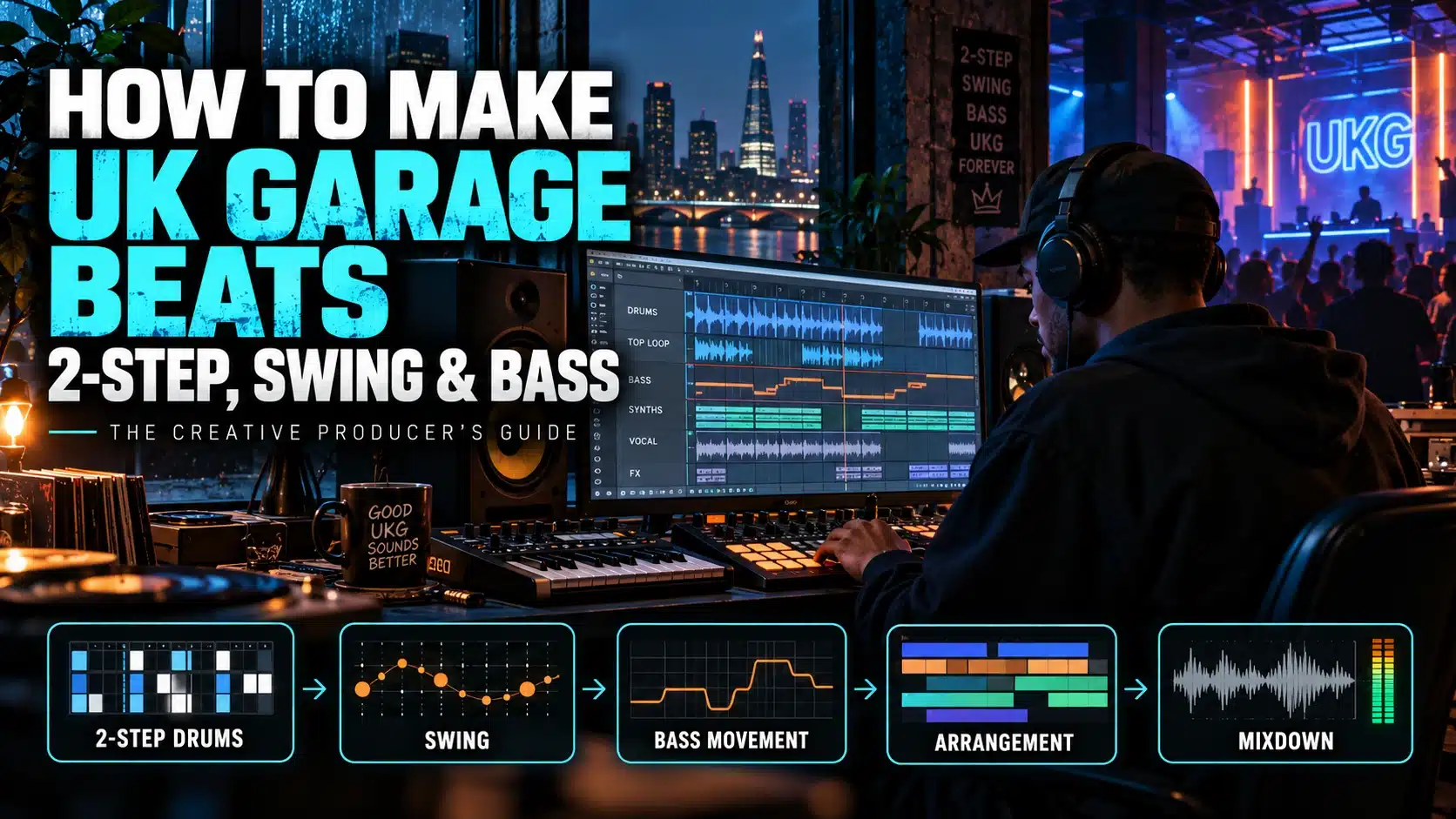
Take a house track running at 132 BPM.
Keep the tempo exactly where it is. Leave the bassline, the synthesiser and the vocal untouched. Now remove two of the four kick drums in each bar, reposition one of the remaining kicks and introduce some swing into the percussion.
Something interesting happens.
The track hasn’t become faster. You haven’t added a more powerful bass sound or increased the volume. In fact, you’ve removed some of the energy-producing elements.
Yet the rhythm can suddenly feel more restless, more playful and more alive.
That’s one of the most fascinating things about UK garage: sometimes the missing kick does more work than the one you played.
As electronic producers look beyond predictable four-on-the-floor arrangements, UK garage and its faster relatives have become an important part of the contemporary dance music conversation.
The Splice × MIDiA Sounds of 2026 report identified speed garage among the uptempo electronic styles experiencing triple-digit growth in sample activity. Meanwhile, Beatport continues to publish dedicated UK Garage/Bassline charts, reflecting an active community of DJs and producers.
These signals don’t guarantee streaming success, but they demonstrate meaningful interest in the music.
The interesting question isn’t why producers are revisiting UK garage.
It’s why a rhythmic idea developed decades ago still sounds so distinctive when much of electronic music uses the same software, samples and production tools.
The answer starts with the drums.
UK Garage Doesn’t Fight the Grid. It Plays Around It.
House music often builds its rhythmic foundation around four evenly spaced kick drums per bar.
The structure is predictable in the best possible way. The pulse gives dancers a consistent point of reference, while basslines, percussion and melodies create variation around it.
UK garage takes many of those ingredients and rearranges their rhythmic relationships.
Some garage styles keep the four-on-the-floor pulse. Others use syncopated kick drums that leave gaps where a listener expects a beat to land.
Those gaps create anticipation.
The snare arrives, but the kick doesn’t necessarily accompany it. A shuffled hi-hat moves against the main pulse. The bassline answers a rhythmic phrase that has already finished.
Everything feels connected, but the elements aren’t necessarily playing at the same time.
That’s what creates the characteristic bounce associated with much of UK garage.
Where the UK Garage Sound Came From
UK garage developed through Britain’s club culture during the 1990s, building on American garage house and drawing from musical influences including jungle, R&B, reggae, dancehall and the UK’s sound-system traditions.
Producers and DJs transformed those influences into something distinctive, developing sounds that ranged from soulful vocal garage to darker bass-heavy records and intricately programmed 2-step.
Artists and producers associated with the genre’s evolution include MJ Cole, Todd Edwards, Artful Dodger, Wookie, Tuff Jam, Zed Bias and many others.
The music also played an important role in the development of grime, dubstep and subsequent UK bass styles.
Its influence extends far beyond records explicitly labelled garage.
What makes that history especially interesting for today’s producers is that the genre wasn’t defined by one synthesiser or particular drum-machine preset.
It developed through decisions about rhythm, sampling, sound systems and the interaction between different musical traditions.
Those decisions remain relevant in modern production.
What Is a 2-Step Garage Beat?
A 2-step garage beat is a form of UK garage rhythm characterised by syncopated kick placement, a prominent backbeat and shuffled supporting percussion.
Unlike a conventional four-on-the-floor house pattern, a 2-step groove doesn’t require a kick on every quarter note.
It often leaves deliberate gaps in the low-frequency rhythm, giving the snare, hi-hats and bassline additional room to shape the groove.
A typical production tempo might fall around 128–135 BPM, although the wider UK garage family includes both slower and faster tracks.
The important distinction is the rhythmic arrangement, not one specific tempo.
Build a 2-Step Drum Pattern From Scratch
Here’s a simple exercise you can recreate in Ableton Live, FL Studio, Logic Pro or another digital audio workstation.
Set the tempo to 132 BPM and create a one-bar MIDI drum pattern in 4/4.
Begin with this eight-position grid. Each column represents an eighth-note position.
| Sound | 1 | & | 2 | & | 3 | & | 4 | & |
|---|---|---|---|---|---|---|---|---|
| Kick | X | — | — | — | — | X | — | — |
| Snare | — | — | X | — | — | — | X | — |
| Closed hat | — | X | — | X | — | X | — | X |
Play the pattern without any bass or melody.
Notice where the second kick arrives. Rather than reinforcing every quarter note, it enters on the offbeat after beat three.
That placement creates a different sense of movement from a conventional house rhythm.
The snare still provides a familiar backbeat, but the kick rhythm leaves space around it.
Now duplicate the pattern into a second bar and change the position of one kick.
You might move the second kick one sixteenth-note earlier or introduce a quiet additional kick before a snare.
The pattern begins developing its own phrasing.
This is a learning exercise, not a definitive historical 2-step pattern. UK garage rhythms vary considerably, and some tracks use more elaborate kick placements or different backbeat structures.
The objective is to hear how syncopation transforms the rhythm without changing the tempo.
Why 132 BPM Can Feel Completely Different in House and UK Garage
Imagine two tracks playing at exactly 132 BPM.
The house record has a kick on every quarter note. The rhythm feels stable, direct and continuous.
The UK garage record leaves gaps in the kick pattern, while swung hi-hats and additional percussion create rhythmic movement around those gaps.
The listener still experiences the same overall musical tempo.
But the internal rhythm creates different expectations.
That difference is why simply increasing the BPM of a house track doesn’t automatically produce a convincing UK garage record.
You can make the kick faster without creating the characteristic rhythmic language.
Conversely, you can create an energetic garage groove at a moderate tempo through note placement and swing.
The Four-on-the-Floor Comparison Test
Create two versions of the same sixteen-bar instrumental.
For Version A, use a standard four-on-the-floor house kick.
For Version B, remove selected kicks and introduce a 2-step-style pattern.
Keep the bass sound, harmonic progression and approximate overall loudness unchanged.
Listen to both versions.
The first may provide stronger rhythmic stability. The second may create more movement and anticipation, especially when the supporting percussion works around the missing kick drums.
Neither is automatically better.
The point is to understand how rhythmic structure changes the musical character of an otherwise similar arrangement.
That distinction becomes useful when you start building basslines and vocal parts.
Swing Isn’t a Button That Makes Everything Sound Better
One of the most recognisable characteristics of UK garage is its shuffled rhythmic feel.
Producers often describe this as swing.
In a simple straight rhythm, notes are placed at mathematically even subdivisions of the beat.
Swing changes the relative timing of selected subdivisions, creating a long-short relationship or a more relaxed sense of movement.
But swing is not one universal setting.
Different DAWs represent swing amounts differently, and different quantisation systems apply timing changes in different ways.
A swing setting that sounds effective on closed hi-hats may create undesirable timing when applied indiscriminately to every element.
The 16th-Note Swing Experiment
Start with a straight sixteenth-note hi-hat pattern.
Keep the kick and main snare unchanged.
Apply a modest amount of swing to the hats.
Listen to how the groove changes.
Now gradually increase the swing amount.
At some point, the percussion may begin to sound exaggerated or disconnected from the kick and snare.
Reduce the setting until the relationship feels coherent again.
Next, try applying similar timing changes to a separate shaker or rimshot pattern.
You may discover that different percussion layers benefit from different rhythmic treatments.
That’s important.
The goal isn’t maximum swing. It’s coordinated movement.
Velocity Matters as Much as Timing
A perfectly timed hat pattern can still feel mechanical when every note has the same velocity.
Try accenting selected hits while reducing the velocity of the others.
Use small changes rather than randomising every note.
A high-frequency percussion pattern can produce a convincing shuffle through the relationship between timing, velocity and silence.
This is one reason great garage rhythms often remain interesting even when the arrangement contains relatively few sounds.
The detail is in the performance of the groove, not simply the number of instruments.
Speed Garage: The Branch That Never Needed to Lose the Kick
Here’s where things become more interesting.
Not every UK garage track uses a broken 2-step kick pattern.
Speed garage often retains a driving four-on-the-floor rhythm, while introducing heavier basslines, shuffled percussion and other elements associated with UK bass music.
Its roots connect to the faster, bass-heavy garage records and remixes circulating through British clubs during the 1990s.
In contemporary production, speed garage can feel like a collision between the rhythmic consistency of house and the restless, bass-focused energy of UK electronic music.
A producer might keep all four kicks, then use aggressive Reese bass movement, pitched vocal fragments and syncopated hats to create a noticeably different feel from conventional house.
That distinction matters because UK garage is a family of related styles, not one drum pattern.
UK Garage, Speed Garage and Bassline Compared
| Style | Typical characteristics | Useful production focus |
|---|---|---|
| 2-Step Garage | Broken kicks, shuffled hats, R&B influences, syncopated percussion | Swing and rhythmic space |
| Speed Garage | Driving kicks, strong low end, bass movement and garage shuffle | Kick/bass interaction |
| Bassline | Prominent characterful bass phrases, strong club rhythms and UK regional influences | Bass sound design |
| Vocal Garage | Soulful or chopped vocals, rhythmic swing and melodic arrangements | Vocal and groove relationship |
| Breakbeat / UK Bass | Broken rhythms, bass experimentation and a wider range of electronic influences | Rhythmic variation |
These categories overlap. An individual recording may combine elements from several styles.
If your track emphasises bassline or 2-step characteristics, explore Upload Bassline & 2-Step Music.
For more experimental broken-beat productions, see Upload Breakbeat & UK Bass Music.
The wider UK Garage catalogue also provides the dedicated BTR genre destination.
Why Speed Garage Is Relevant Going Into 2027
Electronic music production is becoming increasingly fragmented.
There is no single electronic style that defines every club, region or audience.
Some producers are exploring melodic house and atmospheric sounds. Others are moving towards harder, faster and more rhythmically intense records.
The 2026 Splice × MIDiA research highlights this split.
The report identifies significant growth in Afro house while also documenting strong momentum in harder uptempo genres, including speed garage, hard techno and jump-up drum and bass.
This is particularly interesting because those styles don’t all share the same musical philosophy.
A melodic Afro house record and an aggressive speed garage production might both be intended for dancing, yet their musical structures and emotional effects can be entirely different.
For independent producers, the opportunity isn’t necessarily to abandon one sound and follow another.
It’s to understand the musical ideas generating renewed creative interest.
Speed garage demonstrates how a familiar rhythmic foundation can be reinterpreted through tempo, bass sound design and arrangement.
That’s useful knowledge whether you make UK garage, house, breakbeat or drum and bass.
Your UK Garage Bassline Should Dance Around the Drums
A common production mistake is to build an excellent 2-step groove and then cover it with an enormous bassline that never stops playing.
The bass might sound fantastic in isolation.
But it occupies the gaps that gave the drums their character in the first place.
The result can feel surprisingly static.
Instead of treating the bass as a continuous low-frequency layer, think of it as another rhythmic instrument.
Start With a Simple Bass Sound
Use a sine, triangle or filtered sawtooth waveform.
Choose a short phrase that works with your drum pattern.
Avoid excessive processing initially.
Play the kick and bass together.
Where do they overlap? Where does the bass answer a missing kick? Which notes provide the strongest rhythmic movement?
Experiment with the lengths of the notes.
A short bass hit can create a different groove from a sustained note, even when both begin at the same position.
Use Silence Deliberately
Take a four-bar bass pattern.
Remove one note.
Listen again.
Does the gap create anticipation before the next bass phrase?
Now remove another.
At some point, the pattern may lose too much information. The exercise is to identify where the bassline has the strongest effect with the least unnecessary material.
This is particularly useful for 2-step and bassline-influenced music, where the relationship between drums and low-end phrases defines much of the groove.
Experiment With Reese Bass
Reese-style bass sounds, often built from detuned waveforms, can create a thick, moving low-frequency character.
They have a long history across jungle, drum and bass, speed garage and other electronic styles.
Try separating the clean sub-bass foundation from the more distorted upper harmonics.
This can provide additional control over the mix, particularly when the bass has aggressive movement or stereo processing.
For related sound-design ideas, explore the Drum & Bass upload category.
The genres are different, but the techniques used to control bass energy can overlap.
The Vocal Chop Problem: When Your Hook Is Someone Else’s Recording
UK garage has a distinctive relationship with vocals.
Soulful singing, chopped R&B phrases, pitched samples, short rhythmic fragments and MC performances are all part of the genre’s musical vocabulary.
A vocal can act as a conventional melody, but it can also function like percussion.
A syllable becomes a rhythmic accent.
A repeated phrase creates a hook.
An edited breath or fragment of a word introduces movement between the drums.
That flexibility is one of the genre’s strengths.
It also creates a copyright and identity problem for producers who rely too heavily on familiar sampled phrases.
Make the Vocal Part of the Rhythm
Try recording a short original vocal phrase.
It doesn’t need to be a complete verse or chorus.
A handful of words is enough for the exercise.
Place the phrase over your garage drum pattern.
Now slice it into smaller segments.
Move one syllable to an offbeat. Repeat another phrase at a different pitch. Remove part of the sentence to create space before the final word.
Listen to how the voice starts functioning as a rhythmic element rather than simply a melody placed over the instrumental.
The finished result may sound more distinctive because you’ve built the phrase around your actual groove.
Don’t Assume a Sample Is Cleared
A vocal extracted from a commercially released recording is not automatically free to use.
Neither is a phrase downloaded from a random online video.
Check the licence or obtain permission before releasing music that contains third-party material.
If you’re working with recordings you own or are authorised to process, tools such as the BTR AI Stem Splitter can support audio experimentation.
But separating vocals from a recording does not create permission to republish them.
For a detailed explanation of sample-based production, read How to Sample a Song.
Why Your Garage Track Sounds Too Clean
There is a difference between a professionally mixed recording and a recording where every element has been polished until it loses its character.
UK garage often benefits from rhythmic contrast, expressive percussion and distinctive textures.
That doesn’t mean you should introduce distortion, noise or timing problems indiscriminately.
It means that not every sound needs identical transient shaping, perfect quantisation or the same processing chain.
Let Different Elements Have Different Textures
A crisp digital snare can work alongside a rougher sampled hat.
A warm bassline may complement a bright vocal fragment.
A tightly programmed kick can provide stability while the supporting percussion has a looser timing feel.
These differences create contrast.
If every element sounds equally bright, equally compressed and equally wide, the arrangement may become less distinct.
Don’t Overcompress the Shuffle
Heavy compression can reduce the dynamic relationship between loud accents and quieter supporting percussion.
When that happens, the groove may lose some of its sense of movement.
Try balancing the individual drum velocities before applying more compression.
If a ghost note is too prominent, lower its velocity.
If a hat dominates the snare, adjust the level or frequency balance.
Processing should serve the musical result rather than replace basic arrangement decisions.
For further mixing advice, read How to Mix a Song.
The Two-Minute UK Garage Production Audit
Before finishing your track, run a short exercise.
It won’t tell you whether your release will become popular, but it can reveal problems that are difficult to hear after several hours of production.
First 30 Seconds: Drums Only
Mute the bass, vocals and melodic instruments.
Listen to the kick, snare and supporting percussion.
Can you clearly hear the intended rhythm? Does the swing sound coherent? Are the accents working together?
Next 30 Seconds: Introduce the Bass
Bring back the bassline.
Pay attention to the spaces between the kicks.
Does the bass support the groove, or does it fill every available gap?
Next 30 Seconds: Add the Vocal or Main Hook
Restore the vocal or central musical phrase.
Does it interact naturally with the rhythm?
If the vocal competes with the snare or makes the arrangement too busy, simplify one of the surrounding elements.
Final 30 Seconds: Listen to the Full Arrangement
Return all remaining sounds.
Listen without looking at your DAW.
What is the most distinctive element?
If you remove it, does the track lose its identity?
If the answer is yes, you’ve identified an important part of the song.
Make sure your arrangement gives that element enough space.
Where Should Independent UK Garage Producers Release Their Music?
Finishing a convincing groove is only one part of releasing an original recording.
You also need an accurate artist identity, release metadata, suitable artwork and a public destination where listeners can hear your music.
Different publishing platforms serve different purposes.
A music distributor can help deliver recordings to third-party streaming services under its distribution arrangements.
A direct-upload music platform provides another way to publish original recordings and build a catalogue.
BeatsToRapOn is an artist-facing platform connected to BTR Music, its listener streaming app.
Independent producers can create artist profiles, upload finished recordings and manage their releases through the BeatsToRapOn workspace.
Approved and eligible tracks can become available through BTR Music on supported mobile devices.
Upload UK Garage Music Free
A free BeatsToRapOn artist account currently supports up to ten total track uploads.
If you’ve completed your UK garage release, start with the dedicated page:
Upload UK Garage Music Free on BeatsToRapOn
Prepare your finished recording, original square cover artwork, accurate credits and any necessary licences or permissions.
Create or sign into your artist account, complete your profile and submit the track through the workspace.
After the applicable review process, you can share the public listening link once the recording is approved and published.
Artists who need larger catalogues can explore Artist Pro, which offers unlimited uploads and additional features.
Uploading to BeatsToRapOn does not automatically distribute your music to Spotify, Apple Music or other external DSPs. Those services require separate distribution arrangements.
For further details, review the BTR Music Upload Requirements.
Your Artwork Shouldn’t Look Like a Generic Dance Compilation
UK garage has always been closely connected to visual culture, fashion, nightlife and local scenes.
That gives independent artists considerable room to build a recognisable visual identity.
Your artwork might draw on typography, original photography, urban landscapes, abstract illustration or minimal graphic design.
The important thing is that it represents your music rather than relying on an interchangeable image used across unrelated releases.
For BTR, prepare an original, high-quality square image, ideally at least 1000 × 1000 pixels.
Make sure you have the rights to the visual material.
Your artist profile should also include a proper image and a meaningful biography.
Custom artwork and complete artist information matter for eligibility in certain BTR discovery features.
Read the Album Artwork Requirements Guide before publishing.
Promote the Groove, Not Just the Release Date
A generic promotional announcement tells people that your music exists.
A more effective creative approach may be to demonstrate why the music is interesting.
UK garage is particularly suitable for this because small rhythmic decisions can make dramatic differences to the listener’s experience.
Show the Missing Kick
Create a short video demonstrating the difference between a four-on-the-floor house pattern and your finished 2-step garage rhythm.
Start with the original drum loop.
Remove selected kicks.
Introduce the shuffled hi-hats.
Then bring in the bassline.
The listener hears the transformation instead of merely being told that the record is energetic.
Demonstrate the Vocal Chop
If your production uses an original vocal phrase, show how it develops from a complete recording into a short rhythmic hook.
Let listeners hear the original phrase followed by the edited version.
This can communicate your production process and musical identity.
Show How the Bassline Changes the Track
Play the drums by themselves.
Then introduce the bass.
If you’ve designed the rhythm carefully, the relationship between the two should be immediately noticeable.
This is a useful promotional idea because it demonstrates the sound rather than relying entirely on a generic visual effect.
Give Interested Listeners Somewhere to Go
Once your track is approved and publicly available, share its listening URL.
Make sure the cover artwork, artist name and profile are consistent with your promotional content.
Someone who enjoys the clip should be able to find the full recording without having to search across several unrelated pages.
You can explore the BTR AI Music Promo Maker for help preparing visual content.
UK Garage Production: The Questions That Matter
What BPM is UK garage?
Many UK garage records fall around 125–138 BPM, although specific styles vary. Classic 2-step is commonly produced around 130 BPM, while speed garage and bassline-related styles may use faster tempos.
How do you make a 2-step garage beat?
Begin with a 4/4 drum pattern, place the main snare accents on beats two and four, and use syncopated kick placements rather than a continuous four-on-the-floor kick. Add shuffled hi-hats and percussion, then adjust note velocities and timing to develop the groove.
What’s the difference between UK garage and house?
House commonly uses a steady four-on-the-floor kick, while UK garage includes styles with broken kick patterns, stronger swing, chopped vocals and different bassline approaches. However, speed garage and some other garage styles retain a four-on-the-floor foundation.
What’s the difference between UK garage and speed garage?
Speed garage is a related style commonly associated with driving four-on-the-floor rhythms, heavier basslines and faster, bass-focused garage production. UK garage is the broader family of styles that also includes 2-step and vocal garage.
Why does my UK garage beat sound too straight?
Common reasons include perfectly even percussion subdivisions, identical note velocities, overly predictable kick placement and a bassline that follows the kick without rhythmic variation. Experiment with controlled swing, syncopation and silence.
Do I need expensive plugins to produce UK garage?
No. A capable digital audio workstation and basic instruments are enough to create UK garage. Drum programming, timing, sound selection and arrangement have a greater influence on the groove than any particular plugin brand.
Can I use vocal samples in UK garage?
Yes, when you own or have the necessary rights to publish the material. A vocal extracted from another recording is not automatically cleared for commercial use.
Can I upload UK garage music for free?
Yes. BeatsToRapOn currently allows up to ten total track uploads through a free artist account, subject to approval and platform rules. Visit the UK Garage Music Upload Page.
Can I release UK garage without a record label?
Yes. Independent producers can publish original recordings through appropriate platforms, provided they hold the necessary rights and meet the relevant publishing requirements.
Does BeatsToRapOn put my UK garage track on Spotify?
No. BeatsToRapOn publishes within its own artist and listening ecosystem. Spotify and other external DSPs require separate distribution arrangements.
The Beat You Leave Out Might Be Your Best Production Decision
It’s easy to assume that more sounds create more energy.
A bigger kick. Another bass layer. An additional percussion loop. A louder master.
But UK garage demonstrates something more interesting.
The rhythm becomes compelling when the instruments are allowed to interact.
A missing kick creates space for the bass.
A shuffled hat changes the way the snare feels.
A vocal fragment becomes part of the percussion.
A short silence makes the next sound more important.
None of those decisions requires extraordinary equipment.
They require listening, experimentation and understanding how rhythmic elements affect one another.
That’s what makes UK garage such an interesting genre to produce.
Its foundations are familiar, but the possibilities for rhythmic interpretation remain enormous.
Whether you’re creating soulful 2-step, aggressive speed garage or experimental UK bass, the most important task is developing a sound that belongs to you.
And when the track is finished, don’t leave it sitting in your project folder.
Give it proper artwork, accurate credits and an artist identity that listeners can recognise.
Then release it.
Upload UK Garage Music Free on BeatsToRapOn →
Create your artist profile, upload up to ten tracks free and build your independent UK garage catalogue through BeatsToRapOn and the connected BTR Music ecosystem.
Sometimes the beat that changes everything is the one you decided not to play.