
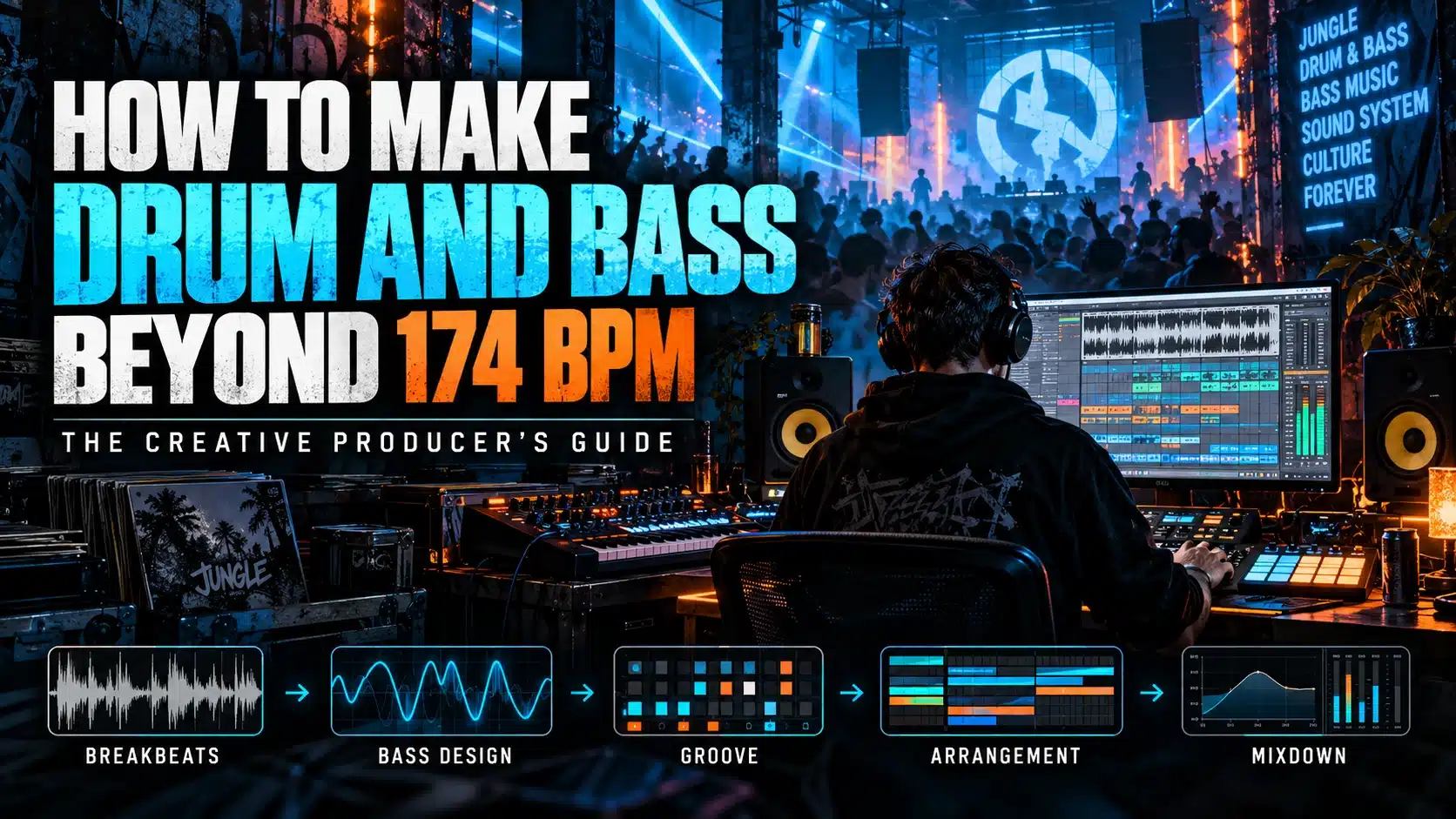
Open a new project in your DAW. Set the tempo to 174 BPM, program a kick and snare, add a rolling breakbeat and put a huge sub-bass underneath it.
Technically, you’ve already assembled the foundations of drum and bass.
But something still doesn’t sound right.
Your drums are fast, yet the track doesn’t feel energetic. The bass is enormous, yet the groove feels strangely empty. You add another break, another distortion plugin and another synthesiser layer, but the result becomes louder rather than more exciting.
The problem isn’t your tempo. It’s what happens between the beats.
That distinction is one of the most important lessons in drum and bass production. A great DnB record creates movement through the relationship between its drums, bass, rhythmic accents and arrangement. Speed is simply the environment in which those relationships operate.
Whether you’re making liquid drum and bass, jump-up, jungle-inspired breaks or darker experimental DnB, understanding that relationship can transform your production.
And once you’ve created something worth releasing, you can upload your drum and bass music free on BeatsToRapOn, build your artist catalogue and introduce your sound to eligible BTR Music listeners.
First, though, let’s deal with the number almost every new producer becomes obsessed with.
Why Is Drum and Bass Usually 174 BPM?
Most contemporary drum and bass sits around 170–176 BPM, with 174 BPM commonly used as a production and DJ-mixing reference. That tempo provides enough room for intricate breakbeat programming while preserving the fast, propulsive character associated with modern DnB.
But 174 isn’t a technical requirement or a magical frequency that makes the genre work.
Drum and bass developed from the UK’s early-1990s breakbeat, jungle and rave scenes. As those musical styles evolved, production techniques, sound-system culture and DJ preferences helped shape the tempo conventions that remain familiar today.
Older jungle records frequently used somewhat slower tempos, while contemporary jump-up, liquid, neurofunk and dancefloor drum and bass often occupy overlapping ranges.
The genres differ far more in rhythmic language, sound design, arrangement and musical identity than they do in one BPM value.
Why Does Some Software Show 87 BPM?
This is a frequent source of confusion.
A drum and bass track produced at 174 BPM may be analysed at 87 BPM because automated tempo-detection software can interpret the rhythmic pulse at half the intended tempo.
Both numbers can describe related levels of the same rhythmic structure. The track has not suddenly become slower.
For a producer, the practical solution is to check the actual musical grid and drum positions rather than relying entirely on an automatic tempo-detection result.
If you’re analysing an existing track, the free BTR BPM and song key finder can help provide a starting measurement.
The Drum Pattern Is Where Your Track Gets Its Identity
Imagine three producers starting new projects at exactly 174 BPM.
The first programmes a clean two-step drum pattern with a heavy kick, snare and precise hi-hats.
The second chops an old funk break into dozens of small fragments, rearranging ghost notes and percussion accents into a constantly shifting rhythm.
The third uses a sparse drum pattern with a deliberately exaggerated, distorted bass sound that answers the snare.
All three could create convincing drum and bass. Yet the resulting records might sound completely different.
That’s because drum programming is not merely a technical step before the real production begins. It is a major part of the composition.
Start With a Basic Two-Step DnB Beat
For a simple exercise, create a 4/4 project at 174 BPM.
Place a strong snare on beats two and four. Put the first kick on beat one, then experiment with a second kick between the main snare accents.
Add a closed hi-hat pattern to establish consistent subdivision.
Here is one possible one-bar starting pattern:
| Sound | 1 | & | 2 | & | 3 | & | 4 | & |
|---|---|---|---|---|---|---|---|---|
| Kick | X | X | ||||||
| Snare | X | X | ||||||
| Hi-hat | X | X | X | X |
This is only a starting exercise, not a definitive drum and bass rhythm. Many excellent DnB tracks use different kick placements, more detailed subdivisions and far more complex break programming.
Play the pattern for eight bars.
Now move the second kick. Try it on beat three instead of the offbeat. Add a quiet snare ghost note before the main backbeat, or change the hi-hat accents.
Listen to how each adjustment changes the perceived movement.
The tempo stays identical.
The groove does not.
Your Ghost Notes Might Be More Important Than Your Main Snare
When producers talk about powerful drum and bass drums, they often focus on the loudest sounds.
The punch of the kick. The weight of the snare. The brightness of the hi-hats.
But quieter rhythmic details can play an equally important musical role.
Ghost notes are low-velocity drum hits that add movement without dominating the main beat. In drum and bass, they can create the rolling, intricate quality associated with breakbeat-driven production.
A quiet snare hit immediately before or after a strong accent can change how the groove feels. Add another ghost note at a carefully chosen point, and the rhythm may begin to sound more fluid.
The important word is carefully.
The Ghost-Note Experiment
Take your basic drum pattern and duplicate it three times.
In the first version, use only the main kick, snare and hi-hat.
In the second, add two quiet ghost notes using a softer snare or part of a recorded breakbeat.
In the third, keep those notes but change their velocities and shift one slightly away from the exact grid.
Level-match the versions and listen to each.
Which feels more natural? Which creates more momentum? Does the extra detail improve the groove, or simply make it busier?
There is no universally correct answer. The purpose of the exercise is to hear how quiet notes and microtiming affect the musical character of a fast breakbeat.
The Difference Between Drum & Bass and Jungle Isn’t Just the Tempo
Jungle and drum and bass share a connected history, and their boundaries have never been completely fixed. Both emerged from UK breakbeat culture, drawing on rave, reggae, dub, hip-hop, sound-system traditions and electronic production.
Classic jungle frequently emphasised chopped and rearranged funk breaks, intricate drum edits, prominent sub-bass and influences from reggae and ragga. Later drum and bass styles explored a broad range of approaches, including more programmed drums, refined sound design, atmospheric textures and different forms of bass synthesis.
These descriptions identify common tendencies, not strict rules. Jungle remains an active style, and contemporary drum and bass artists continue to use breakbeat methods developed decades earlier.
Why the Amen Break Became So Influential
The famous Amen break comes from the drum solo in The Winstons’ 1969 recording Amen, Brother. Its rhythmic character made it extraordinarily adaptable for producers experimenting with sampling, rearrangement and faster electronic music.
By slicing the original break into smaller fragments, producers could rearrange kicks, snares and ghost notes into entirely new rhythmic sequences.
The creative possibilities were enormous.
A producer could repeat a tiny section, reverse an accent, remove a kick, change a note’s position or build a completely different phrase from the recorded performance.
That approach helped make breakbeat editing a form of composition rather than simple playback.
Importantly, the break’s historic influence does not make every recording or derivative use automatically copyright-free. Before publishing music containing sampled recordings, verify the rights and permissions that apply.
For a wider discussion, read How to Sample a Song.
If your music is more closely aligned with jungle, explore the separate Jungle Music Upload Page.
Three Basslines, One Drum Pattern, Three Completely Different Tracks
One of the most effective ways to understand drum and bass is to keep the drums unchanged while replacing the bass.
The drum pattern gives you the rhythmic framework. The bass changes the weight, musical character and perceived energy.
Try creating three versions of the same sixteen-bar loop.
Version One: Clean Sub-Bass
Start with a simple sine-wave synthesiser.
Use a small number of sustained notes that complement the kick and the harmonic direction of the track. Keep the lowest frequencies controlled, and listen for places where the kick and bass interfere with one another.
This approach can work particularly well when the arrangement contains atmospheric chords, expressive vocals or detailed percussion.
The bass supports the music without becoming the dominant character.
Version Two: Reese Bass
A Reese-style bass typically uses detuned waveforms and modulation to create a thicker, moving sound.
Try combining two slightly detuned sawtooth oscillators. Add filtering and controlled saturation, then experiment with the movement created by the interaction between the oscillators.
The result can feel wider, darker or more textured than a pure sub-bass.
Be careful with stereo processing in the lowest frequency range. Many producers keep the sub component centrally focused while allowing higher-frequency harmonics to provide width and movement.
Version Three: Aggressive Jump-Up Bass
Now make the bass an active rhythmic character.
Use a synthesiser with expressive filtering, distortion or wavetable movement. Create short phrases that answer the main drum accents rather than simply sustaining a note underneath them.
Pay attention to silence.
An aggressive bass sound can become less effective when it plays continuously. Short phrases separated by rests can create more pronounced rhythmic impact.
This experiment illustrates why the same drum pattern can support drastically different styles of DnB.
Want to publish music in that lane? Explore Jump-Up Drum & Bass Uploads.
Liquid, Jump-Up, Jungle and Neurofunk: Why the Subgenre Matters
The broad drum and bass category contains several approaches with different musical priorities.
| Style | Distinctive characteristics | Production priority |
|---|---|---|
| Liquid DnB | Soulful harmonies, atmospheric pads, vocals and fluid basslines | Musicality and emotional movement |
| Jump-Up DnB | Characterful bass phrases, strong rhythmic impact and playful or aggressive sound design | Bass-and-drum interaction |
| Jungle | Complex break editing, sound-system influences and rolling rhythmic detail | Breakbeat composition |
| Neurofunk | Detailed bass synthesis, darker textures and precise modulation | Sound design and controlled complexity |
| Dancefloor DnB | Melodic hooks, powerful drops and high-energy arrangements | Contrast and musical impact |
These descriptions overlap. An individual record may combine several characteristics, and many producers work across more than one style.
The important question is not which subgenre currently has the greatest social media visibility.
It’s which musical approach genuinely describes what you’ve made.
That distinction also matters when preparing release metadata. Correct genre information helps listeners understand the recording and navigate relevant catalogue sections.
BTR provides dedicated areas for Liquid Drum & Bass, Jump-Up and Jungle, alongside the broader Drum & Bass category.
Why Jump-Up DnB Deserves Attention Going Into 2027
Jump-up drum and bass has become an important part of the current electronic production conversation.
The Splice × MIDiA Sounds of 2026 research identified jump-up DnB among faster-growing electronic styles, alongside speed garage, hard techno and hard dance. The report described triple-digit growth for these uptempo categories.
Those numbers describe production activity on Splice, not worldwide streaming totals or guaranteed listener demand. Nevertheless, they illustrate the interest producers are taking in harder, higher-energy electronic sounds.
For an independent artist, the lesson isn’t necessarily to abandon liquid DnB, jungle or another preferred style.
It’s that the genre is continuing to evolve.
Don’t Mistake a Popular Bass Preset for an Original Track
A distinctive jump-up bass can grab attention immediately. But if the entire record depends on one fashionable synthesiser sound, the musical identity may disappear when that sound is removed.
Try developing a rhythmic relationship between the bass and drums that would remain interesting even with a simpler tone.
Then experiment with more aggressive sound design.
The result may feel less dependent on a preset and more connected to the underlying composition.
Originality doesn’t require every sound to be unfamiliar. It requires the musical choices to work together in a way that gives the track an identity.
At 174 BPM, Arrangement Happens Faster Than You Think
A sixteen-bar phrase in drum and bass passes quickly compared with the same number of bars in slower electronic styles.
That creates a particular arrangement challenge.
An interesting rhythmic idea can become repetitive if it runs unchanged for too long, but constant edits can also prevent listeners from settling into the groove.
The solution is not to add more effects at every transition. It’s to develop an arrangement where each section contributes something meaningful.
Build a 32-Bar Development
Take your strongest sixteen-bar loop.
For the first eight bars, establish the main drums and bass.
During the next eight bars, introduce a supporting musical element such as a short melodic phrase or additional percussion detail.
At bar seventeen, create a change in energy. That might mean removing the sub-bass, altering the breakbeat or bringing an atmospheric element forward.
Then use the final eight bars to prepare the transition into the next section.
Notice that none of these decisions requires an enormous riser or an abrupt stop.
The musical development itself can carry the listener forward.
Why Some DnB Drops Feel Weak
A drop can fail for reasons that have little to do with its loudness.
Perhaps the build-up already contains too much bass energy. The full drum pattern may have been playing throughout the breakdown, leaving little contrast. Or the drop introduces several complex elements simultaneously, making the result difficult to understand.
Try simplifying the arrangement before the main return.
Let one element become the focus. Reduce competing rhythms, introduce a brief silence or remove the sub-bass for a short period.
When the full groove returns, the contrast can create impact without excessive limiting.
This is especially useful in bass-heavy music, where adding more low-frequency energy does not automatically improve clarity.
The Drum & Bass Mixing Problem: Fast Drums, Slow Low-End Movement
At fast tempos, the kick and snare may deliver frequent rhythmic accents while the bassline creates a slower-feeling musical foundation.
This relationship can make drum and bass feel simultaneously energetic and spacious.
But mixing those elements requires care.
If every drum hit contains excessive low-frequency energy, the sub-bass can lose definition. If the synthesiser bass has too much uncontrolled distortion, it may compete with the percussion and reduce the sense of separation.
Separate Sub-Bass From Bass Character
One useful production method is to create a clean low-frequency foundation and a separate higher-frequency layer that provides texture.
The low-frequency component supplies weight.
The upper layer provides audible harmonics, movement and personality, particularly on smaller playback systems.
This separation can make the mix easier to control, although it isn’t mandatory for every sound.
When using multiple layers, check their phase relationship and avoid introducing unnecessary low-frequency stereo instability.
Keep the Drums Intelligible
Dense breakbeats contain many transients occurring in rapid succession.
Too much compression or saturation can flatten those transients until the drums become a continuous wall of sound.
Use processing with a musical objective.
Sometimes a slightly quieter ghost note or a shorter kick tail will improve clarity more than another dynamics plugin.
Compare at Matched Loudness
When referencing professionally released music, match the playback levels as closely as practical.
A louder recording will often seem more impressive during a quick comparison, even when the balance or dynamics are not actually better.
For additional technical guidance, read How to Mix a Song and How to Master a Song.
You can also explore BTR AI Mastering when preparing your finished recording.
The Best DnB Production Test Is to Remove Things
When a track isn’t working, many producers keep adding more material.
Another drum layer. Another bass patch. Another atmosphere. Another transition effect.
But arrangement problems are frequently easier to diagnose through subtraction.
Take your strongest section and remove every sound that isn’t essential.
Listen to the kick, snare and bass first.
Then introduce each supporting element individually.
Does the hi-hat contribute rhythmic energy? Does the pad improve the emotional character? Does the vocal actually belong in the arrangement?
If removing a sound makes the music clearer without damaging its identity, you may not need that sound.
This approach is particularly useful in drum and bass because complex rhythms and dense synthesis can overwhelm the listener when too many elements compete.
The objective isn’t to make every DnB track minimal.
It’s to make complexity intentional.
Your DnB Track Is Finished. Where Should You Release It?
A finished production deserves a proper release, not an unnamed audio file sitting on a hard drive.
For independent drum and bass producers, the publishing process begins with the recording itself: checking the final master, confirming ownership and preparing accurate release information.
Artwork, titles, credits and genre classification are important because they connect the music to a recognisable artist identity.
BeatsToRapOn provides a direct-upload artist platform connected to BTR Music, its listener-facing streaming app.
Independent producers can create a public artist profile, upload original recordings and build a catalogue.
Approved and eligible tracks can become available to listeners through BTR Music on supported devices.
Upload Drum & Bass Music Free
A free BeatsToRapOn artist account currently supports up to ten total track uploads. Artists who require larger catalogues can explore Artist Pro, which offers unlimited uploads and additional features.
To publish a track, prepare your finished audio, original cover artwork, accurate credits and any necessary permissions. Sign into your artist workspace, submit the recording for review and share the public release after approval.
You can begin through the dedicated Drum & Bass Music Upload Page.
If you have created a continuous recorded DJ set rather than an individual track, use the Drum & Bass Mix Upload Page and check the applicable rules for including third-party recordings.
BeatsToRapOn is not a distributor to Spotify, Apple Music or other external streaming services. Uploading to BTR publishes into its own artist and listening ecosystem; external distribution requires a separate arrangement.
Publishing also does not guarantee streams, chart positions, mobile placement or earnings. Those outcomes depend on eligibility, audience activity and the applicable platform terms.
Don’t Release It With a Default Cover
Drum and bass has a rich history of distinctive visual identities, from underground record-sleeve design to experimental typography, photography and rave-influenced graphic work.
Your artwork doesn’t need to be complicated, but it should be recognisable and appropriate for the record.
A cinematic liquid DnB release may suit atmospheric photography. An aggressive neurofunk track could benefit from a more industrial aesthetic. A jungle-inspired record may call for an entirely different visual language.
These are creative options, not genre requirements.
For BTR, prepare a high-quality square image, ideally at least 1000 × 1000 pixels, and make sure you have the rights to publish it.
A complete artist profile and custom track artwork also matter for eligibility in certain BTR discovery experiences.
For specific preparation advice, see Album Artwork Requirements.
A Better Way to Promote Drum & Bass: Let People Hear the Difference
If you’ve spent weeks programming an intricate breakbeat, don’t reduce your release campaign to a generic cover image and the words “OUT NOW.”
Give listeners an opportunity to hear what makes the recording interesting.
One approach is to demonstrate the development of the drums.
Play the original two-step rhythm, then introduce the ghost notes and edited breakbeat fragments. Let people hear how the groove changes when the quieter details are added.
Another approach is to show the relationship between the sub-bass and a more aggressive synthesiser layer.
Start with the clean low-frequency foundation, introduce the upper harmonics and then play the complete arrangement.
For a liquid DnB production, the most distinctive element might be a chord progression, vocal melody or atmospheric texture rather than an aggressive bass sound.
The point is to demonstrate the musical identity of the track.
Production-focused videos can be particularly useful because they give listeners and other musicians something specific to discuss, share or learn from.
You can explore the BTR AI Music Promo Maker for visual promotional material.
Once your track is approved and public, make sure every promotional post points interested listeners to a working release link and recognisable artist profile.
The Drum & Bass Questions Worth Answering
What BPM should I use to make drum and bass?
Many modern drum and bass tracks are produced between approximately 170 and 176 BPM, with 174 BPM a common starting point. The appropriate tempo depends on the style, arrangement and musical character you want to create.
Why does my drum and bass sound slow at 174 BPM?
Perceived energy depends on more than tempo. Kick and snare placement, ghost notes, hi-hat subdivisions, bass rhythm and arrangement all affect how fast the music feels. A sparse half-time-feeling section can sound much more spacious than a densely edited breakbeat at the same BPM.
How do you make DnB drums roll?
Start with a clear main kick-and-snare rhythm, then introduce carefully placed ghost notes, supporting percussion and variations in velocity. Chopped breakbeats can add additional rhythmic character. The goal is controlled movement rather than filling every available subdivision with a drum hit.
What’s the difference between jungle and drum and bass?
The styles share connected UK rave and breakbeat origins. Jungle is often associated with intricate chopped breaks and strong reggae and sound-system influences, while drum and bass developed a broader range of approaches, including programmed drum patterns and different forms of bass synthesis. The boundaries remain fluid.
Do you need expensive plugins to produce drum and bass?
No. A capable digital audio workstation, suitable instruments and basic audio-processing tools are enough to begin. Programming, arrangement, sound selection and mixing skills matter more than owning a particular plugin collection.
Can I upload liquid, jump-up and jungle-inspired music on BTR?
BTR supports drum and bass and related electronic music categories. Choose the most accurate available genre and subgenre for your recording, and ensure the track meets the applicable upload and publishing requirements.
Can I upload drum and bass for free?
Yes. BeatsToRapOn currently supports up to ten total track uploads on a free artist account. Visit Upload Drum & Bass Music Free to prepare your release.
Can I upload a drum and bass DJ mix?
BTR has dedicated guidance for recorded DJ mixes. Ensure you have the necessary rights and permissions for included material, and follow the relevant upload requirements.
174 BPM Doesn’t Make the Track. Your Decisions Do.
You can set every project to 174 BPM and still create completely different music each time.
A liquid DnB track might use that tempo to support an intimate vocal and warm harmonic progression.
A jungle production might fill the rhythmic space with intricate, constantly evolving break edits.
A jump-up track might use the same pulse to create a powerful relationship between a distinctive bass phrase and a relatively simple drum pattern.
None of those approaches is automatically superior.
What matters is whether the musical choices work together.
The next time your drum and bass track feels too static, don’t immediately reach for another synthesiser or a louder master.
Look at the note that arrives too early.
The ghost snare that’s too loud.
The bass phrase that never pauses.
The section that repeats without developing.
Those small decisions can completely change the way a track moves.
174 BPM is the starting point. The music is everything you build around it.
And when you’ve made a recording that represents your sound, release it with the same care you put into producing it.
Upload Drum & Bass Music Free on BeatsToRapOn →
Create your artist profile, upload up to ten tracks free and build your drum and bass catalogue through BeatsToRapOn and the connected BTR Music listening experience.