
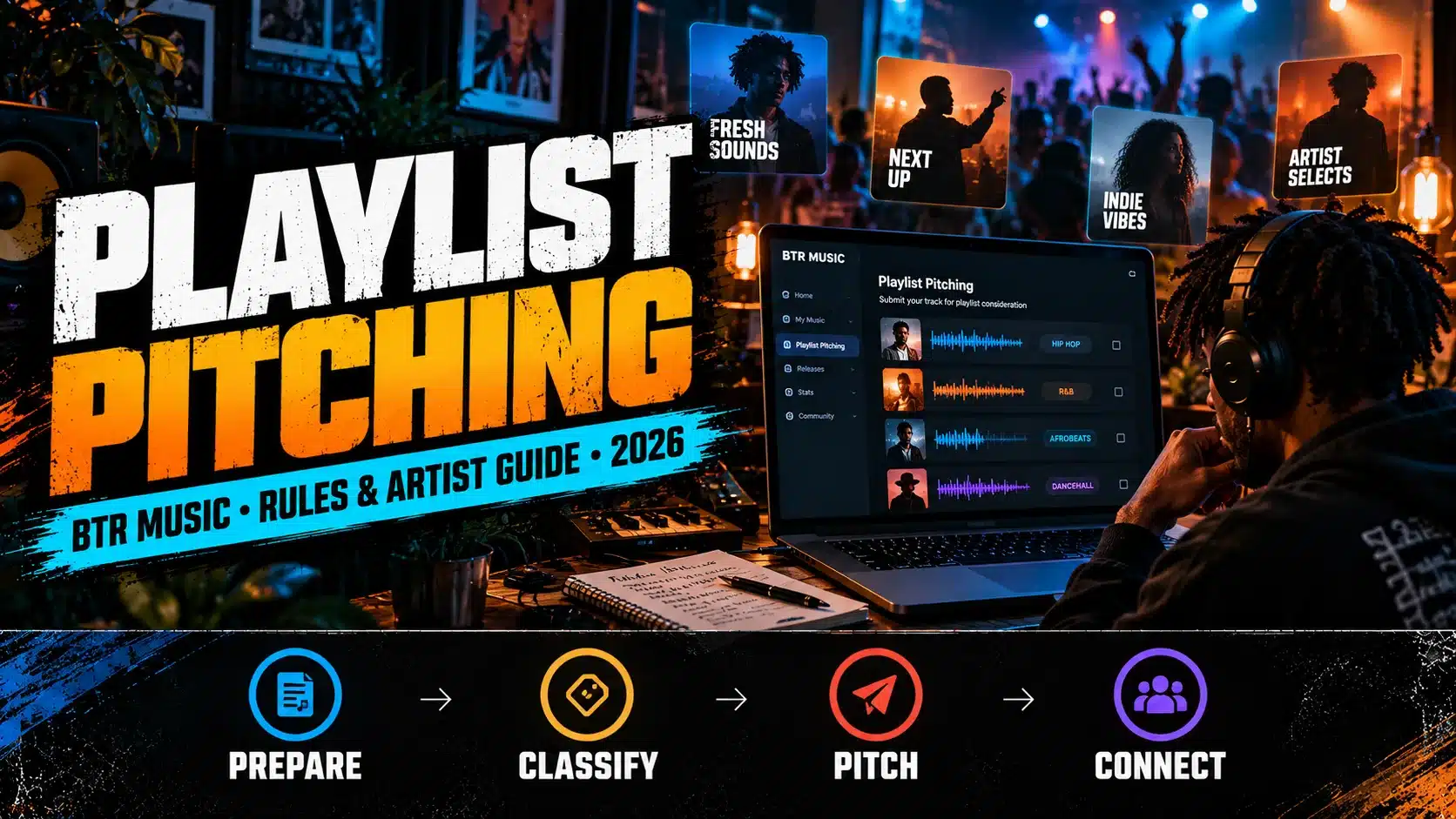
Playlist pitching is how an artist presents a track for consideration by someone assembling a playlist. A good playlist pitch does more than ask for exposure: it explains what the song sounds like, who it is for, why it belongs in a particular listening experience and whether it is ready for a real audience. For an independent artist releasing music through BeatsToRapOn and reaching fans on BTR Music, those details should start with the track itself.
This guide explains playlist pitching rules, music submission standards, pitch-writing techniques and the preparation that can make a track easier to assess. It also draws an important distinction: uploading an approved track to BTR Music is not the same as securing editorial playlist placement. Playlist inclusion is never automatic, and a dedicated first-party pitching form or guaranteed review window should not be assumed unless it is expressly available in the current artist workspace.
Whether you are releasing Hip-Hop, Trap, Drill, R&B, Afrobeats, Amapiano, Dancehall, Phonk, Garage, House or another supported style, the starting point is the same: a finished record, accurate metadata, proper rights and a truthful description of the music. If you have not yet prepared your artist account, start with uploading music on BeatsToRapOn; approved, eligible tracks can become available for discovery in the BTR Music app.
Playlist pitching on BTR Music: the short answer
A strong BTR Music playlist pitch identifies one specific track, gives accurate genre and subgenre information, describes its sound and intended audience, supplies a concise reason for playlist fit and avoids exaggerated claims. The artist should have the right to publish the recording and must meet the relevant BTR content and artist standards. Playlist pitching is a request for consideration—not a purchase of placement, a guaranteed listening total or a way to bypass content review.
Important workflow note: BTR Music offers playlist listening and discovery, but a public, self-service first-party editorial pitch form and fixed pitching deadline could not be independently verified as live when this guide was prepared. References below to recommended lead times, pitch length and submission limits are editorial best-practice recommendations, not representations of an active BTR Music product rule. If BTR announces a formal submission route, follow the instructions and eligibility rules displayed there.
What is playlist pitching—and why does it matter?
Playlist pitching is the process of giving a music curator or editorial reviewer enough useful context to decide whether a track belongs alongside other songs chosen for a particular audience. That context may include the musical style, tempo, mood, language, lyrical theme, location, collaborators and release story. A useful playlist pitch reduces guesswork. It helps someone understand the record before or while listening without asking them to accept the artist’s promotional claims as fact.
Playlists matter because they are organised around a listener’s expectation. Someone opening a late-night R&B sequence expects a different energy from someone exploring high-intensity Drill, laid-back instrumental beats or a club-focused Amapiano set. Good curation respects that expectation; putting an unrelated song in the wrong context can create a poor experience for the listener and do little for the artist.
BTR Music brings together full-track listening, genre discovery, artist profiles, playlists and social music experiences. Artists prepare and manage their music on BeatsToRapOn, while listeners encounter approved music in BTR Music. That two-sided structure gives playlist pitching a natural starting point: a complete release and an artist page worth visiting when someone likes the song. Learn how BTR Music works.
The difference between uploading music and pitching a playlist
Uploading is the process of providing an authorised audio recording, artwork and release information through your artist workspace. The track must satisfy applicable checks before it becomes publicly available and eligible for normal discovery. Your upload is the foundation of your public catalogue.
Playlist pitching adds an editorial argument: why this particular track would work for a particular audience or listening context. A playlist pitch cannot repair an incomplete upload, override content restrictions or create rights you do not hold. It is also not a substitute for building listeners through your artist profile, releases, fan relationships and direct sharing.
An artist may upload ten good songs and decide that only one has the clearest fit for a particular playlist. That is a more useful editorial approach than trying to make every track appear suitable for every audience. Even if a submission tool is introduced, the track needs to stand on its own when the listener presses play.
BTR Music playlist pitching rules: eligibility comes first
The following standards combine existing BTR upload and rights requirements with sensible editorial practices for playlist consideration. They should be read as artist preparation guidelines unless a specific BTR Music pitching policy is formally published.
Rule 1: You must have the necessary rights to your song
You must own or control the permissions necessary to upload and make the music available. That includes relevant rights in the sound recording, composition, beats, samples, vocals, artwork and any other protected material. A playlist pitch cannot legitimise an unauthorised recording, unlicensed riddim or uncleared sample.
If a producer, collaborator, songwriter or rights holder has an interest in the track, confirm the relevant permissions and credits before you seek playlist attention. If you are unsure whether you can lawfully publish a version, resolve that question first. BTR’s current Terms of Service describe artists’ obligations concerning ownership, authority, permissions and accurate information.
Rule 2: The track must be a genuine, properly prepared release
A curator should hear the intended public version—not a rough mix, an accidentally exported instrumental or a file with clipped audio. Check the first seconds, the main hook, the ending, unwanted silence, vocal levels and whether the song translates on ordinary headphones. A strong arrangement may be more important to a listener than extreme loudness.
Mastering does not guarantee playlist pitching success, and an unusual sonic texture is not a defect merely because it is unconventional. The question is whether the recording sounds intentional and whether the release matches the context it is being presented for. Do not misrepresent a demo or unfinished version as a completed master.
Rule 3: Your artist profile should look complete and genuine
A credible playlist pitch points toward a real artist, not an empty placeholder account. Use a genuine artist image, informative bio, consistent name and correct location or country information where required. Give new listeners enough context to recognise the person or group behind the track.
BTR’s existing standards emphasise genuine profile imagery, substantive bios and accurate account details. Some account features and monetisation eligibility have additional requirements under their own terms. Completing your profile does not guarantee playlist selection, but it removes avoidable problems after a listener discovers your song.
Rule 4: Use original, authorised cover artwork
Every serious pitch should be supported by artwork that clearly belongs to the release. Default covers, placeholders, unlicensed images and misleading graphics weaken presentation and can affect eligibility elsewhere in the BTR ecosystem. Your cover should remain recognisable at a small mobile size and should not imitate another artist’s identity in a misleading way.
Artwork is not evidence that a track will become popular. It is part of professional release preparation and a recognisable visual anchor for someone who encounters the music more than once.
Rule 5: Choose the correct primary genre and subgenre
A track’s primary genre should describe the sound a listener will hear, not the audience you wish you had. Accurate subgenres can provide useful context for more specific scenes and listening preferences. A dark, percussive Amapiano track, a melodic Trap record and a club-oriented House release should not all be labelled identically to chase broad exposure.
Genre metadata is particularly important to playlist pitching because it helps explain fit. If a track crosses styles, describe that honestly in the supporting pitch rather than replacing the proper primary category with an unrelated label. Misclassification can send music to the wrong audience and undermine the review.
Rule 6: Keep titles, credits and release data accurate
Use the real public song title and artist name. Credit genuine contributors correctly, label featured artists appropriately and include identifiers or additional metadata only when those details are known and relevant. Avoid keyword-stuffed song titles, invented collaborators and inaccurate release claims.
Your playlist pitch should agree with your track page. If the pitch says the recording is a new vocal version, the audio and metadata should match. If the release is instrumental, a live recording or a remix, make its nature clear rather than forcing a curator to discover the difference themselves.
Rule 7: Pitch a specific song—not your entire catalogue
The strongest playlist pitch gives the reviewer a clear decision to make. Select one track as the focus of each pitch and explain why that recording is the right candidate. You can maintain a larger catalogue on BTR Music, but a sprawling description of twenty songs is not a useful editorial submission.
One focused track per pitch is our recommendation, not a verified live submission limit. If BTR Music introduces a formal pitching product, its published submission caps, permissions and track-status rules will take precedence.
Rule 8: Explain playlist fit rather than promising success
Playlist fit is the relationship between a track and the listening experience it would create. Describe the energy, rhythm, vocals, instrumentation, lyrical content and intended setting. A curator should be able to understand why the record makes sense in a workout sequence, late-night mix, regional discovery set or introspective listening session.
Generic phrases such as “this is a guaranteed hit” provide little value. A concrete description such as “restrained R&B vocals over a minimal two-step rhythm and warm sub-bass, suited to late-night listening” gives the reviewer information they can actually use.
Rule 9: Treat pitch timing as preparation, not a loophole
For a new release, prepare the pitch and accompanying materials two to four weeks before your intended launch whenever possible. That is sensible release-planning advice, not an official BTR Music editorial deadline. If the available BTR workflow currently requires a published, approved track, make sure that status is confirmed before following any submission instructions.
Never assume that submitting seven days ahead automatically places a song in a specific playlist, guarantees exposure to followers or entitles the artist to review. Those would require a clearly documented BTR Music feature and policy. Until such a policy is launched, plan ahead but do not invent eligibility windows.
Rule 10: Make your pitch concise, factual and distinctive
A useful pitch can usually communicate the important information in approximately 75–120 words. Start with the sound and the strongest defining feature, then add relevant context about the song’s origin or scene. Explain the audience fit and mention only real, confirmed activity supporting the release.
Avoid exaggerated statistics, mass-produced hype, personal pressure or requests that have no bearing on the track. Playlist pitching should help editorial judgement; it should not require the reviewer to decode advertising language.
Rule 11: Never attempt to manipulate streams or engagement
Do not use bots, stream farms, automated repeat plays, purchased engagement, misleading incentives or any other means of manufacturing listener activity. Do not present fabricated audience statistics as proof of demand. Artificial activity can damage trust and may trigger enforcement under applicable BTR terms and platform integrity rules.
Legitimate playlist pitching aims to introduce music to real listeners who may enjoy it. It does not depend on a guaranteed stream count, artificial saves or a sudden spike created for the purpose of influencing ranking or payout systems.
Rule 12: No guaranteed editorial placement
A playlist pitch asks for consideration. It is not an entitlement to placement, a promised ranking position or a claim to a particular amount of listening activity. A track can be technically eligible, professionally produced and accurately pitched without being selected for a specific playlist.
Playlist availability, sequencing, updates and editorial choices depend on the needs of the audience and the people or systems responsible for that listening experience. Existing tracks may also be removed from playlists as their context changes. Being declined or not selected is not, by itself, evidence of a technical issue with the upload.
Rule 13: Do not confuse independent promotion services with BTR editorial decisions
BeatsToRapOn includes an artist services ecosystem, while BTR Music is a listener-facing music app. A promotion service, curator contact or private arrangement should never be presented as the official BTR Music editorial decision process. Any claim that a private payment buys guaranteed placement in an official BTR Music editorial playlist should be treated as unverified unless BTR has expressly authorised the arrangement.
For artists, the safest distinction is simple: a third party may offer its own promotional work, but that does not establish BTR Music editorial approval. Editorial review and paid promotional services should remain clearly separated in descriptions, invoices and expectations.
Rule 14: Follow moderation and listener-safety rules
A pitch does not override restrictions related to unlawful content, impersonation, stolen material, misleading metadata, abuse or other conduct prohibited by BTR’s published policies. Describe mature lyrical themes accurately when they are material to the listening context, and do not mislabel a recording to evade content review.
The objective is not to demand that all playlists have the same taste. It is to ensure the recording is lawful, accurately represented and appropriate for the intended audience under the standards that apply to the service.
Rule 15: Respect editorial independence, changes and removals
Editors and playlist owners may choose a different record, change the sequence, adjust a playlist’s focus or remove a song that no longer fits. They may take into account listening context, originality, quality, freshness and audience response. None of those factors operates as a guaranteed formula.
Treat feedback as information, not a verdict on your career. If a song is not selected, review whether you pitched the right track to the right audience, whether the production and presentation were ready and whether your next release gives listeners a clearer reason to return.
How to prepare a BTR Music playlist pitch: step by step
Step 1: Upload your music through BeatsToRapOn
Create or sign into your artist account at BeatsToRapOn, upload the finished recording, add authorised cover artwork and enter the correct genre, title and release details. This is the artist side of the connected ecosystem. You do not need to maintain a second catalogue for BTR Music.
Step 2: Verify the public release and artist details
Check the track status in your workspace. BTR’s current general discovery requirements emphasise music that is approved, public, active and properly classified. A file transfer alone is not proof that a release has passed review or is publicly accessible. Open the track from a listener’s perspective and check the audio, artwork and profile.
Step 3: Select the track with the strongest playlist fit
Your most recent song is not necessarily your best pitch. Choose the track that best matches the audience, energy and format you want to reach. If you have an EP, identify the song that delivers its hook most clearly or represents the project most accurately. Explain why, but avoid calling other tracks inferior.
Step 4: Build a one-paragraph pitch and a fact sheet
Prepare a short description of the sound, dominant genre and subgenre, instruments or production characteristics, mood, lyrical theme where relevant, artist context and intended audience. Keep practical details together so they can be copied into whatever verified BTR submission route is available at the time.
Your fact sheet should distinguish confirmed facts from aspirations. “Recorded with a live percussion ensemble in Sydney” is a usable detail if true. “Expected to become the biggest song of the summer” is not evidence of anything.
Step 5: Check the currently available BTR submission method
Do not look for or assume a button that has not been officially launched. Playlist browsing and public track availability do not establish a first-party editorial submission queue. If BTR Music offers a dedicated playlist pitching form in your artist workspace, use that route and follow its displayed requirements. If no verified official form or submission guidance is available, concentrate on making the track discoverable through the existing BTR ecosystem rather than treating unrelated contact channels as an editorial inbox.
Step 6: Keep supporting the release after submission
An editorial decision is only one possible discovery route. Share a clean track or artist link, introduce the record in your own words, connect with people who genuinely enjoy the genre and give new listeners a reason to explore more than one song. Show the personality or story behind the music without overwhelming the audience with repeated unsolicited messages.
Step 7: Review meaningful results
Where analytics are available, look beyond total play counts. Consider whether listeners follow the artist, revisit the track, explore other releases, interact with the profile and show continued interest over time. A smaller number of people who genuinely care about your music may be more valuable for long-term artist development than a large burst of low-intent activity.
What should a playlist pitch include?
A useful music playlist pitching description gives reviewers a compact, trustworthy snapshot of the recording. The seven elements below are a practical checklist—not a claim that BTR Music currently exposes seven particular fields in a form.
| Element | What to include | What to avoid |
|---|---|---|
| Track identity | Exact artist name and title | Draft filenames or inconsistent names |
| Musical lane | Honest genre and subgenre | Tagging unrelated popular genres |
| Sound | Distinctive rhythm, instrumentation, vocals and production | Empty adjectives and generic hype |
| Mood | Specific emotional or listening context | Every mood at once |
| Story | A relevant, true detail about the recording | Invented hardship or fake milestones |
| Audience fit | The type of listening experience the song suits | Claims that it belongs in every playlist |
| Release support | Real assets, appearances or promotional plans | Purchased engagement or imaginary campaigns |
The best playlist pitching copy is often short because the underlying track and metadata are already strong. Aim to supply the information that listening alone cannot reveal, such as cultural context, a meaningful collaborator or the story behind an unusual sound. You do not need an elaborate sales pitch to explain a clear musical identity.
Playlist pitch examples for BTR Music artists
These are illustrative pitch examples written for this guide, not actual submitted or accepted BTR Music pitches.
Example 1: Hip-Hop / Boom Bap
“Concrete Letters” pairs dusty drums and a stripped-back piano loop with narrative verses about rebuilding trust after a difficult year. The vocal is forward and conversational, with no sung hook; the chorus relies on the central phrase and drum break. The track would suit listeners looking for lyric-led Hip-Hop and grounded Boom Bap rather than high-energy club rap. The release artwork and artist profile are complete, and the song is part of a focused three-track project.
This pitch works because it describes the sound, makes a realistic audience distinction and explains the song’s place in a project. It does not make unsupported claims about streams or editorial interest.
Example 2: Afrobeats / Contemporary R&B
“After the Rain” blends a light Afrobeats pulse, airy guitar phrases and soft R&B harmonies around a restrained late-night vocal. The arrangement stays warm rather than building toward a festival drop, and the lyric is about reconnecting after a long period apart. The song suits relaxed, melodic listening and audiences who enjoy cross-genre vocal records. A live acoustic performance and short visual are prepared to support the release.
The pitch identifies rhythm, instrumentation, vocals, mood and intended listener experience without making the song sound suitable for every possible playlist.
Example 3: House / Global Club
“Northside Motion” is a percussion-led House track built around a syncopated bass groove, minimal vocal phrases and a long instrumental section for continuous listening. It develops gradually, with a clean low end and a late arrangement lift rather than an abrupt switch in energy. The record is aimed at listeners who prefer groove-focused club music and extended rhythmic progression. The artist’s release page includes the final master, original cover and correct electronic subgenre classification.
A good electronic music playlist pitch describes progression and rhythm rather than relying solely on a tempo number. An exact BPM may be useful, but it should support an explanation of the listening context—not replace it.
How far in advance should you prepare a playlist pitch?
A practical independent release calendar gives you time to correct metadata, confirm rights, finish the master and create a clear pitch. The following is recommended preparation, not a verified BTR Music official pitch deadline:
| Planning window | Artist action |
|---|---|
| 3–4 weeks before launch | Finalise master, rights, artwork, contributors and artist profile |
| 2–3 weeks before launch | Upload and check status; write a focused pitch and match it to a listener context |
| 1–2 weeks before launch | Confirm approved/public availability as applicable and consult any official BTR pitching instructions |
| Release week | Check the fan-facing track, share the genuine release link and engage with listeners |
| Following 2–4 weeks | Review real engagement, refine messaging and continue measured outreach |
An artist should never describe a proposed timetable as an automatic playlist inclusion rule. Likewise, previously released songs should not be called ineligible for all playlist consideration unless a particular BTR Music playlist or formal program specifically says so. A newly launched editorial program may set its own timing and eligible track states.
How music is evaluated for playlist fit
An editorial reviewer might listen for a track’s musical identity, the quality of the finished version, the coherence of its genre tags and how it works between surrounding songs. Different playlists serve different audiences. A track may be a strong creative work without fitting the energy, duration, lyrical tone or format of the playlist currently being assembled.
Originality matters, but it does not mean every record must invent a new genre. It may come from the voice, writing, drums, texture, arrangement or perspective. Presentation matters too: a strong artist page and accurate metadata help new listeners understand what they discovered. Neither a polished cover nor a paid marketing campaign should be used as a substitute for editorial judgement.
Playlist pitching is therefore best understood as matching music to listeners. The goal is not to collect the largest possible number of playlists. It is to reach the contexts where the record makes sense and give people a credible path back to the artist behind it.
Playlist pitching mistakes that weaken an otherwise good song
Artists often undermine their own submissions by sending them before the recording is finished, describing an overly broad genre, attaching low-quality artwork or writing a pitch made entirely of predictions. Others confuse a promotional service with an editorial decision or repeatedly send the same generic message to unsuitable curators.
More serious problems include unclear rights, unlicensed samples, inaccurate credits, manipulated engagement and misrepresenting a paid arrangement as an official editorial placement. These are not tactics to improve playlist pitching odds. They create risk for the artist and for listeners and can conflict with the conditions under which the music was uploaded.
The remedy is not a secret algorithmic trick. Fix the fundamentals: use a track you are authorised to release, make the genre and audience clear, prepare the public profile properly and describe the record in language a human being can understand. Then continue promoting through legitimate relationships, not manufactured numbers.
What happens if your playlist pitch is not selected?
A playlist submission that does not lead to inclusion is not proof that the track is bad. There may be limited space, a different editorial direction, existing songs that better match the moment or simply no suitable opportunity. Most artists will need several releases and repeated audience-building efforts to develop meaningful momentum.
Do not respond by re-uploading the same audio as a new track solely to recreate attention, falsifying the metadata or spamming multiple channels. Instead, study where the song is connecting naturally. A listener who discovers it through genre browsing, a shared playlist, a chart, a friend or your own artist link can still become a valuable long-term supporter.
The BTR Music playlist pitching checklist
Before seeking playlist consideration, verify that:
- You own or control the relevant recording, composition, sample, vocal and artwork rights.
- The track is the finished version you intend people to hear.
- Your BTR artist name, genuine photo, biography and account details are complete.
- The track has original, non-placeholder cover artwork.
- The correct primary genre and any appropriate subgenre are saved.
- Credits, release details and other metadata are accurate.
- The track has passed the applicable BTR approval checks and is public/active when required for the available route.
- Your description explains the sound, mood and specific audience fit.
- You have chosen one clear focus track for the pitch.
- You have not purchased artificial streams, followers or other manipulated engagement.
- You understand that editorial consideration does not guarantee placement.
- You have checked that an official BTR Music pitching route is actually available before claiming to have submitted a pitch.
These checks make the recording and its presentation more credible regardless of the playlist outcome. Several also improve the experience for people who discover the track elsewhere in BTR Music.
Playlist pitching FAQs for BTR Music
Can I pitch music to BTR Music playlists?
BTR Music supports playlists and music discovery. A public first-party editorial submission form could not be verified as live at the time of this guide. Artists should prepare complete, approved releases and use a dedicated pitching route only when one is expressly offered through official BTR channels.
Is playlist pitching the same as uploading music?
No. Uploading creates a track in the artist catalogue and, after applicable checks, can make it available in BTR Music. Playlist pitching asks for consideration in a particular curated listening context. Publication is not a guarantee of playlist inclusion.
How do I upload music for BTR Music?
Create an artist account on BeatsToRapOn, prepare the audio and cover, complete the required metadata, submit the track and verify approval and public availability. Eligible approved tracks can appear in BTR Music without a second catalogue upload.
Is BTR Music playlist pitching free?
No verified first-party editorial pitching fee or self-service pitching product was identified for this guide. Do not assume that a paid third-party offer is the same as an official editorial submission, and do not pay anyone claiming guaranteed official playlist placement without verifying the offer and its authority.
How many songs should I include in a playlist pitch?
Choose one focus track and describe it well. That is our recommended approach for a useful editorial pitch, not an official BTR submission quota. Any future formal tool may impose its own limits.
Can I pitch an unreleased song?
That depends on the officially available workflow. BTR’s established direct-upload path is designed around catalogue approval and publication. A separate pre-release editorial pitch state and deadline were not verified as live; do not assume unreleased tracks can currently be submitted to an official queue.
Can I pitch a song that is already released?
A published song can be part of BTR Music’s playlist and discovery ecosystem. Whether a particular editorial program accepts released tracks would be governed by that program’s current published rules, if and when such a program exists.
What makes a good playlist pitch description?
Clear genre, a distinctive sonic detail, a true story or context, the listening mood and an honest explanation of playlist fit. Keep it specific and readable, and avoid inflated claims or invented statistics.
Do I need a record label to pitch my song?
A record label is not required to establish an artist account or upload your own authorised music through BeatsToRapOn. Complete the release properly and follow the official instructions for any pitching mechanism that is actually made available.
Does a playlist pitch guarantee streams or followers?
No. Neither a pitch nor playlist consideration guarantees acceptance, a particular audience size, a chart position, streaming income or fan growth. Those results depend on genuine listening behaviour and the broader release context.
What if my profile or cover uses a default image?
BTR’s current published guidance stresses genuine artist profile images and custom track artwork. Correct missing or placeholder visuals before relying on the release for discovery or any future playlist-pitch review.
Should I change my genre to reach more playlists?
No. Incorrect genre information can mislead listeners and weaken relevance. Use the primary genre and subgenre that accurately describe the recording, then explain genuine crossover influences in your description.
Can I pay for guaranteed BTR Music playlist inclusion?
Do not assume a payment buys official editorial placement. A third party’s promotion offer is distinct from BTR Music editorial curation, and BTR’s applicable terms prohibit artificial or manipulated activity. Seek genuine listeners and verify the authority of anyone making placement claims.
Can explicit lyrics or unusual music be considered?
Eligibility depends on applicable content rules and the context of the playlist. Describe mature content honestly when relevant and do not attempt to evade review by mislabelling a recording. Unusual music is not automatically unsuitable, but every playlist has an intended listener experience.
Does successful playlist pitching mean I will earn streaming revenue?
Not automatically. Playlist inclusion, listening activity and payable streams are separate matters. Any earnings depend on the current BTR Music payment terms, artist and track eligibility, and applicable listening and payout rules. Never buy activity or assume that a displayed play count equals payable revenue.
Where can I read BTR Music’s current rules?
Check the BeatsToRapOn Terms of Service, the relevant artist account guidance and the BTR Music app information. If an official playlist pitching process launches, the rules displayed in that process should be treated as the authoritative instructions for making a submission.
Playlist pitching begins with a record worth hearing
A useful BTR Music playlist pitching strategy does not begin with a shortcut to an editor. It begins with the music, then the presentation and then the audience fit. A complete artist profile, an authorised master, original artwork, accurate genre metadata and a thoughtful description allow a song to be evaluated on something more meaningful than hype.
Prepare the release professionally. Be honest about where it belongs. Treat editorial selection as a possibility rather than a promise, and keep building direct connections with the people who respond to the track. That is the foundation of sustainable playlist discovery.
Ready to release? Upload your music on BeatsToRapOn, complete your artist profile and make your approved music available to listeners through BTR Music.