
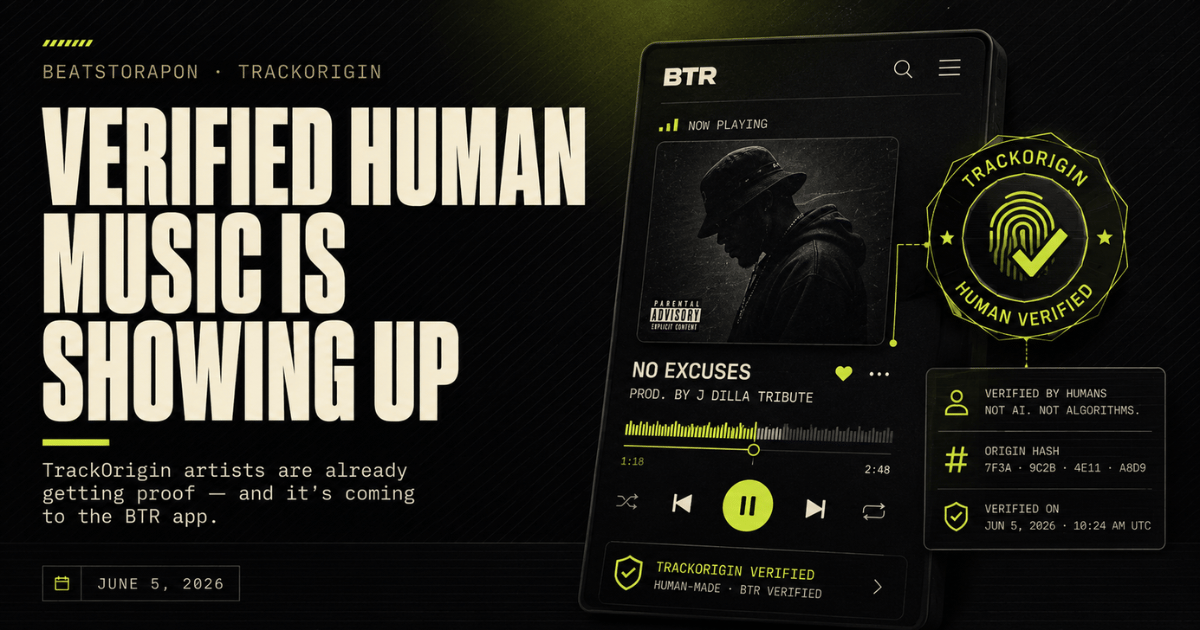
There’s a moment coming that the music industry has never had before. Open a music app, hit play on a track, and see — right there next to the artwork — cryptographic proof that a real human made the song you’re listening to.
Not a vibe. Not a guess. Not a checkbox somebody ticked at upload. Proof.
That moment is coming to the BeatsToRapOn mobile player, and it’s powered by TrackOrigin — the world’s first standard for verifying human-made music. Artists are already getting verified right now, in beta. And for what we believe is the first time in history, that verified status is about to live inside a consumer music app, in the player, where listeners actually are.
Here’s why this matters, what’s already happening, and what it means for every artist on BTR.
The problem: the feed stopped telling the truth
If you make music in 2026, you already feel it. The catalogue is drowning.
Deezer reported in April 2026 that it now receives close to 75,000 fully AI-generated tracks every single day — roughly 44% of everything uploaded to the platform. Your finished master, the one you bled over for weeks, now drops into a feed alongside millions of synthetic tracks batch-generated by people who never touched an instrument.
And here’s the part that should stop you cold: a Deezer and Ipsos study of 9,000 listeners across eight countries found that 97% of people could not reliably tell AI-generated music from human-made music. The “just listen to it, you’ll know” era is over. The ear isn’t the detector anymore. Nobody’s is.
When listeners can’t hear the difference and the algorithm can’t see the difference, the human craft behind real music becomes invisible. Same row in the catalogue. Same thumbnail. Same nothing.
That’s not a discovery problem. It’s a trust problem. And trust problems don’t get fixed with better playlists. They get fixed with proof.
We dug into this in detail when TrackOrigin first launched — if you want the full background, read our original breakdown of what verified human-made music actually means. This article is the next chapter: the proof is no longer theoretical. Artists have it. And it’s coming to your phone.
What TrackOrigin does differently
Most of the industry is fighting AI music the wrong way — by trying to build better detectors that scan a finished file and guess whether it “sounds” synthetic. That’s a losing battle. If 97% of humans can’t tell, the detectors are chasing a moving target that improves every month.
TrackOrigin doesn’t play that game. Instead of asking “does this file sound human?”, it asks the artist a much harder question to fake: “can you prove you made it?”
The approach is deceptively simple and genuinely new:
- Upload your finished master. WAV, FLAC or AIFF. TrackOrigin fingerprints the audio and computes a unique cryptographic hash of the file.
- Declare your process. Your role, instruments, DAW, collaborators, and — yes — any AI tools you used. Honesty here is the whole point.
- Demonstrate authorship live. A short recorded session, 60 to 120 seconds, where you perform fragments of your own track on camera, recall decisions only the author would know, and show your process. The prompts are generated after you upload, from your specific track — so there’s no answer key to rehearse.
- Get the Origin Seal. A cryptographically signed certificate bound to your exact audio file, a public certificate page, and an embeddable seal.
The genius is what runs underneath. Multiple independent verification engines analyse the session in parallel — acoustic, behavioural, visual, linguistic, cryptographic and adversarial evidence all at once. A pass requires convergence: several unrelated signals all pointing the same way. To fake a certificate, an impostor would have to defeat every engine simultaneously, in real time, for questions they can’t see in advance. It’s cheaper to just make the track yourself.
And here’s the part artists love: using AI isn’t disqualifying — hiding it is. TrackOrigin verifies human creative origin. If you used a stem-splitter, a mastering assistant, or generative tools to sketch ideas, you declare it, and it’s recorded on the certificate as honest context. Only fully AI-generated tracks are ineligible. This is about proving the human in the chair is the human on the credits — not pretending no software exists.
If you want the deep technical version — the Ed25519 signatures, the SHA-256 file binding, the 20-year audit retention, the way it maps to the EU AI Act and other global disclosure law — TrackOrigin published the full methodology. It’s one of the most transparent documents we’ve seen in this space.
Artists are already getting verified
This isn’t a roadmap promise. It’s live.
TrackOrigin is in beta right now, running verifications throughout June, and artists are already walking away with signed certificates and Origin Seals on their finished masters. The launch was significant enough to make headlines — you can read the official world-first launch announcement here.
The kicker: your first 15 verifications are free, no credit card. About fifteen minutes per track, and you come out the other side with a certificate that travels with your music — to EPKs, sync submissions, press kits, profiles, and partner platforms. You can start your free verification at TrackOrigin today.
That seal works everywhere you put it. But the surface that’s about to matter most is the one in your pocket.
The world first: verification, in the player, on BTR
Here’s the news.
BeatsToRapOn is building verified human-made status directly into the BTR mobile app. When the feature goes live, listeners scrolling the catalogue and sitting on the Now Playing screen will see a verified human-origin signal attached to tracks that have earned it — pulled live from the artist’s TrackOrigin certificate.
To our knowledge, no consumer music app has ever surfaced cryptographically verified human-origin proof inside the player itself. Badges of various kinds exist. Self-declared “official artist” checkmarks exist. But a live, signed, tamper-evident provenance signal — one that updates the instant a certificate’s status changes — appearing in the listening experience where fans actually are? That’s a first.
Think about what that does:
- For listeners: a real signal in a feed full of noise. Tap play knowing a human stood behind the work — and that the claim is backed by cryptography, not marketing.
- For artists: your craft stops being invisible. In a catalogue where your master sits next to two million AI tracks this month, the verified mark is the thing that says this one is real, and here’s the proof.
- For the culture: hip-hop has always been about authenticity — who’s real, who put in the work, who actually did it. Verified human-made music isn’t a corporate compliance feature here. It’s the oldest value in the genre, finally given infrastructure.
This is exactly why BTR and TrackOrigin fit together. BTR is a full hip-hop ecosystem — catalogue, AI tools, marketplace, events, artist profiles — built for artists who are actually making the music. TrackOrigin proves they did. Putting that proof in the player is the natural next move.
What you should do right now
If you’re an artist, the play is simple, and the window where it’s free is open:
- Get verified. Take a finished master and run it through TrackOrigin while the first 15 verifications are free. Fifteen minutes, no card.
- Be early. When verified status goes live in the BTR app, the artists who already hold certificates are the ones who’ll light up first. Early proof is an advantage.
- Catch up on the why. If you skipped it, our first deep-dive on TrackOrigin covers the trust crisis and the standard in full.
The music industry spent the last two years asking a question it couldn’t answer: is this real? TrackOrigin answers it. And very soon, on BeatsToRapOn, you’ll see the answer the moment you press play.
Made by humans. Proven by humans. Coming to the player.
Ready now? Verify your first track free at TrackOrigin →