
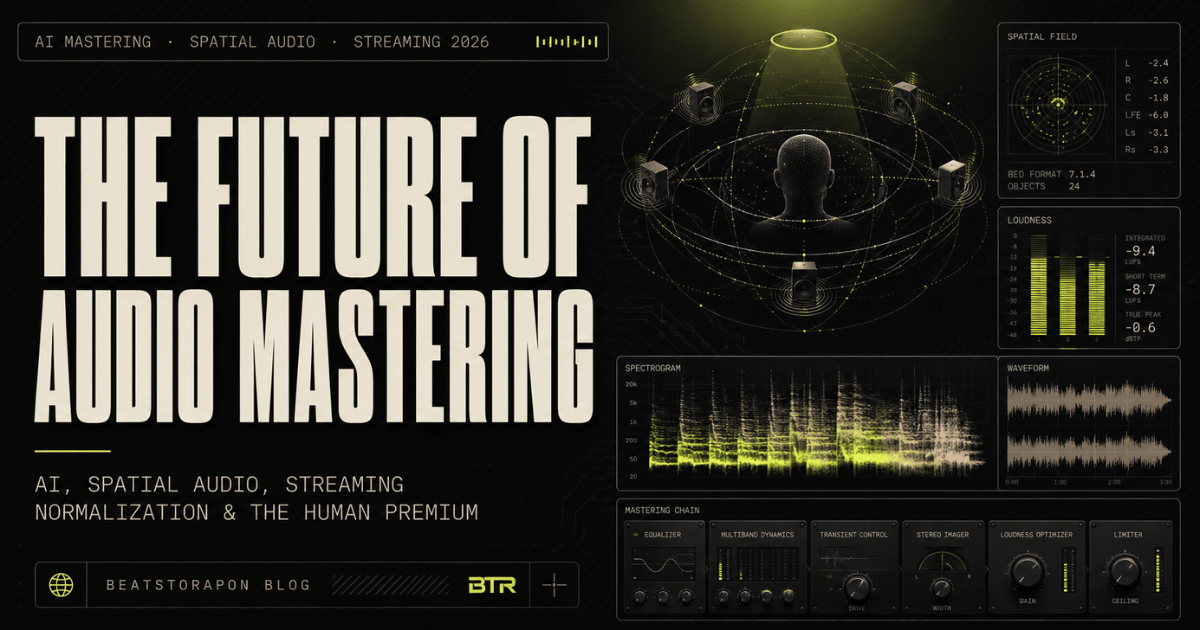
The future of audio mastering in 2026 is not a simple fight between analog engineers and automated software. It is a deeper shift in how records are finished, translated, monetized, and trusted inside a music market now shaped by artificial intelligence, spatial audio, streaming normalization, and generative media.
The landscape of professional audio mastering in 2026 represents a critical inflection point in the history of music production. Historically defined by the application of analog hardware to achieve sonic cohesion, the discipline is currently undergoing a radical, multidimensional transformation. This evolution is driven by the proliferation of artificial intelligence in signal processing, the mass adoption of spatial audio formats by major streaming platforms, and a profound economic recalibration of the recorded music market in the face of generative media. The contemporary conversation surrounding the future of mastering has moved far beyond the rudimentary binary debate of analog versus digital processing of AI Mastering. Instead, it encompasses complex, interconnected challenges such as the algorithmic interpretation of emotional intent, the fragmentation of binaural rendering engines, and the technical mechanisms of streaming normalization.
As digital service providers solidify their loudness algorithms and consumer hardware shifts definitively toward computational audio, the role of the mastering engineer is fundamentally shifting. The practice is transitioning from a purely technical finalization step into a highly specialized, format-dependent creative collaboration. The future of mastering is not defined by the obsolescence of human engineers, but rather by the emergence of a hybrid ecosystem. In this new paradigm, algorithmic precision handles baseline technical corrections, while human artistry dictates the emotional, spatial, and contextual finality of the record. This article provides a multi-layered analysis of the technological, acoustic, legal, and economic vectors shaping the future of music mastering.
The Technological Evolution of Production Paradigms
Audio mastering has progressed through three distinct technological epochs, each fundamentally altering the workflow and aesthetic parameters of music production, as outlined in research comparing AI mastering and human engineers. The initial analog paradigm relied on large-format consoles, tube equalizers, and optical compressors operating via continuous analog voltage. This era was renowned for imparting “warmth” and “depth” through subtle harmonic distortion introduced by physical vacuum tubes and transformers. However, this workflow was constrained by expensive hardware, complex recall procedures, and signal degradation resulting from repeated digital-to-analog conversions.
The subsequent digital paradigm transitioned the process “in the box,” utilizing Digital Audio Workstations, or DAWs, to execute mathematically precise processing. This era introduced capabilities with no physical equivalents, such as linear-phase equalization to adjust frequency balance without phase shifts, surgical spectral editing, and look-ahead limiters capable of transparent loudness maximization. Despite these advantages, an overreliance on visual analyzers occasionally yielded clinically perfect but emotionally lifeless masters, leading to decision fatigue.
By 2026, the industry has synthesized these two histories into an “Analog-Digital Hybrid Renaissance,” according to a 2026 overview of global music production trends. Despite the absolute dominance of digital tools, producers are heavily embracing hybrid workflows that merge analog harmonic saturation with digital precision. This has been fueled by the boom in highly accurate, budget-friendly analog hardware clones, such as Behringer’s 1273 preamp, which replicates legendary Neve circuitry. Concurrently, digital amp modelers have officially overtaken traditional tube amplifiers in market share, offering zero-degradation consistency, silent recording capabilities, and exact digital captures of vintage hardware at a fraction of the cost.
Modern engineers typically track signals through analog preamps for harmonic color, edit within the absolute flexibility of the DAW, mix using high-end emulations of SSL channel strips, and run the final master bus through physical analog equalizers before recapturing the signal back into the digital domain.
The Algorithmic Disruption: Artificial Intelligence in the Mastering Chain
The integration of artificial intelligence into the audio mastering process represents the third major paradigm shift. In 2026, AI is no longer a rudimentary, preset-driven utility; it is a complex, neural-network-driven analytical engine capable of executing relational, multi-stem decisions, as discussed in the 472-person blind test analysis of AI mastering versus human engineers.
The Mechanics of Algorithmic Audio Processing
To understand the capabilities and limitations of AI mastering, it is essential to examine the underlying mechanisms of how these systems perceive and process audio. Modern AI mastering engines do not interpret audio as acoustic energy in the way a human auditory system does; instead, they translate raw audio waveforms into visual and structural data sets. Through the generation of two-dimensional Mel spectrograms, which plot frequency against time with amplitude represented by color density, the artificial intelligence maps the frequency axis to the non-linear Mel scale to mathematically mimic human auditory perception. Furthermore, Mel-Frequency Cepstral Coefficients, or MFCCs, are utilized for sequential modeling.
Advanced algorithmic architectures subsequently deploy Convolutional Neural Networks, or CNNs, that slide filters across these Mel spectrograms. These filters identify localized visual patterns corresponding to specific sonic features within the mix, such as transient impacts, vocal sibilance, or low-frequency rumble. By cross-referencing these visual representations against vast training libraries of commercial releases, the algorithm generates a custom processing chain designed to optimize the input file toward a statistically derived standard of commercial viability.
The evolution of these computational tools has bifurcated into two separate, highly distinct disciplines: AI mastering and AI mixing. RoEx Audio’s 2026 analysis of AI mixing and mastering frames AI mastering as a highly constrained optimization problem. It analyzes a single, pre-bounced stereo file to make broad adjustments to tonal balance, stereo width, and overall loudness. Because it processes a flattened stereo file, AI mastering acts as the “roof” of the production house; it can enhance the existing frequencies but cannot solve fundamental structural flaws within the mix, such as a buried lead vocal or severe frequency masking between a kick drum and a bass guitar. Applying algorithmic mastering compression to a poorly balanced mix frequently exacerbates these underlying frequency fights.
Conversely, AI mixing, which has seen substantial technological leaps leading up to 2026, addresses a far more complex, relational problem. Modern systems can now reliably ingest and process up to 32 individual instrument stems simultaneously, applying appropriate gain staging without clipping, carving out frequency space contextually, and executing spatial processing to place elements within a believable stereo field. By integrating stem separation models, powered by the same neural source-separation technology underlying tools like Spleeter, Moises, and Lalals, modern mastering plugins can now execute surgical equalization on isolated vocals or drums directly from a stereo master bus, effectively blurring the historical boundary between mixing and mastering workflows. This direction is also reflected in testing of AI mixing and mastering tools.
Specialist vs. Generalist AI Engines: A Forensic Comparison
The most significant development in algorithmic processing in 2026 is the transition from broad, generalist AI platforms to targeted, specialist AI pipelines. Early algorithmic platforms relied on massive, diverse training datasets intended to master any genre of music submitted to them. While this generalized approach provided accessibility, it frequently resulted in algorithmic homogeneity, pulling highly stylized tracks toward a generic sonic center, a limitation also discussed in Disc Makers’ analysis of AI mastering and human expertise. In response, the industry has seen the rise of specialized AI agents engineered for the specific sonic demands of distinct musical genres.
A forensic evaluation comparing generalist platforms such as LANDR and eMastered against a specialist engine, BeatsToRapOn, optimized exclusively for bass-dominant and vocal-heavy genres like hip-hop and R&B, reveals distinct architectural differences. Utilizing a standard 44.1kHz/16-bit electronic trap track for objective evaluation, spectral mapping demonstrates that generalist platforms frequently struggle with targeted frequency control.
Forensic Spectrogram and Tonal Balance Comparison of AI Mastering Engines
- Sub-Bass, 20-100 Hz: BeatsToRapOn produced a tight, controlled energy band with no clipping plateau. LANDR produced an extremely dense white band indicating aggressive limiting at 0 dBFS. eMastered produced a solid energy band with moderate limiting but slight smearing.
- Low-Mids, 100-500 Hz: BeatsToRapOn preserved clear variation in kick and bass fundamentals. LANDR created a broad energy plateau that actively masked voice fundamentals. eMastered showed boost-smearing rather than precise dynamic control.
- Midrange, 500 Hz-2 kHz: BeatsToRapOn preserved delicate instrument and vocal separation. LANDR’s midrange presence was heavily overwhelmed by the low-end plateau. eMastered produced a foggy spectral signature where instruments blended together indistinguishably.
- High-End Air, 2-20 kHz: BeatsToRapOn extended clearly to approximately 18 kHz with bright peaks for airy highs. LANDR rolled off prematurely around 17 kHz with less presence. eMastered rolled off heavily between 12 and 15 kHz, removing upper harmonic air.
The algorithmic approach to loudness optimization also differs significantly between these models. eMastered prioritizes maximum overall loudness, achieving -9.7 LUFS but severely flattening the peaks, resulting in a fatiguing crest factor of 11.1 dB. LANDR opts for a highly conservative -13.7 LUFS, retaining moderate transient punch but lacking competitive volume. The specialist engine, however, achieved a competitively loud master at -11.0 LUFS while maintaining the highest crest factor in the test, 12.60 dB, keeping the percussion exceptionally snappy and retaining dynamic impact.
Furthermore, vectorscope analysis reveals critical differences in stereo imaging. LANDR aggressively pushes spatial boundaries, resulting in a sprawling, circular cloud with high phase risk, meaning panned elements could disappear entirely when folded to mono. eMastered forces a narrow, virtually mono signal that avoids phase issues but strips the track of its spatial life. The specialist approach strikes a targeted correlation between +0.5 and +0.8, providing a tasteful stereo width while keeping the foundational bass and lead vocals phase-aligned and centered.
Empirical Performance: The Enduring Premium of Human Artistry
The proliferation of algorithmic mastering tools has inevitably led to rigorous empirical testing to determine whether artificial intelligence can truly replicate the nuanced touch of a professional mastering engineer. The data indicates that while AI has democratized baseline technical competency, human expertise remains an irreplaceable asset for commercial, emotionally resonant releases.
The Dynamics of Listener Preference: The Benn Jordan Study
The most comprehensive data point regarding the efficacy of AI versus human mastering stems from a highly publicized, 472-person double-blind study conducted by electronic music producer Benn Jordan, analyzed in BTR’s report on AI mastering versus human engineers. The study isolated the mastering variable by passing a single, highly dynamic electronic track, “Starlight,” through leading AI algorithms, AI-assisted hybrid chains, and professional human engineers.
The evaluation process featured a rigorous quality control filter prior to the double-blind phase. Several prominent online mastering platforms, specifically LANDR, BandLab, Waves, Virtu, and Mixea, were completely disqualified from the study because they yielded objectively poor, distorted, and heavily clipped results that failed to meet basic broadcast standards. This underscores a critical risk: utilizing fully automated mastering without human oversight can easily ruin a commercially viable mix.
The remaining seven finalists were evaluated by a diverse pool of audio engineers, musicians, and casual music fans based on clarity, presence, depth, and sonic density. The results demonstrated a definitive dominance of human engineering.
Performance Metrics and Listener Preference Rankings
- Max Hosinger: Human professional master. Integrated loudness: -10.2 LUFS. Dynamic Range: DR 10. Preference rank and score: 1, with 6.4/10.
- Ed the Soundman: Human professional master. Integrated loudness: -9.8 LUFS. Dynamic Range: DR 9. Preference rank and score: 2, with 6.1/10.
- Ozone + Neutron: AI hybrid, human guided. Integrated loudness: -9.5 LUFS. Dynamic Range: DR 8. Preference rank and score: 3, with 5.8/10.
- Matchering 2.0: AI local, open source. Integrated loudness: -8.9 LUFS. Dynamic Range: DR 7. Preference rank and score: 3, with 5.9/10.
- Kits.ai: AI automated. Integrated loudness: -10.5 LUFS. Dynamic Range: DR 9. Preference rank and score: 5, with 4.9/10.
- Compound Audio: AI automated. Integrated loudness: -9.1 LUFS. Dynamic Range: DR 8. Preference rank and score: 6, with 4.8/10.
- iZotope Ozone 11: AI automated, unguided. Integrated loudness: -9.3 LUFS. Dynamic Range: DR 8. Preference rank and score: 7, with 3.8/10.
A critical insight derived from this study is the inverse relationship between algorithmic loudness and listener preference. The highest-ranked human master operated at a moderate loudness of -10.2 LUFS while preserving a maximum Dynamic Range score of 10. In stark contrast, AI systems consistently pushed the audio to aggressive loudness limits, such as Matchering 2.0 at -8.9 LUFS, but suffered severe dynamic penalties, reducing the DR score to 7. Listeners overwhelmingly preferred the quieter, more dynamic human masters, praising their superior sonic balance, nuanced presentation, coherent reverb tails, and clean high-frequency sheen, characteristics that algorithms routinely flattened or cluttered.
The Cognitive Limitations of Algorithmic Processing
The empirical superiority of human engineers is rooted in profound cognitive limitations inherent to artificial intelligence. First and foremost, audio mastering is fundamentally an art form, reliant on sensitivity, intention, and subjective perception. Kevork Mastering’s discussion of human mastering versus automated mastering argues that algorithms measure, compare, and normalize signals based on statistical aggregates; they do not perceive the inherent sadness of a minor piano chord, the fragility of an isolated vocal, or the intended aggression of a distorted bassline. Furthermore, an algorithm cannot process abstract, emotion-driven client briefs, such as requesting a track to evoke “the vibe of standing outside your high school prom” or to sound like “heavy air.”
AI mastering tools also inherently lack historical context and the ability to grasp nuanced genre blending. While an algorithm may recognize the spectral footprint of melodic rock, it cannot comprehend that a specific track is intentionally fusing the idiosyncratic production styles of 1970s power pop with modern synthesized textures. Human engineers draw upon decades of critical listening and an intuitive understanding of cultural aesthetics to execute decisions that honor an artist’s unique sonic identity. Standardized algorithms, by design, optimize toward technical parameters that pull music toward algorithmic homogeneity.
When projects involve complex arrangements, such as classical ensembles, jazz combos, or progressive metal tracks featuring radical shifts in dynamic range, AI tools frequently falter. Algorithmic processors apply uniform compression logic that suffocates the expressive micro-dynamics required by these acoustic genres. Ultimately, while AI systems deliver highly cost-effective alternatives that satisfy the baseline requirements of social media uploads and hobbyist drafts, the human factor has evolved into an irreplaceable market premium reserved for commercially competitive, artistically nuanced releases.
AI as an Arrangement and Composition Co-Pilot
While AI struggles to replace the final polish of a mastering engineer, it has thoroughly penetrated the upstream composition and arrangement workflows. In 2026, AI songwriting co-pilots are widely utilized as idea generators, sketch pads, and second-opinion editors rather than autopilot ghostwriters, according to Chartlex’s 2026 report on AI music, human listening time, and market behavior. The highest-leverage workflow places human authorship firmly at the center, utilizing targeted tools to overcome specific creative blocks.
Text-to-music generative platforms like Suno and Udio are frequently used by professionals to generate “vibe references.” Songwriters prompt these tools for specific melodic shapes or unusual genre combinations, listen for surprising rhythmic feels, and then transcribe the generated fragments into their DAW to fundamentally rewrite and humanize them. To generate starting grooves and MIDI seeds, producers rely on tools like BandLab Beats and Lemonaide Music, which instantly generate drum-and-bass sketches or complex chord progressions, allowing topliners to begin writing melodies immediately.
Within the DAW environment, arrangement assistants like Output’s Co-Producer and WavTool actively analyze the structure of a track in progress. If a chorus feels structurally hollow, the AI analyzes the spectral density and harmonic key, subsequently suggesting and generating complementary layers such as counter-melodies, pads, or rhythmic textures. Large Language Models, or LLMs, such as Claude and ChatGPT have also become standard collaborative partners for lyricists, providing syllable-matched rhyme alternates, phonetic translations for non-native English writers, and structural critique on narrative pacing. Finally, synthetic voice models like ElevenLabs Music and Suno Voice allow writers to instantly generate highly realistic scratch demos to pitch tracks to recording artists, evaluating a song’s structural integrity before incurring expensive studio time.
The Post-Loudness War Era: Streaming Normalization Mechanisms
The mass transition to streaming platforms as the primary medium for music distribution has fundamentally altered the technical targets of audio mastering. During the era of physical media and terrestrial radio, the “Loudness Wars” incentivized mastering engineers to push tracks to the absolute threshold of digital clipping to ensure maximum perceived volume. Today, modern streaming services utilize loudness normalization to enforce a consistent listening experience, altering the physics of how loudness behaves in the commercial market, as explained in RMCAD’s overview of music mastering techniques for streaming platforms.
The Mechanics of DSP Loudness Normalization
Loudness normalization operates exclusively during playback; it does not alter, re-encode, or permanently compress the underlying audio file uploaded by the distributor. Digital Service Providers, or DSPs, analyze the Integrated Loudness of a track over its entire duration and apply a static gain compensation offset to ensure consecutive songs playback at a uniform volume, as explained in Swift Mastering’s discussion of streaming in 2026.
The industry standards across major platforms operate within tightly defined thresholds, with Spotify’s artist support documentation on loudness normalization providing one of the clearest platform explanations.
Loudness Normalization and True Peak Targets Across Major DSPs
- Spotify: Target loudness: -14 LUFS. True Peak limit: -1.0 dBTP. Normalization standard: ITU 1770.
- Apple Music: Target loudness: -16 LUFS. True Peak limit: -1.0 dBTP. Normalization standard: Proprietary / ITU.
- YouTube: Target loudness: -14 LUFS. True Peak limit: -1.0 dBTP. Normalization standard: ITU 1770.
- Amazon Music: Target loudness: -14 LUFS. True Peak limit: -1.0 dBTP. Normalization standard: ITU 1770.
- Tidal: Target loudness: -14 to -16 LUFS. True Peak limit: -1.0 dBTP. Normalization standard: ITU 1770.
When a master exceeding these targets, for example a club track mastered to -8 LUFS, is uploaded to Spotify, the normalization engine applies negative gain, quietly turning the overall volume of the track down by 6 dB to meet the -14 LUFS threshold. This process introduces no additional distortion, preserving the master exactly as intended, albeit at a lower volume. Conversely, if a track is softer than the target, for example a jazz recording at -20 LUFS, positive gain is applied to lift the volume. However, platforms strictly consider the track’s digital headroom to prevent clipping. A minimum of 1 dB of headroom is required to account for the inter-sample peaks that inevitably occur when high-resolution audio is subsequently compressed into lossy codecs like Ogg Vorbis or AAC. If the -20 LUFS track possesses a True Peak maximum of -5 dBFS, Spotify will only lift the track to -16 LUFS, halting the positive gain before it risks pushing the peak beyond the safe threshold.
Deconstructing the -14 LUFS Myth
A pervasive and highly damaging myth within modern music production is the belief that every track must be purposefully mastered to precisely -14 LUFS to optimize for streaming algorithms. This directive is fundamentally flawed. The -14 LUFS benchmark is solely a playback reference target for the platform; it is not a universal production target for the recording.
Mastering a high-energy dance or heavy metal track down to -14 LUFS merely to satisfy a numerical algorithm frequently results in a master that sounds technically compliant but musically sterile and emotionally unconvincing. When played alongside comparable commercial releases in the same genre, the artificially restrained master will lack the intended sonic density and cohesive glue provided by proper mix-bus compression. Conversely, aggressively crushing a track into a brickwall limiter to achieve -6 LUFS incurs a severe loudness penalty upon playback; the platform simply turns the track down by 8 dB. The listener hears the audio at the exact same normalized volume as the -14 LUFS track, but is subjected to all the dynamic destruction, flattened transients, and distortion inherent to extreme limiting.
Comprehensive spectral analysis of the top 15 most streamed songs globally in 2025 and 2026 reveals that elite mastering engineers completely ignore the -14 LUFS “rule,” according to Mastering The Mix’s analysis of mastering trends for 2026. The average short-term loudness of these chart-topping tracks sits significantly hotter, ranging between -5.5 LUFS and -7 LUFS. For example, Gracie Abrams’ commercial releases serve as a median reference, heavily utilizing an average loudness of -5.5 LUFS short-term. However, this elevated loudness is achieved without destroying the integrity of the track; the audio maintains a healthy Dynamic Range of 5 to 6.5, and a Loudness Range of 5 to 9 LU, providing enough internal macro-dynamic movement for the track to breathe naturally.
The defining strategy for streaming optimization in 2026 revolves entirely around dynamic preservation. Expert engineers utilize complex multi-stage processing, including parallel compression, multi-band dynamics, and dynamic equalization, to manage bass energy and control errant peaks transparently, explicitly avoiding the temptation to squash the mix through a singular brickwall limiter. Transients are deliberately shaped to suit the groove rather than flattened automatically. In this era, loudness is deployed as a textural and emotional tool to dictate the kinetic “feel” of a record, rather than a metric weaponized to win a volume war.
The Spatial Audio Revolution: Dolby Atmos and Immersive Mastering
While stereo processing remains the historical foundation of audio distribution, the mass integration of spatial audio formats, most notably Dolby Atmos, into consumer streaming ecosystems represents the most significant structural paradigm shift in how music is arranged, panned, and delivered. MasteringBOX’s guide to mixing music in Dolby Atmos and spatial audio explains how immersive audio is no longer an experimental luxury reserved for cinematic post-production; it is a mainstream, mandatory delivery requirement supported by default on Apple Music, Tidal, and Amazon Music.
The Mechanics of Object-Based Immersive Audio
Dolby Atmos demands a radical reconceptualization of traditional audio engineering methodologies because it entirely departs from channel-based restrictions. In conventional stereo or 5.1 surround formats, audio is explicitly routed to a designated left, right, or rear channel. Dolby Atmos utilizes an object-based framework, as outlined in Justin Gray’s workflow guide for Dolby Atmos music production. In an Atmos mix, audio elements are treated as independent “sonic objects” that possess their own precise XYZ spatial coordinate metadata. This metadata instructs the playback device to dynamically render and position the sound anywhere within a complete three-dimensional audio sphere surrounding and elevating above the listener, scaling seamlessly across everything from massive 7.1.4 studio arrays to binaural headphones.
This architecture introduces profound friction into the traditional mastering process. In standard stereo mastering, the engineer applies global equalization, subtle harmonic saturation, and limiting to a single master bus that sums the entirety of the mix. In Dolby Atmos, there is fundamentally no single master bus. The mastering engineer cannot globally process the track in the analog domain without stripping the objects of their XYZ metadata and collapsing the immersive spatial image.
Consequently, experts have pioneered a highly nuanced workflow defined as “multi-channel object-based stem mastering.” This methodology operates primarily under two distinct scenarios. If the mix engineer delivers the session natively, for example utilizing Pro Tools linked to the Dolby Atmos Renderer, all critical object metadata is preserved. This allows the mastering engineer to perform surgical tonal and dynamic manipulation on the individual object stems independently, preserving the original spatial and artistic intent. Conversely, if the session originates from alternative DAWs lacking deep integration, the mastering engineer must meticulously manage raw object placement, frequently executing complex re-spatialization to ensure phase coherence and positional accuracy across the 3D field. When working with legacy catalogs, mastering engineers also employ sophisticated up-mixing tools, such as the Nugen suite, to extract spatial information from standard stereo files, though these tools cannot fully unlock the discrete isolation capabilities of native Atmos production.
Loudness Protocols and Dynamic Preservation in Immersive Environments
The technical specifications governing Dolby Atmos mastering are distinctly more rigorous and restrictive than standard stereo delivery. The final render, exported as a sample-accurate ADM BWF, or Audio Definition Model Broadcast Wave Format, master file, must strictly adhere to an integrated loudness measurement of -18 LKFS, with a True Peak not exceeding -1.0 dBTP. This strict loudness threshold is governed and enforced via the dialnorm metadata parameter embedded directly within the renderer, according to Justin Gray’s tutorial on Dolby Atmos music mastering. Final distribution utilizes highly complex spatial coding formats, including Dolby True HD for lossless playback, DD+ JOC, or Joint Object Coding, for streaming, and AC-4 IMS.
Because the Dolby format legally prohibits the hyper-compressed loudness targets, such as -6 LUFS, found in modern stereo pop music, mastering in Atmos forces an absolute return to dynamic preservation. In an immersive environment, dynamic range is highly prized, utilizing vast dynamic contrasts to breathe life into the emotional landscape of the music. The mastering process ceases to be about maximizing volume density; instead, it involves curating an expansive, deeply engaging sonic environment that accurately tracks listener head movements.
The Binaural Rendering Schism: Apple vs. Dolby
A critical, ongoing complication in the 2026 immersive mastering workflow stems from severe discrepancies in how different technology companies render spatial audio for headphone playback. Because the vast majority of music consumers experience spatial audio exclusively through binaural rendering on standard headphones, rather than dedicated, multi-thousand-dollar 7.1.4 loudspeaker setups, how the 3D objects are mathematically folded down into a two-channel binaural signal is paramount.
A significant engineering friction point exists between the native Dolby Atmos Renderer and Apple’s proprietary spatial audio engine. While mixing in Logic Pro or utilizing standard Dolby tools, engineers assign specific binaural render-mode metadata to each object, setting an object’s binaural distance to Off, Near, Mid, or Far, to dictate how virtual spatialization is applied to the sound. Apple’s Logic Pro documentation on binaural render modes explains these render-mode controls. However, Apple Music and Apple TV utilize a distinct, proprietary headphone virtualization algorithm that deliberately ignores the Dolby binaural render-mode metadata entirely, a friction point discussed in user reports about Apple’s spatial audio engine and Dolby Atmos playback.
Consequently, the exact same ADM BWF file can meter and feel drastically different depending on the rendering engine processing the audio. Professional engineers frequently note that the Apple binaural mix meters significantly hotter, sometimes nearing clipping by an additional 3 dB, compared to the exact same file monitored through the Dolby renderer, as discussed in Dolby Atmos mixing discussions about Apple Spatial loudness in Logic. This behavior is not a software bug; it is a deliberate design choice by Apple to apply its own proprietary spatial speaker virtualization, which includes highly aggressive head-tracking algorithms, Personalized Spatial Audio modeling, and distinct playback curves via Music Mode and Movie Mode. Apple’s Logic Pro documentation on Spatial Audio with Dolby Atmos monitoring formats outlines the monitoring environment around these formats.
This structural schism forces mastering engineers to adopt a cumbersome, dual-monitoring strategy. They must maintain strict level compliance and aesthetic balance against the Dolby renderer’s exact guidance, integrated around -18 LKFS, to fulfill the technical delivery specifications. Simultaneously, they must utilize Apple’s native rendering plugins, or third-party translation tools like the Audiomovers Binaural Renderer for Apple Music reference monitoring, purely as a translation check, ensuring the mix does not aurally degrade, clip, or collapse when subjected to Apple’s consumer-facing playback algorithms on AirPods. Furthermore, Logic Pro’s integration of “Renderer for Built-in Speakers” and “Renderer for Display Speakers” adds an additional layer of complexity, applying specific cross-talk cancellation to simulate 3D audio on MacBook and Apple Studio Display hardware.
Acoustic Virtualization: Bridging the Headphone-Speaker Divide
As spatial audio workflows demand unprecedented precision, and remote collaboration becomes the permanent industry norm, with 70 percent of all music collaborations involving remote elements in 2026, the reliance on headphone monitoring has skyrocketed. However, traditional headphones suffer from a fundamental acoustic limitation: they route isolated audio directly and exclusively into each ear, preventing the natural physical crosstalk and room reflections that occur when listening to standard physical loudspeakers. This physical isolation results in an internalized, “in-the-head” stereo image that severely compromises an engineer’s ability to accurately judge panning width, depth of field, and spatial placement. To bridge this divide, the audio industry has heavily invested in acoustic virtualization technologies that mathematically simulate the physics of a highly calibrated 3D soundfield directly over headphones, as explained in Sonarworks’ guide to binaural monitoring and virtual studio playback.
The Psychoacoustics of Virtual Monitoring
The human auditory system decodes three-dimensional acoustic space through a complex matrix of timing, level, and frequency variations. Virtual monitoring software replicates these cues computationally to trick the brain into perceiving external, physical sound sources.
- Interaural Time Difference, or ITD: The software introduces microsecond delays to replicate the natural timing discrepancy of a sound wave originating from the left speaker reaching the left ear slightly earlier than the right ear, establishing crucial horizontal localization.
- Interaural Level Difference, or ILD: It mathematically simulates the acoustic “head shadow” effect, applying precise level reductions to high-frequency waveforms as they physically pass around the mass of the listener’s head, creating volume differences the brain interprets as direction.
- Spectral Cues and Comb-Filtering: It replicates the frequency alterations caused by acoustic diffraction, such as high-frequency sound waves bending around the physical faceplate of a speaker cabinet, and the complex reflections bouncing off the ridges of the listener’s outer ear, or pinnae.
- Crosstalk Simulation: It introduces artificial acoustic crossfeed. By allowing the left ear to hear a filtered, micro-delayed fraction of the right channel’s signal, the software anchors a stable, realistic “phantom center” directly in front of the listener’s face, replicating the experience of sitting between two physical studio monitors.
Personalized HRTFs and Physical Room Cloning
The manner in which the human brain processes these acoustic cues acts as an entirely unique acoustic fingerprint, dictated by the exact geometric proportions of the listener’s head size, torso width, and ear shape. This highly individualized fingerprint is mathematically represented as a Head-Related Transfer Function, or HRTF.
While software utilizing generic HRTF algorithms based on average human proportions offers a marginal improvement over standard stereo listening, it frequently results in a vague, horizontally narrow, or vertically flattened soundstage because the applied spectral cues do not precisely match the user’s unique anatomy. The profound technological breakthrough in 2026 relies on the mass commercialization of personalized HRTFs combined with virtual room cloning.
Systems such as Sonarworks’ Virtual Monitoring Pro, retailing for $299, or a $229 upgrade, allow a mastering engineer to capture the precise, personalized acoustic signature of their favorite professional mixing room. By inserting dedicated USB binaural measurement microphones directly inside their ear canals and playing 44.1 kHz swept sine waves through the physical studio loudspeakers, the software accurately maps the unique HRTF of the individual user interacting with the specific acoustic reflections of that exact room. The resulting data profile is inverted and applied as an output calibration filter on the user’s over-ear headphones. This technology essentially allows mastering engineers to carry the acoustic exactitude of a million-dollar, treated facility in their backpack, facilitating translation checks across simulated near-field monitors, automotive environments, and consumer devices globally.
Generative AI, Copyright, and Legal Exposure
The proliferation of fully generative AI music tools has triggered an unprecedented volume of litigation, rapidly reshaping the legal and commercial frameworks surrounding audio ownership in 2026. The landscape of AI music generation is defined by a deep schism between platforms actively fighting precedent-setting litigation and those operating within fully licensed, “walled-garden” partnerships, according to Chartlex’s 2026 report on AI-generated music and human listening behavior.
The AI Generator Landscape
Several dominant text-to-music models dictate the current generative market.
- Suno: The category leader in vocal song quality, boasting a $2.45 billion valuation. Capable of generating full pop, rock, and hip-hop arrangements with lyrics from a single text prompt. It features “Suno Studio,” which acts as an AI-native DAW.
- Udio: Suno’s primary competitor, favored heavily by producers due to its superior stem extraction and high-fidelity instrumental generation.
- Stable Audio: Developed by Stability AI, this model focuses exclusively on high-fidelity instrumental tracks up to three minutes long, entirely avoiding vocal generation to secure transparent, commercial-use licensing for sound designers and game developers.
- ElevenLabs Music: Originating from voice-synthesis, this platform excels at generating studio-grade vocal tracks across multiple languages, featuring modular regeneration of specific song sections.
- AIVA: The longest-running cinematic and orchestral generator, highly favored by film students and game developers because it grants full copyright ownership upon export via MIDI and WAV formats.
Technical Capabilities and Legal Structures of Primary AI Music Generators in 2026
- Suno: Core strength: full song structure and genre blending. Vocal generation: yes. Legal posture and commercial rights: settled with WMG; fighting Sony. Commercial use on paid tiers.
- Udio: Core strength: high-fidelity stems and instrumentals. Vocal generation: yes. Legal posture and commercial rights: settled with UMG. Building a licensed walled-garden platform.
- Stable Audio: Core strength: instrumental beds and sound design. Vocal generation: no. Legal posture and commercial rights: highly secure; trained on licensed AudioSparx datasets.
- ElevenLabs: Core strength: multi-language vocal performance. Vocal generation: yes. Legal posture and commercial rights: built entirely on opt-in voice licensing partnerships.
- AIVA: Core strength: orchestral and MIDI export. Vocal generation: no. Legal posture and commercial rights: clean IP status; grants full copyright ownership to Pro users.
Active Litigation and the Legal Friction Point
The music industry has mobilized an aggressive legal strategy against generative AI, dividing into three distinct categories of litigation.
The first category involves walled-garden licensing settlements. Both Warner Music Group, or WMG, and Universal Music Group, or UMG, pursued litigation against Suno and Udio, respectively, but settled in late 2025. In exchange for compensatory payouts, these major labels established equity partnerships to co-launch licensed platforms in 2026. These walled-garden ecosystems allow label artists to optionally ingest their voices into the training models in exchange for direct compensation, under the strict condition that outputs cannot be exported or distributed outside the platform’s proprietary ecosystem.
The second category features active precedent-seeking litigation. Sony Music explicitly refused to settle with either Suno or Udio, opting to actively pursue a legal precedent in federal court. Sony is seeking a definitive ruling on whether scraping copyrighted master recordings to train generative neural networks constitutes transformative fair use, or if it represents industrial-scale copyright infringement. With a ruling anticipated in summer 2026, the outcome will dictate the survival of independent AI developers; a victory for Sony would require all models to retroactively license data, bankrupting smaller competitors and establishing major labels as the absolute gatekeepers of AI training data.
The third category addresses underlying compositions via the Anthropic Shadow Library Case. Representing the largest non-class-action copyright lawsuit in US history, a coalition of major publishers, including UMG, Concord, and ABKCO, is seeking $3 billion in damages against Anthropic. The lawsuit alleges that the Claude LLM was trained on torrented “shadow libraries” containing over 20,000 unlicensed song lyrics and chord progressions. Following the Bartz v. Anthropic precedent, courts are increasingly signaling that piracy-sourced training material is explicitly disqualified from fair use protections.
Furthermore, the legal status of copyrighting the output of these tools remains constrained. The US Copyright Office firmly maintains that purely AI-generated audio cannot be copyrighted. Consequently, these tracks cannot generate PRO, or Performing Rights Organization, performance royalties on the publishing side due to the absence of human authorship, though mechanical royalties attached to the master recording may still flow.
Market Economics: Streaming Fraud and the Supply-Demand Mismatch
The democratization of generative AI has triggered an unprecedented explosion in audio supply, creating severe friction with the finite limitations of human listening capacity and the economic architectures of digital service providers.
The 66x Supply-Demand Gap
In May 2026, Apple Music publicly disclosed that fully AI-generated tracks, synthesized entirely by tools like Suno, constituted over 33 percent of all new daily uploads to the platform. Competing platforms, such as Deezer, reported ingestion rates hovering around 50 percent. However, despite dominating the supply pipeline, consumer demand for synthetic content is virtually nonexistent. AI-generated tracks account for less than 0.5 percent of total human listening time across major DSPs.
This represents the largest publicly disclosed supply-demand mismatch in the history of recorded music distribution, a 66x gap. The disparity exists primarily due to highly sensitive human taste discrimination. Listeners intuitively identify and reject the subtle unnatural artifacts of generative audio, such as thin vocal harmonics, formulaic A/B structural repetition, and generic lyric tropes. When matched against human-produced releases of the same genre and marketing budget, AI tracks heavily underperform, demonstrating a 25 to 40 percent lower save rate, a 15 to 25 percent lower track completion rate, and a 30 to 50 percent higher skip rate. Because DSP recommendation engines algorithmically suppress content with high skip rates, AI tracks are systematically starved of playlist placements, ensuring they rarely escape their initial upload silos.
Crucially, because streaming subscription royalty pools operate on a fixed, pro-rata model based on aggregate stream share, this massive influx of AI supply has not diluted the payouts for human artists. Because 99.5 percent of listening time remains dedicated to human-created music, 99.5 percent of the financial pool continues to flow to human creators, structurally insulating the professional class from the algorithmic flood.
The 2026 Streaming Fraud Crackdown
The near-zero marginal cost of generating AI audio has incentivized malicious actors to upload millions of speculative tracks, utilizing automated bot networks to farm micro-streams and extract royalties, an enterprise estimated to drain $2 billion annually from the global streaming pool. To eradicate the economic incentive for low-volume fraud, the industry launched a massive, coordinated crackdown in 2026.
DSPs and distributors deployed a multi-layered technical detection stack capable of identifying bot-driven streaming, residential proxy networks, and click farms. Platforms like Spotify analyze behavioral anomalies, such as listen-time uniformity, where bots skip exactly at the 30-second royalty trigger mark, geographic clustering, and irregular subscriber-to-stream ratios. Third-party security vendors, including Beatdapp and Pex, track malicious network proxy pools and utilize audio fingerprinting to identify unauthorized AI-cloned tracks.
Spotify led the economic reform by instituting a strict 1,000-stream annual minimum before a track qualifies to earn any royalties, destroying the financial viability of mass-uploading AI ambient spam. More severely, the platform implemented a $10 penalty fee charged directly to music distributors for every track flagged for artificial streaming manipulation, forcing distributors to actively terminate serial offenders to avoid catastrophic financial liabilities. These systemic reforms, backed by federal wire fraud indictments against streaming fraudsters, guarantee that professional mastering and high-quality human production remain the baseline prerequisites for surviving in the digital music economy.
Algorithmic Discovery and Recommendation Engines
With over 770 million global paid streaming subscribers relying on algorithmic curation, understanding how platforms evaluate and surface tracks is critical. The Apple Music discovery algorithm of 2026 functions by ranking tracks through seven primary telemetry signals, heavily distinguishing between human-curated editorial pitches and compounding behavioral algorithms.
- Library Add Rate: The single most predictive signal on Apple Music. Tracks exhibiting a 14-day library add rate above 4 percent of unique listeners secure massive downstream algorithmic placements, whereas tracks falling below 1.5 percent rarely escape their initial audience.
- Replay Completion Rate: Dictated heavily by the first 30 seconds of the track, high completion rates guarantee insertion into the continuous “Now Playing” auto-radio queue.
- Shazam Tag Volume: Physical plays in commercial spaces translate to digital Shazam tags. Surges in specific metro areas trigger editorial inclusion in localized “City Charts.”
- Discovered Listeners: Tracks the acquisition of listeners specifically through algorithmic or editorial funnels rather than direct profile searches.
- Auto-Radio Session Length: Tracks that serve as strong sonic seeds and consistently produce 30-minute continued listening sessions are prioritized.
- Geographic Listening Patterns: Over-indexes heavily on local-language and local-genre behavior in high-growth markets like Japan and MENA.
- Apple Music Classical Rank: Operates on an entirely distinct metadata schema mapping composer, conductor, and ensemble data.
Tracks mastered in Spatial Audio, or Dolby Atmos, receive a measurable algorithmic prioritization inside Apple’s recommendation surfaces, alongside earning roughly a 10 percent royalty payout lift over standard stereo streams, heavily incentivizing the transition toward immersive mastering.
The Financial Architecture of the Mastering Profession
The technological integration of AI and Dolby Atmos has fragmented the pricing models for professional mastering into distinct, tier-based structures that reflect the degree of human involvement, acoustic precision, and analog processing applied, as outlined in Alexander Wright’s 2026 guide to mastering rates and costs.
- Algorithmic and Automated Services, $5 to $40 per track: Generating instantaneous results, these services cater to hobbyists, social media content creators, and independent artists requiring fast, budget-friendly baseline optimization prior to releasing demos.
- Entry-Level and DIY Engineers, $20 to $50 per track: Operating entirely in the digital domain within home studios, this tier bridges the gap between automated tools and professional ears, offering localized human oversight.
- Mid-Tier Independent Professionals, $75 to $100 per track: Servicing the majority of serious independent artists, this tier offers customized feedback, hybrid analog-digital processing, and cohesive album sequencing. Album rates typically range from $500 to $2,000.
- Boutique and Top-Tier Facilities, $100 to $500+ per track: Elite engineers operating in specialized, acoustically perfect rooms utilizing highly curated analog signal chains command premium rates. Engineers at major mastering houses, carrying Grammy credentials and a proven history of chart success, routinely exceed $500 per track. The premium is paid not merely for loudness, but for the engineer’s deep historical context, superior analog harmonic saturation, and the absolute guarantee of translatability across all playback mediums.
The capital requirements for entering the spatial audio mastering sector remain exceptionally steep, preserving a strong economic moat for high-end facilities. Engineers seeking to upgrade to professional Dolby Atmos standards face significant educational barriers, with specialized certification programs, such as Advanced Mixing in Dolby Atmos, costing between $1,350 and $4,500 for dedicated one-on-one practical studio instruction, as reflected in Dolby Atmos course pricing from Clear Track Studios.
Strategic Conclusions: The Hybrid Future
The future of music mastering in 2026 is distinctly and irrevocably hybrid. The anxiety that artificial intelligence would entirely replace the human mastering engineer has been systematically challenged by both empirical double-blind listening tests and mass-market consumption data. Instead, a deeply symbiotic relationship has emerged. The industry has effectively absorbed algorithmic capabilities to streamline redundant technical chores, such as baseline gain staging, multitrack frequency balancing, dynamic equalization, and targeted stem separation, allowing the creative focus to shift entirely toward high-level artistic interpretation and emotional execution.
Simultaneously, the widespread integration of Dolby Atmos spatial audio has fractured the traditional stereo master bus, forcing engineers to master three-dimensional sonic objects while carefully navigating the severe complexities of competing, proprietary binaural rendering engines from Dolby and Apple. As the technical parameters of commercial delivery multiply across platforms, the professional human mastering engineer’s value proposition has never been higher. Their expertise is no longer measured merely in achieving competitive loudness, but in managing spatial phase coherence, preserving micro-dynamics against aggressive streaming normalization algorithms, translating complex emotional context, and utilizing specialized analog outboard gear to imprint a unique sonic signature that deterministic algorithms fundamentally cannot replicate.
Ultimately, technology continues to radically lower the barrier to entry for baseline music creation, but it simultaneously raises the ceiling for artistic excellence. As the sheer volume of synthetic, AI-generated music expands indefinitely to flood the market, the nuanced imperfections, profound historical understanding, and genuine emotional resonance provided by a master human engineer stand as the ultimate, irreplaceable differentiating premium in the global recorded music ecosystem.