
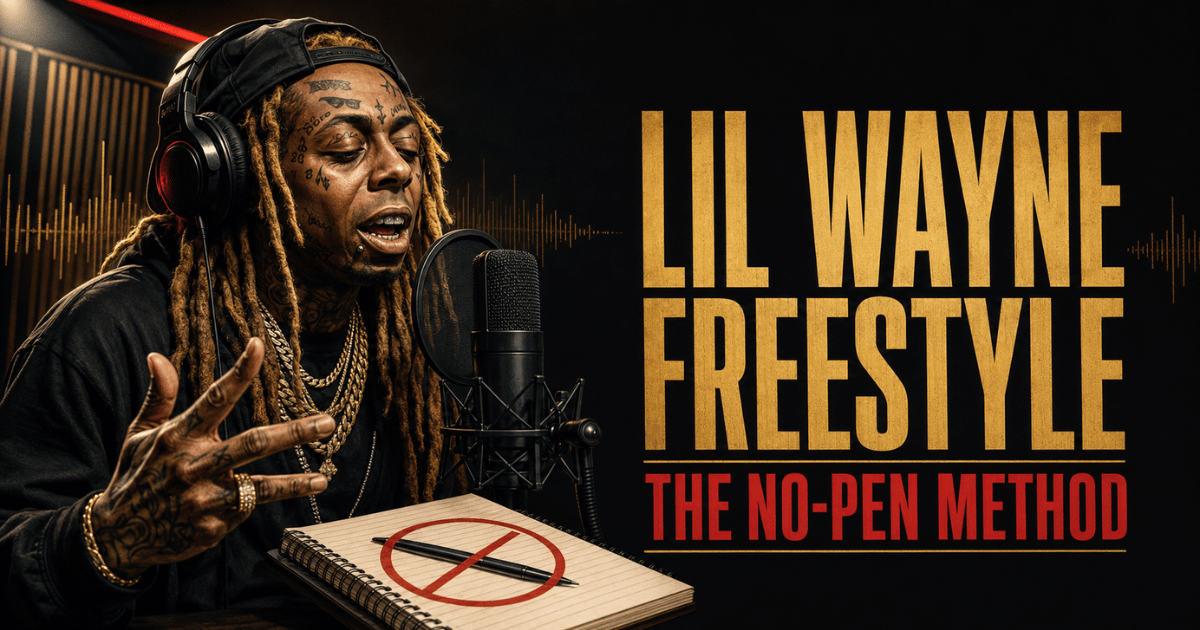
Lil Wayne is often described as a rapper who freestyles every song. That description is close enough to spread, but too imprecise to explain his craft. Wayne’s most important technique is better understood as no-pen composition: he listens to the beat, develops lines in his head, records them, plays the result back, edits and continues. He creates through the microphone instead of transferring a finished verse from paper.
That process can produce material that feels spontaneous, and it overlaps with freestyle skills, but Wayne has explicitly distinguished it from pure off-the-dome rapping. The distinction matters. A live freestyle asks the artist to invent and deliver continuously in real time. Wayne’s studio method allows listening, memory, recording, deletion, repetition and arrangement. It removes the notebook without removing composition.
Quick answer: Lil Wayne stopped routinely writing lyrics on paper in the early 2000s after learning that Jay-Z composed without a notebook. Wayne has identified the extended 2002 recording commonly known as 10,000 Bars as the final purge of his written rhyme books. Since then, his core workflow has been to create inside the recording process. His famous mixtape “freestyles” are usually crafted recordings over existing beats, while his live radio performances represent a different test of improvisation. The common thread is an enormous internal vocabulary, rhythmic control, fast association and relentless studio practice.
This guide separates those methods, traces the mixtape run that changed rap, analyses Wayne’s flow and punchline architecture, and converts the evidence into a practical system. It does not reproduce copyrighted lyrics. Artists can study the craft, choose original freestyle rap beats and build a distinct voice without copying Wayne’s recordings, identity or delivery.
Researched and reviewed: July 17, 2026
Lil Wayne facts at a glance
| Question | Answer |
|---|---|
| What is Lil Wayne’s real name? | Dwayne Michael Carter Jr. |
| When was Lil Wayne born? | September 27, 1982 |
| How old is Lil Wayne? | 43 as of July 2026 |
| Where is Lil Wayne from? | New Orleans, Louisiana; he is closely associated with Hollygrove in the city’s 17th Ward |
| What are his best-known nicknames? | Weezy, Weezy F. Baby, Tunechi and President Carter |
| When did his career begin? | He joined Cash Money Records as a child and had been recording from approximately age 11 |
| Did Lil Wayne write his lyrics? | He wrote lyrics earlier in his career, but has composed primarily without writing them on paper since the early 2000s |
| What was the last project he wrote down? | Wayne has identified the 2002 recording known as 10,000 Bars as the end of his notebook era |
| Is every Lil Wayne song a freestyle? | No. His no-pen studio composition, live off-the-dome freestyling and mixtape tracks labelled “freestyle” are different formats |
| What was his biggest solo hit? | “Lollipop” featuring Static Major, his first Billboard Hot 100 No. 1 and a Diamond-certified single |
| How many Grammys has Lil Wayne won? | Five wins from 28 nominations through the 2026 Grammy Awards |
| What is his latest studio album? | Tha Carter VI, released June 6, 2025 |
The official Grammy artist record for Lil Wayne lists five wins and 28 nominations, including a 2026 Best Rap Song nomination connected to Tyler, the Creator’s “Sticky.” The same record traces his breakthrough from Tha Block Is Hot to the Grammy sweep surrounding Tha Carter III. The RIAA’s Lil Wayne certification database confirms the long commercial tail of songs including “Lollipop,” “A Milli,” “6 Foot 7 Foot,” “How to Love,” “Mona Lisa” and “Love Me.”
Who is Lil Wayne?
Dwayne Michael Carter Jr. grew up in New Orleans and entered the professional recording system unusually young. Cash Money co-founder Bryan “Birdman” Williams recognised his ability while Wayne was still a child. He recorded first as part of the B.G.’z with B.G., then joined Juvenile, B.G. and Turk in the Hot Boys. That environment gave him years of apprenticeship before most rappers have booked a first serious session.
The Hot Boys helped define late-1990s Cash Money: Mannie Fresh’s bright, elastic drums; regional slang; New Orleans bounce energy; and a group dynamic in which every voice needed to be immediately recognisable. Wayne’s solo debut, Tha Block Is Hot, arrived in 1999 and reached No. 3 on the Billboard 200. The success was significant, but his transformation into the artist later called the Best Rapper Alive took several more years.
Tha Carter in 2004 sharpened his identity. Tha Carter II in 2005 expanded the technical ambition. At the same time, Wayne flooded the mixtape circuit through Sqad Up releases, the Dedication series and the Da Drought tapes. Albums demonstrated he could construct records; mixtapes demonstrated that almost any available instrumental could become a platform for his voice.
The breakthrough became an avalanche. Dedication 2 and Da Drought 3 placed him at the centre of critical conversation, while a relentless feature run made him nearly unavoidable. Tha Carter III sold more than one million U.S. copies in its opening week in 2008. “Lollipop” reached No. 1; “A Milli” turned a skeletal loop into a display of verbal pressure; and the album won Best Rap Album at the Grammys.
Wayne also built an institution. Young Money Entertainment became the launch platform for Drake and Nicki Minaj, two artists who would define the following era of mainstream rap and pop. His influence therefore moved through both sound and infrastructure: vocal style, release strategy, features, mixtapes, artist development and the idea that a rapper could be simultaneously regional, internet-native and globally commercial.
Later projects tested the elasticity of that identity. Rebirth moved toward rap rock; I Am Not a Human Being and Tha Carter IV extended his chart dominance; Tha Carter V arrived in 2018 after years of label conflict; Funeral followed in 2020; and Tha Carter VI appeared in 2025. The Recording Academy’s guide to all six Tha Carter albums describes a twenty-year arc from Southern prodigy to hitmaker to elder statesman.
That scale can obscure the mechanism beneath it. Wayne’s catalogue is enormous not simply because he had ideas. It is enormous because he developed a recording system capable of converting ideas into audio with minimal delay.
Lil Wayne freestyle versus no-pen composition: the crucial difference
The word freestyle carries several meanings in hip-hop. Search results mix them together, but an accurate analysis needs to separate at least four practices.
| Practice | How it works | How it relates to Lil Wayne |
|---|---|---|
| Off-the-dome freestyle | Words and delivery are improvised continuously during the performance | Wayne has performed spontaneous verses, but this is not the best description of every studio song |
| Prepared freestyle | Existing lines, fragments or written material are delivered in a freestyle setting | Some radio performances may combine familiar material with immediate reactions, as experienced MCs commonly do |
| Mixtape freestyle | A newly recorded rap is placed over another artist’s released instrumental | This is central to Dedication, Da Drought 3, No Ceilings and Wayne’s legend |
| No-pen studio composition | The artist composes mentally while recording, replaying and editing instead of writing on paper | This is the clearest description of Wayne’s primary studio method |
The strongest evidence comes from direct studio observation. In a detailed GQ profile of Lil Wayne’s working process, Devin Friedman watched Wayne loop the beginning of a Swizz Beatz track and construct the vocal through recording. The profile explains that Wayne considered this process different from freestyling: he was composing, evaluating, deleting and moving forward, but the medium holding the work was audio rather than paper.
That distinction resolves a common argument. One listener says Wayne freestyles everything because he does not write. Another says the claim is false because he pauses and thinks before recording. Both are using freestyle differently. Wayne’s method is spontaneous relative to a finished written page, yet deliberate relative to an uninterrupted off-the-dome performance.
The no-pen method also should not be reduced to one-bar punching. Punching in is a DAW technique: record a section, stop, resume from a chosen point and join the takes. Some modern artists use extremely short punches. Wayne can use playback and sectional recording, but his long apprenticeship allows him to hold larger rhythmic and lyrical units in memory. Collaborators have described him completing long verses or songs rapidly rather than assembling every line as an isolated fragment.
For aspiring rappers, terminology is less important than honest diagnosis. Ask what you are training:
- If the beat plays continuously and you cannot stop, you are training real-time improvisation.
- If you think silently, record a section, replay and continue, you are training no-pen composition.
- If you bring memorised lines into a live setting, you are training performance and adaptation.
- If you reinterpret an existing instrumental, you are practising the mixtape tradition—but commercial release requires appropriate rights.
BTR’s wider guide to freestyle rap explains the off-the-dome tradition. The method studied here is the bridge between that improvisational reflex and a finished studio record.
10,000 Bars: when Lil Wayne left the notebook behind
The turning point in Wayne’s writing story is the extended 2002 recording generally called 10,000 Bars. The title is not a reliable literal bar count, and the track should not be treated as a conventional single. It is an approximately thirty-five-minute performance built from the accumulated material in Wayne’s rhyme books.
Wayne has repeatedly connected the decision to Jay-Z. After hearing that Jay-Z could compose without physically writing lyrics, Wayne decided to abandon the notebook himself. In a 2023 interview discussed by American Songwriter, he identified 10,000 Bars as the last time he worked through written rhymes in that way.
The story is often converted into mythology: Wayne emptied a notebook and instantly became a supernatural freestyler. A more useful reading is that he changed storage systems. Before the transition, the page stored language outside his body. After it, memory, rehearsal, repeated playback and the DAW carried more of the load.
That change created several consequences:
- Delivery entered composition earlier. A line was judged as sound against drums, not only as text.
- The beat shaped the wording. Cadence and rhyme could respond to the instrumental before the verse became fixed.
- Editing became audible. Playback revealed whether a phrase landed, dragged or needed replacement.
- Output accelerated. Wayne did not need to complete a page before entering the booth.
- Memory became a trained instrument. Images, rhymes, names and punchline structures needed to remain available without visual prompts.
The method came after years of writing and recording. That order matters. Wayne did not skip literacy, vocabulary, rhyme practice or performance experience. He internalised them. Beginners who throw away the notebook before building the underlying skills may remove support without gaining freedom.
Does “no pen” mean Lil Wayne is not a songwriter?
No. Songwriting describes the creation of musical and lyrical material, not the physical object used to preserve it. A composer can work through notation, an instrument, voice notes, a DAW, improvisation or collaboration. Wayne receives songwriting credits because he creates words, melodies, structures and performances. The phrase does not write means he generally does not handwrite or type a finished lyric sheet before recording; it does not mean the lyrics have no author.
Does no pen prove every line is the first thought?
No. The studio allows reconsideration. Wayne can listen to a loop, hold a line internally, test it, replace it, extend it or record another take. The absence of visible writing says nothing by itself about how many mental drafts occurred. The craft is not diminished by selection. Selection is part of composition.
How Lil Wayne records songs without writing lyrics
There is no single official Wayne template applied to every session. His process has changed across decades, collaborators and technologies. Still, observed sessions and engineer accounts reveal a consistent operating model.
1. He gives the beat enough time to become usable
Wayne does not always attack the first second of an instrumental. Manny Galvez, his full-time engineer since 2016, told Revolt that Wayne may listen for a long period before he is ready. The engineer’s challenge is remaining alert because the recording moment can arrive after an extended session.
Listening is not inactivity. The artist is locating the tempo, snare, subdivisions, open spaces, tonal mood and possible entrance. A beat can support several flows; the first task is selecting the version of the beat the voice will reveal.
2. He composes in sound, not silent prose
Written lyrics can look strong while fitting a beat poorly. No-pen composition reverses the order. The line exists with its stress, breath, tone and timing attached. If a word is technically correct but awkward in the mouth, it is less likely to survive.
This helps explain Wayne’s abundance of compressed phrases, elastic pronunciations and surprising rhyme links. He is not merely choosing dictionary matches. He is testing what language can become when spoken in that pocket.
3. Playback becomes the notebook
After a section is recorded, the audio stores it. Wayne can hear the previous cadence, remember the final sound and decide where the next thought should move. This reduces the need to keep the entire verse active in working memory at once.
A good engineer makes this frictionless. The session must be labelled, routed and ready; the artist should not wait while someone searches for a track or repairs an avoidable technical problem. Galvez’s account of Wayne’s sessions emphasises permanent readiness because inspiration does not follow office hours.
4. The next line grows from the previous line
Wayne’s writing often moves through association. A noun suggests an object; the object suggests a brand, athlete, film, location or idiom; that reference opens a second meaning; the second meaning supplies the punchline. The chain does not always build a linear story, but it builds local momentum.
This is one reason his verses can feel unpredictable without sounding random. The connection may be phonetic, cultural or metaphorical rather than narrative. The listener experiences a series of doors opening.
5. He can deliver substantial passages
Modern discussion sometimes assumes every no-pen rapper records one bar at a time. Wayne’s technique is more flexible. Years of performance allow him to retain longer combinations, while the studio still permits pauses and revisions. The correct unit is whatever preserves energy and accuracy: a line, four bars, a complete verse or an entire take.
6. Volume creates selection
During the making of Tha Carter V, Galvez recalled days that ended with approximately fifty bounced files. He compared Wayne’s studio routine to an elite athlete treating practice as a daily gym. The release is the public game; much of the training remains unheard.
That volume changes creativity. If one song must carry the value of an entire week, the artist may overprotect every idea. If several recordings can be made, risk becomes cheaper. Strange flows, difficult beats and imperfect experiments are allowed to exist. The catalogue benefits from the small percentage that becomes exceptional.
7. Speed does not eliminate finishing
Galvez described “Dedicate” as a song Wayne recorded in no more than fifteen or twenty minutes. That account proves rapid vocal creation, not instant commercial completion. Production, hook decisions, editing, arrangement, mixing, mastering, clearances and release strategy remain separate stages.
The useful principle is division of labour: capture the performance before the idea cools, then let finishing decisions happen with better perspective.
How Lil Wayne’s mixtape run changed rap
Lil Wayne’s no-pen method would be historically important even without the mixtapes. The mixtapes made the method public at industrial scale. Instead of waiting for an album cycle, he could respond to the sound of the moment, take beats listeners already recognised and demonstrate a different way to inhabit them.
Sqad Up and the early laboratory
The Sqad Up tapes helped establish repetition as development. Wayne could rap frequently, test his identity and operate outside the pressure placed on a formal Cash Money album. These releases are important because the famous 2005–2009 run did not appear from nowhere. It grew from years of lower-stakes recording.
Dedication 2: concentration and competitive identity
Hosted by DJ Drama and released in 2006, Dedication 2 placed Wayne inside the Gangsta Grillz tradition while sharpening his Best Rapper Alive claim. The tape balances technical displays, political commentary, humour and New Orleans identity. It functions as a complete argument rather than a random folder of remixes.
“Cannon” demonstrates sustained attack over a beat already associated with other voices. “Georgia… Bush” shows that the format could carry political anger and Hurricane Katrina commentary, not only boasts. The lesson is that beat appropriation was a distribution format, but the artist still needed a point of view.
Da Drought 3: every beat becomes Wayne’s territory
Released in 2007 as a free, DJ-less double mixtape, Da Drought 3 contains roughly one hundred minutes of rapping across 29 tracks. Pitchfork’s contemporary Da Drought 3 review described its free-associative force, versatile flow and abundance of jokes and similes as a vision of rap’s future.
The tape’s power comes partly from recognition. Listeners know the original beat, so every Wayne choice becomes a comparison: entrance, cadence, concept, intensity and memorability. He did not need to prove that he commissioned the instrumental. He needed to prove that his imagination could change its owner in the audience’s mind.
No Ceilings: reclaiming momentum after superstardom
No Ceilings arrived in 2009 after Tha Carter III had made Wayne a global star. Instead of protecting the brand through only expensive singles, he returned to popular beats. The Pitchfork review of No Ceilings highlighted the way he transformed tracks including “Swag Surfin” and “Ice Cream Paint Job” through free movement, punchlines and control.
The tape matters strategically. An artist can use formal albums for ownership, narrative and commercial focus while using looser formats to maintain cultural conversation. Wayne’s output made the gap between campaigns feel active rather than empty.
Sorry 4 the Wait, later Dedication tapes and No Ceilings sequels
When album delays created frustration, the mixtape became an apology expressed through more music. Sorry 4 the Wait turned a business delay into fan service. Later projects showed that Wayne could return to the format after the original peak, even as streaming changed how unofficial samples and borrowed beats could be distributed.
The legal lesson independent artists cannot ignore
A free download from the mixtape era and a monetised release on modern streaming services are not legally equivalent. A rapper may create a brilliant new vocal over a famous instrumental and still lack rights to distribute or monetise the underlying master and composition. Streaming editions of classic mixtapes have sometimes omitted tracks because clearances were unavailable.
Use Wayne’s method as a creative exercise, not as automatic permission. For a public commercial release, commission an original instrumental, secure the necessary licences or choose properly licensed rap beats. BTR’s copyright and contracts guide for rap artists explains why crediting the original artist does not replace clearance.
Best Lil Wayne freestyles and mixtape performances to study
“Best” is subjective, and the word freestyle is being used here in the broad mixtape and performance sense. This list is not a substitute for Wayne’s albums. It is a study path showing different strengths of the no-pen and beat-reinterpretation method.
| Performance | Project or context | What to study |
|---|---|---|
| “Cannon” | Dedication 2 | Sustained pressure, internal rhyme and competitive focus |
| “Georgia… Bush” | Dedication 2 | How a mixtape beat can carry political and regional meaning |
| “Live From 504” | Da Drought 3 | Free association that remains rhythmically controlled |
| “Dough Is What I Got” | Da Drought 3 | Reframing a famous Jay-Z instrumental through personality and punchlines |
| “Upgrade U” | Da Drought 3 | Adapting to a beat outside a narrow street-rap template |
| “Sky Is the Limit” | Da Drought 3 | Confidence, memorable comparisons and command of a recognisable loop |
| “Swag Surfin” | No Ceilings | Riding a simple regional hit with variation and verbal energy |
| “Ice Cream Paint Job” | No Ceilings | Pocket control and the ability to make another artist’s single feel newly claimed |
| “Run This Town” | No Ceilings | How Wayne handles a larger, more dramatic instrumental |
| “Back to Back” | No Ceilings 2 | Responding to a contemporary beat while maintaining his established identity |
| “BB King Freestyle” with Drake | No Ceilings 3 | Mature pacing, collaborative contrast and conversational confidence |
| Rap City / radio appearances | Live or broadcast settings | Breath, presence and the difference between performance spontaneity and studio construction |
Pitchfork’s 2025 selection of the 50 best Lil Wayne songs placed “Live From 504” near the top of his entire catalogue, illustrating how mixtape performances can carry equal or greater cultural weight than formal singles. The important study question is not whether every syllable appeared without prior thought. It is how completely Wayne converts a borrowed musical environment into his own language.
Why Lil Wayne’s flow, punchlines and wordplay work
No-pen speed alone does not explain Wayne. Thousands of artists can record quickly. His peak work remains memorable because several technical systems operate together.
1. He builds punchlines through semantic hinges
A semantic hinge is a word or phrase with more than one usable direction. Wayne introduces an ordinary object, name or expression, then turns it so the second meaning completes the joke or boast. The setup often feels casual because the crucial word has not yet revealed its second function.
To practise the mechanism, choose a common word—charge, court, case, current or weight. List its literal, commercial, legal, athletic and emotional meanings. Build one bar that establishes the first meaning and another that flips to the second. Do not borrow Wayne’s reference; learn the architecture.
2. He thinks in networks of comparison
Wayne’s similes draw from sports, cartoons, films, brands, technology, street language and everyday objects. A large reference library increases the chance that an unexpected comparison will be available at the correct rhyme sound.
The weakness of imitation is obvious: artists copy the surface topics and produce dated references. The real skill is maintaining an actively updated personal reference bank. Read outside rap. Watch sport, learn local history, notice work, family, transport and technology. Original comparison depends on original observation.
3. His free association is locally coherent
A Wayne verse may change subject quickly, but adjacent lines often connect through sound, image or double meaning. Global narrative coherence is optional; local transition is not. The listener accepts the leap because the landing rewards attention.
This is why a rap rhyme generator can help only if used before the session to expand possibility. Random rhyming words do not create Wayne’s associative logic. The artist must know why one image opens the next.
4. He uses modular rhythmic cells
A long flow can be built from smaller repeatable cells: a three-syllable pickup, a stressed landing near the snare, a triplet burst, a pause and a stretched final vowel. Wayne can repeat the cell long enough to establish control, then alter one variable before predictability becomes boredom.
Music theorists define flow broadly through the rhythmic and articulative features of rap delivery. Research published by the Society for Music Theory on collaborative flow in rap music shows how accent, rhythm, structure and interaction create identity beyond the words alone. Wayne’s verses demonstrate the point: printed text cannot capture the precise placement, rasp, elongation and interruption that make the line his.
5. His voice acts like a percussion instrument
Wayne’s high, weathered rasp cuts through dense mixes. Hard consonants can reinforce drums; nasal vowels can sustain above bass; sudden vocal cracks add emphasis. Ad-libs operate as punctuation and character, not only decoration.
This distinct timbre made a feature immediately identifiable. A listener did not need to wait for a name. For independent artists, that is a branding lesson with musical consequences: a recognisable vocal texture can create recall before the hook arrives.
6. He varies density
Technical rappers sometimes fill every subdivision. Wayne can be dense, but he also leaves room, drags a word, laughs, pauses or repeats a compact phrase. Density feels impressive because space exists around it.
Use BTR’s guide to improving rap flow and delivery to practise the same verse at three densities. If every version has the same number of syllables, the flow is not yet flexible.
7. He treats pronunciation as adjustable
In rap, rhyme is heard rather than inspected. Wayne bends vowels, clips consonants and changes emphasis to bring distant words closer. The technique works when the altered pronunciation remains intelligible and characterful. Forced beyond that point, it becomes noise.
8. He commits to the persona
The strangest comparison can survive if the delivery signals total belief. Wayne’s humour, menace, absurdity and confidence share a stable centre: the voice assumes that its imagination is the most important event on the beat. Commitment turns a risky line into a memorable one.
Lil Wayne songs that reveal the recording method
The mixtapes reveal competitive beat control. The albums show what happens when that verbal engine is integrated with original production, hooks, storytelling and commercial structure.
“A Milli”: minimal production as a lyrical runway
“A Milli” removes many of the supports expected from a mainstream single. Bangladesh’s beat revolves around a repetitive vocal fragment, heavy drums and open space. There is no conventional sung chorus interrupting the central rap performance. The track asks whether voice alone can create enough variation.
Wayne answers through cadence changes, vocal emphasis, one-line images and accumulation. The beat became attractive to other rappers precisely because it exposes technique. It is the commercial version of a cipher environment: simple enough to enter, unforgiving if the voice lacks presence.
“6 Foot 7 Foot”: punchline density with structural control
This track is frequently used to teach figurative language because its comparisons arrive at unusual speed. The better lesson is structural. Dense wordplay remains attached to a recurring rhythmic engine, and Cory Gunz’s guest verse changes the energy rather than merely duplicating Wayne.
Study the spaces between the biggest moments. A punchline cannot land if the setup, breath and following phrase all compete at the same intensity.
“Let the Beat Build”: arrangement awareness becomes the concept
The production develops incrementally, and Wayne aligns the vocal concept with that development. The song demonstrates that a no-pen rapper is not separate from arrangement. Hearing when drums, bass and samples enter can create subject, pacing and escalation.
Producers should supply versions with clear development points. Rappers should mark where the beat changes before recording. A verse can feel composed even when created spontaneously if its intensity follows the instrumental architecture.
“Mona Lisa”: evidence that Wayne can sustain narrative
Wayne is often reduced to unrelated punchlines. “Mona Lisa,” featuring Kendrick Lamar, shows a different capability: characters, deception, perspective and plot. The performance proves that no-pen composition does not require abandoning story. It requires keeping the scene and objective active while generating detail.
For story-based practice, define four anchors before recording: character, desire, obstacle and turn. The exact lines can remain unwritten; the narrative coordinates prevent free association from leaving the story.
“How to Love”: melody expands the emotional range
Wayne’s influence is not confined to technical bars. “How to Love” foregrounds melody, vulnerability and a restrained arrangement. His willingness to sing, use pitch correction and cross genre boundaries helped make later melodic rap feel less like a departure from the rapper’s identity.
“Lollipop”: the catalogue needed songs as well as demonstrations
“Lollipop” is not the ideal example of a freestyle showcase. It is the ideal reminder that careers require different record functions. A mixtape verse can establish supremacy; a hook-led single can reach an audience that will never study a thirty-five-minute rap. The RIAA certified “Lollipop” Diamond in 2022, confirming a level of reach that technical admiration alone rarely produces.
“Dedicate”: rapid recording supported by decades of preparation
Manny Galvez’s Studio Sessions account places the recording time for “Dedicate” at roughly fifteen to twenty minutes. The song arrived near the end of a long session after Wayne heard Galvez’s beat, recorded one verse, appeared ready to leave, then returned for another.
The story is useful because it contains both speed and context. The fast recording happened inside a life built around recording. The spectacular twenty minutes rested on years of ordinary hours.
Tha Carter VI: longevity does not guarantee every experiment works
Released in 2025, Tha Carter VI confirmed Wayne’s continued willingness to collaborate across styles. It also received substantial criticism for uneven direction and overextended technical habits, including in Pitchfork’s review of Tha Carter VI. That tension belongs in an honest study. A productive method can generate masterpieces, useful experiments and forgettable material. Output increases opportunity; it does not suspend editorial judgment.
The mature lesson is not “record fast and release everything.” It is “record freely, then select with standards strong enough to protect the catalogue.”
A practical Lil Wayne no-pen workflow for rappers
This exercise adapts the principles without pretending that one session can reproduce Wayne’s decades of experience. The goal is to move composition closer to performance while preserving meaning and editability.
Stage 1: prepare the session before inspiration arrives
Create a template with the beat routed, microphone checked and recording tracks named. Use:
- one scratch lead track;
- two alternate lead tracks;
- one hook track;
- two double tracks;
- one ad-lib track;
- a marker lane for section names;
- a notes field for the concept, not finished lyrics.
Latency should be low enough that monitoring feels immediate. Save the template. Creative speed is often the result of eliminating repeated setup decisions.
Stage 2: listen without recording
Play the beat three times. During the first pass, hear the mood. During the second, focus on drums and possible entrances. During the third, test silent cadences. Do not force words yet.
Use the free online BPM analyser if the tempo is unclear. Knowing whether the beat is being felt in half-time or double-time helps the session grid, but the body’s pocket matters more than the displayed number.
Stage 3: choose one verbal engine
Select one of four engines:
- Punchline engine: each pair of bars turns a word or image.
- Story engine: every section advances character, obstacle or consequence.
- Emotion engine: every image returns to one feeling.
- Competition engine: every line reinforces skill, status or intent.
Wayne can move between engines because his control is exceptional. A developing artist should begin with one so the verse has a centre.
Stage 4: hold two bars, then record
Find an opening line and one continuation. Repeat them internally until the rhythm is stable, then record. If you can comfortably hold four or eight bars, increase the unit. If you cannot hold two, simplify rather than mumbling filler.
Do not type the lines after recording. Let the waveform become the record of the thought. This is the specific memory skill the exercise is training.
Stage 5: replay only what you need
Listen from several seconds before the endpoint. Identify three things:
- the final rhyme sound;
- the unresolved image or claim;
- the rhythmic shape that should continue or change.
Compose the next unit and record. Continue until a sixteen-bar verse exists. Do not restart from bar one after every minor flaw.
Stage 6: perform one complete pass
Now listen to the assembled verse until its logic is familiar, then record a complete take. This step stops the final performance from sounding like disconnected clips. Keep the assembled version as insurance and compare energy, timing and clarity.
Stage 7: extract the hook
Review the verse for the phrase with the strongest memory, title potential or emotional summary. Build a hook around it. If no phrase survives, the concept may not be strong enough. Use BTR’s guide to creating a rap hook to test repetition, contrast and title placement.
Stage 8: edit with a scorecard
| Dimension | Question | Score |
|---|---|---|
| Do stresses and pauses feel intentional against the drums? | 1–5 | |
| Clarity | Can a listener understand the words and main idea? | 1–5 |
| Originality | Are the comparisons and details recognisably yours? | 1–5 |
| Continuity | Does each line create a reason for the next? | 1–5 |
| Performance | Does the vocal sound committed rather than tentative? | 1–5 |
| Recall | Can you remember one phrase ten minutes later? | 1–5 |
Replace sections scoring below three. Do not preserve a weak line merely because it arrived spontaneously. The method values discovery, not first-take superstition.
30-day Lil Wayne freestyle and no-pen training plan
This plan trains memory, association, rhythm and completion in stages. Record every day, but release none of the exercises until the final review.
| Days | Training focus | Daily assignment |
|---|---|---|
| 1–3 | Rhythmic memory | Create and retain two-bar phrases, then record without written prompts |
| 4–6 | Rhyme families | Choose one vowel family and build eight connected bars |
| 7 | Review | Score the week for pocket, clarity and continuity |
| 8–10 | Double meanings | Build four original semantic hinges from everyday words |
| 11–13 | Comparison | Create similes from your own work, city, family, hobbies and routines |
| 14 | Complete verse | Record sixteen bars using no visible lyrics |
| 15–17 | Beat adaptation | Use three different tempos while keeping the same central concept |
| 18–20 | Density control | Record sparse, medium and dense versions of one verse |
| 21 | Uninterrupted performance | Deliver a three-minute off-the-dome freestyle without restarting |
| 22–24 | Song construction | Build hook, verse and hook return through audio-first composition |
| 25–27 | Alternate takes | Record three complete performances with different vocal intensity |
| 28 | Edit | Comp the strongest performance without destroying natural timing |
| 29 | Mix and test | Create a rough mix and test on headphones, phone and car speakers |
| 30 | Catalogue review | Choose one finished song and document the method that produced it |
The day-21 off-the-dome session serves a different purpose from the other exercises. It trains recovery and forward motion. Complete it with BTR’s freestyle experience, then return to studio composition with less fear of imperfect first thoughts.
A weekly vocabulary system
Every week, collect twenty-five usable references from outside your existing rap vocabulary:
- five local places or details;
- five terms from work or a technical field;
- five people, moments or rules from sport;
- five objects encountered in daily life;
- five emotional or relational observations.
Build rhyme families and double meanings around them. Wayne’s associative abundance depends on inputs. A rapper who consumes only other rap lyrics will eventually recycle the genre’s most obvious references.
How to make a Lil Wayne-inspired type beat without copying a song
There is no single Lil Wayne type beat. His catalogue crosses New Orleans bounce, Southern hip-hop, sparse lyrical showcases, pop rap, rock experiments, trap and contemporary production. A useful producer chooses an era and a vocal function instead of copying one famous instrumental.
| Direction | Production characteristics | Vocal opportunity |
|---|---|---|
| Early Cash Money / Mannie Fresh-inspired | Bright synth movement, bounce-informed drums, elastic bass and playful space | Animated cadence, regional character and conversational swagger |
| Tha Carter II-inspired | Soulful or cinematic textures, strong drums and room for long verses | Focused lyricism, storytelling and confident projection |
| “A Milli”-style lyrical runway | Minimal loop, unforgettable vocal fragment, heavy low end and few harmonic distractions | Flow changes, punchline density and vocal dominance |
| No Ceilings-inspired modern beat | Immediate drums, recognisable energy and a pocket that rewards reinterpretation | Competitive verses and fast associative movement |
| Melodic Wayne-inspired | Guitar or keyboard motif, simple chord loop, restrained drums and hook space | Rap-singing, emotional phrasing and pitch-treated texture |
| Modern experimental Carter-inspired | Unexpected sample colour, section changes and cross-genre instrumentation | Character shifts, unusual references and contrast |
Tempo: leave more than one lane
Wayne has worked across a wide tempo range, so there is no authentic number every type beat must match. A practical zone for contemporary rap is roughly 70–100 BPM, or 140–200 when counted in double-time. What matters is whether the drums allow sparse speech, rapid subdivisions and clear punchline landings.
Make the loop memorable but not crowded
A no-pen rapper benefits from repetition because the beat becomes predictable enough to support mental composition. The main loop should establish identity quickly, then leave frequency and rhythmic space for the vocal. Complexity can appear through arrangement rather than constant instrumentation.
Use drum details as navigation
Small fills, dropouts and hi-hat changes can tell the rapper where sections are moving. Avoid changing everything every two bars. The performer needs a stable floor before a surprise has value.
Build an arrangement that can grow after the vocal
Provide an eight-bar loop for discovery, then create full sections after the strongest vocal exists. This lets the rapper shape the first performance freely and lets the producer answer it with mutes, transitions and added instrumentation.
Explore hip-hop beats and judge them by vocal opportunity: Can a rapper enter immediately? Is there space for a distinct voice? Does the beat contain a memorable identity without finishing the entire conversation itself?
How to record and mix a no-pen rap song
Keep the signal consistent across a long session
Set the microphone distance and input gain before recording. Mark the standing position if necessary. Long sessions generate many takes; inconsistent distance makes comping and mixing harder. Record with healthy headroom rather than chasing maximum waveform size.
Do not print heavy effects into the only lead vocal
Monitoring with compression, reverb or pitch correction can inspire performance, but preserve a clean vocal when possible. Wayne’s engineer has discussed moving away from an overreliance on Auto-Tune toward other pitch tools and accepting some expressive imperfection. The lesson is not that one plugin is always better. It is that processing should support the artist rather than erase the human signal.
If melodic sections need correction, use BTR’s online Auto-Tune and pitch-correction tool with restraint. Keep the intentional slides, cracks and rasp that carry character.
Label every take immediately
No-pen output can become an archive problem. Use names such as V1_LEAD_A, V1_FULL_PASS, HOOK_ALT_02 and ADLIB_HIGH. Add dates, BPM and key to the session folder. A brilliant line is useless if nobody can locate the correct file.
Comp for thought and energy
The technically cleanest take may not be the most persuasive. Choose sections that preserve meaning, pocket, vocal character and continuity. Avoid switching takes in the middle of every word merely because the DAW permits it. Excessive micro-editing can make spontaneous delivery feel assembled.
Use doubles as emphasis, not permanent camouflage
Double the hook, selected phrase endings or high-energy bars. A constant loud double can blur consonants and weaken intimacy. Ad-libs should create a second layer of attitude or rhythm rather than repeat every lead word.
Finish for the listening environment
Check vocal intelligibility at low volume, bass balance in mono and harshness on small speakers. The rapper should remain clear without the beat losing impact. BTR’s guide to mixing and mastering rap vocals covers corrective EQ, compression, de-essing, ambience and final delivery in detail.
Common mistakes when learning from Lil Wayne
Mistake 1: believing no notebook means no thinking
Wayne’s method still contains thought, revision and selection. Refusing to plan a concept or replace a weak section does not make a recording authentic. It makes the editor absent.
Mistake 2: abandoning writing before building language
Written practice develops imagery, narrative, vocabulary and complex rhyme without the time pressure of a beat. Wayne wrote for years before making the transition. Keep writing exercises even if the final vocal is composed in the booth.
Mistake 3: copying Wayne’s voice and reference library
A rasp, familiar ad-lib or collection of sports metaphors may create a superficial resemblance. It will not create the authority behind the original. Use local detail and your actual obsessions. The method should make your identity more immediate, not replace it with his.
Mistake 4: treating every line as a punchline
Without setup, contrast and breathing room, punchlines flatten into a list. Use connective bars, images, silence and changes in density. A song needs movement, not only captions.
Mistake 5: releasing uncleared freestyles commercially
Rapping over a famous beat is valuable practice and part of mixtape history. It does not automatically grant distribution rights. Keep exercises private, share only where the licence permits or replace the beat with an original before monetisation.
Mistake 6: confusing substance use with creative technique
Wayne’s public history includes references to substance use and serious health events. None is required for no-pen composition. The transferable method is listening, memory, repetition, recording readiness and work ethic. Romanticising harmful behaviour obscures the craft and creates avoidable risk.
Mistake 7: keeping every recording because output feels productive
High output is a search process. The public catalogue still needs selection. Separate the roles of creator and editor: generate without fear, then review later against clear standards.
Mistake 8: failing to finish songs
Hundreds of sixteen-bar files are not an album. Schedule arrangement, hooks, features, mixes, artwork, metadata and release decisions. Use BTR’s guide to rap song structure to turn the strongest verse into a complete record.
How Lil Wayne’s freestyle and no-pen method influenced modern rap
Wayne did not invent oral composition. MCs improvised before rap was recorded, and artists including the Notorious B.I.G. and Jay-Z became famous for composing without conventional lyric sheets. Wayne’s contribution was to make the method extraordinarily visible during the internet-mixtape transition and prove it could support enormous output, technical respect and pop success at the same time.
He normalised the studio as a writing instrument
The DAW stopped being only the place where finished writing was captured. It became where writing happened. Playback, punch points, alternate tracks and rapid bounces formed part of the compositional environment. That model is now common across trap and melodic rap.
He made abundance a marketing language
A Wayne feature, leak or freestyle could appear at any moment. The abundance communicated appetite: he seemed to enjoy rapping too much to wait for a campaign. Modern artists use snippets, loosies, deluxe editions and constant features in a different platform economy, but the expectation that presence can be maintained through music owes much to the mixtape era he dominated.
He showed that borrowed beats could build an original brand
The instrumental supplied familiarity; Wayne supplied transformation. That logic can be seen in modern freestyle videos, remix challenges and short-form platform trends. The contemporary artist must add a legal distinction: attention built on a borrowed sound does not automatically transfer into ownership.
His Young Money tree multiplied the influence
Drake and Nicki Minaj developed distinct methods, but Young Money placed Wayne’s risk-taking, punchline flexibility and feature culture near the centre of the next generation. His mentorship and label role extended his importance beyond direct sonic imitation.
Juice WRLD made the microphone-first idea melodic
Juice WRLD’s documented ability to improvise complete melodic songs represents a later branch of microphone-first composition. Wayne’s method often foregrounds line construction and punchlines; Juice could foreground melody and emotional continuity. Read BTR’s complete Juice WRLD freestyle method analysis to compare two forms of rapid studio creation without pretending they were identical.
The strongest legacy is permission to create differently
Some artists think best on paper. Some need to walk while recording voice notes. Some discover melody through humming. Some require a live room. Wayne’s career demonstrates that the culturally accepted image of songwriting—a person silently filling pages—is only one valid system.
The standard is not whether the audience can see a notebook. The standard is whether the process repeatedly produces language, rhythm, feeling and records worth returning to.
Frequently asked questions about Lil Wayne freestyle
Does Lil Wayne really freestyle?
Yes, Lil Wayne has performed spontaneous and broadcast freestyles, but not every song made without paper is a pure off-the-dome freestyle. His primary studio technique is no-pen composition: he creates mentally while recording, replaying, editing and continuing.
Does Lil Wayne write his lyrics?
He wrote lyrics earlier in his career but has generally avoided writing them on paper since the early 2000s. He still authors and composes lyrics; he stores and develops them through memory and recording instead of a finished lyric sheet.
What was the last Lil Wayne song written on paper?
Wayne has identified the extended 2002 recording known as 10,000 Bars as the final project made from his accumulated written rhyme books before he adopted the no-pen method.
How long is Lil Wayne’s 10,000 Bars?
It runs for roughly thirty-five minutes. The title should not be interpreted as a verified literal count of ten thousand musical bars.
What is Lil Wayne’s best freestyle?
There is no objective winner. “Live From 504,” “Cannon,” “Dough Is What I Got,” “Sky Is the Limit,” “Swag Surfin” and “Ice Cream Paint Job” are strong starting points because they reveal different combinations of flow, punchlines, beat adaptation and presence.
What is Lil Wayne’s best mixtape?
Da Drought 3, Dedication 2 and No Ceilings are the three most common answers. Da Drought 3 provides the broadest demonstration of his beat-reinterpretation method, while Dedication 2 is more concentrated and No Ceilings captures the post-superstardom return to mixtape form.
What is Lil Wayne’s real name?
Lil Wayne’s real name is Dwayne Michael Carter Jr. He was born in New Orleans, Louisiana, on September 27, 1982.
How old is Lil Wayne?
Lil Wayne is 43 years old as of July 2026. He will turn 44 on September 27, 2026.
How many songs does Lil Wayne have?
No authoritative total exists. His official albums, mixtapes, group recordings, features, leaks and unreleased sessions create different possible counts. Wayne once claimed to have recorded more than a million songs, but that statement should be understood as hyperbole expressing his lifelong output, not a verified catalogue number.
What is Lil Wayne’s biggest song?
“Lollipop” featuring Static Major is his biggest solo commercial hit. It became his first Billboard Hot 100 No. 1 and received Diamond certification from the RIAA.
How many Grammys does Lil Wayne have?
He has five Grammy wins from 28 nominations through the 2026 awards. Four of those wins came at the 2009 ceremony connected to his 2008 work, including Best Rap Album for Tha Carter III.
What is the Lil Wayne no-pen method?
It is a studio composition system in which the rapper listens to the beat, creates lines mentally, records a section, replays it and continues without first writing a complete verse on paper or a phone.
Is the no-pen method the same as punching in?
Not exactly. Punching in describes the recording technique used to enter or replace a section. No-pen describes where and how the lyrics are composed. An artist can compose without paper and deliver a complete verse, or use punches of different lengths.
What BPM works for a Lil Wayne-inspired freestyle beat?
Wayne’s catalogue is too varied for one definitive tempo. Roughly 70–100 BPM, or 140–200 in double-time counting, offers useful space for modern rap practice. Beat clarity and vocal pocket are more important than matching a specific number.
Can a beginner use Lil Wayne’s recording method?
Yes, but beginners should keep written practice while gradually training memory. Start with two-bar no-pen sections, replay them, continue to sixteen bars and then record one complete pass. Increase the memory unit only when rhythm and meaning remain clear.
Final lesson: the microphone can be a notebook
Lil Wayne did not change rap by proving that paper was bad. He changed it by demonstrating how completely a rapper could think through sound. Rhythm, pronunciation, breath, tone and beat response entered the writing process at the moment of creation. The microphone became a notebook that could remember performance as well as language.
The public heard speed, but the hidden foundation was repetition: recording since childhood, absorbing thousands of references, adapting to countless beats, spending extreme hours in studios and generating enough material to make selection possible. No-pen composition was not the absence of work. It was a system built to convert work into audio quickly.
Choose an original beat from BTR’s freestyle rap beats, listen three times, hold two connected bars in memory and press record. Build the verse through sound, then judge it with the standards of a writer. Keep what is alive. Replace what is weak. Finish the song.
Editorial note: This independent educational analysis is based on credited recordings, public interviews, studio observations, engineer accounts, chart and certification records, and cited criticism. It does not reproduce Lil Wayne’s lyrics or claim affiliation with Lil Wayne, Young Money, Cash Money Records or their representatives. References to substance use are historical context, not creative advice. Artists should obtain the necessary rights before distributing vocals recorded over third-party instrumentals.