
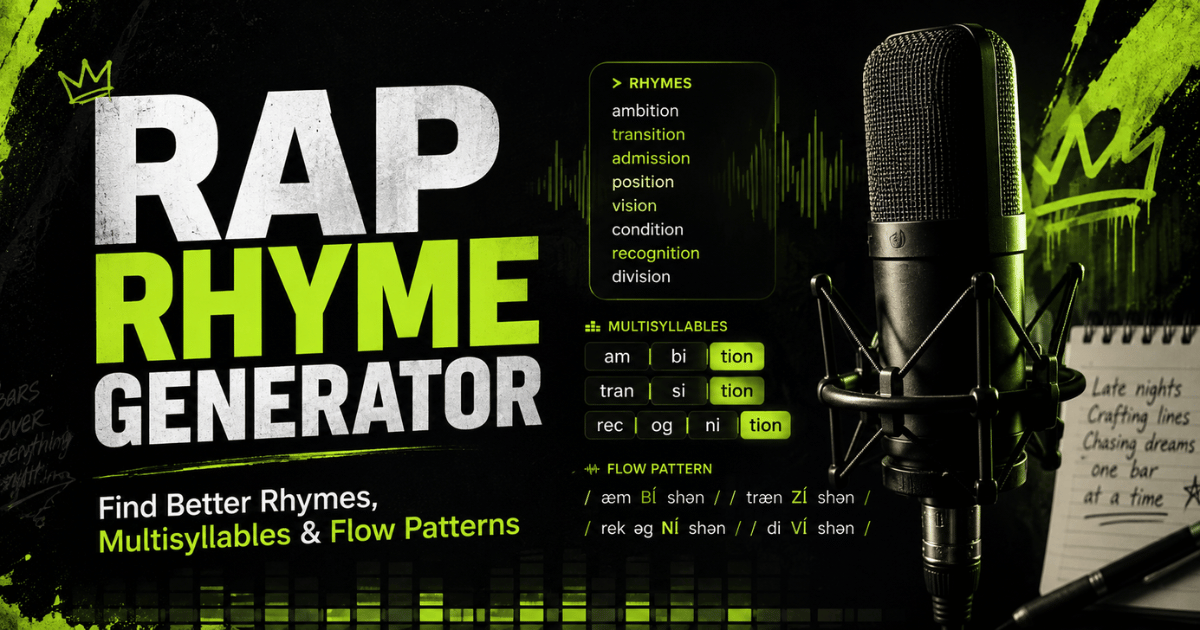
Type a word. Find rhymes. Build better bars.
For decades, the art of hip-hop lyricism was perceived as a mystical convergence of natural vocabulary, mental agility, and improvisational genius. Emcees relied on physical rhyming dictionaries that were primarily designed for traditional Western poetry, often finding them inadequate for the syncopated, percussive demands of rap. Today, the landscape of vocal arrangement and songwriting has fundamentally shifted. The modern rap rhyme generator is no longer a simple alphabetical glossary of perfect rhyming couplets; it is an algorithmic songwriting partner designed to parse phonetics, count syllables, and suggest complex multisyllabic sequences that lock perfectly into a beat’s metric grid, as shown by tools such as Rhymes for Rap on Google Play.
Build stronger bars faster with BTR’s Rap Song Lyric Generator for turning ideas into full verses, then use Cypher Pad to write, test, and tighten your flow. Pair them with this rap rhyme generator to find better rhymes, multisyllables, slant rhymes, and flow patterns before you record.
The contemporary rapper is judged not merely on narrative capability, but on the rhythmic architecture of their vocal delivery—commonly referred to as “flow.” Flow encompasses all rhythmical and articulative features of a rapper’s delivery, demanding an expansive vocabulary of sounds rather than just correctly spelled words, a point explored in Adam Krims and Kyle Adams’s work on metrical techniques of flow in rap music. This comprehensive report explores the exhaustive mechanics of modern rap lyricism, detailing how algorithms and digital tools, such as the multisyllabic rhyme generator and the rap rhyming dictionary, assist writers in building superior bars through internal rhyming, slant rhyming, and multisyllable pattern mapping.
Why Basic Rhymes Are Not Enough in Modern Rap
In the foundational years of hip-hop, lyricism was primarily driven by standard perfect end-rhymes. Pairing words like “cat,” “hat,” and “back” represented the beginner level of lyrical structure, serving a functional purpose for early party-centric music, as discussed in Luke Mounthill Beats’ AI rhyme generator guide. Early 1980s artists utilized simple AABB rhyme schemes, placing their rhymes reliably on the fourth beat of every measure, which provided a steady, predictable groove but lacked intricate rhythmic tension, as described in research on the metrical techniques of rap flow. While this was sufficient for the genre’s infancy, the evolution of hip-hop quickly outpaced these simplistic linguistic frameworks.
Relying on fundamental, single-syllable perfect rhymes renders a modern verse predictable and elementary. When a rhyme resolves too cleanly, it sounds childish to the modern listener’s ear, bordering on a nursery-rhyme status that disengages the audience, a problem addressed by RhymeFlux’s rhyme scheme analyzer. The human brain relies heavily on patterns as a cognitive shortcut for parsing vast amounts of auditory information; humans hear and retain sonic patterns before they process the semantic meaning of the words, as explained in the M & M’s of Phonetic Excellence guide for rappers. When a lyrical pattern is entirely predictable, the brain’s pattern-recognition centers disengage. Conversely, when a pattern introduces slight tension—such as matching vowels but mismatching consonants—the brain must work a fraction of a second harder to bridge the phonetic gap, interpreting that micro-effort as a satisfying auditory texture, a concept central to RhymeFlux’s explanation of slant rhyme in rap.
Advanced hip-hop lyricism requires a drastic departure from traditional poetic constraints. The modern verse is defined by internal, slant, compound, and multisyllable rhymes, as outlined in LyricStudio’s guide to slant, internal, and multisyllabic rhymes. Academic analyses of rap music, such as those conducted through the Musical Corpus of Flow (MCFlow), indicate a documented historical trend showing a massive increase in rhyme density and phrase variability from the 1980s through the 2000s, according to the MCFlow digital corpus of rap transcriptions. Rappers like MF DOOM, Nas, AZ, and the Wu-Tang Clan abandoned the predictable fourth-beat couplet in favor of dense, syncopated phonetic barrages that fall across multiple subdivisions of a measure, fundamentally altering how words that rhyme are utilized, as discussed in research on flow in rap music. A modern rap rhyme generator must accommodate this reality, focusing on the sounds words make rather than their alphabetical spellings, moving far beyond the archaic constraints of traditional English poetry, as argued in the phonetic excellence guide for rappers.
What Makes a Strong Rap Rhyme
Crafting a compelling rap verse requires treating the human voice as a percussive instrument that interplays with the instrumental track. A strong rap rhyme is not evaluated by its adherence to standard English grammar, but by its performance across several critical acoustic and metric dimensions, a principle explored in analysis of generative elements in Kendrick Lamar’s To Pimp a Butterfly. When analyzing how to rhyme in rap effectively, five distinct pillars emerge that separate amateur writers from elite lyricists.
Sound Match: Phonetic Resonance
A superior rhyme depends entirely on phonetic resonance rather than orthographic spelling. The English language is notorious for words that look identical but sound different, or look vastly different but share identical vowel sounds. A high-quality rap rhyming dictionary focuses strictly on these phonetics. For instance, the words “speech,” “leaf,” “spree,” and “beach” are perfectly acceptable rhymes in rap because they share the long “E” vowel sound, regardless of their disparate ending consonants, as explained in the phonetic excellence guide for rappers. The strongest rhymes lock the vowel sound and let the consonants act merely as percussive texture, creating a cohesive auditory experience that defies visual spelling rules.
Syllable Count
The structural integrity of a bar is governed by its syllable count. Musical measures in rap generally operate within a “cardinality-16 metric space,” meaning there are sixteen potential sixteenth-note positions within a standard 4/4 measure, as described in research on lyric, rhythm, and non-alignment in Kendrick Lamar’s “Momma”. A rhyme must mathematically fit within these rhythmic slots. If a writer utilizes a rhyme generator to find a word that perfectly matches the vowel sound but adds three extra syllables, it will overflow the bar, causing the rapper to rush, slur, or trip over the beat in the recording booth. Advanced tools like RhymeFlux feature live syllable counting and classify results into specific syllable buckets, ensuring the chosen word maintains the exact rhythm and tempo of the preceding line, as discussed in RhymeFlux’s guide to internal rhymes.
Stress Pattern
Matching vowels and syllables is insufficient if the natural linguistic stress of the words does not align. Every multisyllabic word contains stressed (heavy) and unstressed (light) syllables. For a rhyme to sit seamlessly in the instrumental pocket, the heavy syllables must fall on the prominent beats—typically the kick or the snare drum, as described in research on rhythm and non-alignment in Kendrick Lamar’s “Momma”. If a writer attempts to rhyme a word stressed on the first syllable with a word stressed on the second, the natural pronunciation will fight against the instrumental track, destroying the flow, as explained in RhymeFlux’s multisyllabic rhymes guide. Aligning linguistic stress with metrical stress is the hallmark of a professional vocal delivery.
Meaning and Narrative Context
A rhyme is mathematically and phonetically useless if it compromises the narrative integrity of the song. The “lyrical miracle” syndrome occurs when lyricists prioritize complex phonetic patterns at the expense of substance, spitting rapid-fire syllables that convey zero actual meaning, a critique reflected in the phonetic excellence guide for rappers. A strong rap rhyme advances the story, delivers a poignant punchline, or reinforces the emotional tone of the track. The rap rhyme generator must serve as a utility to uncover words that fit the existing thought, not as an algorithmic dictator that forces a nonsensical sentence just to complete a complex rhyme scheme.
Placement in the Bar
The final hallmark of a strong rhyme is its geographic location within the musical measure. Standard verses park rhymes solely at the end of the line, acting as aural punctuation marks where the artist pauses to breathe, as explained in RhymeFlux’s internal rhyme guide. However, elite lyricists place rhymes on upbeats, downbeats, and off-beats throughout the interior of the bar, a feature analyzed in research on Kendrick Lamar’s generative flow techniques. Shifting the placement of a rhyme alters the metrical tension; placing rhymes closer together increases the pace and affective tension, while spreading them apart provides relaxation, as discussed in research on rhyme, metrical tension, and formal ambiguity in Kendrick Lamar’s flow.
Rhyme Quality Metrics
- Sound Match: In traditional poetry, sound match relies on exact consonant and vowel matches, or perfect rhymes. In modern rap, it relies on vowel-based phonetic matching through slant and near rhymes. The impact on delivery and flow is that it allows for expansive vocabulary and prevents predictable, childish cadence.
- Syllable Count: In traditional poetry, syllable count is loose and often governed by iambic pentameter. In modern rap, it requires strict mathematical adherence to the beat’s metric grid. The impact on delivery and flow is that it prevents rushing or slurring and ensures words sit perfectly in the pocket.
- Stress Pattern: In traditional poetry, stress pattern is aligned with poetic meter, such as trochaic or dactylic structures. In modern rap, stress pattern is aligned with the instrumental kick and snare drums. The impact on delivery and flow is that it drives the percussive momentum of the vocal performance.
- Placement: In traditional poetry, placement is predictably at the end of a line through schemes such as AABB or ABAB. In modern rap, placement is interlaced throughout the internal structure of the measure. The impact on delivery and flow is that it creates secondary rhythmic pulses and dictates affective tension.
Multisyllable Rhymes Explained
Multisyllabic rhymes—often referred to colloquially in hip-hop as “multis,” compound rhymes, or polysyllabic rhymes—occur when a sequence of two or more syllables rhymes simultaneously across different phrases, as defined in LyricStudio’s guide to multisyllabic rhymes. This specific technique is the primary distinguishing factor between intermediate songwriters and elite lyricists. While standard poetry might match the single final syllable of a line, such as “cat” and “hat,” multisyllabic writing matches the entire phrase tail, requiring a highly sophisticated command of language and rhythm, as shown by RhymeFlux’s multisyllabic rhyme finder.
A prime example of a compound multisyllabic pattern can be observed by matching the original phrase “industry pressure” with “enemy gesture.” In this instance, the rhyme spans across five distinct syllables, matching the underlying vowel cadence perfectly without relying on exact alphabetical spelling. The breakdown of this multisyllabic match reveals a precise phonetic architecture: the segment In-dus-try matches En-e-my by mirroring the Short I, Uh, and Long E vowel sequence, while the segment Pres-sure perfectly mirrors the Short E and Er sounds in Ges-ture. The consonants drift, but the vowel skeleton remains locked.
When utilizing a multisyllabic rhyme generator, the algorithmic tool analyzes the unstressed and stressed phonemes leading up to the end of the word, as reflected in multisyllabic rhyme finder tools. The hierarchy of rhyming complexity is broken down into three distinct levels of phonetic locking. At the foundational level is the monosyllabic rhyme, where only a single syllable locks; this is safe but becomes rhythmically flat by the eighth bar. The second tier is the syllabic rhyme, where the unstressed tail matches, but only one syllable does the heavy percussive lifting. The apex is the true multisyllabic rhyme, where a continuous run of stressed and unstressed syllables locks simultaneously across phrases.
The cognitive and auditory impact of multisyllables on the listener is profound. When three, four, or five syllables link perfectly, it creates a sense of rapid inevitability. The brain processes the sheer density of the rhyme scheme, tricking the ear into feeling that the verse is moving faster than the actual beats per minute (BPM) of the instrumental track, as discussed in RhymeFlux’s analysis of internal rhyme density. Artists such as Eminem, Big Pun, AZ, and Kool G Rap popularized this dense structural technique, effectively proving that the human voice could rival the rhythmic complexity of a drum machine, a technique also associated with multisyllabic rhymes in hip-hop.
When writing multis, extreme precision is required in stress alignment. The primary rule established by emcees and academic analysts alike is to match the linguistic stress, not just the vowels, as explained in RhymeFlux’s multisyllabic rhyme guide. Furthermore, when stretching rhymes beyond three syllables, perfect consonant matches become nearly impossible to find in the English language. Therefore, the writer must let the consonants drift and focus entirely on the vowel sequence, leading directly to the necessity of utilizing slant rhymes to maintain the multisyllabic illusion, as shown in multisyllabic rhyme finder workflows.
Internal Rhymes: Manipulating the Rhythmic Pocket
Internal rhymes, frequently referred to as middle rhymes, occur when rhyming words appear inside the measure rather than exclusively at the end of the vocal phrase, as defined in LyricStudio’s guide to internal rhymes. While end rhymes serve as the foundational skeleton of a verse—acting as predictable anchor points that the listener’s ear tracks—internal rhymes function as the musculature, providing dense rhythmic texture and unpredictable syncopation, as discussed in RhymeFlux’s guide to advanced interlaced wordplay.
Listeners do not necessarily hear internal rhymes consciously; rather, they feel them as a percussive force. When a rhyme hides inside the bar instead of capping it, the listener’s brain performs a fraction of extra cognitive work to track the pattern, ensuring their attention remains locked on the verse without experiencing auditory fatigue, as described in RhymeFlux’s internal rhyme analysis. In the context of rap rhyme generation, internal rhymes present a placement challenge rather than a vocabulary challenge. The usage of internal rhymes in rap has increased dramatically over time, appearing in early works like “Rapper’s Delight” and evolving into manic, hyper-dense structures seen in the works of MF DOOM, Black Thought, and Kendrick Lamar, as reflected in research on rap flow techniques.
There are three primary architectural placements for internal rhymes rap artists utilize to construct their flows, as outlined in RhymeFlux’s guide to internal rhyme placement. The first is intralinear placement, which confines the entire rhyme sequence within a single 4/4 measure. The lyricist establishes a vowel sound and lands it multiple times before the next snare drum hits, creating a fast bounce that artificially accelerates the perceived tempo of the bar.
The second is interlaced placement, which spreads the internal rhyme across the middle of consecutive measures. By placing one rhyming strike on the second beat of bar one, and the matching strike on the exact same second beat of bar two, the artist creates a secondary rhythmic pulse operating independently of the end-rhymes. The third is linked placement, occurring when the final word of the first bar rhymes with the first word of the second bar, bridging the line break. This effectively erases the natural pause expected at the end of a line, forcing a continuous flow of air and momentum.
To execute internal rhymes correctly, lyricists must master specific breath-control strategies. A stacked intralinear bar requires the rapper to inhale on the upbeat immediately preceding the bar, running the entire sequence in one continuous push of air. Attempting to sneak a breath within a dense internal scheme destroys the illusion of continuous rhythm, highlighting the physiological demands of complex rap flows, as discussed in guidance on advanced internal rhyming.
Slant Rhymes: The Art of Vowel Bending and Phonetic Manipulation
The secret weapon of the elite rapper, and the core technology driving the most effective rap rhyming dictionaries, is the slant rhyme, as explained in RhymeFlux’s guide to slant rhyme in rap. Variously known as a half-rhyme, near-rhyme, off-rhyme, or approximate rhyme, a slant rhyme is a phonetic manipulation where the vowel sounds of words match perfectly, but their consonant sounds differ.
If a lyricist relies solely on perfect rhymes, their vocabulary is severely restricted, often leading to cliché or repetitive themes. There are technically zero perfect rhymes for the word “orange” in the standard English dictionary. However, through multisyllabic slant rhyming, a rapper can seamlessly match it with phrases like “door hinge,” “score bench,” “porridge,” or “forage,” as discussed in Luke Mounthill Beats’ rhyme generator guide. Slant rhyming opens up the entirety of the English dictionary, allowing a writer to maintain a single rhyme scheme for sixteen consecutive bars without repeating words or sounding forced, as described in RhymeFlux’s slant rhyme guide.
Vowel Pattern Mapping
Slant rhyming requires the lyricist to strip away the consonants and isolate the core vowel sequence—a process known as vowel pattern mapping, as explained in RhymeFlux’s work on vowel pattern mapping. For example, the word “Lately” possesses the vowel pattern EY-EE. A rap rhyme generator tuned for phonetics, rather than alphabetical sorting, will ignore the consonants and return words matching that exact EY-EE structure, such as “Weighty,” “Greatly,” “Maybe,” or “Fake tree.” By mapping these vowel patterns to the beat grid, for instance, placing the EY-EE pattern on the 14th, 15th, and 16th sixteenth-note slots of a bar, the listener’s brain locks onto the pocket.
The Physics of Vowel Bendability
Slant rhyming is a physical, vocal technique as much as it is a literary one. In the recording booth, the rapper utilizes cadence, breath control, and jaw placement to force unmatched words to sound identical, as discussed in RhymeFlux’s analysis of vocal execution and internal rhyme. This is achieved through consonant compression—muffling, swallowing, or blurring the hard consonant clusters so that only the vowel tail rings out prominently over the beat, as explained in RhymeFlux’s guide to slant rhyme technique.
Certain vowels are physiologically easier to bend based on human anatomy and the shape of the vocal tract during performance.
- Short I: Example words include bit, sit, grip, and split. Bendability is high. Physical execution in the vocal booth involves the tongue held high while the jaw remains rigid; it is very easily manipulated and stretched, according to RhymeFlux’s internal rhyme guide.
- Open O / AW: Example words include saw, raw, boss, and flaw. Bendability is high. Physical execution in the vocal booth involves the jaw dropping low, the mouth opening wide, and the tongue lying flat; this allows for massive phonetic distortion, as described in RhymeFlux’s internal rhyme guide.
- Long O: Example words include go, slow, flow, and grow. Bendability is medium. Physical execution in the vocal booth involves rounded lips and the throat held in a mid-range position; it requires moderate consonant suppression, as described in RhymeFlux’s internal rhyme guide.
- Long I: Example words include sky, try, fly, and high. Bendability is low. Physical execution in the vocal booth requires deep chest tone and an open mouth; it is much harder to mask mismatched ending consonants, as described in RhymeFlux’s internal rhyme guide.
Legendary artists like MF DOOM and Eminem built entire cadential styles around the concept of consonant compression and vowel stretching. By drawing out specific vowel sounds, for example stretching the “ahhh” sound in words like Pac, Nas, lot, not, bother, and problem, the interfering consonants are kept under strict control, creating an illusion of a perfect multisyllabic rhyme where none technically exists, as discussed in the MakingHipHop discussion on stretch rhymes. Similarly, regional accents—such as a Southern drawl or a New York inflection that naturally drops the “g” in “-ing” suffixes—organically bend vowels, transforming disparate words into flawless slant rhymes without extreme performative effort, as noted in RhymeFlux’s slant rhyme guide.
How to Use a Rhyme Generator Without Sounding Fake
The proliferation of digital tools—from mobile apps like Rhymer’s Block, RhymeFlux, and RapPad to AI-driven generation platforms like Freebeat, Leap-Me, and Remusic—has democratized access to complex lyricism, as discussed in RhymeFlux’s guide to lyric writing apps for rappers. RhymeZone alone attracts millions of organic visits, proving the massive demand for tools that reveal what rhymes with specific keywords, according to RhymeFlux’s lyric writing app overview. However, over-relying on algorithmic suggestions can result in verses that sound robotic, disjointed, and profoundly inauthentic. To use a multisyllabic rhyme generator effectively, the artist must utilize it as a strict co-writer, not as an autonomous ghostwriter.
The most fatal error when utilizing a rap rhyming dictionary is letting the available rhymes dictate the narrative direction of the song. If an artist wishes to write a line about personal struggle but chooses a rhyming word simply because it is a mathematically perfect five-syllable match, the emotional weight and authenticity of the track are instantly compromised, a risk reflected in the phonetic excellence guide for rappers. The correct professional workflow is to establish the desired concept, write the anchor line prioritizing meaning, and then use the generator to find phonetic swaps that align perfectly with the pre-established narrative tone, as explained in RhymeFlux’s guide to lyric writing apps.
Another common trap is utilizing a rhyme generator to stack so many internal rhymes that the end of the bar is neglected, resulting in density without a structural skeleton, as discussed in RhymeFlux’s internal rhyme guide. Writers should lock in the final end-rhyme target first using the generator, and only then work backward into the interior of the bar to apply internal slant rhymes for texture. Furthermore, when searching for options, writers must filter by vowels and syllables, not by the alphabet. While amateur writers scroll through alphabetical lists of perfect matches on basic sites, professionals use phonetic generators that rank results by sound matching and sort them into syllable buckets, as discussed in RhymeFlux’s analysis of lyric writing tools. Finding a word that slant-rhymes and possesses the exact same syllable count guarantees the word will sit flawlessly in the instrumental pocket.
Finally, lyricists must never let an AI model control the entire line. While AI rap lyrics generators, such as those powered by advanced NLP and machine learning models, can parse intricate rhyme schemes and generate smooth rhythmic verses across multiple languages, they fundamentally lack lived human experience, as discussed in Luke Mounthill Beats’ AI rhyme generator guide. When using an AI generator to break writer’s block, the artist should extract the underlying structural cadence or a specific multisyllabic phrase, but heavily rewrite the contextual framing. The optimal method is to use the tool to map the vowel pattern, but insert personal vernacular, regional slang, and authentic viewpoints to reclaim the vocal identity, as recommended in RhymeFlux’s guide to lyric writing apps for rappers.
Rap Rhyme Practice Drills
Translating the algorithmic output of a rhyme generator into natural freestyle ability or fluid studio performance requires deliberate, structured practice. Just as a classical musician practices scales to build muscle memory, a rapper must condition their brain’s neuroplasticity to recognize phonetic patterns and multisyllable structures instantaneously. The following drills are utilized by songwriters to bridge the gap between dictionary lookups and live execution, drawing from songwriting practice exercises.
The 10-Minute Vowel Pattern Drill
This rigorous exercise trains the brain to ignore ending consonants and hunt strictly for vowels, facilitating absolute mastery over slant rhymes, as explained in RhymeFlux’s slant rhyme guide. The writer selects a random two-syllable word with a clean vowel pattern, such as “Stranger,” representing the EY-ER pattern. Setting a ten-minute timer, the constraint is to write ten consecutive bars where every single line ends on that exact EY-ER pattern. The execution requires the writer to bypass perfect rhymes entirely and reach for slant matches generated by their vocabulary or a tool, utilizing words like Danger, Manger, Ranger, Trader, Player, Paper, and Laser. This breaks the reliance on perfect phonetic closures.
The 16-Bar Density Drill
This drill is explicitly designed to master the “interlaced” internal rhyme placement and control metrical tension, as discussed in RhymeFlux’s internal rhyme guide. The writer first establishes a standard AABB end-rhyme scheme for a full 16-bar verse, providing the structural skeleton. The challenging constraint is to then choose a completely unrelated vowel sound and force it to land exactly on the second beat of every single bar for the entire 16-bar duration. Executing this drill builds the immense mental muscle required to juggle two independent rhyme schemes simultaneously, ensuring that the internal percussive texture never overwhelms the primary end-line cadence.
The Freestyle Word Generator Drill
Used to build improvisational agility, expand active vocabulary, and eliminate hesitation. The artist utilizes a random word generator, such as RapScript’s freestyle rap word generator, set to cast multisyllabic, complex, or foreign words onto a screen while an instrumental beat loops in the background. As the words flash on the screen, the artist must continuously freestyle without pausing or stumbling, instantly incorporating each new generated word into the ongoing rhyme scheme. This drill strips away the safety net of the written page, forcing the brain to compute slant rhymes, syllable counts, and rhythmic pacing in real-time under extreme pressure.
The Hook Substitution Drill
A highly effective structural exercise to understand how pop and rap melodies utilize phonetics to create unforgettable earworms, as reflected in songwriting practice exercises. The target is a highly successful, contemporary rap or R&B hook, for example a chorus from a charting Billboard track. The constraint is to rewrite the entire hook using completely original words, but strictly maintaining the exact same syllable count, internal rhythm, and vowel rhyme scheme as the original. This execution forces the writer to dissect exactly why the original hook was catchy, proving that melodic rhythm, syncopation, and vowel placement often dictate a song’s commercial success far more than the literal definition of the lyrics, as also discussed in the phonetic excellence guide for rappers.
Common Mistakes in Complex Rhyme Schemes
The integration of advanced rhyming dictionaries and AI tools has undoubtedly elevated the technical floor of hip-hop lyricism, but it has simultaneously introduced a series of common algorithmic pitfalls. Falling into these traps instantly exposes a writer as an amateur who relies on software rather than rhythmic intuition, as discussed in RhymeFlux’s internal rhyme guide.
The most frequent mistake when utilizing a multisyllable generator is forcing the rhyme through syllable overflow. A writer may find an incredibly impressive, multi-word phrase that perfectly matches the vowel pattern, but it adds excessive syllables to the measure. If the instrumental track is a slow boom-bap beat, and the artist attempts to cram a rapid six-syllable rhyme phrase into a rhythmic slot built for three, the vocal delivery will trip, stutter, and completely lose the pocket. If a generated rhyme does not mathematically fit the beat’s metric grid, it must be deleted or drastically edited, regardless of how clever the wordplay appears on the page, as supported by research on rap rhythm and metric placement.
A secondary trap is over-rhyming, which results in extreme density without a structural skeleton. In the pursuit of proving lyrical complexity, writers often use generators to stack so many internal and slant rhymes into a single measure that the verse becomes an unintelligible, breathless barrage of vowels, a risk discussed in the phonetic excellence guide for rappers. When an entire page of lyrics is highlighted as one continuous rhyme family in an analyzer, the verse loses its ability to breathe, as shown by RhymeFlux’s rhyme scheme analyzer. Affective tension in music requires periods of release; if a verse is entirely composed of densely paced, hyper-fast rhymes, it rapidly exhausts the listener’s ear, as discussed in research on rhyme and metrical tension in Kendrick Lamar’s flow. The professional solution is to intentionally break the long rhyme scheme with a completely contrasting vowel sound to provide necessary aural relief, a practice connected to rhyme scheme analysis.
Furthermore, artists often fall victim to rhyming without saying anything. Often dubbed the “spiritual lyrical individual” trap, this occurs when a rapper leans so heavily on a multisyllabic rhyme generator that the resulting lines form a string of grammatically correct but logically hollow phrases. Rapping phrases like “I’m an individual lyrical biblical performing miracles, criminal in your subliminals” is mathematically and phonetically perfect, but artistically void and universally mocked in rap critique, as reflected in rap critique around phonetic excess. A rhyme scheme must serve strictly as the vehicle for the message, not as the message itself.
Finally, writers frequently err by copying obvious rhyme pairs. Certain perfect rhyme pairs have been entirely exhausted by decades of popular music. Relying on generic, exact alphabetical matches such as love/above, fire/desire/higher, or right/tonight/light instantly dates a track, making it sound cliché and signaling a distinct lack of creative effort, as discussed in the phonetic excellence guide for rappers. When an artist utilizes a rhyme generator, they should deliberately bypass the top three perfect rhymes suggested by the algorithm and scroll down to the multi-syllabic, vowel-based slant rhymes to construct a phonetic sequence that the audience has never anticipated, as recommended in RhymeFlux’s guide to lyric writing apps.
FAQ
What is a rap rhyme generator?
A rap rhyme generator is a specialized digital songwriting tool explicitly designed to assist lyricists, emcees, and producers in finding phonetic matches, multisyllabic patterns, and internal rhymes, as shown by Rhymes for Rap on Google Play. Unlike traditional poetic dictionaries that strictly match alphabetical word endings and return perfect rhymes, advanced rap generators such as RhymeFlux, MultiRhyme, or AI-assisted platforms use phonetic algorithms to analyze vowel structures, syllable counts, and modern hip-hop slang. They provide results that bend consonants and map directly to a beat’s percussive rhythm, acting as a technical co-writer rather than a simple glossary, as discussed in RhymeFlux’s lyric writing app guide.
What is a multisyllabic rhyme?
A multisyllabic rhyme, also known as a compound, polysyllabic, or simply a “multi,” occurs when two or more syllables in a phonetic sequence rhyme simultaneously across different lines or phrases, as defined in LyricStudio’s guide to multisyllabic rhymes. Rather than rhyming a single, simple end-word, such as rhyming cat with hat, a multisyllabic rhyme locks a complex chain of stressed and unstressed vowels together. An example is matching the multi-word phrase “industry pressure” perfectly with “enemy gesture,” a technique associated with multisyllabic rhymes. This technique requires advanced vocabulary and creates a sense of high-paced rhythmic density that is considered the hallmark of elite, technical lyricism, as discussed in Tellingbeatzz’s explanation of rap rhyme schemes, multis, and flow.
What rhymes best in rap?
Slant rhymes, also known as near-rhymes, half-rhymes, or off-rhymes, are considered the most effective and widely utilized rhymes in modern rap music, according to RhymeFlux’s guide to slant rhyme in rap. Because perfect rhymes resolve too cleanly and can sound juvenile or predictable, professional rappers prefer to match the core vowel sounds of words while completely ignoring or compressing the surrounding consonants, for example, rhyming silver with deliver, or problem with column. This technique creates satisfying musical texture, maintains rhythmic tension, and practically unlocks the entire English language for uninterrupted songwriting.
How do rappers rhyme so much?
Elite rappers achieve extreme, rapid-fire rhyme density through two primary techniques: internal rhyme placement and precise vowel pattern mapping, as explained in RhymeFlux’s slant rhyme guide. Instead of only placing rhymes at the very end of a sentence, they strategically interlace rhyming vowels on the upbeats, downbeats, and off-beats within the interior of the musical measure, as described in RhymeFlux’s internal rhyme guide. By isolating a single vowel sequence and repeating it across multiple rhythmic subdivisions—ignoring spelling and muffling consonants—a rapper can pack four, five, or six rhymes into a single four-second bar without breaking the underlying narrative or losing the instrumental pocket.
Should I use AI to write rap lyrics?
AI lyrics generators should be used strictly as collaborative tools for sparking inspiration, mapping cadences, and overcoming severe writer’s block, rather than as autonomous replacements for human creativity, as discussed in Luke Mounthill Beats’ AI rhyme generator guide. While an AI model can instantly generate structurally sound multisyllabic rhyme schemes and adhere flawlessly to complex rhythmic grids, it inherently lacks the authentic, lived experience and emotional weight that defines hip-hop culture. The most professional approach is to leverage AI to suggest unique phonetic patterns, uncover slant rhyme connections, or map flow structures, and then heavily rewrite the generated output using personal vocabulary, regional dialect, and genuine storytelling to maintain artistic integrity, as recommended in RhymeFlux’s lyric writing app guide.
Related BTR Guides for Building Better Bars
- Freestyle rap can help artists turn rhyme drills into live improvisational agility.
- How to improve your rap flow and delivery connects rhyme placement, breath control, and vocal rhythm.
- How to create the best rap hook expands on hook substitution, vowel placement, and melodic rhythm.
- AI rap lyrics generator: turn ideas into bars in seconds explores how AI can support structure without replacing voice.
- Essential tips for writing impactful rap verses for beginners gives newer writers a foundation before moving into dense multisyllable schemes.
- How to create a rap name helps artists develop a memorable identity around their sound and writing style.
Conclusion
The modern rap rhyme generator is most useful when it respects what rap actually demands: phonetic precision, syllable control, stress alignment, narrative meaning, and placement inside the bar. Basic perfect rhymes still have a place, but modern hip-hop lyricism has moved far beyond single-syllable end-rhyme patterns. Strong rap writing now depends on internal rhymes, slant rhymes, multisyllabic structures, vowel pattern mapping, and the disciplined ability to make technical complexity serve the song.
Used badly, a rap rhyming dictionary or AI lyrics tool can flatten a verse into robotic wordplay. Used properly, it can help a writer uncover stronger sound matches, maintain flow patterns, tighten multis, and build bars that sit inside the beat without losing meaning. The tool should never replace the rapper’s voice, lived experience, regional language, or story. It should support them.