
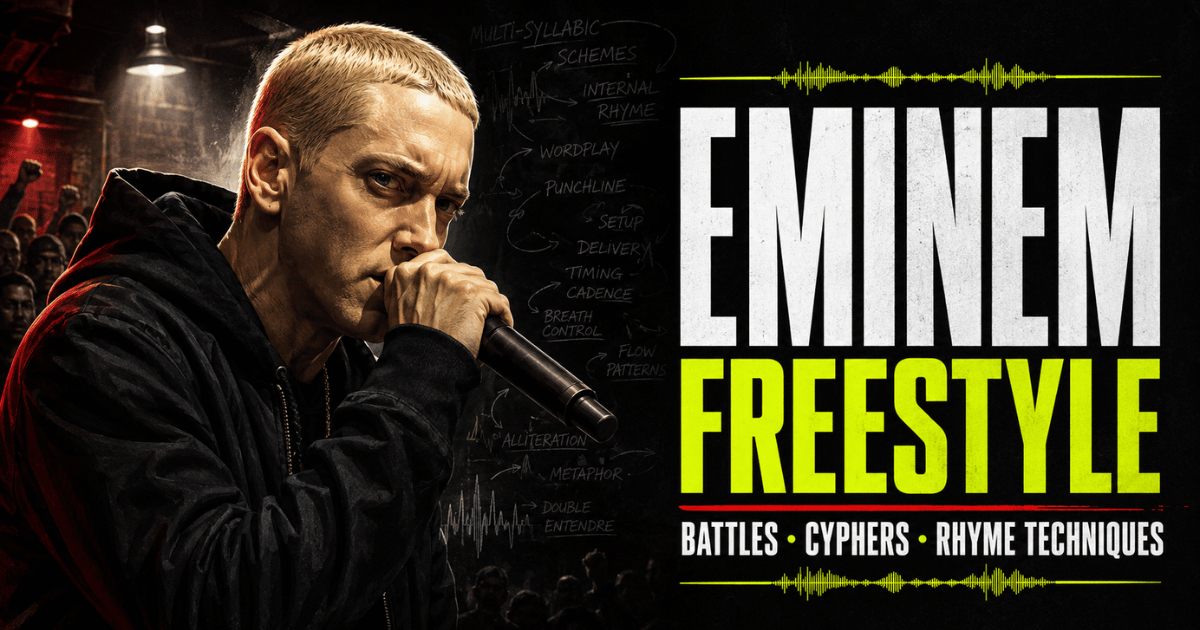
Search for an Eminem freestyle and you will find several different art forms wearing the same label. One clip may capture a genuine battle round built in the pressure of a room. Another may be a polished verse delivered on radio. A third may be an a cappella promotional piece that was composed beforehand. A fourth may be a cypher verse: new to the audience, but not necessarily invented at the microphone.
That confusion has followed freestyle rap for decades, and it is especially important with Eminem. His reputation was forged in Detroit battles where real-time adaptation mattered, yet he is also one of rap’s most meticulous writers. Calling every impressive verse “off the top” understates the writing. Calling every performance “prewritten” erases the improvisational intelligence, opponent awareness and crowd control that helped build his career.
Quick answer: Eminem can and historically did freestyle off the top, particularly in the competitive scene that developed his skills. He has also explained that effective battlers may hold several punchlines in reserve and improvise the connecting material around them. Many famous “Eminem freestyles” are therefore better classified as hybrids, prepared performance verses, cyphers or promotional tracks. The most useful question is not “Was every syllable invented instantly?” It is “What creative problem was he solving, and which parts of the performance required improvisation?”
This guide answers that question. It traces the Detroit venues and battles, ranks the major sessions, explains the rhyme and flow systems without reproducing copyrighted lyrics, and converts the underlying principles into a practical method. If you want to apply the lessons, begin with an original instrumental from BTR’s freestyle rap beats rather than redistributing a copyrighted Eminem recording.
Researched and reviewed: July 17, 2026
Eminem facts at a glance
| Question | Answer |
|---|---|
| What is Eminem’s real name? | Marshall Bruce Mathers III |
| When was Eminem born? | October 17, 1972 |
| How old is Eminem? | 53 as of July 17, 2026 |
| Where was he born? | St. Joseph, Missouri |
| Which city shaped his rap career? | Detroit, Michigan, especially its 1990s open-mic and battle circuit |
| What is his best-known alter ego? | Slim Shady |
| Did Eminem begin as a battle rapper? | Battle rap was central to his development, alongside recording with groups and making independent music |
| Where did he battle in Detroit? | Important locations included the Hip Hop Shop and events connected to Saint Andrew’s Hall and the Shelter |
| Who was his most important early freestyle mentor? | Proof, his close friend and later D12 bandmate, hosted battles and modelled how to combine prepared punchlines with improvisation |
| What happened at the 1997 Rap Olympics? | Eminem placed second; an Interscope staff connection obtained his Slim Shady EP, helping the recording reach Jimmy Iovine and Dr. Dre |
| Does Eminem write lyrics? | Yes. His notebooks and interviews demonstrate an intensive writing process, even though he can improvise and draw on memorised material |
| How many Grammys has Eminem won? | 15 wins from 47 nominations on the Recording Academy’s artist record |
| When did he enter the Rock & Roll Hall of Fame? | 2022, inducted by Dr. Dre |
| What is his latest studio album? | The Death of Slim Shady (Coup de Grâce), released in 2024, remained his latest studio album as of this review |
The Recording Academy’s Eminem profile records 15 Grammy wins and 47 nominations and identifies his second-place finish at the 1997 Rap Olympics as a critical link in his discovery. A 2025 Grammy career retrospective describes him as the top-selling hip-hop artist of all time and traces the distinct eras of his catalogue. The Rock & Roll Hall of Fame, which inducted him in 2022, highlights his Detroit underground roots, rapid-fire delivery and run of ten consecutive No. 1-debuting albums.
What counts as an Eminem freestyle?
The word freestyle does not have one universal test. In one community it means a verse created entirely in real time. In another it means a verse that is free of a song’s normal subject or structure. Radio shows and mixtapes have long advertised exclusive verses as freestyles even when artists arrived with material. Cyphers frequently combine rehearsed verses with spontaneous reactions. Battle rounds can include prepared attack lines, adaptable modules and true rebuttals in the same minute.
That history is why a binary verdict—real or fake—usually produces more heat than understanding. A better classification asks what the artist knew before the performance, what changed in the room and what was created under pressure.
1. True off-the-top improvisation
The rapper creates language and rhythm while performing. Evidence may include immediate references to the room, an opponent’s clothing, a word supplied by the audience, an interruption or something said seconds earlier. Mistakes, repairs and simpler stretches can be signs of genuine generation, although a flawless passage does not automatically prove preparation.
2. Battle freestyle with banked punchlines
This is a hybrid. The rapper carries several strong lines, rhyme endings or attack concepts, then improvises routes between them. Eminem has described learning this approach from Proof: in the 1990s Detroit scene, competitors were expected to go off the top, but a smart battler could keep a few reaction-tested punches ready and build around them. This is not cheating; it is a practical model of expert improvisation.
3. Radio or platform “freestyle”
An artist performs an exclusive verse over a host’s beat or a sequence of instrumentals. The verse may be written, memorised, partly improvised or assembled from unreleased material. The platform label describes the format, not a forensic guarantee about how every bar was composed.
4. Cypher verse
A cypher is a shared lyrical exhibition. In an informal circle, participants may genuinely improvise. In a televised or professionally filmed cypher, artists often prepare their verses because camera time, brand stakes and production schedules reward reliability. Spontaneous ad-libs and responses can still occur around the prepared core.
5. Promotional freestyle track
Tracks such as “Despicable,” “Campaign Speech” and “Kick Off” are called freestyles because they foreground uninterrupted rapping, loose structure or lyrical exhibition. That does not mean the recordings document a first-take stream of consciousness. They are authored releases and should be analysed as such unless reliable evidence establishes otherwise.
6. Battle round
A battle round is defined by competitive purpose: attack the opponent, win the room and survive rebuttal. Older battles placed a higher premium on real-time material. Modern organised battle rap often features fully written rounds. The art is still battle rap because opponent-specific writing, delivery, memory and performance are the core test.
This taxonomy protects both sides of Eminem’s skill. It gives proper credit to his writing while preserving the live intelligence visible in early battles. For a broader history of the form, use BTR’s complete freestyle rap guide. The rest of this page applies the distinctions specifically to Eminem.
Detroit battle roots: where Eminem’s freestyle method formed
Eminem did not emerge from a vacuum, and his story should never flatten Detroit hip-hop into one famous white rapper. The city had producers, crews, DJs, open mics and regional traditions before the world knew Slim Shady. His development depended on entering that ecosystem, earning reactions and repeatedly facing MCs who could expose weak writing or shaky timing in public.
The Hip Hop Shop was a laboratory
Maurice Malone’s Hip Hop Shop was a clothing store on West Seven Mile Road that became a focal point for Detroit rap. Clothes were moved to create performance space, and Saturday sessions allowed MCs to test themselves. Proof became a crucial host and connector. The official Shady Records oral history of the 8 Mile battles describes the Hip Hop Shop as an epicentre of the scene and stresses that the competitive instinct survived long after the original rooms disappeared.
Eminem later recalled a weekly circuit that included Saint Andrew’s, the Hip Hop Shop and other Detroit venues. Repetition mattered. A battler could watch which setups lost the audience, which punchlines created an instant noise spike and how an opponent’s confidence changed after a clean hit. That is audience research conducted at microphone speed.
Proof taught preparation inside improvisation
Proof’s role was larger than friendship or hype. He modelled a way to manage cognitive load: hold a few strong destinations in memory, improvise the connective path and remain alert to the room. Eminem explained this principle in a 2023 New York Times oral history marking hip-hop’s 50th anniversary. The method accounts for why an elite battle performance can sound structurally sharp while still reacting to the present moment.
Think of it as a modular system:
- Prepared anchors: punchlines, rhyme families, character observations and closing ideas.
- Live connectors: short phrases that move from the current bar toward an anchor.
- Environmental evidence: details about the opponent, crowd, host or room.
- Repair tools: repetition, a reset phrase, a slower pocket or a return to the central angle.
- Delivery control: pausing for reaction instead of rapping through the punch.
This hybrid approach is central to the Eminem freestyle story. It is also more teachable than the myth that a genius simply opens his mouth and receives perfect verses from nowhere.
The 1996 battle with Kuniva shows the local proving ground
Archive footage dated February 17, 1996 captures Eminem battling Kuniva at the Hip Hop Shop with Proof hosting. Kuniva later became a D12 member. The surviving clip matters less as a perfect technical document than as evidence of the environment: close crowd, direct opponent address, immediate evaluation and no protective distance between rapper and listener.
Battle skill in that setting required more than rhyme density. A line had to be understood quickly. A clever idea that needed a paragraph of explanation was weaker than a direct attack the room could process before the next snare. Eminem’s later records often preserve that reaction-first logic even when the schemes become far denser.
The 1997 Rap Olympics loss became a career hinge
Eminem finished second to Otherwize at the 1997 Rap Olympics in Los Angeles. The loss is important because the event still placed his work in front of the right industry connection. The Recording Academy’s official biography reports that an Interscope staff member encountered him through the event; his Slim Shady EP ultimately reached Jimmy Iovine and then Dr. Dre.
The useful lesson is not that losing automatically creates opportunity. It is that a competitive performance can generate evidence: a recording, a reputation, a contact and a reason for someone to carry the work into another room. Artists seeking gigs or battles can apply the same logic through BTR’s Rap Battle Arena: treat each appearance as both a contest and a portfolio asset.
8 Mile translated the psychology, not every biographical fact
The 2002 film 8 Mile is not a documentary. B-Rabbit is a constructed character, and the story compresses, changes and dramatises experience. Yet the film accurately communicates several pressures of battle rap: hostile rooms, identity attacks, freezing under expectation, the strategic power of self-disclosure and the need to convert vulnerability into control.
The final battles popularised a principle that applies well beyond the film: if you name your most obvious weakness before the opponent does, you can reduce its surprise value and force the other rapper to find a new angle. That is not a universal trick, but it is a powerful lesson in information control.
Eminem freestyle timeline: battles, radio sessions, cyphers and releases
The dates below organise widely circulated performances without claiming that every one is a pure improvisation. The “best classification” column describes the most defensible format based on available evidence.
| Year | Performance | Best classification | Why it matters |
|---|---|---|---|
| 1996 | Hip Hop Shop battle with Kuniva | Competitive battle freestyle / hybrid | Surviving evidence of Eminem inside Detroit’s local battle ecosystem |
| 1997 | Baruch College Solo Vibes session with A.L. | Radio cypher / freestyle session | Captures a pre-fame voice, battle pacing and collaborative exchange |
| 1997 | Rap Olympics | Competitive battle rounds | The second-place finish indirectly helped his EP reach the industry path that led to Dr. Dre |
| 1999 | Eminem and Proof on Tim Westwood / New York Live | Extended radio freestyle and partner cypher | Displays chemistry, humour and the ability to alternate without losing momentum |
| 1999 | Live from Tramps, New York freestyles | Live performance freestyles | Officially preserved in the expanded Eminem Show catalogue |
| Early 2000s | Rap City: Tha Basement appearances | Televised booth freestyles / prepared performance verses | Connected battle presence to national rap television; material later associated with “No Apologies” complicates the off-top label |
| 2003 era | “The Conspiracy Freestyle” | Mixtape / promotional freestyle track | Shows how the freestyle label operated within the DJ and mixtape ecosystem |
| 2009 | BET cypher with Black Thought and Mos Def | Televised cypher verse | Places Eminem beside two elite lyricists in a compact showcase format |
| 2009 | Tim Westwood session with Mr Porter | Multi-beat radio freestyle / performance session | One of the most searched and replayed examples of his post-hiatus technical style |
| 2010 | “Despicable” | Promotional freestyle track | Announced the Recovery era through aggressive beat adaptation and uninterrupted rapping |
| 2011 | Shady 2.0 BET Cypher | Prepared televised cypher verse | A high-density closing performance that showcased the Shady Records roster |
| 2014 | SHADY CXVPHER | Filmed a cappella label cypher | An extended promotional showcase built around voice, writing and location rather than a beat |
| 2015 | Sway / Shade 45 Southpaw freestyle | A cappella radio performance freestyle | Nearly eight minutes of dense material with no instrumental support |
| 2016 | “Campaign Speech” | Long-form promotional freestyle track | Uses a one-verse, hookless format for technical display and political commentary |
| 2017 | “The Storm” at the BET Hip Hop Awards | Prepared political a cappella freestyle | Demonstrates the freestyle format as public argument rather than entertainment alone |
| 2018 | “Kick Off” | Authored long-form battle-style freestyle | Returns physically and conceptually to the Shelter while extending for roughly eleven minutes |
Official sources confirm several anchor points. Eminem’s site dates “Kick Off” to November 30, 2018 and identifies the Shelter at Saint Andrew’s in Detroit as its location. The same site identifies “The Storm” as his 2017 BET Hip Hop Awards return. Shady Records published the SHADYXV CXVPHER in November 2014, and Eminem’s official catalogue includes “Freestyle #1 – Live From Tramps” and “Freestyle #2 – Live From Tramps.”
The 15 best Eminem freestyles, battles and cyphers to study
This ranking is editorial, not a claim that one performance is objectively superior. It weighs five qualities: historical importance, technical execution, live pressure, replay value and usefulness for students of rap. It also rewards performances that reveal a distinct part of Eminem’s development.
| Rank | Performance | Best reason to study it | Primary lesson |
|---|---|---|---|
| 1 | 2009 Tim Westwood session with Mr Porter | Extended multi-beat control and a clear post-hiatus technical identity | Change cadence when the instrumental changes |
| 2 | 1999 Eminem and Proof Westwood session | Chemistry, timing, humour and conversational handoffs | A partner can increase spontaneity instead of interrupting it |
| 3 | 2011 Shady 2.0 BET Cypher | Compressed rhyme density and a memorable closing slot | Escalate after other strong performers without merely rapping faster |
| 4 | 1997 Rap Olympics rounds | Highest career consequence and real competitive stakes | A loss can still reveal professional-level ability |
| 5 | 1997 Baruch College Solo Vibes session | Pre-fame hunger and audible battle habits | Strong projection makes complex rhymes easier to follow |
| 6 | Early-2000s Rap City sessions | National booth presence and the boundary between freestyle and reusable writing | A performance verse can become part of a later song |
| 7 | 2018 “Kick Off” | Long-form battle aesthetics in the physical home associated with 8 Mile | Sustain variation across an unusually long a cappella performance |
| 8 | 2010 “Despicable” | Efficient promotional impact over recognisable contemporary beats | Use beat switches to reset energy and announce a new era |
| 9 | 2014 SHADY CXVPHER | A cappella writing and label-level competitive framing | Without drums, consonants and pauses must create their own percussion |
| 10 | 2009 BET cypher with Black Thought and Mos Def | Elite company and compact television structure | Identity must remain clear beside contrasting master stylists |
| 11 | 2017 “The Storm” | Political clarity and cultural reach | A freestyle format can function as direct public speech |
| 12 | 2015 Sway / Shade 45 freestyle | Eight-minute a cappella control | Voice and rhyme placement can imply a beat that is not present |
| 13 | 1996 Hip Hop Shop battle with Kuniva | Local roots and direct opponent work | Battle writing is judged by immediate reaction |
| 14 | 1999 Live from Tramps freestyles | Officially available live documents from the breakthrough era | Stage energy changes how familiar skills land |
| 15 | “The Conspiracy Freestyle” | Mixtape-era context and catalogue afterlife | A freestyle can function as a strategic message inside rap’s media cycle |
If you only have twenty minutes, begin with the 2009 Westwood session, the 1999 exchange with Proof and the Shady 2.0 Cypher. Together they show three different skill sets: adapting across beats, reacting with a partner and delivering a prepared showcase under television pressure. Then watch an early battle to understand where the reaction-first mentality began.
Essential Eminem freestyle performance breakdowns
A list tells you what to play. A breakdown tells you what to hear. The following analyses focus on structure, adaptation, voice and context. They intentionally avoid transcribing lyrics; the original recordings remain the proper place to experience the performances.
1999 with Proof: chemistry is a freestyle skill
Tim Westwood recorded Eminem and Proof together in 1999, around the breakthrough period of The Slim Shady LP. A much longer version surfaced years later. NME reported that the expanded recording runs roughly thirteen minutes, about three times the length of the previously circulating excerpt.
The value of the session is not merely that two rappers rhyme for a long time. Proof changes the social conditions of the performance. Eminem has someone to surprise, answer and amuse. Laughter becomes feedback. A handoff becomes a compositional boundary. If one rapper raises the absurdity, the other can continue the premise or deliberately break it.
Listen for four partner skills:
- Clean exits: a line resolves strongly enough for the other MC to enter.
- Shared tone: both artists understand when the exchange is playful, competitive or aggressive.
- Active listening: the next contribution feels related to the energy already in the room.
- Permission to be imperfect: laughter and loose moments humanise the session instead of destroying it.
Solo rappers can practise this with a partner using four-bar trades. The goal is not to overpower the other person. It is to make the combined eight bars feel more alive than either isolated verse.
2009 Tim Westwood: the beat switch as a new tactical problem
The 2009 Westwood performance with Mr Porter is frequently described by uploaders and fans as Eminem’s best freestyle. Tim Westwood’s own audio listing identifies it as an eight-minute session from the 2009 show. The wording of “best” is subjective, but the recording earns its status because it keeps presenting new constraints.
A beat switch changes more than background music. It changes where a long vowel can sit, how much space follows a snare, whether a dense phrase feels urgent or cramped and which vocal register fits the track. Eminem responds by changing rhythmic shape rather than treating the entire session as one long verse placed over several unrelated loops.
Study the transition points. Count four bars before a switch and four after it. Mark changes in:
- average syllables per beat;
- sentence length;
- pause placement;
- pitch and character voice;
- how quickly a new rhyme family is established.
This creates a practical drill: queue three legal-to-use beats at different tempos, change every sixteen bars and force yourself to redesign the pocket within the first two measures. Do not carry the same cadence across all three.
Rap City and “No Apologies”: why “freestyle” does not always mean disposable
Eminem’s appearances in the booth on Rap City: Tha Basement helped connect his battle persona to a national television audience. They also provide one of the clearest reasons to avoid simplistic authenticity tests. Material associated with those performances was later incorporated into “No Apologies,” released on Eminem Presents: The Re-Up in 2006.
The official Eminem catalogue lists “No Apologies”, while the official Re-Up track list places it as the closing track. The path from booth performance to finished song demonstrates that a verse can serve several lives: live showcase, proof of technique, draft material and permanent recording.
For creators, the lesson is valuable. Do not assume a freestyle must disappear after the camera stops. Review every session. A strong eight-bar sequence might become a verse. A phrase might become a hook. A character voice might define a new song. Improvisation generates raw material; editing determines whether that material deserves a second life.
2009 BET cypher: identity beside Black Thought and Mos Def
A cypher with Black Thought and Mos Def creates a difficult comparison because each MC has a distinct relationship to rhythm and language. The strategic mistake would be to imitate the artist immediately before you. Eminem instead remains recognisable through clipped attacks, elastic pronunciation and dense internal connections.
This is the identity test of a cypher: can a listener identify the rapper within seconds, even without a visual? Technical ability matters, but contrast creates memorability. Black Thought’s grounded command, Mos Def’s musical ease and Eminem’s compressed intensity occupy different spaces. The combination works because excellence is not reduced to a single metric such as speed.
“Despicable”: a promotional freestyle that does one job well
“Despicable” appeared in April 2010 as Eminem prepared the Recovery campaign. It uses beats already associated with contemporary records, which gives the listener an immediate comparison point. The performance is less a neutral experiment than an announcement: the voice, attack and technical hunger of the new era are arriving before the formal single.
That is a classic promotional-freestyle function. A recognisable instrumental lowers the listener’s orientation cost. The rapper can focus attention on how differently they occupy it. Independent artists should understand the legal boundary, however. Performing over another artist’s instrumental for practice or a non-commercial tradition does not automatically grant rights to distribute or monetise a new recording. For a release, license the beat or use an original one.
2011 Shady 2.0 Cypher: how to close a stacked lineup
The 2011 BET segment placed Eminem after Yelawolf and the four members of Slaughterhouse. By the time he appears, the audience has already heard multiple flows and punchline styles. The closer therefore needs a new level of focus, not merely additional volume.
Eminem’s approach concentrates the experience. Long rhyme chains reduce the sense of reset between bars. Repeated consonant attacks make the verse percussive. Escalating images maintain forward pressure. The result feels like a closing argument because it collects momentum rather than starting a separate show.
DJBooth’s contemporary entry documents the lineup and the use of East Flatbush Project’s “Tried by 12” beat. When studying it, separate three questions:
- How does the verse establish a rhyme family?
- How long does the family continue before the ear needs contrast?
- Where does delivery become simpler so the biggest idea can land?
Density becomes impressive when the listener can still locate the destination.
2014 SHADY CXVPHER: when the voice must supply the drums
Shady Records released the SHADY CXVPHER to support the label’s fifteenth-anniversary project. Slaughterhouse, Yelawolf and Eminem perform a cappella in separate location-driven segments. Without a conventional instrumental, the rappers control the listener’s internal metronome through stress, consonants, silence and phrase length.
A cappella rap exposes weak timing. On a beat, the kick and snare keep telling the audience where the grid is. Without them, the performer must imply the grid or intentionally abandon it. Eminem uses repeated stress patterns to create temporary measures, then stretches or compresses them for emphasis.
Practise this by recording sixteen bars over a metronome, muting the click and performing the verse again. When the click returns, see whether your strong stresses still align with the intended pulse. Then repeat a cappella with deliberate pauses. Silence is not dead air when it frames a punch.
2015 Sway / Shade 45: sustaining an a cappella monologue
During promotion for Southpaw, Eminem delivered a long a cappella performance on Sway’s Shade 45 program. NME’s report from July 2015 describes an approximately eight-minute freestyle filled with topical celebrity references.
The content drew justified criticism for several targets and images. From a purely structural standpoint, the challenge is maintaining continuity without drums or a repeating hook. Eminem solves it with recurring sound families, high articulation and frequent shifts in sentence shape. The ear receives micro-sections even when the recording does not announce formal verses.
The ethical lesson matters alongside the technical one. Topicality can make a freestyle feel immediate, but speed does not remove responsibility. A reference to a real person or tragedy may generate attention while ageing badly, hurting people or obscuring the craft. Writers should ask whether shock serves a defensible idea or merely fills the space where insight should be.
“Campaign Speech”: long-form topical rap without a normal song frame
Released in October 2016, “Campaign Speech” is structured as an extended verse rather than a conventional verse-hook single. Its minimal musical frame places attention on language and political reference. Eminem’s official catalogue preserves the track entry.
The performance shows both the strength and risk of maximal density. Continuous surprise can create fascination, but it can also flatten emphasis because every line competes to be the event. Rappers studying long-form pieces should mark intentional valleys: a simpler sentence, slower articulation or repeated word can reset the listener before the next dense run.
2017 “The Storm”: freestyle as direct political speech
“The Storm” was presented at the 2017 BET Hip Hop Awards as an a cappella attack on then-President Donald Trump. The official Eminem page dates the performance to October 10, 2017. It became a major news event because the argument was unusually direct and because Eminem challenged a portion of his own audience rather than choosing a distant target.
Musically, the absence of a beat makes the piece resemble a public address. The camera, parking-garage setting and group behind him create a visual frame, but the words carry the entire rhythmic burden. The performance is most useful as a study of stance: decide what the verse believes, identify who it addresses and make the conclusion unmistakable.
Political clarity does not guarantee musical perfection or universal agreement. It does, however, show that the freestyle format can intervene in public debate quickly and without the commercial architecture of a normal single.
2018 “Kick Off”: a return to battle space
“Kick Off” was filmed at the Shelter in Saint Andrew’s Hall, a location tied to Detroit battle culture and the mythology surrounding 8 Mile. The performance extends for roughly eleven minutes. Pitchfork’s release report confirms the date, length and location; Eminem’s official site hosts the performance.
The piece is an authored return to battle aesthetics, not footage of an unknown opponent suddenly challenging Eminem. That distinction makes it more interesting, not less. He is staging a conversation between his current technical identity and the competitive space that helped create him.
Long duration requires segmentation. Listen for changes in:
- imagined opponent or target;
- vocal intensity;
- rhyme vowel;
- sentence width;
- comic versus threatening tone;
- moments when a pause functions like a section break.
The performance also illustrates a limitation of shock-centred battle writing. A technically complex reference can dominate discussion for ethical reasons and leave the rhyme craft secondary. An aspiring rapper should not conclude that crossing the most painful line is the highest form of courage. Originality, accuracy, humour, self-awareness and opponent-specific insight offer harder—and often more durable—routes to impact.
How Eminem’s rhyme system works
Eminem’s reputation is frequently reduced to “he rhymes many syllables” or “he raps fast.” Both descriptions are incomplete. Speed is one possible surface. The deeper system connects sound choice, rhythmic placement, narrative pressure and performance. Music theorist Mitchell Ohriner’s Oxford University Press chapter on flow and metric complexity in Eminem argues that changing vocal-groove complexity can support and even foreshadow events in the text. In other words, the rhythm is not decoration placed on top of meaning; it helps tell the story.
1. Build rhyme families, not isolated pairs
A beginner often thinks in couplets: find one word that rhymes, complete the pair and start again. Eminem frequently sustains a family across several bars. The family may include exact rhymes, slant rhymes and phrases whose stressed vowels align even when every consonant does not.
Use a neutral training word such as motion. A family might include phrases built around the long “o” and unstressed “shun” sound. Do not begin by writing a verse. Build ten sound-compatible fragments. Then arrange only the fragments that contribute to one subject. The constraint is sound; the edit is meaning.
2. Use multisyllabic rhyme as a rhythmic rail
A multisyllabic rhyme repeats a sequence of stressed and unstressed sounds, not merely the final syllable. Once the sequence is established, it acts like a rail. The listener anticipates its return, and the rapper can delay or reposition that return to create tension.
The danger is backwards writing: choosing awkward language solely because it fits the sound. Eminem sometimes embraces distortion for comic or character effect, but an aspiring rapper should first learn to preserve natural syntax. If the audience must decode why a person would ever speak that sentence, the rhyme has begun to control the writer.
3. Stack internal and terminal rhymes
Terminal rhyme occurs near the end of a line. Internal rhyme creates additional links before the line finishes. Multiple internal points make a verse feel active even when the end word is delayed. They also let the rapper recover: if one planned ending disappears during a freestyle, an internal sound can become the new anchor.
A practical grid uses four positions per bar:
- early internal sound;
- mid-bar echo;
- pre-snare accent;
- end-of-bar resolution.
Do not fill all four positions in every bar. Alternate a dense bar with a cleaner one. Contrast allows the audience to perceive density instead of hearing an undifferentiated stream.
4. Treat slant rhyme as pronunciation design
Perfect rhyme is only one tool. Rap permits vowel bending, consonant substitution, regional pronunciation and stress changes. Eminem often searches for the audible overlap between phrases that look unrelated on a page. This expands the vocabulary available to a rhyme family.
The test is the recording, not the spelling. Say both phrases at performance speed. If the resemblance exists only after extreme distortion that damages comprehension, keep searching. If a modest stress adjustment makes the sounds lock while the words remain clear, the slant rhyme is doing useful work.
5. Change the rhyme before the listener becomes numb
Sustained schemes demonstrate control, but repetition eventually loses force. Eminem often announces a new section by changing the dominant vowel, shortening the phrase or switching from compound patterns to blunt end rhymes. The change itself creates energy.
Map a sixteen-bar verse with colour. Give each dominant rhyme family a colour and mark where it begins, peaks and exits. If one colour covers the entire page, ask whether the subject truly earns that persistence. If every line is a different colour, the verse may lack cohesion.
6. Use consonants as drums
Plosives such as p, b, t and k create attacks. Sibilants create friction. Nasal sounds can soften a phrase. Eminem’s aggressive passages often coordinate stressed consonants with rhythmic events, making the vocal feel percussive even a cappella.
Record the same four bars three ways: first emphasise vowels, then hard consonants, then meaning. The third take should combine the most useful parts of the first two. This prevents technical articulation from becoming detached from the sentence’s emotional purpose.
7. Construct punchlines through expectation and reversal
A punchline is not merely a reference or a pun. It creates an expectation, then redirects it. Battle rap intensifies the mechanism because the reversal usually damages an opponent, elevates the speaker or transforms a detail in the room.
A clean setup should do at least one of three jobs:
- establish the ordinary meaning that will be reversed;
- make the opponent’s vulnerability visible;
- create a rhythmic pattern the punch can break.
If the setup exists only to reach a clever end word, the punch may feel manufactured. Strong battle lines are efficient: the target, angle and turn can be processed in real time.
8. Link technical complexity to emotional escalation
The most valuable insight from formal flow analysis is that complexity should move. A verse can begin in a stable groove, accumulate off-grid accents and reach a rhythmically unstable peak as the subject intensifies. It can then resolve into a direct sentence. The listener feels the argument before consciously counting anything.
Try a four-stage design:
- Bars 1–4: clear pocket and premise.
- Bars 5–8: more internal rhyme and longer sentences.
- Bars 9–12: maximum rhythmic displacement or density.
- Bars 13–16: reduce complexity and state the conclusion.
The architecture is inspired by a general principle, not a template for impersonating Eminem. Use your own subject, vocabulary and accent.
9. Revise sound on the page and meaning in the microphone
Eminem is a writer. Accounts of his notebooks describe pages filled with rhyme fragments and schemes that may be retrieved years later. The important habit is collection without immediate obligation. A rhyme idea can be valuable even if it does not yet belong to a song.
Keep two documents:
- Sound bank: rhyme families, interesting stress patterns and unusual phrase matches.
- Meaning bank: stories, observations, arguments, images and emotional conflicts.
A song begins when an item from one bank genuinely strengthens an item from the other. This reduces empty technical writing.
Flow, delivery and battle psychology
Rhyme is visible on a lyric sheet. Flow exists in time. Two rappers can perform the same words and create different music because they place stress, breath, silence and pitch differently. Eminem’s strongest performances use delivery to clarify the underlying design rather than simply demonstrating lung capacity.
Find the pocket before decorating it
The pocket is the repeatable relationship between the vocal and the beat. A rapper can sit directly on the kick and snare, lean behind them, anticipate them or move between those positions. Technical passages remain convincing when the listener senses an intentional relationship to the pulse.
Before writing internal rhymes, speak one plain sentence over the loop for eight bars. Move the same sentence into three placements:
- start exactly on beat one;
- enter after beat one and lean back;
- begin just before beat one and push forward.
Choose the placement that fits the emotional stance. An accusation may feel stronger when it anticipates the beat. A reflective thought may benefit from sitting behind it. There is no permanently correct pocket.
Cadence switches should change function
A cadence switch attracts attention because the listener’s prediction stops working. The weakest version changes speed but not meaning. The strongest version signals a new stage of the argument: a setup becomes a barrage, a joke becomes a threat, or a complicated section resolves into a plain conclusion.
Label each switch in a draft with its job. If the only explanation is “this sounds impressive,” the switch may still work, but it is not carrying its full weight.
Speed is contrast, not a permanent ranking system
Eminem’s fast passages receive enormous attention, particularly around “Rap God” and “Godzilla.” Speed can intensify a peak, demonstrate articulation or create a feeling of overflow. It is not proof that one rapper is automatically better than another. Groove, tone, story, restraint and originality matter just as much.
BTR’s existing analysis of Eminem’s “Rap God” is the appropriate deep dive for that song. In a freestyle context, use speed only after you can deliver the same idea slowly with clear stresses. If the slow version has no musical shape, accelerating it will produce blur.
Character voices alter rhythm
Eminem has long used changes in pitch, accent, texture and persona. A character voice is not just theatre. Narrow vowels can make phrases feel tighter. A nasal placement can sharpen articulation. A lower register can make pauses feel heavier. A comic voice can signal that an outrageous image belongs to a constructed persona, though persona does not erase the real-world effect of the words.
Artists should avoid copying Eminem’s voices. Instead, map their own natural range. Record the same four bars as calm narration, controlled anger, dry humour and intimate confession. Notice which consonants, pauses and pitches change automatically. The goal is to discover credible modes already available in your voice.
Breath is part of composition
A breath mark is not evidence of weakness. It is a structural decision. Long schemes should include locations where the performer can inhale without cutting the central idea. Eminem’s studio work may use editing and comping, but live and a cappella performances still depend on planned breath behaviour.
Print or display sixteen bars and mark:
- full breath before a new sentence;
- quick breath after an internal clause;
- no-breath run reserved for the intended peak;
- recovery bar with fewer syllables after the peak.
Practise at 80 percent energy before full projection. Breath control improves through repeatable support, not by tightening the throat.
Crowd reaction changes the clock
In a battle, the written bar is only half the event. If the room reacts and the rapper continues immediately, the next setup can disappear. Eminem’s Detroit experience taught him to anticipate response. A pause after a punch communicates confidence and lets the audience complete the emotional cycle.
Practise a verse with a friend making random reaction noise after selected lines. Your task is to pause, keep the next entry on time and avoid restarting the entire bar. This simulates the disruption that a quiet bedroom cannot provide.
Opponent-specific detail beats generic aggression
Battle rounds become convincing when they could not be delivered unchanged to anyone else. Clothing, previous claims, hometown, performance habits and contradictions give the verse a target. Generic threats may sound forceful but provide little proof of observation.
Use a three-column battle sheet:
| Evidence | Interpretation | Angle |
|---|---|---|
| A specific statement, visual detail or past performance | What it reveals or contradicts | The concise claim your round will prove |
Do not invent serious allegations. A clever battle angle built on a false factual claim can create reputational and legal harm outside the performance.
Self-disclosure can remove an opponent’s easiest weapon
8 Mile popularised a battle strategy Eminem understood from experience: acknowledge an obvious vulnerability, frame it on your terms and force the opponent to find another route. This works only when the admission is specific enough to feel real and strong enough to support a counterargument.
The technique is not “insult yourself before anyone else can.” It is information control. Name what the room already knows, explain why it does not defeat your case and redirect attention toward the opponent’s weaker position.
The science of freestyle: what happens during improvisation?
Freestyle feels mysterious because fluent language, rhythm, motor control and emotional expression occur at once. A frequently cited 2012 study in Scientific Reports used functional MRI to compare improvised freestyle rap with rehearsed performance. The researchers observed a pattern involving increased activity in medial prefrontal regions and reduced activity in dorsolateral prefrontal regions, alongside broader networks related to language, movement, motivation and affect.
The open-access paper, “Neural Correlates of Lyrical Improvisation,” offers a useful model: skilled improvisation may involve loosening some forms of conscious supervisory control while self-generated action proceeds. It does not prove that planning is bad, that every rapper enters the same state or that a brain scan can certify whether a specific Eminem performance was off the top.
Three details are especially practical:
- The participants were experienced. Spontaneity was supported by years of domain training, not the absence of training.
- Improvised and rehearsed performances used the same musical background. The contrast concerned generation, not a different beat.
- Verbal fluency mattered. The artists performed strongly on language-fluency measures, consistent with a large, rapidly accessible vocabulary.
The takeaway is simple: reduce self-editing during the generation pass, then restore critical judgment during review. Trying to generate and perfect each word at the same instant often creates hesitation. Recording everything without later selection creates a different failure. Expert workflow separates the two modes.
A practical Eminem freestyle training system
This system trains the transferable foundations—rhyme retrieval, pocket control, observation, rebuttal, structure and performance—without asking you to impersonate Eminem. Use your own accent, subject matter and ethical boundaries.
Stage 1: establish a baseline
Choose one beat you are legally allowed to use. Record three sixty-second takes:
- a true off-the-top freestyle with no preparation;
- a hybrid with three banked punchlines;
- a written verse performed as a radio freestyle.
Label the files honestly. Compare fluency, originality, clarity and energy. Most artists discover that each format reveals a different strength. The off-top take may feel alive but vague. The written take may be dense but stiff. The hybrid may offer the best balance.
Stage 2: build five rhyme families
Select five ordinary words related to your actual life. For each, produce:
- five exact or close rhyme words;
- five multisyllabic phrase matches;
- three slant rhymes that work when spoken;
- two images or memories connected to the sound family.
This creates language with emotional content. A random rhyming dictionary can expand options, but your memories supply authorship.
Stage 3: practise anchor-and-connector improvisation
Write four punchlines on separate cards. Do not write setups. Shuffle the cards, start the beat and reveal one every four bars. Improvise toward the visible punchline. If the connection feels forced, say a clean reset phrase and begin a new path.
The exercise trains the Proof principle: know a few destinations without scripting every step. Over time, replace written cards with memorised anchors.
Stage 4: train environmental evidence
Look around the room and name five neutral details: colour, object, sound, temperature and movement. Freestyle for one minute while incorporating each detail once. The reference must contribute to an idea; simply listing objects does not count.
Next, ask a partner to change one object or hold up a word. Refer to the change within two bars. This produces stronger evidence of real-time attention than a generic claim that everything is spontaneous.
Stage 5: build rebuttal reflexes
Have a partner make a harmless competitive claim, such as “your flow never changes.” You get two bars to acknowledge the claim and two bars to reverse it. Do not rely on insults about identity, appearance or trauma. Attack the argument or performance behaviour.
A rebuttal has three moves:
- Receive: demonstrate that you heard the exact claim.
- Reframe: change what the evidence means.
- Return: show why the new interpretation hurts the opponent’s case.
Stage 6: switch pockets on command
Use a beat between approximately 86 and 94 BPM. Perform four bars in a simple quarter-note-oriented pocket, four bars with more syncopation, four bars in double-time subdivision and four bars returning to the opening pocket. Keep the subject continuous.
Record the drill and check whether the switches occur at clear bar boundaries. Later, practise switching mid-bar. Control comes before surprise.
Stage 7: create a cappella time
Write or memorise eight bars, practise them with a metronome and then remove the click. Keep an internal four-count. Add one intentional pause after the strongest line. When finished, turn the metronome back on and see whether your ending remains near the intended bar.
This is not about robotic precision. It teaches you to choose when time stretches instead of drifting accidentally.
Stage 8: practise partner handoffs
Trade two bars, then four bars, then eight bars with another rapper. Each new entry must reuse one word, image or rhythmic idea from the previous person. The constraint forces listening. If both rappers deliver unrelated memorised verses, the exercise has failed even if the verses are strong.
Stage 9: edit the session into a song asset
After a ten-minute freestyle, do not immediately publish it. Mark the recording:
- green: original, clear and emotionally true;
- yellow: useful idea with weak wording;
- red: filler, accidental imitation, factual risk or harmful material without purpose.
Transcribe only the green sections and the best yellow concepts. Build a new verse from them. This turns improvisation into research for your own song.
Stage 10: use a repeatable scorecard
| Category | Question | Score |
|---|---|---|
| Time | Did the vocal maintain or intentionally manipulate the pocket? | 1–5 |
| Clarity | Could a first-time listener understand the main ideas? | 1–5 |
| Rhyme | Were sound families sustained without unnatural wording? | 1–5 |
| Originality | Did the performance sound specific to your experience and voice? | 1–5 |
| Adaptation | Did you react to the beat, room, partner or prompt? | 1–5 |
| Structure | Did the minute develop, peak and resolve? | 1–5 |
| Judgment | Did the content avoid lazy imitation, false claims and pointless harm? | 1–5 |
Keep the scores for a month. Do not chase a perfect total in every take. Look for a weak category that remains weak across several sessions. That category becomes the next week’s training priority.
30-day Eminem freestyle skills plan
The plan requires approximately thirty to forty-five minutes per day. “Eminem” describes the skills under study, not a goal of sounding like him.
Week 1: timing and rhyme retrieval
| Day | Assignment | Deliverable |
|---|---|---|
| 1 | Record the three-format baseline: off top, hybrid and written performance. | Three one-minute files and first scorecard |
| 2 | Build two ten-item rhyme families from words connected to your life. | Twenty spoken phrases |
| 3 | Rap one family for eight bars, then switch to the second family. | Three clean takes |
| 4 | Perform one plain sentence in three pockets. | Annotated favourite pocket |
| 5 | Alternate dense and simple bars. | Sixteen-bar contrast exercise |
| 6 | Freestyle using five room details. | One sixty-second environmental take |
| 7 | Review the week without recording new material. | Five strengths, five repairs |
Week 2: anchors, punchlines and rebuttals
| Day | Assignment | Deliverable |
|---|---|---|
| 8 | Write four punchlines built on clear setup-and-reversal logic. | Four anchor cards |
| 9 | Improvise four-bar paths toward shuffled anchor cards. | Eight successful connections |
| 10 | Build opponent-specific angles from harmless observable details. | Three evidence-to-angle maps |
| 11 | Respond to ten claims in four bars each. | Ten receive-reframe-return attempts |
| 12 | Practise self-disclosure followed by a redirect. | Eight bars with one controlled admission |
| 13 | Perform for one person and pause for reactions. | One live two-minute take |
| 14 | Review accuracy and ethics as well as technique. | Second scorecard and content cuts |
Week 3: cadence, a cappella control and collaboration
| Day | Assignment | Deliverable |
|---|---|---|
| 15 | Switch among simple, syncopated and double-time subdivisions. | Sixteen bars with three audible modes |
| 16 | Mark breaths and recovery bars. | One performable sixteen-bar verse |
| 17 | Practise eight bars with and without a metronome. | Timing comparison |
| 18 | Trade two bars with a partner. | Three minutes of responsive exchange |
| 19 | Trade four bars and reuse one detail from each handoff. | One coherent partner cypher |
| 20 | Move across three beats without keeping the same cadence. | Forty-eight-bar switch session |
| 21 | Listen at half speed and identify unclear consonants or rushed stresses. | Delivery repair list |
Week 4: performance, selection and original release
| Day | Assignment | Deliverable |
|---|---|---|
| 22 | Record a ten-minute generation session over licensed or original beats. | Unedited source recording |
| 23 | Green-yellow-red the entire session. | Time-coded edit map |
| 24 | Transcribe the strongest material and identify one central subject. | Selected lyric document |
| 25 | Rewrite selected material into two structured verses. | Draft song |
| 26 | Develop a hook that states the subject more simply. | Three hook options |
| 27 | Record full takes before comping individual repairs. | Lead vocal session |
| 28 | Edit doubles, breaths and ad-libs; remove filler. | Clean vocal arrangement |
| 29 | Play the track for two trusted listeners without explaining it first. | Comprehension notes |
| 30 | Repeat the Day 1 baseline and compare scores. | Final scorecard and next-month priority |
If you miss a day, continue with the next numbered task rather than doubling the workload. The plan measures accumulated skill, not calendar purity.
How to choose or make a beat for technical freestyle rap
There is no single “Eminem freestyle BPM.” The recordings discussed here include a cappella performances, 1990s battle rhythms, radio sessions over multiple instrumentals and modern promotional pieces. The correct beat is one that exposes the skill you want to train.
Use tempo as a training variable
| Practice goal | Useful starting range | Why it helps |
|---|---|---|
| Clear battle setups and punchlines | 84–94 BPM | Enough room for direct language while retaining classic head-nod momentum |
| Dense internal-rhyme control | 76–88 BPM | Slower pulse leaves space for subdivisions without forcing speed |
| Double-time articulation | 70–78 BPM or 140–156 BPM counted in halftime | Creates a stable grid for alternating normal and rapid passages |
| Energetic modern cypher | 96–108 BPM | Encourages shorter phrases, sharper entrances and less lyrical overpacking |
| A cappella time | Practise first with 80–92 BPM click, then remove it | Builds an internal pulse before intentional stretching |
These are practice ranges, not rules about Eminem’s catalogue. If you already have an instrumental, check it with BTR’s free online BPM analyzer instead of guessing from mood.
Keep the harmonic loop memorable and restrained
A technical verse needs a stable reference point. A two- or four-bar motif often works better than a constantly changing chord sequence. Dark piano, filtered strings, a restrained guitar phrase or a synthetic texture can support intensity, but “dark” is not a substitute for musical identity.
Leave the midrange available for the voice. If the lead instrument plays continuous notes in the same register as the rapper, rhyme detail becomes harder to understand. Test the loop at low volume. If its identity disappears completely, improve the motif. If it dominates before the vocal enters, simplify the voicing or arrangement.
Make the drums readable
Freestyle practice benefits from a clear kick-snare relationship. The rapper should feel bar boundaries without staring at the DAW. Add complexity through occasional ghost notes, fills and dropouts rather than constant percussion.
A useful starting pattern includes:
- a firm snare or clap that defines the backbeat;
- a kick pattern with at least one open space per bar;
- hats that communicate subdivision without masking consonants;
- a short fill every eight or sixteen bars;
- one-bar dropouts that test whether the rapper can hold time.
Arrange for rounds, not just loops
A two-minute battle or cypher beat still needs navigation. Use an eight-bar introduction, sixteen-bar primary section, short dropout, second sixteen and a clear ending. For a longer freestyle, switch or filter an element every sixteen bars so the rapper receives a structural cue.
Browse BTR’s rap beats and hip-hop beats for original material. Confirm the specific licence before releasing, monetising or distributing a track. “Free to listen” and “free for commercial use” are not the same permission.
Do not clone a recognisable Eminem recording
Learning from a production era is legitimate. Rebuilding a protected melody, copying a distinctive sample, imitating a vocal identity or marketing a track as an official Eminem collaboration is not. Use broad attributes—sparse battle drums, dramatic tension, room for dense vocals—and combine them with your own sound sources and arrangement.
How to record and mix a technical freestyle
The mix should reveal articulation and energy without making the vocal painfully sharp. Technical rap often contains more consonant attacks and faster level changes than a sustained sung melody, so capture quality and automation matter.
Set the room before chasing plugins
Use the quietest practical space. Place absorptive material behind and beside the performer if the room is reflective. Keep computer fans and air-conditioning noise away from the microphone. A clean moderate recording beats an overprocessed noisy one.
Position a pop filter several inches from the microphone and begin with the performer another few inches behind it. Exact distance depends on the mic, room and delivery. Set gain so the loudest battle projection does not clip. Twenty-four-bit recording provides enough headroom; there is no need to drive the waveform to the ceiling.
Record one complete performance before repairs
A full take preserves escalation and breath logic. Record at least three complete passes. Only then repair individual bars or words. If every line is punched separately from the beginning, the result may be precise but emotionally flat.
For a genuine off-top session, keep the first uninterrupted take even if you later build a song from selected moments. That file is the evidence of the improvisational process. The edited release is a different artifact and should be described honestly.
Comp for meaning, not only cleanliness
The technically cleanest syllable is not always the best choice. A slightly rough phrase may carry the performance’s emotional turn. When comping, listen through the sentence before switching takes. Excessive word-by-word editing can create unnatural changes in tone and background noise.
Build a clear lead-vocal chain
A starting chain might include corrective EQ, moderate compression, de-essing and level automation. The order can change. The decisions matter more than the plugin names.
- High-pass carefully: remove unusable rumble without thinning the chest of the voice.
- Cut narrow problems: address resonances only when they are consistently distracting.
- Compress in stages: two gentle compressors can sound more natural than one extreme setting.
- De-ess in context: technical rap needs consonants; do not erase every “s” and “t.”
- Automate phrases: bring quiet setups forward and control shouted peaks manually.
Use doubles to frame important moments
Constant full-volume doubling can reduce intelligibility. Double the hook, selected punchline endings or a rapid passage that needs extra weight. Keep the lead central. Pan supporting ad-libs or doubles modestly and high-pass them more aggressively if they crowd the main voice.
Create depth without washing out language
Short room ambience or a compact plate can prevent the lead from feeling pasted onto the beat. Use pre-delay so the dry consonant arrives first. A filtered delay throw on the last word of a section often preserves clarity better than continuous long reverb.
Master for impact without destroying transients
Compare the track at matched loudness with professional references. Check earbuds, phone speaker, headphones and a larger system. The verse should remain understandable at low volume. If the master becomes impressive only when louder than the reference, return to balance and dynamics.
BTR’s AI mastering tool can provide a fast alternate master, but automatic processing cannot decide whether a punchline is buried by an ad-lib or whether the vocal performance feels coherent. Use it as a comparison and quality-control stage, not a replacement for listening.
Common mistakes when studying Eminem freestyles
Mistake 1: calling every performance off the top
This inflates one skill by erasing another. Written cypher verses and promotional freestyles can be extraordinary. Label the format accurately and analyse what it actually demands.
Mistake 2: believing written means fake
Writing, memorisation, performance and improvisation overlap. Battle rappers have long used prepared material alongside spontaneous rebuttals. The artistic question is whether the performer solves the format’s problem convincingly.
Mistake 3: measuring rap only by speed
Speed without groove, clarity or purpose is an athletic drill. Use rapid articulation as one colour. Study slower Eminem passages and battle pauses to hear how much impact comes from timing rather than syllable count.
Mistake 4: forcing multisyllabic rhymes into unnatural sentences
A long sound match is not automatically a strong bar. Read the sentence as ordinary speech. If meaning collapses, simplify or find a better phrase.
Mistake 5: copying the Slim Shady persona
A persona grows from an artist’s history, conflicts, humour and cultural moment. Copying the accent, shock tactics or vocal mannerisms produces imitation. Build a character from tensions in your own experience.
Mistake 6: treating harm as proof of fearlessness
Battle rap permits exaggeration and attack, but not every target is equally defensible. Real tragedies and vulnerable groups are not technical shortcuts. Ask whether the reference reveals hypocrisy, advances an argument or contributes insight. If its only function is to make the room gasp, rewrite it.
Mistake 7: ignoring Detroit and Proof
The lone-genius version of the story is inaccurate. Eminem’s abilities developed through Detroit’s Black-led hip-hop spaces, competitors, collaborators and audiences. Proof’s mentorship and friendship were foundational. Give the ecosystem its proper place.
Mistake 8: freestyling endlessly without reviewing
Volume improves fluency only when feedback exists. Save sessions, score them and extract patterns. Ten unreviewed hours can repeat the same weakness.
Mistake 9: releasing over copyrighted beats without permission
Tradition and copyright are not identical systems. A beat used in a radio or mixtape freestyle may belong to another writer, producer, label or publisher. Obtain a licence or replace it with an original instrumental before commercial release.
Mistake 10: confusing fan ranking with historical fact
“Best freestyle ever” is an opinion. Dates, locations, official releases and competition results are factual claims. Keep the two categories separate and cite the latter.
How Eminem’s freestyle and battle legacy changed rap
He carried battle logic into global songwriting
Eminem has said that battle rap taught him to anticipate listener reaction. That principle appears throughout his records: create a setup, make the audience predict one ending, then land somewhere sharper. The listener becomes an invisible opponent whose attention must be won bar by bar.
He made technical rap legible to a mass audience
Multisyllabic rhyme and complex flow existed long before Eminem. His contribution was not invention. His global success made millions of listeners actively discuss internal rhyme, syllable density, battle rounds and alter egos. That visibility helped create an enormous audience for technical breakdowns, reaction videos and rhyme visualisations.
8 Mile gave battle rap a shared cinematic language
The film did not create battle rap, but it gave mainstream audiences a dramatic model: three rounds, hostile crowd, personal attacks, rebuttal and a final strategic reversal. The image of B-Rabbit at the Shelter became a cultural shorthand. Real battle leagues later developed in different directions, often emphasising written a cappella rounds, but the movie remains an entry point for new listeners.
Radio freestyles became permanent catalogue
Recordings once heard in a broadcast window now circulate for decades. Westwood sessions, old battle footage and booth appearances can attract new listeners long after the campaign they supported. This changes the standard for an “informal” performance. An artist should assume that a radio verse may become a searchable career document.
His methods expose the false war between writing and improvisation
Eminem’s story contains notebooks, memorised rhyme resources, live adaptation, partner chemistry and opponent-specific rebuttal. These are not mutually exclusive claims. Deep writing can enlarge the material available to improvisation. Freestyling can discover phrases worth writing down. An expert moves between modes.
The most useful influence is process, not imitation
An artist does not honour the legacy by borrowing the voice. The durable lessons are less visible:
- perform repeatedly in rooms that provide honest feedback;
- build a large sound and vocabulary bank;
- prepare strong anchors while remaining present;
- connect rhythmic complexity to emotional movement;
- review improvised material and turn the best parts into songs;
- understand that technical freedom requires years of preparation.
The comparison with other major freestyle traditions makes the point clearer. Lil Wayne’s microphone-first studio composition removes the notebook but retains revision. Juice WRLD’s marathon improvisation used melody and rapid association. Eminem’s core model comes from battle preparation, written sound architecture and live adaptation. Read BTR’s Lil Wayne freestyle method to see why “freestyler” can describe very different creative systems.
Frequently asked questions about Eminem freestyle
Does Eminem really freestyle?
Yes. Eminem developed in Detroit battles where off-the-top ability and real-time adaptation mattered. However, not every recording labelled an Eminem freestyle was invented entirely in the moment. Many are hybrids, prepared cypher verses or authored promotional performances.
Are Eminem’s freestyles written?
Some are written or substantially prepared; others contain improvised material. Eminem has described a battle method that uses several memorised punchlines with improvised connections around them. The correct classification depends on the specific performance.
What is the best Eminem freestyle?
The 2009 Tim Westwood session with Mr Porter is the strongest all-around starting point because it combines length, beat changes, technical control and replay value. The 1999 Proof session is best for chemistry, while the 2011 Shady 2.0 Cypher is a leading prepared showcase.
What is the Eminem 2009 Tim Westwood freestyle?
It is an extended radio performance by Eminem with Mr Porter on Tim Westwood’s show. The session moves across multiple beats and is widely circulated under titles describing it as Eminem’s biggest or best freestyle.
What is Eminem’s “Kick Off” freestyle?
“Kick Off” is an approximately eleven-minute battle-style performance released on November 30, 2018. It was filmed at the Shelter at Saint Andrew’s Hall in Detroit and officially presented as a freestyle.
What is Eminem’s “The Storm” freestyle?
“The Storm” is a prepared a cappella political freestyle presented at the 2017 BET Hip Hop Awards. Eminem used it to attack Donald Trump’s presidency and directly challenge supporters within his audience.
Was the Shady 2.0 Cypher off the top?
It is most defensibly classified as a prepared televised cypher. The performance can be appreciated for writing, delivery and sequencing without claiming that every line was created on camera.
Was Eminem a battle rapper?
Yes. Battle rap was central to his 1990s development. He competed in Detroit venues, travelled to events including Scribble Jam and finished second at the 1997 Rap Olympics.
Who beat Eminem at the 1997 Rap Olympics?
Los Angeles rapper Otherwize won the 1997 Rap Olympics, with Eminem placing second.
How did losing the Rap Olympics help Eminem?
The event exposed Eminem’s work to an Interscope connection who obtained his Slim Shady EP. The recording eventually reached Jimmy Iovine and Dr. Dre, helping create the opportunity that led to his Aftermath deal.
What is Eminem’s real name?
Eminem’s real name is Marshall Bruce Mathers III.
How old is Eminem?
Eminem was born October 17, 1972. He was 53 years old on July 17, 2026.
Where is Eminem from?
He was born in St. Joseph, Missouri, but Detroit, Michigan shaped his identity, battle career and musical rise.
How many Grammys has Eminem won?
The Recording Academy lists 15 Grammy wins and 47 nominations for Eminem.
How can I practise Eminem-style rhyme technique without copying him?
Train multisyllabic rhyme families, internal rhyme, cadence changes, rebuttals and a cappella timing using your own stories and natural voice. Study the process, then remove any borrowed accent, persona or recognisable lyric.
What BPM is good for an Eminem-inspired freestyle?
There is no single required tempo. Approximately 84–94 BPM is a useful starting range for clear battle setups, while 70–78 BPM can support double-time subdivision. Choose the tempo that exposes the skill you need to train.
Can I release a freestyle over an Eminem beat?
Not automatically. The composition and recording may be copyrighted. A practice performance does not grant commercial distribution rights. Obtain permission or replace the beat with an original or properly licensed instrumental.
What is the difference between a freestyle and a cypher?
A freestyle describes a lyrical format that may be improvised or loosely structured. A cypher is a shared performance setting where multiple MCs take turns. A cypher verse can be off the top, prepared or hybrid.
Research notes and primary sources
This article prioritises official artist and label pages, institutional records, contemporary reporting and peer-reviewed research. Key sources include:
- Eminem official: “Kick Off”
- Eminem official: “The Storm”
- Shady Records: oral history of the 8 Mile rap battles
- Shady Records: SHADYXV CXVPHER
- The New York Times: 50 rappers tell the story of hip-hop
- Recording Academy: Eminem awards and biography
- Rock & Roll Hall of Fame: Eminem
- Oxford Academic: flow, metric complexity and text in Eminem
- Scientific Reports: neural correlates of lyrical improvisation
- NME: the extended 1999 Eminem and Proof freestyle
- Pitchfork: “Kick Off” release report
Final word: preparation creates improvisational freedom
The mythology says Eminem became dangerous because words appeared instantly. The evidence tells a richer story. He spent years in rooms where weak lines failed publicly. He learned from Proof to combine stored punches with live connection. He built notebooks full of sound. He studied reaction, shaped character voices, wrote intensively and carried battle logic into songs heard around the world.
That is better news for an aspiring rapper than a myth of effortless genius. You can train retrieval. You can expand rhyme families. You can learn to hear the pocket, react to a partner, pause for a crowd and revise a freestyle into a song. You do not need Eminem’s voice. You need your own material, honest feedback and enough disciplined repetition for preparation to become freedom.
Choose an original freestyle beat, record the three-format baseline and begin with one minute. Save the take. Review it tomorrow. The goal is not to prove that every word arrived from nowhere. The goal is to make the next word more intentional than it was yesterday.