
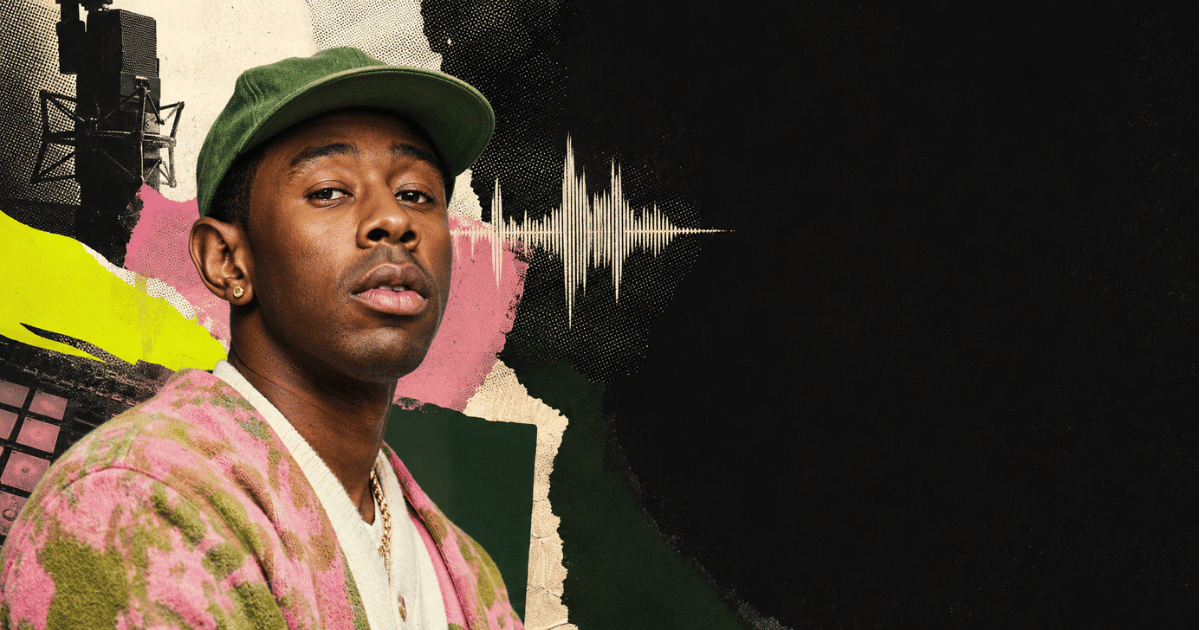
Search for Tyler, the Creator songs and you are not searching for one stable sound. You may be looking for the abrasive minimalism of “Yonkers,” the sunlit orchestration of Flower Boy, the distorted emotional pressure of IGOR, the luxury-rap precision of CALL ME IF YOU GET LOST, the self-interrogation of CHROMAKOPIA or the movement-first funk of DON’T TAP THE GLASS. The same artist made all of them, but he did not reach them by repeating one formula.
That range is exactly why short “top ten” lists usually fail. Streaming totals tell us which songs reached the most listeners, but not which tracks best explain Tyler as a writer, producer, arranger, performer and visual world-builder. Fan favourites reveal emotional attachment, but they can undervalue songs that changed the direction of his catalogue. Critical rankings identify craft, but they sometimes miss the records people actually return to.
Quick answer: “See You Again” is Tyler, the Creator’s most-streamed lead song and the clearest answer to “What is his most popular song?” In this editorial ranking, “NEW MAGIC WAND” takes the number-one position because it compresses his greatest strengths—distorted synth design, escalating arrangement, character performance, melodic tension and explosive rap delivery—into one definitive track. The two answers are different because most popular is measurable while best requires stated criteria.
This guide gives you both. It ranks 50 essential Tyler, the Creator songs without reproducing copyrighted lyrics, shows the largest Spotify totals in a dated snapshot, puts the nine core albums in chronological order, maps the collaborations and explains the production ideas an independent artist can study without copying Tyler’s voice or compositions. To apply the lessons, start with original material from BTR’s hip-hop beats and build a world that belongs to you.
Researched and reviewed: July 18, 2026. Streaming totals are a dated snapshot and will continue to change.
Tyler, the Creator facts at a glance
| Question | Answer |
|---|---|
| What is Tyler, the Creator’s real name? | Tyler Gregory Okonma |
| When was Tyler, the Creator born? | March 6, 1991 |
| How old is Tyler, the Creator? | 35 as of July 18, 2026 |
| Where is he from? | Hawthorne, California, with his identity and career rooted in the Los Angeles area |
| What does he do besides rap? | He sings, writes, produces, arranges, directs visual work and develops fashion and design projects |
| Which collective did he co-found? | Odd Future, also known as OFWGKTA |
| What was his first major breakthrough song? | “Yonkers” in 2011 |
| What is his most popular lead song? | “See You Again” featuring Kali Uchis, based on the Spotify streaming snapshot used here |
| What is his latest album? | DON’T TAP THE GLASS, released July 21, 2025 |
| How many core studio albums does he have? | Nine when Bastard is counted as Tyler counts it; some older references historically labelled that free release a mixtape |
| Does Tyler produce his own songs? | Yes. Self-production and arrangement are central to his catalogue; many projects are produced primarily or entirely by him |
| What genre is Tyler, the Creator? | Most broadly alternative hip-hop, but his catalogue also draws from soul, jazz, funk, R&B, synth-pop, rock, house and other dance music |
| How many Grammys has he won? | Three wins from eleven nominations on the Recording Academy profile as reviewed in July 2026 |
| Which albums won Best Rap Album? | IGOR and CALL ME IF YOU GET LOST |
| What did he win at the 2026 Grammys? | The inaugural Best Album Cover award for CHROMAKOPIA |
| Which major platform named him Artist of the Year? | Apple Music named him its 2025 Artist of the Year |
The Recording Academy’s Tyler, the Creator profile lists three wins and eleven nominations, including Best Rap Album wins for IGOR and CALL ME IF YOU GET LOST and the 2026 Best Album Cover win for CHROMAKOPIA. Apple Music’s 2025 Artist of the Year announcement confirms how large the catalogue became during the combined CHROMAKOPIA and DON’T TAP THE GLASS period. His official YouTube channel remains the clearest source for the videos and visual direction attached to the songs.
What is Tyler, the Creator’s most popular song?
“See You Again” featuring Kali Uchis is Tyler’s most popular lead-artist song by Spotify streams. A third-party tracker snapshot dated July 17, 2026 recorded approximately 3.025 billion Spotify streams—more than twice the total shown for “EARFQUAKE,” the next lead track. That makes “See You Again” the defensible answer when the question means biggest by cumulative Spotify reach.
Popularity still depends on the measurement. “Yonkers” was the decisive early breakthrough. “EARFQUAKE” was the major melodic crossover from IGOR. “Like Him” became a defining streaming-era track from CHROMAKOPIA. “Sugar on My Tongue” led the dance-facing afterlife of DON’T TAP THE GLASS. A song can be historically important, rapidly growing or dominant on another platform without owning the largest all-time Spotify total.
Tyler, the Creator’s 15 most-streamed lead songs on Spotify
| Rank | Song | Project | Approx. Spotify streams |
|---|---|---|---|
| 1 | See You Again (feat. Kali Uchis) | Flower Boy | 3.025 billion |
| 2 | EARFQUAKE | IGOR | 1.345 billion |
| 3 | ARE WE STILL FRIENDS? | IGOR | 924.6 million |
| 4 | NEW MAGIC WAND | IGOR | 907.6 million |
| 5 | BEST INTEREST | Non-album single | 824.9 million |
| 6 | She (feat. Frank Ocean) | Goblin | 806.5 million |
| 7 | Like Him (feat. Lola Young) | CHROMAKOPIA | 798.1 million |
| 8 | GONE, GONE / THANK YOU | IGOR | 580.3 million |
| 9 | Sticky (feat. GloRilla, Sexyy Red & Lil Wayne) | CHROMAKOPIA | 533.2 million |
| 10 | 911 / Mr. Lonely (feat. Frank Ocean & Steve Lacy) | Flower Boy | 464.8 million |
| 11 | WUSYANAME (feat. YoungBoy Never Broke Again & Ty Dolla $ign) | CALL ME IF YOU GET LOST | 464.2 million |
| 12 | SWEET / I THOUGHT YOU WANTED TO DANCE | CALL ME IF YOU GET LOST | 425.0 million |
| 13 | I THINK | IGOR | 420.7 million |
| 14 | Sugar on My Tongue | DON’T TAP THE GLASS | 396.5 million |
| 15 | RUNNING OUT OF TIME | IGOR | 389.3 million |
Method note: Totals are rounded from the July 17, 2026 snapshot published by Kworb’s Spotify tracker. They are not lifetime totals across every platform and will change daily. Featured appearances on another artist’s release were excluded from this lead-song table.
How the 50 songs were ranked
This is an editorial ranking, not a disguised stream chart. Every song was assessed across five categories:
- Composition and production — 30%: harmony, rhythm, sound design, arrangement and how completely the music serves the idea.
- Writing and performance — 25%: perspective, emotional precision, rap delivery, singing, character and control.
- Career importance — 20%: whether the track opened a new era, changed public perception or influenced the work that followed.
- Replay and emotional durability — 15%: how well the record survives repeat listening outside its release cycle.
- Cultural reach — 10%: streaming, live importance, visual impact and catalogue rediscovery.
The ranking includes lead songs from Tyler’s solo catalogue. Guest verses on other artists’ releases are discussed later. Multipart tracks are treated as one work because their contrast and transitions are part of the composition. No copyrighted lyrics are reproduced; descriptions focus on themes, sound and structure.
The 50 best Tyler, the Creator songs ranked
50. “Bastard” — Bastard (2009)
The opening title track established the therapy-session frame that connected Tyler’s earliest narrative world. Its sound is skeletal and home-built, but the limitations are revealing: ominous keys, direct voice placement and a character speaking as if the album were a private room. The material is intentionally confrontational and has not aged evenly, yet the track matters because it shows the blueprint before better equipment, broader harmony and public success. The producer was already thinking in scenes, not isolated singles.
49. “Domo23” — Wolf (2013)
“Domo23” is compact, rude, percussive and designed to hit immediately. The drums and shouted refrain make it one of the cleanest examples of Tyler converting Odd Future chaos into a focused solo record. It is not his deepest composition, but it demonstrates timing: he knows when a beat needs space, when a voice should become percussion and when two minutes of concentrated energy are more useful than another verse.
48. “Jamba” featuring Hodgy — Wolf (2013)
The lurching low end and crooked keyboard figures make “Jamba” feel unstable without losing its pocket. Tyler and Hodgy trade presence rather than trying to polish the edges away. It captures the point where his early horror textures were becoming more musical and less dependent on pure shock. Producers should notice the negative space: the beat feels larger because every frequency is not permanently occupied.
47. “48” — Wolf (2013)
Built around a drug-dealer perspective and the damage surrounding it, “48” is one of the strongest examples of Tyler using character to complicate a moral problem. The production balances low-end weight with melancholy colour, and the song never collapses into a simple sermon. It shows a writer becoming more interested in consequence—who profits, who suffers and how people justify themselves—without abandoning the theatrical framing of Wolf.
46. “Glitter” — Flower Boy (2017)
“Glitter” plays like an emotional voicemail sent from inside the glow of Flower Boy. The arrangement is sweet but not weightless: stacked voices, warm chords and a late rhythmic shift turn infatuation into uncertainty. Its strength is not a giant hook but controlled atmosphere. Tyler lets texture carry feelings that the narrator cannot state cleanly, a technique that becomes central to IGOR.
45. “I Ain’t Got Time!” — Flower Boy (2017)
After the softness surrounding much of Flower Boy, “I Ain’t Got Time!” restores abrasion. The beat is clipped and urgent, the delivery snaps forward and the song carries the confidence of someone refusing to be reduced to one newly visible emotional register. Its placement is crucial: a carefully sequenced album needs contrast, and Tyler uses this track to stop beauty from becoming sameness.
44. “Foreword” featuring Rex Orange County — Flower Boy (2017)
As an opener, “Foreword” does more than establish tempo. It asks what remains after success, possession and public identity stop answering deeper questions. Rex Orange County’s presence softens the frame while the bass and keys create forward motion. The song is an early signal that Flower Boy will be less about provocation than inventory: what Tyler has, what he wants and what loneliness survives the difference.
43. “Big Poe” featuring Sk8brd — DON’T TAP THE GLASS (2025)
“Big Poe” opens Tyler’s shortest and most movement-focused album with a deliberate look backward. The track channels the physical swagger of earlier rap and dance records while keeping Tyler’s ear for odd samples and exaggerated character. Pharrell’s Sk8brd persona makes the influence explicit without turning the song into imitation. The point is lineage: a producer can honour a period through rhythm, sound choice and attitude while still composing a new record.
42. “Ring Ring Ring” — DON’T TAP THE GLASS (2025)
A telephone motif becomes a frame for glossy funk, romantic pursuit and tight pop economy. “Ring Ring Ring” is useful because it shows Tyler reducing scale after the emotional density of CHROMAKOPIA. The parts are bright, the bass is active and the arrangement reaches its point quickly. Complexity is not always more layers; sometimes it is the discipline to choose one groove, make every sound serve it and leave before the energy fades.
41. “Rah Tah Tah” — CHROMAKOPIA (2024)
“Rah Tah Tah” is Tyler in attack mode: heavy drums, blunt rhythmic phrases and momentum that feels almost military after the opening album scene. Its value comes from placement and tone. CHROMAKOPIA repeatedly moves between armour and confession, and this track supplies the armour. The production is direct enough for a live crowd but detailed enough to reward headphones.
40. “Balloon” featuring Doechii — CHROMAKOPIA (2024)
Following one of the album’s most emotionally demanding passages, “Balloon” releases pressure with bounce, colour and Doechii’s elastic performance. That contrast is the craft. Tyler understands that sequencing can change how a song feels: placed elsewhere, it might seem like a playful detour; here it becomes oxygen. The collaboration works because Doechii brings a distinct centre of gravity instead of merely decorating Tyler’s track.
39. “Noid” — CHROMAKOPIA (2024)
“Noid” turns surveillance anxiety and the loss of ordinary privacy into a tense production that never fully settles. The arrangement uses voices and instrumental colour like approaching figures at the edge of vision. It also proves that Tyler’s adult work can revisit fear without returning to the fictional violence of his youth. The danger is now attention itself: cameras, strangers, access and the instability created by being recognised.
38. “Potato Salad” with A$AP Rocky — Potato Salad (2018)
Tyler and A$AP Rocky sound relaxed because the technical work is internalised. Over the familiar jazz-rap foundation, both rappers play with pocket, tone and conversational confidence. “Potato Salad” is less about building a new sonic world than demonstrating chemistry. It belongs in the ranking because effortless rap records are rarely effortless; they depend on taste, breath control, listening and the confidence to avoid over-performing.
37. “LUMBERJACK” — CALL ME IF YOU GET LOST (2021)
“LUMBERJACK” announced the return of Tyler the rapper without discarding Tyler the arranger. The beat is hard, compact and sample-driven, while DJ Drama’s presence places the track in a mixtape tradition. Luxury talk works here as character construction rather than a random list of purchases. After the vulnerable inward movement of IGOR, the song reclaims outward confidence in under three minutes.
36. “HOT WIND BLOWS” featuring Lil Wayne — CALL ME IF YOU GET LOST (2021)
Flute, soft-edged harmony and travel imagery create an elegant surface, then Lil Wayne enters with a verse that treats the pocket as elastic. The collaboration is important to BTR’s recent freestyle cluster: Wayne sounds spontaneous because his phrasing keeps changing shape, even inside a carefully produced record. Tyler’s achievement is architectural. He gives the guest enough identity to dominate a moment without letting the album lose its visual or musical world.
35. “DOGTOOTH” — CALL ME IF YOU GET LOST: The Estate Sale (2023)
“DOGTOOTH” makes generosity, appetite and status sound playful rather than defensive. The drums knock, the horn colour feels celebratory and Tyler’s cadence stays loose across a densely arranged beat. As a deluxe-era song, it also shows how strong the unused material from the sessions was. The track is not an appendix; it extends the Baudelaire persona while sounding complete enough to lead its own campaign.
34. “SORRY NOT SORRY” — CALL ME IF YOU GET LOST: The Estate Sale (2023)
Tyler addresses past selves, people he hurt, people who misread him and the contradictions inside apology. The music video turns those identities into visible characters, but the song works without the visual because the arrangement keeps shifting emotional position. Remorse, irritation and self-protection coexist. It is one of his clearest demonstrations that maturity does not mean presenting a cleaned-up hero; it means becoming specific about the mess.
33. “OKAGA, CA” featuring Alice Smith, Leon Ware and Clem Creevy — Cherry Bomb (2015)
“OKAGA, CA” is the destination toward which Cherry Bomb’s distortion had been travelling. Lush voices, soft-focus harmony and romantic escape create an ending far more patient than the album’s loudest moments suggest. It previews the orchestral confidence of Flower Boy. The mix is full, but the emotional centre remains legible—a lesson Tyler had not mastered consistently elsewhere on the project.
32. “2SEATER” — Cherry Bomb (2015)
Multiple sections turn a drive into a small suite. “2SEATER” matters because it demonstrates Tyler’s refusal to treat beat switches as novelty. Each change reveals another emotional camera angle, and the strings, keys and vocal layers carry as much narrative as the verses. The track can feel excessive, but productive excess is part of its value: it documents an arranger stretching before the restraint of Flower Boy.
31. “Rusty” featuring Domo Genesis and Earl Sweatshirt — Wolf (2013)
“Rusty” is a long-form rap performance in which three distinct voices occupy the same austere world. Domo brings control, Earl compresses language and Tyler closes with a sustained defence of the collective against public caricature. The beat avoids distracting from the verses, yet its dark tones keep the song cinematic. For listeners who reduce early Odd Future to chaos, this is one of the strongest counterarguments.
30. “FIND YOUR WINGS” — Cherry Bomb (2015)
Roy Ayers, Syd, Kali Uchis and the soft-jazz arrangement make “FIND YOUR WINGS” feel like advice transmitted through harmony. The song’s gentleness was once easy to treat as a side of Tyler; later albums proved it was a foundation. Chords are not background decoration here. They create emotional permission, allowing the message to feel encouraging without becoming motivational wallpaper.
29. “November” — Flower Boy (2017)
“November” uses the idea of a remembered safe period to examine anxiety about decline, ownership and whether a creative peak can disappear. The song is structurally conversational, with voices widening the question beyond Tyler’s own nostalgia. Its insight is durable: people often romanticise a past moment not because it was perfect, but because the future had not yet become threatening.
28. “Boredom” featuring Rex Orange County and Anna of the North — Flower Boy (2017)
Few songs make inactivity feel this arranged. Guitars, gentle voices and open space turn isolation into something warm enough to sit inside, even as the narrator wants connection. “Boredom” is a key bridge between Tyler’s earlier loneliness and the more explicit emotional story of IGOR. The groove barely needs to push because the suspended feeling is the subject.
27. “Where This Flower Blooms” featuring Frank Ocean — Flower Boy (2017)
The track pairs self-belief with the memory of limitation. Frank Ocean’s understated contribution adds lift without hijacking the record, and Tyler’s arrangement opens gradually like the title image. It is a career-transition song: the former outsider can now see material success, but he frames growth as permission to become visible rather than proof that money solved everything.
26. “Garden Shed” featuring Estelle — Flower Boy (2017)
“Garden Shed” is built around concealment, private identity and the fear surrounding disclosure. The guitars and slow expansion let the metaphor breathe; Estelle’s voice feels like atmosphere and invitation at once. The song became central to discussion of Tyler’s sexuality because it resists a neat announcement. Artistically, that ambiguity is the point: the arrangement models the distance between knowing something internally and saying it in public.
25. “Take Your Mask Off” featuring Daniel Caesar and LaToiya Williams — CHROMAKOPIA (2024)
Tyler studies the protective identities people construct and then turns the final lens toward himself. The song works because observation becomes confession instead of remaining judgement. Gospel and soul colours soften the confrontation while Daniel Caesar and LaToiya Williams expand the emotional space. On an album obsessed with the difference between persona and person, “Take Your Mask Off” is the conceptual centre.
24. “St. Chroma” featuring Daniel Caesar — CHROMAKOPIA (2024)
A whispered delivery, marching rhythm and growing wall of voices introduce the album’s masked figure with controlled suspense. “St. Chroma” is an opener built for scale, yet its most effective choice is restraint: Tyler delays the full release so every added part feels consequential. The song announces that colour, light, leadership and identity will be connected across the album rather than explained in one verse.
23. “Darling, I” featuring Teezo Touchdown — CHROMAKOPIA (2024)
“Darling, I” turns romantic indecision into buoyant pop-soul. Teezo Touchdown helps the hook float while Tyler articulates a conflict between affection and permanence. The musical brightness does not resolve the ethical tension; it makes the uncertainty easier to sing. That contrast is one of Tyler’s most reliable adult techniques: give a difficult admission a beautiful surface, then let the listener notice what the beauty cannot fix.
22. “Thought I Was Dead” featuring ScHoolboy Q and Santigold — CHROMAKOPIA (2024)
Marching percussion, brass force and a defiant refrain make “Thought I Was Dead” one of Tyler’s strongest large-stage records. ScHoolboy Q adds physical rap energy while Santigold’s voice cuts across the arrangement like an alarm. The title addresses anyone who expected Tyler’s relevance to fade, but the song avoids sounding like a nostalgia act because its production is too restless to live in one era.
21. “Sugar on My Tongue” — DON’T TAP THE GLASS (2025)
The strongest pure dance record in Tyler’s catalogue is concise, flirtatious and driven by springy synth-funk. It does not carry the narrative weight of his concept albums, and that is precisely why it succeeds. Tyler made DON’T TAP THE GLASS around movement rather than seated analysis; “Sugar on My Tongue” is the clearest expression of that instruction. Its strong continuing daily streams in 2026 show that the lighter mode was not a disposable detour.
20. “WUSYANAME” featuring YoungBoy Never Broke Again and Ty Dolla $ign — CALL ME IF YOU GET LOST (2021)
Tyler frames attraction through travel, luxury and comic nervousness while a soft sample creates the feeling of a remembered summer record. YoungBoy Never Broke Again adapts to the elegance of the production instead of being pasted onto it, and Ty Dolla $ign adds melodic polish. “WUSYANAME” proves Tyler can make an accessible single without flattening the oddness of his phrasing or visual world.
19. “JUGGERNAUT” featuring Lil Uzi Vert and Pharrell Williams — CALL ME IF YOU GET LOST (2021)
Three artists with unmistakable identities meet over a beat that feels both minimal and oversized. Lil Uzi Vert bends the rhythm, Tyler attacks with compact confidence and Pharrell closes the lineage loop. The arrangement makes room by changing focus rather than stacking everyone at once. It is a masterclass in feature sequencing: each voice gets an entrance, a purpose and a different relationship to the drums.
18. “Who Dat Boy” featuring A$AP Rocky — Flower Boy (2017)
The distorted brass-like figure and heavy drums initially sounded like the opposite of Flower Boy’s soft palette. In context, “Who Dat Boy” is the necessary rupture. A$AP Rocky’s cool delivery plays against Tyler’s aggression, and the video extends their chemistry into grotesque comedy. The song helped announce that emotional growth would not require abandoning the energy that built the audience.
17. “Yonkers” — Goblin (2011)
“Yonkers” is not Tyler’s most advanced composition, but no responsible career ranking can ignore the record that transformed an internet cult figure into an international conversation. The beat is famously spare: a crawling low end, dry drums and a dissonant figure that leaves the vocal exposed. The black-and-white video made the performance inseparable from the song. Its shock tactics require context and criticism, yet its command of minimalism remains undeniable.
16. “Answer” — Wolf (2013)
Tyler addresses the absence of his father with more vulnerability than the surrounding album initially prepares the listener to expect. A gentle guitar figure and subdued drums prevent the production from telling the audience how loudly to feel. The emotional contradiction—anger alongside the wish that the phone might still be answered—gives the track durability. “Answer” is where the person behind the provocateur becomes impossible to ignore.
15. “She” featuring Frank Ocean — Goblin (2011)
Frank Ocean’s smooth hook and Tyler’s dark narrative create a deliberate and disturbing contrast. The song’s stalking perspective should not be romanticised, but the record is historically important because it revealed how compelling Tyler’s melodic instincts could become when paired with the right voice. Its continuing streaming reach is partly evidence of that musical pull. Study the tension and arrangement; do not copy the harmful behaviour at the centre of the story.
14. “IFHY” featuring Pharrell — Wolf (2013)
Love and resentment occupy the same sentence, and the production behaves accordingly. Thick chords feel tender until distortion and vocal intensity make them claustrophobic. Pharrell’s presence matters not merely as a feature but as a connection to the producer whose chords, drums, design sense and refusal of category deeply influenced Tyler. “IFHY” is an early point where that influence becomes a personal language rather than a borrowed vocabulary.
13. “BEST INTEREST” — single (2019)
Left off IGOR, “BEST INTEREST” became bigger than most artists’ lead singles. It compresses longing, secrecy and self-awareness into a bright arrangement whose looseness makes the emotion feel immediate. The song’s extraordinary streaming life demonstrates a useful truth: a record does not need to fit the album sequence to deserve release. Sometimes the right standalone context allows an idea to breathe.
12. “A BOY IS A GUN*” — IGOR (2019)
The central metaphor holds attraction and danger together. Soul sampling, pitched voices and a steady groove make the song feel elegant while the relationship becomes less safe. Tyler’s production does not simply illustrate a lyric; it lets warmth and threat coexist in the same sound. The asterisk in the title even makes the phrase feel like a warning label attached after the attraction has already taken effect.
11. “RUNNING OUT OF TIME” — IGOR (2019)
“RUNNING OUT OF TIME” stretches urgency across a slow, watery arrangement. The narrator wants clarity, but the synths and layered vocals blur the edges of every statement. That is why the song works inside IGOR: time is supposedly running out, yet the relationship remains suspended. Tyler uses texture to create dramatic irony—the music drifts while the character insists something must happen now.
10. “SMUCKERS” featuring Lil Wayne and Kanye West — Cherry Bomb (2015)
One of Tyler’s greatest rap constructions places two superstar guests inside his arrangement without surrendering authorship. The brass, beat changes and vocal handoffs turn the track into a sequence of escalating entrances. Kanye West sounds amused and sharp; Lil Wayne attacks the closing pocket; Tyler remains the director. “SMUCKERS” is evidence that the messy ambition of Cherry Bomb could produce spectacular control.
9. “SWEET / I THOUGHT YOU WANTED TO DANCE” featuring Brent Faiyaz and Fana Hues — CALL ME IF YOU GET LOST (2021)
The first half luxuriates in romantic sweetness before the second shifts toward reggae-inflected space and disappointment. The transition is not a trick; it changes the meaning of what came before. Brent Faiyaz and Fana Hues give each half a distinct emotional climate, while Tyler’s sequencing turns attraction into aftermath. It is one of his best examples of using a multipart song as narrative editing.
8. “I THINK” — IGOR (2019)
Dance-floor momentum collides with romantic uncertainty. The drums keep moving, the synths flash and Tyler’s pitched voice sounds both exhilarated and unstable. “I THINK” captures the early rush of surrender before the album’s relationship becomes destructive. Its construction also shows how Tyler absorbs dance and pop references: not by cleaning up his edges, but by forcing bright movement through a voice that still feels strange.
7. “911 / Mr. Lonely” featuring Frank Ocean and Steve Lacy — Flower Boy (2017)
The first section is bright, social and beautifully arranged; the second exposes the loneliness underneath the availability. Frank Ocean and Steve Lacy add colour without weakening Tyler’s centre. The emergency-call concept is effective because the song’s form performs it: public charm answers first, private isolation arrives after the switch. Few tracks explain the emotional logic of Flower Boy more efficiently.
6. “Like Him” featuring Lola Young — CHROMAKOPIA (2024)
“Like Him” turns a lifelong question about resemblance, absence and family story into one of Tyler’s most affecting slow builds. Piano, massed voices and Lola Young’s contribution create a climax that feels earned rather than mechanically oversized. The track’s streaming growth reflects its direct emotional access, but its craft is more specific: Tyler delays information, changes the meaning of the search and lets the arrangement carry the shock after language becomes insufficient.
5. “EARFQUAKE” — IGOR (2019)
Tyler’s major melodic crossover is intentionally imperfect. The vulnerable lead vocal, simple central image and bright keyboard movement make the plea immediate, while guest textures sit inside the mix rather than announcing themselves. “EARFQUAKE” proved that the artist once defined by abrasive provocation could make an enormous pop record without sounding anonymous. Its simplicity is the result of editing, not a lack of ideas.
4. “GONE, GONE / THANK YOU” — IGOR (2019)
The first half grieves with almost weightless melody; the second offers gratitude sharpened by refusal. Together they perform the difficult move from loss toward boundary. Tyler uses pitched voices, guitar colour, percussion changes and tonal contrast to make the emotional transition physical. The song is long because closure is not one feeling. It is affection, humiliation, memory and the decision not to repeat the experience.
3. “ARE WE STILL FRIENDS?” — IGOR (2019)
The closing question of IGOR is devastating because the arrangement keeps getting larger while the request remains unresolved. Soul influence, distorted peaks and increasingly desperate vocals turn politeness into need. Rather than provide narrative closure, Tyler ends on a relationship category that may be impossible. It is among his finest album closers and one of the clearest examples of production becoming emotional action.
2. “See You Again” featuring Kali Uchis — Flower Boy (2017)
Tyler’s biggest song is also one of his most beautifully constructed. The opening keys establish longing before the drums expand the fantasy; Kali Uchis provides a melody that feels both present and unreachable. Tyler originally intended the song for another singer, but keeping it made the vulnerability part of his own catalogue. Its later streaming explosion was not an algorithm manufacturing quality. It was a new audience discovering a hook, harmony and dream-state concept strong enough to survive years before becoming gigantic.
1. “NEW MAGIC WAND” — IGOR (2019)
“NEW MAGIC WAND” is the best Tyler, the Creator song because every major part of his artistry is under pressure at once. The synth bass is distorted but precise. The drums feel like a threat. Character voices and pitched vocals turn jealousy into theatre. The arrangement escalates through subtraction, repetition and sudden density, then Tyler’s final delivery provides the explosive rap performance the song has been withholding.
Tyler has identified it as a personal favourite, and the choice makes sense. The track connects early aggression to adult composition: the emotional extremity of the old work remains, but now it is disciplined by harmony, sound design, narrative placement and exact control of climax. “See You Again” is the biggest. “NEW MAGIC WAND” is the fullest demonstration of the creator.
Tyler, the Creator albums in order
Tyler’s core album sequence contains nine projects when Bastard is treated as the first album, as Tyler has treated it. Older sources sometimes call the free 2009 release a mixtape, while Goblin remains his major-label debut. CALL ME IF YOU GET LOST: The Estate Sale is an expanded edition rather than a separate core studio album, and Music Inspired by Illumination & Dr. Seuss’ The Grinch is a short soundtrack-related EP.
| Order | Album | Release | Best starting tracks | Core sound |
|---|---|---|---|---|
| 1 | Bastard | December 25, 2009 | Bastard, Odd Toddlers, Inglorious | Lo-fi alternative rap, horrorcore, home-built narrative production |
| 2 | Goblin | May 10, 2011 | Yonkers, She, Analog | Minimal menace, shock writing, Odd Future-era abrasion |
| 3 | Wolf | April 2, 2013 | Answer, IFHY, Rusty | Richer chords, character narrative, rap and jazz-soul growth |
| 4 | Cherry Bomb | April 13, 2015 | SMUCKERS, FIND YOUR WINGS, 2SEATER | Distortion, live instrumentation, ambitious maximalist arrangement |
| 5 | Flower Boy | July 21, 2017 | See You Again, 911 / Mr. Lonely, Garden Shed | Warm orchestration, vulnerability, concise and colourful songwriting |
| 6 | IGOR | May 17, 2019 | NEW MAGIC WAND, EARFQUAKE, ARE WE STILL FRIENDS? | Distorted synth-soul, pitched vocals, continuous heartbreak narrative |
| 7 | CALL ME IF YOU GET LOST | June 25, 2021 | WUSYANAME, HOT WIND BLOWS, SWEET / I THOUGHT YOU WANTED TO DANCE | Mixtape framing, luxury rap, travel, dense self-produced elegance |
| 8 | CHROMAKOPIA | October 28, 2024 | Like Him, St. Chroma, Take Your Mask Off | Confession, masks, family, marching rhythms and cinematic scale |
| 9 | DON’T TAP THE GLASS | July 21, 2025 | Sugar on My Tongue, Ring Ring Ring, Big Poe | Dance, rap-house, funk, electro and movement-first brevity |
1. Bastard (2009): the raw blueprint
Bastard introduced the therapy framing, alter-ego logic and self-contained visual world that would define Tyler’s early career. The production was made with accessible software and limited resources, which leaves rough edges but also exposes the underlying instincts: dissonant keyboard colour, dry drums, voices staged like characters and albums treated as narratives. New listeners should approach the lyrics with context; the shock material is central to the period and frequently harmful. The useful historical question is how an unknown teenager used constraint to create identity.
2. Goblin (2011): breakthrough and backlash
“Yonkers” made Tyler impossible to ignore, and Goblin expanded the Dr. TC conversation into a major-label-length project. The album is long, intentionally abrasive and uneven. Its best moments show extraordinary command of atmosphere; its worst lean on provocation that now obscures the musical idea. “She” reveals melodic possibility through Frank Ocean, while “Analog” points toward a softer palette. Start with selected tracks rather than treating the album as the easiest entry point.
3. Wolf (2013): the bridge to musical maturity
Wolf retains characters and conflict but gives harmony, storytelling and emotional contradiction more room. “Answer” addresses paternal absence; “IFHY” turns love into claustrophobia; “Rusty” demonstrates serious rap ability. The album is the missing bridge for listeners who jump from “Yonkers” to Flower Boy and assume the transformation happened overnight. Tyler was already learning how chords could complicate rage and how an album sequence could alternate beauty with impact.
4. Cherry Bomb (2015): the necessary explosion
Cherry Bomb is the catalogue’s laboratory. Distortion sometimes buries the vocals, sections collide and the album refuses one stable scale. Yet “FIND YOUR WINGS,” “2SEATER,” “SMUCKERS” and “OKAGA, CA” contain the arranger who would soon make Flower Boy. It is best heard as creative expansion rather than failed polish. Tyler tested live instrumentation, jazz harmony, suites, aggressive rock texture and large guest architecture. The next album works partly because this one discovered which excesses to keep.
5. Flower Boy (2017): colour, clarity and revelation
Flower Boy is the strongest first full album for many listeners. It balances rap records with orchestral warmth, concise hooks and sustained themes of loneliness, growth and identity. “See You Again” became the enormous sleeper hit, but “Garden Shed,” “911 / Mr. Lonely,” “Boredom” and “November” explain why the album changed public perception. The production is detailed without smothering the lead idea. Tyler no longer needs chaos to prove authorship.
6. IGOR (2019): the complete concept record
IGOR is designed as a continuous emotional sequence, and first-time listeners should play it in order. The voice is often pitched and treated as another instrument. Synths distort, soul references reappear in unfamiliar shapes and rap verses arrive when the narrative pressure demands them. “EARFQUAKE” is the crossover, “NEW MAGIC WAND” is the explosion, and “ARE WE STILL FRIENDS?” refuses clean closure. The album won Tyler his first Grammy and remains the best single demonstration of production, character and sequencing operating as one system.
7. CALL ME IF YOU GET LOST (2021): rap mastery with passport stamps
DJ Drama frames the album like a luxury travel mixtape, but beneath the boasts is a story about desire, secrecy and emotional displacement. Tyler raps with renewed directness while keeping the harmonic lessons of Flower Boy and IGOR. “LUMBERJACK” hits hard, “WUSYANAME” glides and the ten-minute “SWEET / I THOUGHT YOU WANTED TO DANCE” proves he still thinks in suites. The Estate Sale expansion adds “DOGTOOTH,” “SORRY NOT SORRY” and other strong session material.
8. CHROMAKOPIA (2024): the mask turns inward
Tyler uses a masked character and his mother’s voice to examine ageing, family narratives, intimacy, fame, masculinity and the identities people perform to survive. The production can march, whisper, explode or open into gospel colour. “Like Him” became the emotional streaming giant, while “Take Your Mask Off” carries the thesis and “St. Chroma” supplies the cinematic entry. The album earned an Album of the Year nomination and won the first Grammy for Best Album Cover.
9. DON’T TAP THE GLASS (2025): movement over explanation
Released less than a year after CHROMAKOPIA, DON’T TAP THE GLASS deliberately rejects another heavy concept. Ten short tracks move through funk, house, electro, bass music and rap history. Tyler produced the album and designed it for dancing, driving and physical response. “Sugar on My Tongue” supplies the clearest pop-funk high, while “Big Poe” and “Ring Ring Ring” connect different generations of groove. It is not his deepest album; it is a valuable reminder that joy, brevity and movement are also serious arrangement goals.
Where should a new Tyler, the Creator listener start?
The best starting point depends on what you already enjoy. Tyler’s catalogue rewards chronological listening, but demanding that every newcomer begin with the harshest early record can hide the reasons the artist matters now.
| If you want… | Start with this album | Play these songs first |
|---|---|---|
| The most accessible introduction | Flower Boy | See You Again; 911 / Mr. Lonely; Boredom |
| The best complete narrative | IGOR | Play the entire album in order |
| Tyler primarily rapping | CALL ME IF YOU GET LOST | LUMBERJACK; HOT WIND BLOWS; CORSO |
| Recent emotional work | CHROMAKOPIA | Like Him; Take Your Mask Off; Darling, I |
| Dance and funk | DON’T TAP THE GLASS | Sugar on My Tongue; Ring Ring Ring; Big Poe |
| The raw Odd Future period | Wolf, then Goblin | Rusty; Answer; Yonkers; She |
| Production ambition and distortion | Cherry Bomb | SMUCKERS; 2SEATER; FIND YOUR WINGS |
A 12-song beginner playlist
- See You Again
- NEW MAGIC WAND
- 911 / Mr. Lonely
- Answer
- SMUCKERS
- EARFQUAKE
- WUSYANAME
- SWEET / I THOUGHT YOU WANTED TO DANCE
- Like Him
- Take Your Mask Off
- Sugar on My Tongue
- Yonkers
That order is intentionally non-chronological. It begins with melodic access, moves through emotional and technical high points, reaches the recent work and ends with the breakthrough so the early minimalism has context. After that route, choose the album connected to the songs that held your attention.
Tyler, the Creator’s essential collaborations
Tyler’s best collaborations do not treat guests as search-engine decoration. He writes a role for the voice, changes the production around it or uses the feature to connect musical generations. These are the most important recurring relationships and one-off combinations.
Tyler, the Creator and Frank Ocean songs
Frank Ocean appears across the Odd Future-connected years as both a featured singer and a subtle supporting presence. Begin with “She,” “Where This Flower Blooms,” “911 / Mr. Lonely,” “Slater” and “Bimmer.” The pairing works because Frank’s calm, elastic tone can soften Tyler’s rough voice without erasing it. On later songs, his contribution is often brief; Tyler uses recognisable voices as colours inside the arrangement rather than always giving them a conventional guest verse.
Tyler, the Creator and Kali Uchis songs
“See You Again” is the essential collaboration, but Kali Uchis also contributes to the world surrounding Cherry Bomb and Tyler’s broader catalogue. Her precise, airy melodic delivery fits his saturated chords and romantic arrangements. The lesson is range matching: a guest does not need the same tone as the lead artist. Contrast can clarify the emotion the narrator cannot sing convincingly alone.
Tyler, the Creator and A$AP Rocky songs
“Who Dat Boy,” “Potato Salad” and “WHARF TALK” show three versions of the chemistry: aggressive single, relaxed rap exercise and polished romantic travel record. Rocky’s ease offsets Tyler’s urge to direct every detail. Their best work sounds like friendship because the performances leave room for humour and interruption rather than forcing identical styles.
Tyler, the Creator and Lil Wayne songs
“SMUCKERS,” “HOT WIND BLOWS,” “Droppin’ Seeds” and “Sticky” place Wayne in very different arrangements. Tyler understands Wayne’s rhythmic flexibility and gives him beats with enough open space to bend syllables. The pair also connects generations of self-invention: both artists use voices, characters and unexpected phrasing to make rapping feel less fixed.
Tyler, the Creator and Pharrell Williams songs
Pharrell’s importance exceeds the feature list. “IFHY,” “JUGGERNAUT,” “KEEP DA O’S” and “Big Poe” document a relationship between formative influence and eventual collaborator. Tyler absorbed lessons from the Neptunes—unusual chords, dry drums, fashion as world-building and permission to be a producer who refuses a narrow category—but his mature records no longer sound like imitation. That is the correct outcome of influence.
Best guest appearances by Tyler, the Creator
- Kali Uchis — “After the Storm”: warm funk and a concise Tyler verse inside Kali’s world.
- Freddie Gibbs — “Something to Rap About”: elegant production and unusually reflective luxury rap.
- Frank Ocean — “Biking”: Tyler and Jay-Z contribute different generational textures to Frank’s meditation.
- The Game — “Martians vs Goblins”: an early high-profile appearance that preserves Tyler’s disruptive persona.
- Maxo Kream — “Big Persona”: a forceful feature built around scale, confidence and unlikely chemistry.
- Channel Tres — “fuego”: Tyler operating inside a dance-focused pocket.
- Westside Gunn — “327”: art-rap detail and a calmer, luxury-facing performance.
The best Tyler, the Creator love songs and emotional tracks
Tyler’s love songs rarely describe a stable, uncomplicated relationship. They are usually about fantasy, secrecy, jealousy, distance, timing, non-exclusivity or the wish to preserve connection after romance fails. That tension is one reason the songs travel so widely: the arrangements sound beautiful while the narrators remain unreliable or uncertain.
| Mood | Song | Why it fits |
|---|---|---|
| Dreaming about someone | See You Again | Romantic fantasy is treated as a place that may exist more clearly in imagination than reality |
| Falling too quickly | I THINK | Dance energy captures the rush before certainty arrives |
| Fear of losing someone | EARFQUAKE | A simple plea becomes emotionally huge through melody and vocal vulnerability |
| Jealousy and obsession | NEW MAGIC WAND | The arrangement escalates as the character’s need for control intensifies |
| Love mixed with resentment | IFHY | Tender chords and aggressive delivery hold contradiction together |
| A relationship becoming dangerous | A BOY IS A GUN* | Warm soul colour carries a warning about attraction |
| Longing for clarity | RUNNING OUT OF TIME | Urgency is suspended inside drifting production |
| Breakup and release | GONE, GONE / THANK YOU | Two linked sections move from grief toward a boundary |
| Wanting connection after the ending | ARE WE STILL FRIENDS? | The final question remains deliberately unanswered |
| Romantic freedom versus permanence | Darling, I | Bright pop-soul carries an honest conflict about commitment |
How Tyler, the Creator’s production style works
There is no single “Tyler, the Creator type beat.” A convincing analysis has to explain what remains consistent while the surface changes. The durable traits are not one drum kit or chord preset. They are a way of arranging contrast, treating voices as instruments, using harmony as character and building a visual-emotional world around every project.
1. Harmony carries the emotional argument
Tyler often uses extended chords, chromatic movement, unexpected bass notes and voicings associated with soul, jazz and R&B. The important lesson is not “always add a ninth.” A rich chord is only useful when its tension matches the scene. On “See You Again,” harmony creates romantic suspension. On “IFHY,” thick chords become claustrophobic. On “Like Him,” piano and voices enlarge a family question. The chord vocabulary changes meaning through register, instrumentation and what comes before it.
If you cannot identify the harmony in a reference, use BTR’s song key and BPM finder as a starting measurement, then verify by ear or instrument. Key detection does not explain a progression; it gives you a map on which to begin listening.
2. Drums alternate between dry force and human movement
The early records often use hard, exposed drums with little decorative polish. Later projects widen the vocabulary: boom-bap knock, marching patterns, live-feeling percussion, clipped funk, house pulse, New Orleans bounce influence and programmed swing. The common feature is decisive placement. Tyler’s best drums have a physical instruction—stomp, lurch, glide, march or dance.
Tempo alone will not reproduce that feeling. Two tracks at a similar BPM can move differently because of subdivision, swing, note length and where the kick argues with the bass. Use a BPM analyser, but study the pocket after you know the number.
3. Bass is a character, not a frequency requirement
On aggressive songs, bass may be distorted, sustained and threatening. On funk records it becomes mobile and conversational. On softer tracks it can imply harmony without drawing attention. Tyler frequently lets low-end timbre define the era: the crawl of “Yonkers,” the pressure of “NEW MAGIC WAND,” the luxury glide of CALL ME IF YOU GET LOST and the bounce-driven movement of DON’T TAP THE GLASS.
4. Voices are arranged like a strange choir
Tyler layers pitched leads, spoken characters, whispers, gang vocals, guest fragments, doubles and harmonies. A famous guest may be mixed as texture rather than given a spotlight. That approach makes the voice part of orchestration. Independent artists can borrow the principle without copying the sound: record several functions—lead, low support, high harmony, rhythmic double and distant response—then mute anything that does not strengthen the emotional direction.
5. Distortion is used as narrative pressure
Distortion in Tyler’s catalogue is not always a mastering accident or a demand for maximum loudness. It can represent obsession, chaos, anger or a character losing control. Cherry Bomb sometimes pushes the choice beyond clarity; IGOR applies it with greater hierarchy. The transferable lesson is to distort a selected layer for meaning while protecting enough contrast for the climax to feel larger.
6. Beat switches change perspective
Multipart Tyler songs often move because the emotional camera moves. “911 / Mr. Lonely” turns public availability into private isolation. “SWEET / I THOUGHT YOU WANTED TO DANCE” reframes romance as disappointment. “GONE, GONE / THANK YOU” shifts from grief toward guarded release. A beat switch earns its place when the new section says something the old production could not.
BTR’s guide to rap song structure can help you plan the form, but do not add a switch merely because modern songs use one. Write the reason for the perspective change before designing the transition.
7. Samples are transformed through context
Tyler draws from soul, jazz, rap history, funk and less predictable sources, but the creative value comes from placement and transformation. A source may become a harmonic bed, a rhythmic cue, an easter egg or a bridge between eras. Sampling is not permission to redistribute any recording you can isolate. Learn the composition and clearance issues in BTR’s music sampling guide.
8. Arrangement is inseparable from visual identity
Each era has a palette, character, clothing language, typography and performance behaviour. Those choices feed back into the music. The green mask and marching geometry of CHROMAKOPIA match its tension between public armour and private confession. The red, blue and yellow dance-world of DON’T TAP THE GLASS matches its physical directness. A strong creative world does not decorate the song after mastering; it helps decide which sounds belong.
9. Imperfection is curated
Tyler’s singing may be pitched, strained or deliberately rough. Synths may clip. A transition may feel abrupt. The distinction between character and amateurism is control. Curated imperfection appears beside evidence that the artist can make a cleaner choice and rejected it for a reason. If every layer is out of tune, distorted and crowded, the listener cannot identify which imperfection matters.
10. Album sequencing completes the production
A song’s meaning changes according to its neighbours. “Balloon” releases the pressure after “Like Him.” “Who Dat Boy” interrupts the softness of Flower Boy. “ARE WE STILL FRIENDS?” reopens the relationship at the exact moment IGOR should offer closure. Tyler’s albums rank highly because sequencing is not administration. It is the final arrangement layer.
How to study Tyler’s sound without copying it
The goal is not to make a counterfeit Tyler song. A direct clone competes with the original artist on familiarity and loses. Study the decisions beneath the style, then apply them to your own story, natural voice and legal source material.
- Choose one emotional contradiction. Examples include confidence versus loneliness, love versus resentment or public identity versus private fear.
- Assign each side a sound. One may use warm chords; the other may use dry drums, distortion or a narrower vocal register.
- Write two contrasting sections. Do not create a beat switch until the perspective genuinely changes.
- Build a four- or eight-chord palette by ear. Use extended harmony only where it adds the required tension.
- Make the drums describe movement. Decide whether the body should nod, march, lurch or dance.
- Record vocal roles, not endless doubles. Give every layer a function and remove redundant parts.
- Create one visual rule. A colour, location, object or character can help you reject sounds that do not belong.
- Protect the climax. Save the widest harmony, hardest drums or most exposed vocal for the point of maximum meaning.
- Replace all reference-specific details. Remove borrowed ad-libs, vocal pitching, chord sequences, lyrics, album imagery and character names.
- Test the master in context. Compare tonal balance and dynamics, not copied loudness or exact timbre, using BTR’s AI mastering workflow.
You may use BTR’s AI stem splitter to study arrangement on audio you are authorised to process. Isolating a stem does not transfer copyright or create permission to sample, publish or sell the separated recording. Analysis is a listening tool, not a rights-clearing shortcut.
Sources and methodology
This guide separates stable facts, dated platform measurements and editorial judgement. Release and award details were checked against artist, platform, chart and Recording Academy sources. Streaming totals were captured as a dated third-party snapshot and rounded so normal daily movement does not create false precision. The song ranking is original editorial analysis based on the stated scoring criteria; it is not presented as a public vote or official chart.
- Recording Academy: Tyler, the Creator awards and nominations
- Apple Newsroom: Apple Music’s 2025 Artist of the Year
- Apple Music: Tyler, the Creator artist catalogue
- Spotify: Tyler, the Creator artist catalogue
- Official Tyler, the Creator YouTube channel
- Official Charts: Tyler, the Creator chart history
- Official Charts: CHROMAKOPIA
- Official Charts: DON’T TAP THE GLASS
- Apple Music: DON’T TAP THE GLASS track list and interview
- Kworb: dated Spotify song totals used for the streaming snapshot
- Universal Audio: recording Tyler, the Creator with engineer Vic Wainstein
Frequently asked questions about Tyler, the Creator songs
What is Tyler, the Creator’s most popular song?
“See You Again” featuring Kali Uchis is his most-streamed lead song on Spotify in the July 17, 2026 snapshot used for this guide, with approximately 3.025 billion streams.
What is the best Tyler, the Creator song?
This guide ranks “NEW MAGIC WAND” first because it most completely combines Tyler’s production, arrangement, character performance, emotional tension and rap delivery. “See You Again” ranks second and remains his biggest song by Spotify reach.
What song made Tyler, the Creator famous?
“Yonkers” was his decisive 2011 breakthrough. Its minimal beat, confrontational performance and black-and-white video pushed Tyler and Odd Future into global attention.
What is Tyler, the Creator’s real name?
His real name is Tyler Gregory Okonma.
How old is Tyler, the Creator?
He was born March 6, 1991 and was 35 years old on July 18, 2026.
Where is Tyler, the Creator from?
He is from Hawthorne, California, and his career is closely associated with Los Angeles and the Southern California creative scene.
What is Tyler, the Creator’s latest album?
DON’T TAP THE GLASS, released July 21, 2025, was his latest studio album as of this article’s July 18, 2026 review.
How many albums does Tyler, the Creator have?
The core sequence contains nine studio albums when Bastard is counted as Tyler counts it. Some older sources called the free 2009 release a mixtape, while Goblin remains his major-label debut.
What order should I listen to Tyler, the Creator’s albums?
Chronological order is Bastard, Goblin, Wolf, Cherry Bomb, Flower Boy, IGOR, CALL ME IF YOU GET LOST, CHROMAKOPIA and DON’T TAP THE GLASS. New listeners can begin with Flower Boy or IGOR before returning to the early work.
What is Tyler, the Creator’s best album?
IGOR is the strongest complete concept album and the best single starting point for his production-led storytelling. Flower Boy is the most accessible introduction, while CALL ME IF YOU GET LOST is the best choice for listeners who primarily want rap.
What genre is Tyler, the Creator?
Alternative hip-hop is the broadest useful label, but his catalogue moves through soul, jazz, R&B, funk, synth-pop, rock, house, electro and other dance styles.
Does Tyler, the Creator produce his own songs?
Yes. He is a producer and arranger as well as a rapper and singer. Self-production is central to his albums, and DON’T TAP THE GLASS was produced by Tyler across all ten tracks.
Which Tyler, the Creator album is “See You Again” on?
“See You Again” featuring Kali Uchis appears on Flower Boy, released in 2017.
Which Tyler, the Creator album is “NEW MAGIC WAND” on?
“NEW MAGIC WAND” appears on IGOR, released in 2019.
Which Tyler, the Creator album is “Like Him” on?
“Like Him” featuring Lola Young appears on CHROMAKOPIA, released in 2024.
What are the best Tyler, the Creator songs with Frank Ocean?
Start with “She,” “911 / Mr. Lonely,” “Where This Flower Blooms,” “Slater” and the “Bimmer” section of “PartyIsntOver/Campfire/Bimmer.” Frank’s role ranges from featured hook to brief supporting texture.
What are the best Tyler, the Creator love songs?
“See You Again,” “I THINK,” “EARFQUAKE,” “IFHY,” “A BOY IS A GUN*,” “RUNNING OUT OF TIME,” “GONE, GONE / THANK YOU” and “ARE WE STILL FRIENDS?” trace different stages of fantasy, attraction, jealousy, loss and attempted connection.
Why does Tyler pitch his vocals?
Pitching helps him create characters, separate emotional roles and use the voice as part of the arrangement. It can also make a vulnerable statement feel less like an untreated diary entry while preserving the emotion.
Can I sample a Tyler, the Creator song?
Not automatically. The composition and sound recording are protected. Commercial sampling generally requires the relevant permissions. Isolating audio with a stem tool does not grant those rights.
How can I make a Tyler-inspired beat without copying him?
Study principles rather than assets: emotional contrast, extended harmony, purposeful drum movement, layered vocal roles, visual world-building and beat switches that change perspective. Use original chords, melodies, drums, lyrics and legal source material.
Final word: the catalogue is the story
Tyler, the Creator’s catalogue did not grow by replacing an embarrassing past with a respectable present. It grew by turning each era into material for the next one. The dry menace of the early beats became controlled distortion. The characters became masks he could interrogate. The love of Pharrell and Stevie Wonder became a personal harmonic language. The urge to shock became an ability to stage emotional contradiction.
That evolution is why a single viral song cannot explain him, even when “See You Again” has crossed three billion Spotify streams. Listen to “Yonkers,” “Answer,” “SMUCKERS,” “Garden Shed,” “NEW MAGIC WAND,” “SWEET / I THOUGHT YOU WANTED TO DANCE,” “Like Him” and “Sugar on My Tongue” in sequence. You will hear one producer learning when to add, when to distort, when to confess and when to make the room move.
For an independent artist, the most valuable lesson is not the chord pack or vocal effect. It is the refusal to build a career around one successful surface. Study references closely, use legal and original rap beats, and let each release prove you learned something the previous one could not teach.