
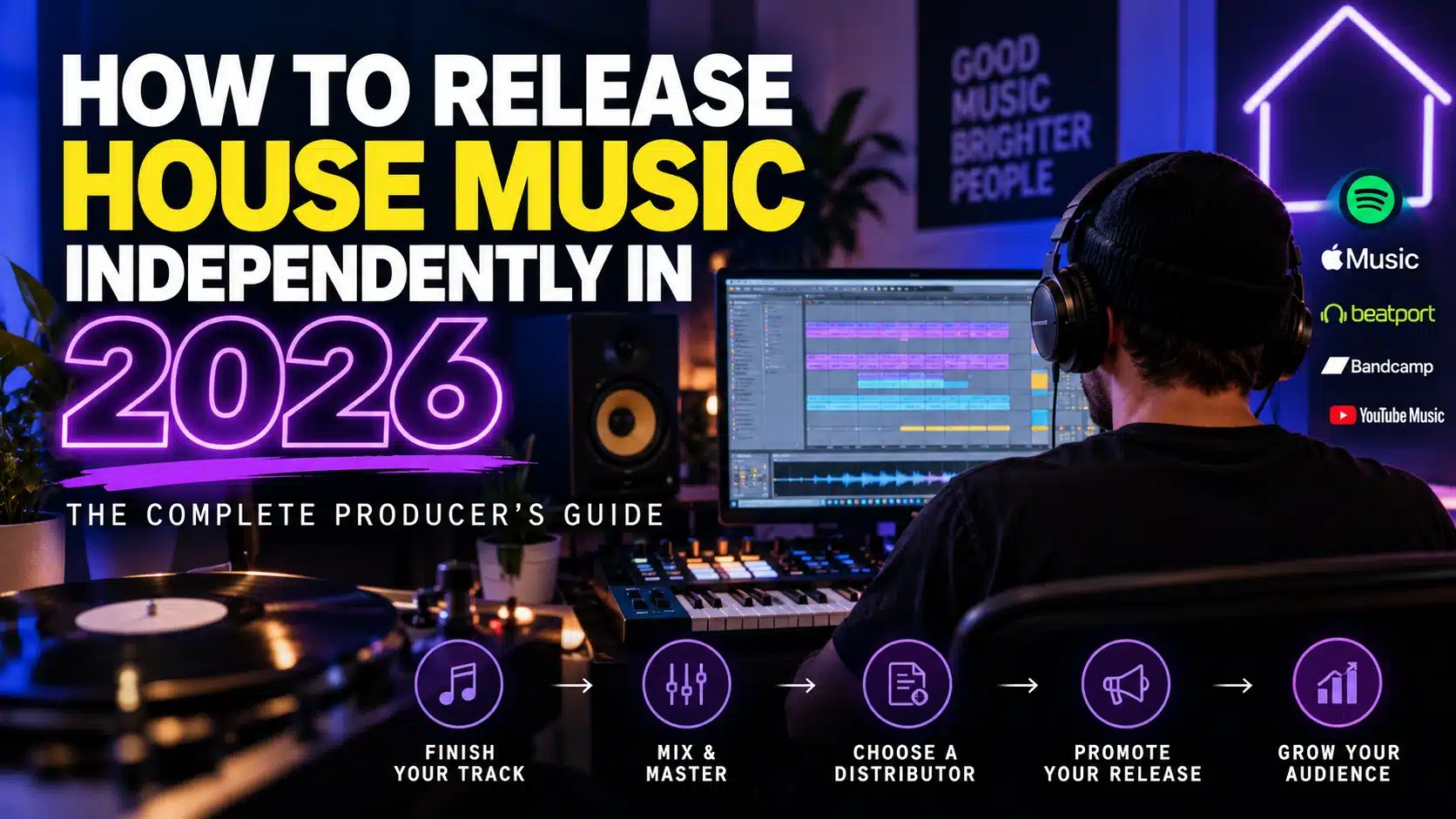
You have spent hours perfecting the kick drum, tightening the bassline, shaping the groove and getting the breakdown exactly right. Your house track is finished. Now comes the question every independent producer faces: how do you actually release house music and get people to hear it?
In 2026, releasing house music independently does not necessarily require a record label, expensive distribution campaign or industry connections. You can build your own artist catalogue, publish original productions and introduce your sound directly to listeners.
But releasing a track and building an audience are two different jobs.
This guide covers the complete process, from preparing a release-ready house record to publishing it, developing your artist profile, finding the right audience and promoting your music without wasting money.
Ready to publish? Upload your house music free on BeatsToRapOn and start building your artist catalogue.
1. Understand Where Your House Music Fits
House music is one of electronic music’s most influential genres, but it is not a single sound.
Originating in Chicago’s club culture during the 1980s, house music developed from disco, electronic production and DJ-driven experimentation. Its influence now extends across underground dance floors, festivals, radio, global club scenes and independent music communities.
At its foundation, house music typically combines a steady four-on-the-floor kick drum with syncopated percussion, basslines and repeating musical phrases. What makes each production distinctive is its arrangement, groove, sound selection and atmosphere.
Before uploading your release, identify which style best represents your sound.
Deep House
Deep house frequently emphasises warm chords, soulful textures, restrained percussion and rolling basslines. It can work particularly well for atmospheric, melodic and groove-focused records.
Explore Deep House music to understand how producers approach the style.
Tech House
Tech house combines elements of house and techno, commonly emphasising rhythmic precision, bass movement, vocal fragments and DJ-friendly arrangements.
If your production focuses on stripped-back grooves and club functionality, explore the Tech House catalogue.
Afro House
Afro house often features layered percussion, expressive rhythms, melodic elements and influences from African electronic music traditions.
It has its own creative history and should not simply be treated as a marketing label for any house record containing percussion.
If this is your sound, read the dedicated guide to upload Afro house music.
Classic, Acid and Progressive House
Classic house often draws on foundational drum-machine grooves, piano chords and soulful vocal traditions.
Acid house is strongly associated with resonant, evolving synthesiser patterns, particularly those created using TB-303-style sounds.
Progressive house typically develops musical themes over longer arrangements, using gradual transitions and evolving energy.
Why does subgenre selection matter?
The right genre helps listeners, DJs and potential fans understand what they are about to hear. A progressive house record and an underground tech house track may appeal to different audiences.
Choose the label that accurately describes your recording rather than whichever genre currently appears most popular.
2. Prepare Your House Track for Release
A finished production session is not automatically a finished master.
House music depends heavily on the relationship between drums, bass, rhythm and dynamics. Problems that seem insignificant in your studio can become much more obvious through headphones, mobile devices or larger sound systems.
Before releasing your track, work through these essential checks.
Check the Kick and Bass Relationship
Your kick and bassline should complement each other rather than compete for the same space.
Listen carefully for:
- Excessive low-frequency buildup.
- Bass notes masking the kick transient.
- Phase cancellation or inconsistent low-end energy.
- Sidechain compression that pumps unnaturally.
- Bass movement that overwhelms the groove.
Sidechain compression can help create space around the kick, but it is not mandatory for every house production. The goal is a controlled low end that works with the track’s rhythm.
Test the Arrangement
For club-oriented house music, structure matters.
DJs may appreciate introductions and outros that support mixing, while casual listeners often respond to a clear musical identity early in the track.
Consider whether your arrangement includes an effective opening, meaningful development, a recognisable central groove and transitions that serve the music.
There is no universal arrangement every house producer must follow. A streaming-focused vocal house single may be shorter and more direct than a seven-minute underground club record.
Check Your Master
Listen on several playback systems where possible.
A studio monitor, headphones, phone speaker and ordinary Bluetooth speaker reveal different problems.
Pay particular attention to distortion, uncontrolled limiting, harsh high frequencies and excessive low-end energy.
Do not force every track to the same loudness number. Preserve enough dynamic movement for your production to breathe.
If you need additional processing, explore BTR’s AI mastering tool, and compare the result against your original recording before publishing.
3. Prepare the Artwork, Title and Release Metadata
Your house track needs more than an audio file.
Listeners should be able to recognise your release, identify the producer and find the music again.
Create Distinctive Cover Artwork
Strong electronic music artwork does not have to be complicated.
Minimal typography, architectural photography, striking colour, abstract shapes or distinctive photographic compositions can work effectively.
The objective is to communicate a recognisable identity at thumbnail size.
For a BTR upload, prepare a high-quality square image, ideally at least 1000 × 1000 pixels, and use original artwork that you own or are authorised to use.
Avoid relying on default artwork. A distinctive cover contributes to your artist identity and helps meet artwork-related eligibility requirements for BTR discovery features.
Choose a Searchable Track Title
Use the actual title of your release.
Avoid adding unrelated artist names, trending keywords or misleading descriptions just to attract clicks.
For example, a title such as Midnight Frequency is more credible than Best Tech House EDM Festival Club Hit 2026.
Your artist name should also remain consistent across releases.
Confirm Your Metadata
Before submission, check the following:
- Artist name and track title.
- Correct primary genre and available subgenre.
- Collaborator and producer credits.
- Original cover image.
- Final audio version.
- Any necessary copyright and licensing permissions.
Metadata errors create confusion and can make it harder for listeners to locate your catalogue.
4. Where Can You Upload House Music for Free?
Independent producers have different publishing options depending on what they want to achieve.
Some services distribute music to third-party streaming platforms. Others provide direct artist uploads, music communities or specialist DJ marketplaces.
These are not identical services.
BeatsToRapOn provides a direct-upload artist platform connected to BTR Music, its listener-facing streaming app.
Artists manage their music through BeatsToRapOn, while approved and eligible releases can become available for discovery and listening through BTR Music.
A free BeatsToRapOn artist account currently allows up to 10 track uploads in total. Artists who need a larger catalogue can explore Artist Pro, which offers unlimited uploads and additional features.
To get started:
- Visit Upload House Music Free.
- Create or sign into your artist account.
- Open the artist track workspace.
- Upload your finished house recording and add its artwork, title, genre and credits.
- Submit the track for review.
- Once approved and published, share the public release link.
Important: Uploading to BeatsToRapOn does not automatically distribute your track to Spotify, Apple Music or other external streaming platforms. Those services require a separate distribution workflow.
BTR is a destination platform with its own artist and listener ecosystem.
5. Build an Artist Profile People Want to Follow
A listener discovering one strong track may want to know who made it.
Your artist profile should answer that question immediately.
Start with a recognisable artist photo, a short biography and a consistent musical identity.
An effective biography does not need to exaggerate achievements.
Instead of writing:
“Internationally recognised superstar producer changing the electronic music industry.”
Try something specific:
“Independent house producer creating late-night club grooves, rolling basslines and atmospheric electronic music.”
That tells a potential listener what they can expect.
Keep the same artist identity across your releases and promotional accounts, so someone who discovers your music can find you again.
On BTR, complete profile information and proper artwork also matter for participation in certain discovery and monetisation features. Publishing alone does not guarantee exposure.
6. How to Promote House Music Without a Record Label
Promotion works best when it is connected to the actual sound of your release.
A carefully targeted campaign can be more useful than sending a generic announcement to thousands of unrelated people.
Create a Short Video Around Your Strongest Moment
Identify the section of your house track that communicates its identity fastest.
It might be a bassline drop, vocal hook, distinctive percussion groove or melodic breakdown.
Turn that moment into a short promotional video.
The visual can show your production process, studio setup, DJ performance or a suitable original graphic.
Include the artist name, track title and a clear destination for listeners.
BTR also provides an AI music promo maker for artists exploring music-related promotional content.
Contact DJs Who Actually Play Your Style
House music has a strong DJ culture, making thoughtful DJ outreach valuable.
But genre relevance matters.
A deep house producer should not assume a hard-techno DJ wants the same releases.
Research the sets and sounds of DJs before contacting them.
A short message that identifies the track, its style and why it may suit the recipient is generally more useful than a mass email claiming your song is the next global hit.
Do not assume unsolicited submissions will receive a response.
Develop Relationships With Other Producers
House music has a long history of remixes, collaborative records and community-driven scenes.
Look for producers whose work complements your own.
Collaboration could involve a vocal contribution, a remix arrangement, an original co-production or feedback on unfinished material.
Make sure any ownership, crediting and release permissions are agreed before publishing a collaborative recording.
Promote the Track More Than Once
A single social post rarely communicates everything interesting about a release.
Use different angles over time:
- A short preview before release.
- A production breakdown showing the main groove.
- A clip explaining the track’s inspiration.
- The release announcement and public listening link.
- A DJ performance or mix featuring the track, where you have the necessary rights.
- A follow-up featuring a different musical section.
Each post should offer something useful or interesting rather than repeating the same advertisement.
7. Should You Release a House Single, EP or DJ Mix?
The correct format depends on the material you have finished and the audience you want to reach.
House Singles
A single is often a practical starting point for an independent producer.
It allows you to focus promotional effort on one recording and learn which sounds attract interest before planning the next release.
House EPs
An EP can demonstrate a wider musical identity.
For example, an EP might contain an atmospheric deep house track, a more rhythmic club production and an alternate mix.
The tracks should still feel connected rather than assembled merely to increase the number of releases.
House DJ Mixes
A DJ mix is different from an individual original production.
A mix can demonstrate track selection, transitions, pacing and the way you build energy across a complete session.
BeatsToRapOn has a dedicated category for full-length DJ mixes, with specific upload guidance and expectations around tracklists, credits and rights.
If you have prepared a complete set, see How to Upload DJ Mixes.
A DJ mix containing third-party recordings may require permissions that differ from those needed for publishing an original house track.
8. Can Independent House Producers Earn Money From Their Music?
Yes, there are several potential revenue paths, although none is guaranteed.
Depending on the platform and eligibility rules, these may include qualifying streaming royalties, direct fan support, sales, licensing, production services, collaborations and performance income.
On BTR, eligible artists may earn through qualifying streams and supported direct-to-fan products.
The ecosystem also includes ways for fans to support artists directly through features such as Superfans, Tips, Backers and Shoutouts, subject to applicable rules.
That creates opportunities beyond simply asking listeners to press play.
However, uploading a track, gaining a follower or receiving a play does not automatically create a payable earning.
Artists should review the applicable BTR payment terms and product eligibility requirements.
For independent producers, the important long-term objective is to build a recognisable catalogue and an audience that chooses to return.
9. A Practical 14-Day House Music Release Plan
A simple release plan keeps the focus on tasks that can actually be completed.
Days 1–3: Finalise the Recording
Complete the mix and master. Listen on different playback systems and check the entire file for unwanted silence, clipping or export errors.
Confirm ownership and any required permissions.
Days 4–5: Prepare Your Identity
Finish the artwork, artist biography, release title and relevant credits.
Choose the correct house subgenre.
Days 6–7: Submit Your Release
Create your BTR artist account and submit your track.
Use the House Music Upload Page to begin.
Check the publishing status in your workspace. Do not announce the track as available before it is approved and live.
Days 8–10: Introduce the Music
Once the release is public, share the track link with your existing audience.
Create a short video, contact a small selection of relevant DJs and introduce the music to communities where your production style genuinely fits.
Days 11–14: Build on the Response
Look at the information available from your artist tools and listener feedback.
Which promotional clips brought genuine engagement? Did listeners respond to a particular section of the track? Were there questions about the production?
Use that information to improve the next release.
The goal is not to manufacture artificial activity. It is to understand where your music connects with real listeners.
10. Common Mistakes Independent House Producers Make
Uploading an unfinished master: A good groove can be weakened by an unbalanced mix or excessive limiting. Review the recording before publishing.
Using the wrong genre: Labelling every electronic track as EDM or tech house can create a mismatch between the music and its intended audience.
Neglecting artwork: Generic or default artwork makes a release harder to recognise and may affect eligibility for certain discovery features.
Using uncleared samples: A sample downloaded from the internet is not automatically licensed for commercial release. Check the specific usage rights.
Expecting instant discovery: A public release creates an opportunity to reach listeners, not a guarantee of streams, chart placement or revenue.
Promoting only on release day: Give listeners several meaningful ways to discover the music rather than relying on a single announcement.
Frequently Asked Questions
Where can I upload house music for free?
Independent producers can upload original house recordings to BeatsToRapOn using a free artist account, which currently supports up to 10 total track uploads. Visit the house music upload page to get started.
Do I need a record label to release house music?
No. A record label is not a requirement for independently publishing music. You do need the necessary rights to the recordings and other material you release.
Can I upload deep house, tech house and Afro house?
BTR supports a wide electronic music catalogue, including house-related subgenres. Choose the most accurate genre available in the artist workspace. Dedicated guidance is also available for tech house uploads and Afro house uploads.
Will my house track appear in the BTR Music app?
Approved, published tracks that satisfy the relevant artist, content and mobile eligibility requirements can appear in BTR Music. Uploading alone does not guarantee mobile availability or promotional placement.
Can I upload a house track with samples?
Only when you own or have the necessary rights to publish the sampled material. A sample pack, loop library or third-party recording may impose particular licensing conditions.
How many house tracks should I release?
There is no universal number. A manageable release schedule that allows you to maintain quality, accurately credit your work and support each release is generally more useful than uploading unfinished tracks simply to build volume.
Is BeatsToRapOn a music distributor?
No. BeatsToRapOn is an artist-facing platform connected to the BTR Music listener app. It does not automatically deliver uploads to Spotify, Apple Music or other third-party DSPs.
Final Thoughts: Your Next House Release Starts With One Track
Independent house music has always been shaped by producers willing to experiment, develop their own sound and connect with listeners through music.
You do not need to have a record label behind you before taking that first step.
Start with a finished recording. Give it distinctive artwork. Use accurate metadata. Build an artist profile that represents your music, and share the release with people who actually listen to your style.
Then take what you learn into your next production.
Ready to release your music?
Upload House Music Free on BeatsToRapOn →
Start with up to 10 free tracks, create your artist profile and publish your original house productions for eligible discovery across the BeatsToRapOn and BTR Music ecosystem.