
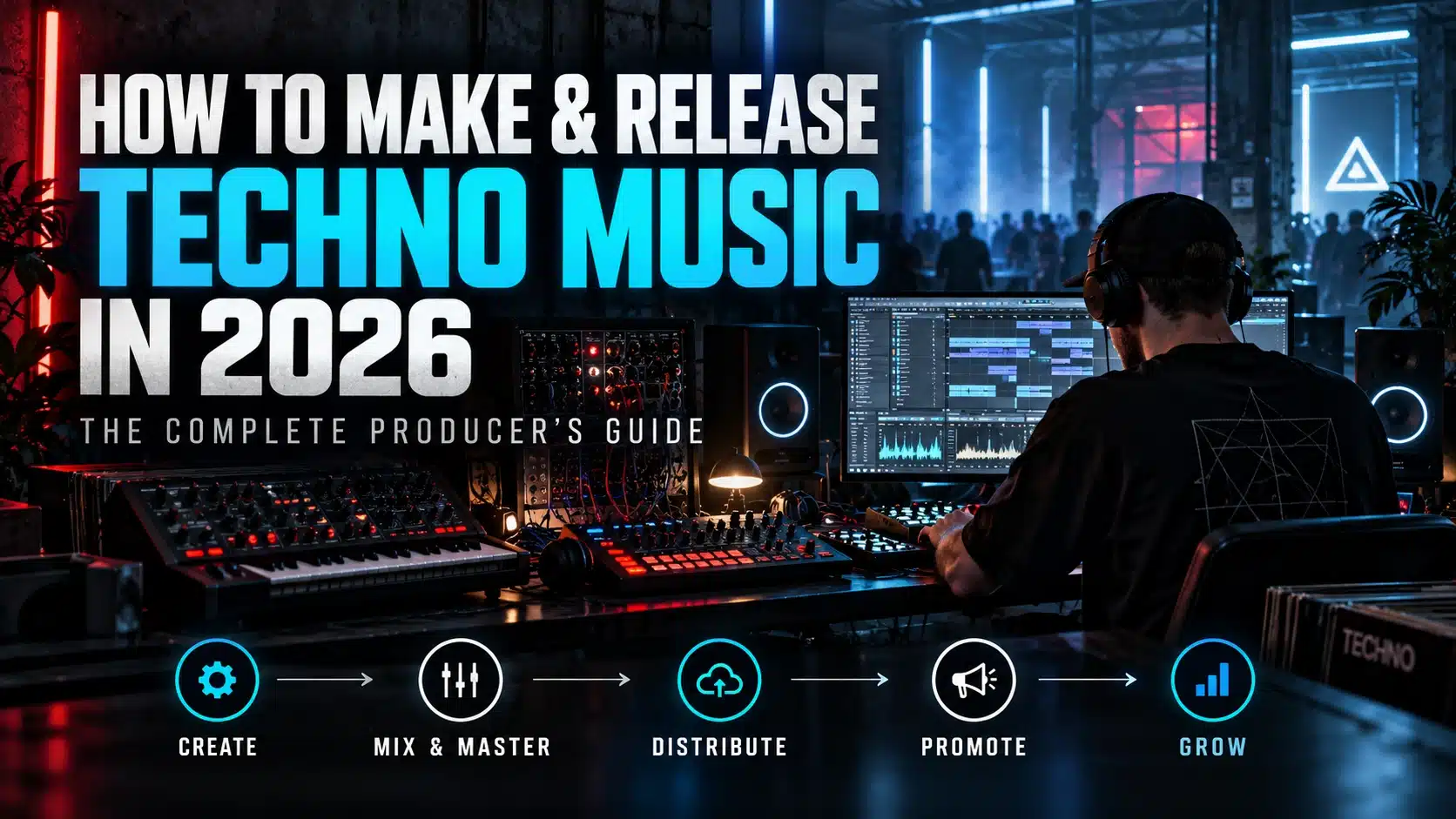
Techno does not need a huge vocal hook, an expensive recording studio or a major record label to make an impact.
Sometimes, all it takes is a relentless kick drum, a hypnotic synthesiser sequence and a groove powerful enough to keep a dance floor moving.
But creating techno that sounds professional is harder than simply placing a kick on every beat.
The difference between a repetitive loop and a compelling techno record comes down to sound design, rhythmic tension, arrangement, mixing and creative identity.
And once the production is finished, independent artists face another challenge: where to release techno music, how to reach DJs and listeners, and how to build a catalogue without relying entirely on traditional record labels.
In 2026, electronic music production continues to diversify. The Splice × MIDiA Sounds of 2026 report identifies strong momentum in harder, faster electronic styles, including hard techno and other uptempo genres.
For independent techno producers, there is a clear opportunity to develop a distinctive sound and publish music directly to listeners.
This guide explains how to produce, mix, master, upload and promote techno music independently.
Already finished your track? Upload techno music free on BeatsToRapOn and start building your artist catalogue.
1. What Is Techno Music?
Techno is a genre of electronic dance music built around rhythm, repetition, synthesis and gradual musical transformation.
Its foundations emerged in Detroit during the 1980s, where electronic music pioneers combined futuristic synthesiser sounds with influences from funk, electro, disco and European electronic music.
Juan Atkins, Derrick May and Kevin Saunderson, collectively known as the Belleville Three, are central figures in the development of Detroit techno.
Other innovators, including Eddie Fowlkes, Jeff Mills, Robert Hood, Underground Resistance and Carl Craig, helped expand the genre’s musical vocabulary and cultural influence.
Techno subsequently developed through club scenes around the world, with particularly influential communities in Detroit, Berlin and other major electronic music centres.
At its core, techno often features:
- A consistent four-on-the-floor kick drum.
- Repetitive basslines and sequenced synthesiser patterns.
- Percussion that creates forward movement.
- Filter automation and evolving textures.
- Gradual transitions rather than conventional pop songwriting.
- Hypnotic repetition that rewards extended listening.
- Arrangements suited to club performance and DJ mixing.
Unlike many vocal-led genres, techno frequently creates its identity through the interaction of rhythm and sound design.
A single carefully programmed synthesiser sequence can become the central idea of an entire track.
Explore the Techno music catalogue on BeatsToRapOn to discover the range of sounds independent producers are creating.
2. Understand the Different Types of Techno
Techno is not one fixed production style.
Before starting a track, identify which direction best matches your artistic goals.
Detroit Techno
Detroit techno emphasises futuristic electronic production, rhythmic invention and musical ideas shaped by the genre’s original innovators.
Its characteristics vary considerably, from melodic and soulful records to raw, mechanical and experimental productions.
Minimal Techno and Deep Tech
Minimal techno focuses on controlled arrangements, carefully selected sounds and subtle changes over time.
A short percussion pattern, isolated bass note or evolving synthesiser texture can carry an entire section.
The challenge is making limited material feel intentional rather than unfinished.
Explore the Minimal and Deep Tech upload guide.
Hard Techno
Hard techno tends to emphasise higher energy, forceful kick drums, aggressive sound design and sustained rhythmic intensity.
Modern tracks may incorporate distortion, industrial textures and harder rave influences.
Explore Hard Techno music uploads.
Acid Techno
Acid techno commonly uses resonant, evolving synthesiser sequences inspired by the Roland TB-303.
The movement of filter cutoff, resonance and pitch can become the main musical feature.
For this direction, see Upload Acid Techno.
Melodic Techno
Melodic techno often places more emphasis on harmonic progression, atmospheric soundscapes and memorable synthesiser motifs.
It may overlap with melodic house and progressive electronic music, but the rhythmic approach and production identity help distinguish individual tracks.
Explore related music through Melodic House and Techno.
Production advice: Do not choose a subgenre simply because it is trending. Make the music first, understand its defining characteristics and select accurate metadata when publishing.
3. What BPM Is Techno Music?
One of the most common questions new producers ask is: what tempo should techno be?
There is no single correct BPM.
A useful production starting range for many techno styles is approximately 125–145 BPM, with some slower deep or hypnotic productions and faster hard-techno tracks falling outside that range.
| BPM | Possible production direction |
|---|---|
| 120–128 | Slower, deeper or more restrained techno |
| 128–135 | Driving, hypnotic and groove-focused techno |
| 135–145 | Higher-energy, peak-time or harder techno |
| 145–160+ | Fast hard techno and crossover rave styles |
These are approximate production ranges, not rules for classifying music.
Tempo does not determine genre on its own.
A 140 BPM track could be techno, trance, hard dance or another electronic style depending on its arrangement and sound design.
Start With 132 BPM
If you are learning techno production, try opening a new project at 132 BPM.
Program a kick on every quarter note.
Build a simple bassline and high-frequency percussion pattern around that pulse.
Once the groove works, experiment with changing the tempo.
Notice how faster playback changes the perceived urgency of your percussion and synthesiser phrases.
You can analyse an existing reference using the free BPM and song key finder.
4. How to Make a Powerful Techno Kick Drum
The kick is arguably the most important single sound in many techno arrangements.
It provides the physical foundation of the record and influences how every other low-frequency element should behave.
Choose the Right Kick
Start with a kick that suits the track’s musical direction.
For restrained or hypnotic techno, a deep and controlled kick may be sufficient.
For harder productions, you might use a kick with additional saturation, distortion or a more aggressive transient.
Avoid choosing a sound simply because it is louder than everything else in your sample folder.
Consider the attack, body, decay and tonal balance.
Programme a Four-on-the-Floor Pattern
In a typical 4/4 techno groove, the kick falls on beats one, two, three and four.
This creates a steady pulse that makes the record practical for dancing and DJ mixing.
However, repeating the same kick pattern is only the foundation.
The creative work comes from the sounds and rhythms surrounding it.
Shape the Low End
The kick should feel powerful without overwhelming the track.
Use envelope shaping to control its decay.
Pay attention to resonances and unnecessary sub-bass buildup.
If the kick occupies too much low-frequency space, the bassline may become indistinct.
Avoid Unnecessary Layering
Layering several kick samples can create phase problems and inconsistent transients.
Begin with one strong sound.
Only introduce another layer when it adds something specific, such as attack or texture.
Compare the layered result with the original at matched loudness.
If it does not genuinely improve the sound, simplify.
5. Build a Techno Groove With Hats, Rides and Percussion
A four-on-the-floor kick is not enough to sustain an entire track.
Techno gains forward motion through the relationship between the kick and supporting rhythms.
Start With an Offbeat Hi-Hat
Place a short open or closed hi-hat between the kick beats.
This simple pattern can immediately create energy.
Experiment with different velocity levels and note lengths.
A slightly quieter hat can sound more integrated than one competing directly with the kick.
Introduce a Sixteenth-Note Pattern
Add subtle closed hats or percussion hits at sixteenth-note intervals.
Do not fill every position automatically.
Use rests and accents to create rhythmic shape.
Create Movement Through Automation
Instead of replacing the percussion constantly, automate:
- Filter cutoff.
- Reverb send.
- Stereo width.
- Sample decay.
- Velocity and accent.
- Distortion or saturation amount.
Small changes across eight or sixteen bars can make a repeating pattern feel alive.
Use Silence as a Production Tool
Remove the main hat before a transition.
Mute the kick for one bar.
Introduce a short percussion fill before the groove returns.
The contrast can make the next section feel more powerful without increasing the overall loudness.
6. How to Design Techno Basslines
A techno bassline does not need to be melodically complex.
Some of the most effective patterns use only one or two notes, with rhythm and timbre doing most of the work.
Start With a Simple Synthesiser
Choose a basic waveform such as a sine, triangle, sawtooth or square.
Shape it using the filter and amplitude envelope.
A short, punchy sound can work well for rhythmic bass sequences, while longer notes may suit atmospheric or slower productions.
Make the Bass Work With the Kick
Listen to the kick and bass together before adding more instruments.
Watch for overlapping low frequencies, inconsistent note levels and phase interactions.
Consider whether the bass should hit between kicks, reinforce particular beats or run as a continuous sequence.
Use Controlled Sidechain Compression
Sidechain compression can help the kick remain clear by temporarily reducing the bass level.
But excessive pumping is not always appropriate.
Some tracks work better with careful note placement and envelope design instead.
Use the approach that supports the groove.
Add Harmonic Character
A pure sub-bass may sound strong on large systems but become difficult to hear through smaller speakers.
Subtle saturation can introduce harmonics that make the bass more audible.
Check the result in mono and at different playback levels.
7. Techno Sound Design: Make Repetition Interesting
Techno often uses repetition deliberately.
The real challenge is creating enough movement around a repeating idea to maintain interest.
Build a Hypnotic Synthesiser Sequence
Start with a sequence of three to five notes.
Repeat it over several bars.
Then change one aspect at a time:
- Filter cutoff.
- Resonance.
- Note length.
- Pitch.
- Delay feedback.
- Envelope shape.
- Distortion intensity.
Listen to how the sequence evolves.
A simple pattern can become a defining musical hook when the sound itself changes over time.
Experiment With FM Synthesis
Frequency modulation can create metallic, bell-like or industrial timbres.
These sounds are particularly useful for techno that emphasises texture and mechanical character.
Start with restrained modulation and gradually increase complexity.
Develop Atmospheric Textures
Noise, drones, field recordings and synthesised textures can establish a sense of space.
Do not fill the entire frequency spectrum with atmosphere.
Leave room for the rhythm.
Record Your Own Automation
Instead of drawing every filter movement with a mouse, try recording yourself adjusting synthesiser parameters in real time.
These human gestures can give an electronic production a more distinctive character.
The result may need editing, but it often produces musical movement that is difficult to create through rigid repetition.
8. How to Arrange a Techno Track for DJs
Techno arrangement is closely connected to DJ performance.
Many club-oriented productions are structured so DJs can blend tracks without abrupt transitions.
A potential arrangement might include:
| Section | Main purpose |
|---|---|
| Intro | Establish rhythm and mixing space |
| Groove development | Introduce percussion, bass and main sequence |
| First progression | Build texture and intensity |
| Breakdown | Create contrast or remove rhythmic elements |
| Main return | Reintroduce the central groove |
| Final development | Add controlled variation |
| Outro | Gradually reduce elements for mixing |
This is a flexible example, not a mandatory formula.
Think in 16- and 32-Bar Phrases
Many electronic DJs work with repeated musical phrases.
Introducing or removing elements at recognisable phrase boundaries can make a track easier to mix.
Try making a meaningful arrangement change every sixteen or thirty-two bars.
That change might be subtle: a new hi-hat, a filter opening or a change in percussion density.
Do Not Rely on Endless Risers
Techno can build tension through rhythm and timbre.
You do not need a dramatic white-noise sweep before every transition.
A carefully timed drum dropout can create just as much anticipation.
Test the Arrangement Away From the Screen
Export the track and listen without looking at your DAW timeline.
Does the music progress naturally?
Does it become repetitive in an uninteresting way?
Is there enough contrast between sections?
If the arrangement loses momentum, consider changing the sound design or rhythmic density rather than adding unrelated instruments.
9. Mixing and Mastering Techno for Club Playback
A professional techno master needs more than high loudness.
It must preserve clarity, low-frequency control and sustained impact.
Keep the Kick and Bass Defined
The kick and bass should remain distinct when played together.
Use EQ, envelope control, note selection and compression where necessary.
Avoid excessive sub-bass energy that makes the entire mix unstable.
Control Harsh Midrange Frequencies
Aggressive synthesisers, distortion and resonant filters can create unpleasant midrange peaks.
Listen for harshness and fatigue, especially during extended sections.
Use subtractive EQ or dynamic processing when a particular frequency becomes excessive.
Manage the High End
Closed hats, rides and noise layers can accumulate high-frequency energy.
Check whether the percussion still sounds comfortable at realistic listening levels.
A bright master is not automatically a better master.
Preserve Dynamic Contrast
Even aggressive techno benefits from changes in energy and texture.
Over-limiting can reduce the perceived impact of kicks and transients.
Compare your master with relevant reference tracks at matched listening loudness.
Check the Final Export
Listen to the full track after rendering.
Look for clicks, unwanted silence, clipping, missing automation and unexpected sound changes.
If you need mastering assistance, explore BTR AI Mastering or read How to Master a Song.
10. How to Release Techno Music Independently in 2026
You do not need a traditional record-label agreement to publish your own techno tracks.
Independent artists can release music through direct-upload platforms, use distributors for third-party streaming services or collaborate with established electronic labels.
These options serve different purposes.
BeatsToRapOn is a direct-upload artist platform connected to BTR Music, its listener-facing streaming app.
Producers can create an artist profile, upload original recordings and build a catalogue.
Approved releases that meet the relevant eligibility requirements can become available through BTR Music.
How to Upload Techno Music Free
- Visit Upload Techno Music Free.
- Create a free BeatsToRapOn artist account or sign in.
- Complete your artist profile with an original image and biography.
- Open the track workspace.
- Upload your finished techno recording.
- Add original cover artwork, the track title and accurate credits.
- Select the most appropriate available genre.
- Submit your track for review.
- Once approved and published, share its public release URL.
A free BeatsToRapOn artist account currently supports up to 10 total track uploads.
Producers releasing larger catalogues can explore Artist Pro, which offers unlimited uploads and additional features.
Important: Uploading to BeatsToRapOn does not automatically send your music to Spotify, Apple Music, Beatport or other external platforms. Those workflows require separate arrangements.
For additional preparation advice, see Music Upload Requirements.
11. Create Techno Cover Artwork That Looks Professional
Techno has a strong visual culture.
Typography, architecture, industrial photography, abstract graphics and experimental design can all contribute to a recognisable release identity.
Your artwork should complement the production without relying on generic images.
For a minimal techno track, a restrained composition may be appropriate.
For a harder industrial production, a more severe photographic or graphic direction might suit the record.
Make the artwork legible at thumbnail size.
For BTR uploads, prepare a high-quality square image, ideally at least 1000 × 1000 pixels, using artwork that you own or are authorised to publish.
Avoid leaving the default cover in place.
Custom artwork and a complete artist identity matter for BTR discovery eligibility.
For more details, read the album artwork requirements guide.
12. How to Promote Techno Music Without a Record Label
Techno promotion differs from generic pop marketing.
DJs, independent labels, radio shows, local club communities and electronic music enthusiasts can all play important roles in discovery.
Send Your Track to Relevant DJs
Research DJs who actually play your style.
A hypnotic underground production may not be relevant to a DJ focused entirely on fast industrial techno.
Listen to their recent sets before making contact.
Send a concise introduction with the track’s style, tempo and listening link.
Do not demand a response or claim your track is guaranteed to succeed.
Show Your Production Process
Techno provides excellent material for short production videos.
Demonstrate how a kick and synthesiser sequence develop into a full groove.
Record a filter automation performance.
Show the difference between your first loop and the finished master.
These videos communicate both your sound and your creative identity.
Explore Local Electronic Music Events
Supporting a scene can be more valuable than repeatedly posting music links to strangers.
Attend relevant events, meet DJs and producers, and learn which communities support your particular sound.
BTR also offers an events section for exploring music-related activity.
Publish DJ Mixes
A DJ mix can show how your music fits within a wider set.
If you have the necessary rights and permissions for the recordings used, explore the DJ Mix Upload Guide.
Create a Consistent Release Identity
Use a recognisable artist name, clear profile image and visual direction across your releases.
Make it easy for a listener who likes one track to discover your other productions.
13. How Independent Techno Producers Can Earn Money
Independent electronic artists can pursue several potential income streams.
These may include qualifying streaming earnings, DJ performances, production work, licensing, sample-pack creation and direct fan support.
Individual opportunities depend on rights, audience activity, agreements and eligibility.
On BTR, eligible artists can participate in qualifying streaming earnings and supported direct-to-fan products.
Depending on eligibility, these may include Superfans, Tips, Backers and Shoutouts.
These features create potential ways for fans to support an artist beyond simply playing a track.
However, no upload, follower, chart position or ordinary play guarantees a payment.
Review the BTR Payment Terms before relying on any particular earnings expectation.
14. A 14-Day Techno Release Plan
Days 1–3: Finish the Production
Complete the arrangement and verify your sound design.
Review the kick and bass relationship, manage harsh frequencies and export the final master.
Confirm you have the rights to all included samples and recordings.
Days 4–5: Prepare Artwork and Metadata
Finalise your artwork, stage name, track title, credits and genre classification.
Complete your artist profile.
Days 6–7: Submit Your Track
Upload your recording through BeatsToRapOn’s Techno Upload Page.
Wait for the relevant review and approval process.
Days 8–10: Introduce the Release
Once the track is public, share the listening link.
Create a short production video and approach DJs who play the relevant style.
Days 11–14: Build Relationships
Follow up with meaningful promotional content.
Participate in relevant producer communities, review legitimate listener engagement and plan your next production.
A sustainable release process is more useful than a short promotional burst followed by months of inactivity.
15. Common Techno Production and Release Mistakes
Making the kick unnecessarily loud: Low-end control creates power. Excessive volume can destroy mix balance.
Using too many synthesiser layers: More sounds do not automatically create a larger track.
Ignoring musical development: A repeating loop still needs purposeful changes to remain interesting.
Overusing distortion: Aggressive sound design can lose definition when every element is saturated.
Choosing the wrong subgenre: Accurate classification helps the right listeners understand your music.
Uploading uncleared samples: Downloaded material does not automatically include unrestricted publishing rights.
Using default artwork: A generic cover weakens the release identity and can affect BTR discovery eligibility.
Expecting immediate exposure: Publishing creates an opportunity to reach listeners, not a guarantee of streams or chart placement.
Frequently Asked Questions About Techno Music
What BPM is techno music?
Many techno tracks fall roughly between 125 and 145 BPM, although deep or hypnotic styles can be slower and hard techno can be considerably faster.
Can I make techno without hardware synthesisers?
Yes. Modern digital audio workstations and software synthesisers can create professional electronic productions. Hardware is an artistic option, not a requirement.
What is the difference between house and techno?
Both share electronic dance music traditions and frequently use four-on-the-floor rhythms. Techno often places particular emphasis on repetitive sequences, rhythmic pressure and evolving timbres, while house has distinct traditions around groove, disco influences and musical warmth. The boundaries can overlap.
Can I upload techno music for free?
Yes. BeatsToRapOn currently allows up to 10 total track uploads through a free artist account. Visit Upload Techno Music Free.
Can I upload hard techno and acid techno?
Yes, where your recording meets BTR’s general upload requirements and you select an appropriate available category. Separate guides are available for hard techno and acid techno.
Should a techno track have a long intro?
Not necessarily. Longer DJ-friendly arrangements may benefit from structured introductions and outros, while shorter versions can work well for direct listening.
Can I upload techno DJ mixes?
BTR offers a separate workflow for full-length DJ mixes. You must have the necessary rights and permissions for any third-party recordings used.
Does BTR distribute techno to Spotify?
No. BeatsToRapOn provides direct publishing within its own ecosystem and does not automatically distribute uploads to external streaming platforms.
How do I get DJs to play my techno?
Create a strong recording, identify DJs whose styles match the track and contact them professionally. Provide a working listening link and clear information about the release. Airplay and support cannot be guaranteed.
Final Thoughts: Your Next Techno Release Starts With One Strong Track
Techno has always been driven by experimentation.
From Detroit’s early electronic innovators to contemporary underground producers, the genre rewards originality, technical curiosity and commitment to the music.
You do not need the most expensive equipment or a label contract before beginning your independent release journey.
Build a powerful groove.
Give the track an identifiable character.
Finish the arrangement and master properly.
Publish the recording with accurate metadata and distinctive artwork.
Then introduce your music to listeners, DJs and communities that genuinely appreciate your sound.
Ready to release your next techno track?
Upload Techno Music Free on BeatsToRapOn →
Create your artist profile, upload up to 10 tracks free and build your independent techno catalogue through BeatsToRapOn and the connected BTR Music ecosystem.