
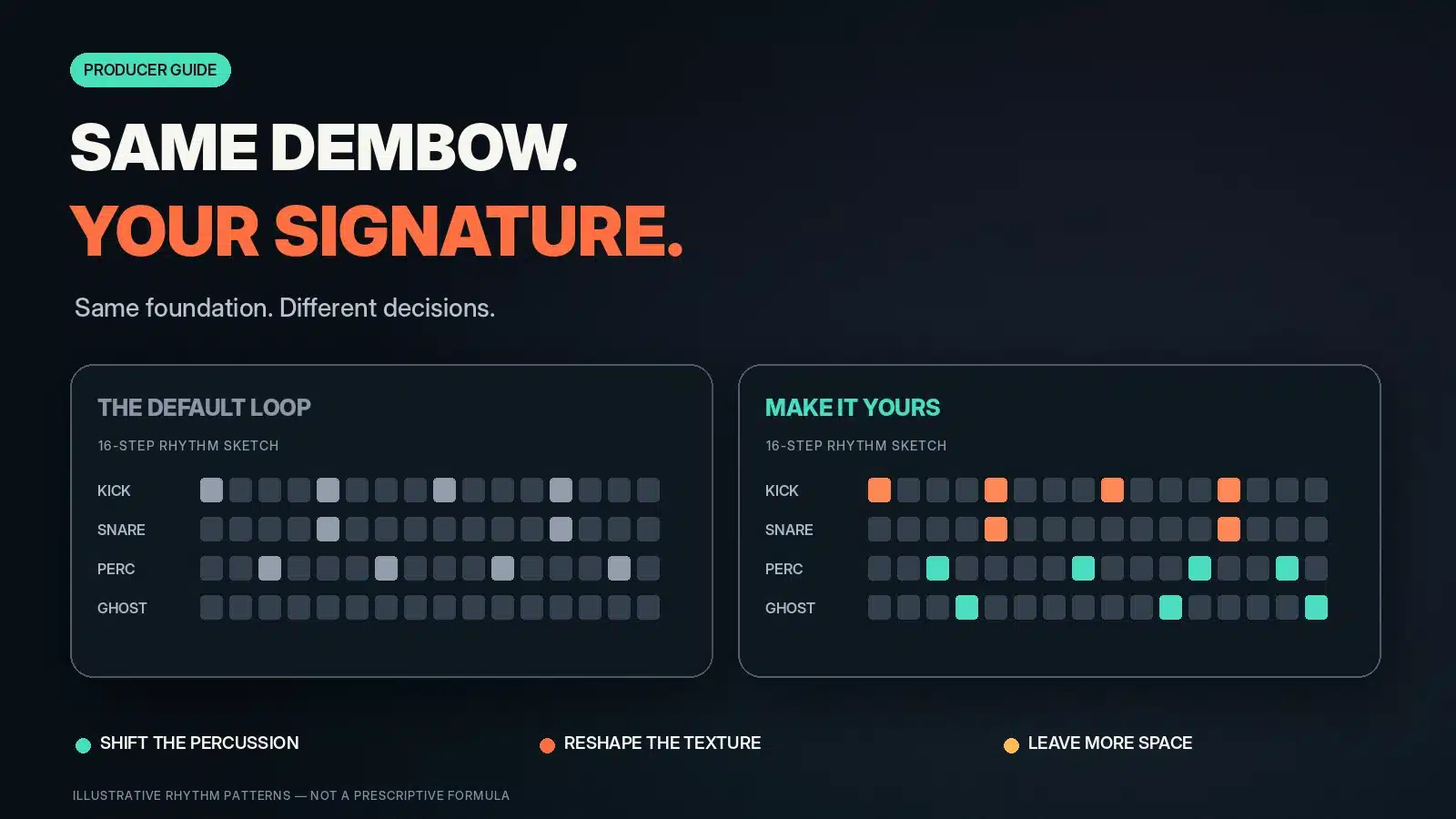
You open your DAW.
Set the tempo to 95 BPM.
Load a dembow loop.
Drop in a bassline, add a minor-key guitar melody, throw some reverb on the vocals, and suddenly you’ve made reggaeton.
Congratulations.
So has everybody else.
The problem isn’t that the beat sounds bad. It probably sounds fine.
The problem is that there’s nothing in it that makes a listener remember you.
In a genre built around one of the most recognisable rhythms on the planet, originality is becoming the difference between a track someone enjoys for thirty seconds and an artist they actually want to follow.
And in 2026, that distinction matters.
Reggaeton entered the ten most-searched genres on Splice in its 2025 production data, according to the Splice and MIDiA Sounds of 2026 research. That’s a measure of producer interest, not a guarantee of commercial popularity, but it reveals how active the creative community has become.
More people can produce convincing reggaeton records than ever before.
Making the rhythm is no longer the difficult part.
Making the rhythm mean something is.
The Dembow Was Never Supposed to Be Your Entire Identity
Let’s get something straight.
The dembow rhythm isn’t the problem.
It’s one of the most influential rhythmic foundations in contemporary music.
Its story moves through Jamaican dancehall, Panamanian reggae en español, Puerto Rican underground music and the wider Caribbean communities that transformed it into a global cultural force.
That history matters.
The rhythm endured because artists continuously reinvented what could happen around it.
Different vocal deliveries. Different production textures. Different stories. Different attitudes.
The same rhythmic family could support an aggressive underground record, a romantic song or a massive club anthem.
As Berklee College of Music explains in its history of dembow, the rhythm’s reach extends far beyond one genre.
Its familiarity isn’t a limitation.
It’s a foundation.
The mistake is assuming that foundation is enough to make a finished song interesting.
You wouldn’t expect a rock band to become unforgettable simply because its drummer knows how to play a backbeat.
Why expect something different from reggaeton?
Imagine Two Reggaeton Tracks
Both tracks are 94 BPM.
Both have a dembow groove, deep bass and a four-chord progression.
Both are competently mixed.
The first track starts with an eight-bar instrumental intro.
A singer enters, delivers a predictable verse and moves into a chorus that repeats the same familiar melodic shapes.
The song is perfectly listenable.
But after it finishes, there’s little that distinguishes it from dozens of others.
Now imagine the second track.
It opens with an unusual vocal phrase.
The bass doesn’t arrive when you expect it.
A particular percussion sound creates an unmistakable rhythmic signature.
The chorus contains five words that feel impossible not to repeat.
And suddenly, even without knowing the artist’s name, you recognise the record.
That’s the difference.
Not necessarily better equipment. Not necessarily more expensive mixing.
A stronger musical identity.
The following techniques are ways to develop that identity, not a formula for guaranteed popularity.
Stop Beginning Every Track With the Same Drum Loop
Here’s an experiment worth trying.
Open your DAW and load your normal reggaeton template.
Now mute the dembow.
What’s left?
If the answer is a generic guitar loop, an ordinary bass patch and a synthesiser preset you haven’t changed, your recording may be depending almost entirely on a familiar rhythm for its character.
Try reversing the process.
Start with something that doesn’t sound like a finished reggaeton beat.
A vocal recording.
An unusual percussion pattern.
A piano phrase with an unexpected harmonic change.
A distorted synthesiser that creates tension.
An original guitar performance.
Build the identity first.
Then introduce the dembow.
You’ll still be working within reggaeton’s rhythmic language, but the record will have something recognisable beyond that rhythm.
The one-sound challenge
Choose a single element in your production and make it distinctive enough that a listener could recognise it without hearing the whole track.
For example:
- A three-note synthesiser phrase with an unusual rhythm.
- A percussion sound you recorded yourself.
- A vocal fragment with a distinctive pitch or rhythmic treatment.
- A bassline that responds directly to the vocal.
- A guitar melody built around an unexpected interval.
Don’t make every sound strange.
Make one sound memorable.
Then build a coherent record around it.
Your Chorus Is Competing With the Listener’s Memory
Think about the reggaeton songs you remember most clearly.
Not necessarily your favourites.
The ones that come to mind almost immediately.
You probably remember a vocal phrase, rhythmic accent or melodic moment before you remember the complete arrangement.
That’s useful information for your own songwriting.
A hook needs to create recognition.
It doesn’t need to be lyrically complicated.
It doesn’t need twelve vocal layers.
And it certainly doesn’t need to sound like a copy of whatever was popular last month.
Write the hook without the beat
Try this before you complete your next production.
Mute the instrumental.
Sing or rap the chorus by itself.
Does it still have rhythmic character?
Can you recognise the melody?
Does the phrase sound natural when performed?
If the hook only seems exciting when surrounded by a massive instrumental, it may need more work.
Try shortening the phrase.
Experiment with different rhythmic placements.
Leave more space between words.
Use repetition deliberately.
The objective is to create a vocal moment that belongs to the song, rather than a melody that could have been dropped over any generic beat.
Give the hook something to contrast against
A common arrangement problem is making every section equally busy.
If the verse already has full percussion, aggressive bass, multiple melodic layers and stacked vocals, where does the chorus go?
Instead, create contrast.
Make the verse more restrained.
Remove a percussion element.
Reduce the harmonic density.
Then bring back selected layers when the hook arrives.
The chorus can feel more impactful without the master becoming louder.
Reggaeton Doesn’t Have to Sound Like a Template From Miami
Modern reggaeton is often presented as though it has one acceptable sound.
A familiar dembow.
An 808.
A polished vocal.
A minor-key guitar.
An expensive-looking visual.
But the genre’s history demonstrates something more interesting.
Reggaeton developed through the interaction of different cultures, technologies and local scenes.
Its character was never restricted to one studio preset or production arrangement.
That makes experimentation an important part of continuing the genre’s evolution.
Could your musical background contribute something distinctive?
Maybe you grew up listening to R&B.
Maybe your strongest influences come from dancehall, electronic music, salsa or hip-hop.
Maybe your sound is shaped by the city where you live, the musicians you work with or the instruments you actually play.
These influences can make your music more personal.
The key is to integrate them thoughtfully.
A random genre crossover isn’t automatically innovative.
A well-developed musical idea can be.
Understand the difference between influence and imitation
Studying artists such as Bad Bunny, Karol G, Tego Calderón, Ivy Queen or Daddy Yankee can teach you about arrangement, vocal presence and musical identity.
But learning from a recording is different from rebuilding it sound for sound.
Instead of asking, “How can I make the same beat?”
Ask:
“What makes this song immediately recognisable, and what would recognition sound like in my own music?”
That’s a much more useful creative question.
The First 30 Seconds Deserve Their Own Production Session
Open your latest track.
Listen to the first thirty seconds without skipping.
Now imagine hearing it as a complete stranger.
You have no relationship with the artist.
You don’t know how many hours the production required.
You haven’t seen the studio footage.
Is there something that makes you curious about what happens next?
This doesn’t mean every reggaeton track must begin with the chorus.
Sometimes the most effective opening is an intimate vocal.
Sometimes it’s a strange sound.
Sometimes the rhythm itself is the introduction.
The point is that the opening should feel deliberate.
Try three versions of the introduction
Export three short versions of your song.
Version A: Begin with the dembow and establish the groove.
Version B: Begin with the main vocal phrase.
Version C: Begin with the most distinctive instrumental sound.
Play them to a few people who haven’t heard the song before.
Ask which one makes them want to continue listening, and why.
Avoid leading them toward the answer you prefer.
This isn’t a scientific prediction of streaming success.
It’s a practical creative test that can reveal weaknesses you’ve stopped noticing after listening to the same arrangement for hours.
The Other Mistake: A Great Beat With No Artist Behind It
Suppose you’ve solved the production problem.
You’ve made something distinctive.
The hook works.
The mix sounds professional.
You publish it.
Now what?
A surprising number of independent artists invest enormous effort in the recording and very little in the identity surrounding it.
The cover is generic.
The biography says almost nothing.
There’s no obvious connection between the music and the person responsible for creating it.
The first song may attract interest.
But where does that interest go?
A listener who enjoys the track needs a way to recognise the artist and explore more music.
That’s why a release should be treated as part of a catalogue, not an isolated audio file.
Your release should pass the recognition test
Imagine someone sees the artwork for five seconds.
Could they recognise it again?
If they open your artist profile, does the visual identity feel connected to the song?
Can they understand what kind of music you create?
Is the artist name consistent?
Does the page contain accurate credits and a useful biography?
These details won’t turn an ordinary record into a great one.
But they can help make a good record easier to remember and revisit.
Where Do You Release Reggaeton Without a Label?
You don’t need a traditional record-label agreement to begin publishing original reggaeton music.
Independent artists can choose different release approaches depending on their goals.
If you want delivery to external services such as Spotify or Apple Music, you’ll generally need a distributor or another authorised arrangement.
If you want to publish directly through an independent artist platform with a connected listener app, BeatsToRapOn offers a different option.
Upload your reggaeton music free on BeatsToRapOn.
BeatsToRapOn is the artist-facing side of the ecosystem, where musicians can create profiles, upload tracks and manage releases.
BTR Music is its connected listener platform, where approved and eligible music can reach fans.
A free BeatsToRapOn artist account currently supports up to 10 total track uploads, with Artist Pro available for unlimited uploads and additional features.
To prepare your reggaeton release, you’ll need:
- Your finished audio recording.
- Accurate track and artist information.
- Distinctive, properly licensed square cover artwork.
- The necessary permissions for all included recordings, samples and collaborations.
- A completed artist profile.
- A track that passes the applicable review process.
Once the release is approved and published, you can share its public listening link.
A BTR upload does not automatically deliver the recording to Spotify, Apple Music or other external DSPs, and publication does not guarantee streams, discovery placement or earnings.
For detailed requirements, see the BTR music upload guide.
Your Next Release Needs a Moment, Not Just an Announcement
When a track is ready, think about what you can show people.
Not simply what you can tell them.
A generic promotional post says:
“My new reggaeton single is out now.”
It gives the listener almost no reason to pay attention.
A more interesting promotion might show how you recorded an unusual percussion sound, how a vocalist developed the hook or how the track changed between the original demo and final master.
It gives the music a story.
Three promotional ideas worth testing
The beat transformation: Play the earliest version of your instrumental, then cut directly to the final recording. Let listeners hear the transformation.
The isolated hook: Remove most of the instrumental and feature the vocal phrase that gives the record its identity. Then introduce the complete arrangement.
The studio moment: Show a real creative decision, such as a vocalist changing the delivery or a producer rebuilding a bassline to better support the groove.
These formats provide something specific rather than relying exclusively on promotional language.
Link interested listeners to the published track.
Use the same artist identity across the release, video and public profile.
And keep experimenting with the types of content that generate genuine engagement.
Before You Upload, Ask Yourself Five Questions
Before submitting your next reggaeton track, listen to it one final time and answer these questions.
1. What makes this song recognisable?
If the only answer is “the dembow beat”, find another element worth developing.
2. Is the hook stronger than the instrumental?
For a vocal-led reggaeton song, the chorus needs an identity of its own.
3. Does the arrangement give the listener something to anticipate?
Contrast, silence and changes in energy can make a repetitive groove more engaging.
4. Does the artist profile reflect the music?
Your visual identity, cover artwork and credits should make the release easy to recognise.
5. Is the next step obvious?
When someone enjoys your song, they should know where to hear it and find your other work.
If you can answer all five, you have a stronger foundation for your release.
Not a guarantee of success.
A better creative and publishing process.
The Future of Reggaeton Doesn’t Need Another Copy
The dembow rhythm has travelled through generations, scenes and countries because musicians kept discovering new ways to express themselves through it.
That is one of reggaeton’s greatest strengths.
The rhythm is familiar, but the possibilities around it are enormous.
New voices.
Different melodies.
Unexpected arrangements.
Distinctive production.
Music shaped by real people with something to communicate.
If you’re an independent producer, the opportunity isn’t simply to make another competent reggaeton beat.
It’s to create a recording that sounds unmistakably like yours.
Finish that record properly.
Give it the artwork and artist identity it deserves.
Then put it somewhere people can actually hear it.
Upload Reggaeton Music Free on BeatsToRapOn →
Create your artist profile, upload up to 10 tracks free and begin building a catalogue that gives listeners a reason to remember your name.
The dembow gets the rhythm moving. Your identity gives people a reason to come back.