
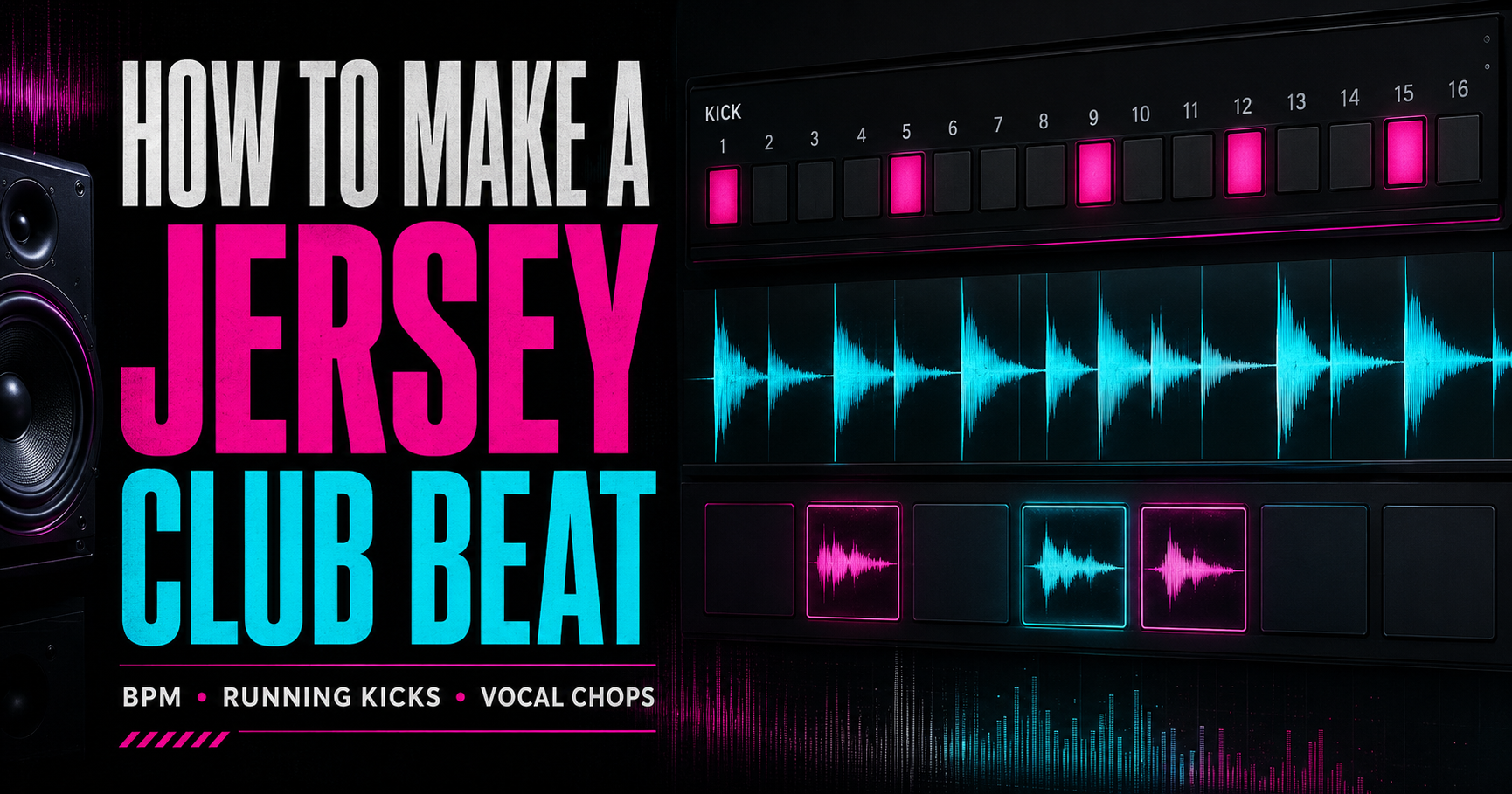
A convincing Jersey Club beat is not simply a house loop played faster. Its identity comes from the interaction of a running five-kick rhythm, hard transient control, chopped vocals used like percussion, compact low end and quick changes that tell dancers or rappers where the next burst of energy will land.
Quick answer: To make a Jersey Club beat, set your project around 130–140 BPM in 4/4. Program a starter running kick on sixteenth-note steps 1, 5, 9, 12 and 15, then add tight percussion, a short bass or 808 and an original or properly licensed vocal chop. Build variations every four or eight bars, and remove vocal chops or drum hits when a rapper needs more space.
Before opening your DAW, compare the records in the BTR Jersey Club collection with the songs moving on the live Jersey Club Power Charts. Listen for the kick rhythm before the melody: where it repeats exactly, where one hit disappears, how vocal fragments answer it and how the pattern changes when a verse begins.
Jersey Club beat settings at a glance
| Element | Reliable starting point | What to listen for |
|---|---|---|
| Tempo | 130–140 BPM for classic Jersey Club; some rap and drill hybrids move faster | Urgency without making every sound long or crowded |
| Time signature | 4/4 | Syncopation inside a regular bar |
| Starter kick | Sixteenth-note steps 1, 5, 9, 12 and 15 | The five-hit running motion rather than four-on-the-floor |
| Drum phrase | One-bar foundation with two-, four- or eight-bar variations | Repetition that changes at useful moments |
| Vocal chop | One word, syllable, breath or original call-out sliced into a playable kit | Call-and-response rhythm, not a vocal pasted over the drums |
| Low end | Short kick tail, compact 808 or simple pitched bass | Weight that stops before it blurs the next kick |
| Melody | Minimal chord stab, sample fragment, pad, pluck or short lead | A supporting hook that does not compete with the vocal chop |
| Arrangement | Quick dropouts, eight-bar changes and clear returns | Cues for dancers, DJs and vocalists |
These settings describe a useful foundation, not a certification test. Jersey Club has changed across generations, producers and neighbouring scenes. The goal is to understand the rhythmic language well enough to create your own record without erasing where that language came from.
What is Jersey Club music, and where did it begin?
Jersey Club is a Black dance-music culture and production style rooted in Newark, New Jersey. It grew from Newark’s house history and the influence of Baltimore Club. In The FADER’s oral history of Jersey Club, DJ Tameil dates the creation of Brick City Club to approximately 1999–2000 and explains that the name broadened to Jersey Club as producers beyond Newark entered the scene. The same history credits foundational figures including DJ Tameil, DJ Tim Dolla, Mike V and DJ Black Mic, followed by generations that included DJ Sliink, UNIIQU3, Nadus and others.
That lineage is not trivia to place above a tutorial and forget. Baltimore Club supplied an essential rhythmic foundation; Newark producers changed the feel through harder kicks, more intensive vocal chopping, local dances and their own party culture. A producer using the sound today should credit both the Baltimore source and the Newark community that established Jersey Club as its own form.
Jersey Club also developed with dancers, not only with listeners wearing headphones. Its sudden stops, repeated instructions, vocal calls and rhythmic resets make physical sense because they create moments for movement. Later club-rap records opened a different lane. Pitchfork’s reporting on Newark and Philadelphia club rap documents how performers such as Bandmanrill and producer Mcvertt adapted the rapid triplet-kick energy for rappers while retaining the music’s local identity.
Choose the Jersey Club lane before building the beat
The classic running-kick skeleton can support several kinds of record. Decide who needs to use the beat before choosing how dense the vocals, drums and bass should become.
| Lane | Primary purpose | Production emphasis | Space strategy |
|---|---|---|---|
| Classic dance or remix | Dancers and DJ sets | Running kick, recognisable vocal chopping, call-outs and fast resets | The vocal chop can function as the lead instrument |
| Original Jersey Club song | Singer, producer-vocalist or complete song | Original topline, club drums and clearer harmonic development | Instrumental chops answer rather than mask the lead vocal |
| Jersey Club Rap | Verses, chants and high-energy hooks | Hard kick rhythm, shorter chop phrases and a direct bass pocket | Reduce chop density during bars and restore it around hooks |
| Jersey Drill hybrid | Drill flow over club movement | Running kicks combined with darker harmony, harder 808s or selected slides | Let the rapper own the midrange and avoid constant bass movement |
| Pop crossover | Song-first structure and broad playback | Cleaner sound selection, memorable topline and selective club-pattern sections | Use the running kick as contrast rather than filling the whole song |
If the goal is rap, audition the dedicated Jersey Club Rap beats alongside dance-first Jersey Club. The most important difference is usually not the BPM. It is the amount of rhythmic information competing with the voice.
Step 1: Set the BPM and analyse a reference
Set the project to 140 BPM for this workflow. That sits at the energetic end of the 130–140 BPM range identified by Jersey Club producer UNIIQU3 in The FADER’s oral history and by the Native Instruments Jersey Club production guide. Move the tempo after the groove exists: slower can create more swing and vocal room; faster can push the beat toward club rap or a drill hybrid.
If you are studying a reference track you own or are authorised to analyse, upload it to the free BTR Song Key and BPM Finder. Tempo and key detection are estimates, so confirm the pulse and tonal centre by ear. The guide to BPM, tap tempo and metronomes explains why software can return half-time or double-time readings for fast rhythmic music.
Use the reference to answer six questions:
- Is the track dance-first, rap-first, remix-led or a drill/pop hybrid?
- Where are the five main kick attacks in one bar?
- Does the low end come from the kick, a separate bass or both?
- Is the vocal chop a hook, a percussion layer or an occasional transition?
- What disappears when a lead vocal or rap verse enters?
- How often does the producer interrupt the loop with silence, a stop or a fill?
Write down the answers and close the reference. The objective is to learn a production system, not copy a protected sample, melody or full arrangement.
Step 2: Program the Jersey Club running kick pattern
Start with one bar divided into sixteen equal sixteenth notes. A widely used five-kick skeleton places attacks on steps 1, 5, 9, 12 and 15. Native Instruments describes the same rhythm as two quarter notes, followed by two dotted eighth notes and an eighth note.
| Count | 1 | e | & | a | 2 | e | & | a | 3 | e | & | a | 4 | e | & | a |
|---|---|---|---|---|---|---|---|---|---|---|---|---|---|---|---|---|
| Step | 1 | 2 | 3 | 4 | 5 | 6 | 7 | 8 | 9 | 10 | 11 | 12 | 13 | 14 | 15 | 16 |
| Kick | ● | – | – | – | ● | – | – | – | ● | – | – | ● | – | – | ● | – |
Compact grid: ●--- ●--- ●--● --●-
The interval sequence is four sixteenth notes, four sixteenth notes, three, three and two before the loop restarts. That uneven final half of the bar creates the running sensation.
Is the Jersey Club kick a triplet pattern?
People commonly describe the Jersey Club bounce as triplet-based, shuffled or tresillo-like. Those descriptions communicate the rolling feel, but the starter pattern above can be programmed directly on a straight sixteenth-note grid. Do not switch the entire project to a triplet grid automatically. Use triplet subdivisions only when the reference or variation genuinely requires them.
Choose a kick with a clear job
Use a short, hard kick that remains identifiable through five attacks per bar. If the kick also supplies the sub-bass, make sure its tail finishes before the next important hit. If a separate 808 or bass will carry the deepest frequencies, shorten or filter the kick’s low tail rather than stacking two uncontrolled subs.
Turn the skeleton into a groove
Loop the untouched pattern until you can identify it without looking at the screen. Then create a second bar and make only one change:
- Remove the final kick to create a breath before the loop returns.
- Lower the velocity of one middle hit so the pattern has an accent hierarchy.
- Add one quiet pickup before a drop, but keep the five-hit skeleton audible.
- Mute the last beat of bar two to make room for a vocal call or transition.
- Replace one kick with a thinner percussion hit during a verse.
Do not randomise the whole bar. Repetition is what makes the rhythm legible to a dancer; controlled variation is what keeps that repetition alive.
Step 3: Add claps, hats, percussion and original ear candy
Build the remaining drums around the kick rather than over it. Start with one crisp clap or snare that gives the bar a stable reference. Then add a closed hat, rim, shaker or hand percussion only where it creates a useful response. The running kick already supplies substantial motion, so every additional hit must justify its place.
A reliable process is:
- Add a simple clap or snare backbeat and listen against the kick by itself.
- Program a restrained closed-hat pulse, then delete hits that duplicate kick transients.
- Vary hat and percussion velocities so secondary notes sit behind the anchors.
- Add one open hat, rim or shaker response near the end of the two-bar phrase.
- Create one short fill for the transition into the hook or drop.
- Use a stop, reverse tail or single effect instead of another full drum layer.
Original sounds are especially valuable here. In Splice’s session with UNIIQU3, she demonstrates using field recordings—including everyday environmental sounds—to escape the same loops and kits used by everybody else. Record a door latch, crowd response, shoe scrape, hand clap or short spoken call, then trim and process it as percussion. Get permission before recording identifiable people or using audio captured in a restricted setting.
Step 4: Create Jersey Club vocal chops without creating a clearance problem
In Jersey Club, the vocal chop often functions like another drum. A single syllable can mark the end of the kick pattern; a repeated word can become the hook; a longer phrase can create call-and-response with a dancer or rapper.
The safest creative sources are:
- Your own recorded voice.
- A vocalist recorded under a written agreement covering the intended release.
- A sample sold or supplied under a licence that clearly permits your planned commercial use.
- Material in the public domain, while remembering that a modern recording of a public-domain composition may still have its own rights.
- An independently recorded original phrase that does not copy protected lyrics or melody.
Do not assume that a very short sample is automatically free to release. The U.S. Copyright Office’s musician guide to sampling explains that sampling a released recording can implicate both the sound recording and the underlying musical work, which may have different owners. Laws and exceptions vary by country, so obtain qualified advice for an uncertain commercial release.
The BTR music sampling guide covers the practical difference between creative transformation and permission. An AI stem splitter can help analyse your own or authorised audio, but separating a vocal does not grant rights to release it.
Turn one clean phrase into a playable chop kit
- Record or import the authorised phrase.
- Remove silence and background noise without stripping the voice of all character.
- Cut at zero crossings or use very short fades to prevent clicks.
- Create slices around consonants, vowels, breaths and complete words.
- Map the slices across consecutive MIDI notes.
- Set playback to mono if overlapping slices make the phrase muddy.
- Pitch selected slices by an octave or a few semitones while checking the song key.
- Write a one-bar response to the kick, then a different ending in bar two.
Begin with rhythm before effects. A clear dry chop in the correct pocket is more effective than an unfocused phrase covered in reverb. Once the MIDI pattern works, try a short delay throw, filtered duplicate, reverse pickup, formant change or brief stutter on selected hits.
How to chop Jersey Club vocals in FL Studio
Load the authorised recording into Slicex, Fruity Slicer or Edison. The official Image-Line Slicex manual explains that Slicex can detect regions, map them to the Piano Roll and let each slice be triggered independently. Correct any automatic slice markers by hand, declick the region boundaries, then play the slices rhythmically instead of reconstructing the original phrase unchanged.
How to chop Jersey Club vocals in Ableton Live
Drop the recording into Simpler and select Slicing mode. The official Ableton Live manual documents four slicing methods: transient, beat, region and manual. Transient mode is fast for clean consonants; manual mode gives more control over breaths and vowel fragments. Choose mono playback for tight call-and-response or poly playback when deliberately layering slices.
Step 5: Add a short bass or 808 that does not erase the kick rhythm
Classic Jersey Club does not require a long sliding 808. Some records use a low kick at one pitch; others add a simple pitched bassline. Modern rap and drill hybrids often use a more obvious 808, but its envelope still has to respect the rapid drum movement.
Build the low end in this order:
- Identify the bass or 808 sample’s fundamental pitch.
- Set the sampler’s root note correctly.
- Switch to mono playback if overlapping notes create uncontrolled sub energy.
- Write one or two stable notes that support the song key.
- Shorten each note until the running kick remains readable.
- Add one rhythmic answer or octave change only after the simple version works.
- Use slides selectively if the chosen lane is Jersey Drill rather than classic dance-first Jersey Club.
If the bass follows every kick exactly, the low end can become one continuous wall. Let the kick carry some attacks alone. For a rap beat, place bass notes around the rapper’s likely phrase endings and preserve gaps where low consonants and vocal fundamentals need room.
Make the kick and bass one system
Choose which element supplies the deepest weight. If the bass owns the sub, use a shorter or lighter kick. If the kick has a long low tail, choose a simpler bass with less attack. Check envelope length, timing and polarity before adding aggressive EQ or sidechain compression. A small edit to note length often restores more bounce than another processor.
Step 6: Write a melody that supports the rhythm
The drums and vocal chops already contain a hook. Begin with one musical layer: a short chord stab, pluck, pad, synth pulse, sample fragment or two-note lead. Complex harmony is optional; clear rhythmic placement is essential.
Try this workflow:
- Choose a key that suits the intended vocalist or sample.
- Write a two- or four-chord loop, or hold one tonal centre under the drums.
- Shorten the sound’s attack and release if it smears the kick and vocal chops.
- Leave a deliberate gap where the most recognisable chop lands.
- Create one alternate chord, inversion or octave change for the second half of the phrase.
- Remove the melodic layer and verify that the drums still identify the genre.
For Jersey Club Rap, a darker pad, bell or sampled texture can connect the beat to trap or drill, but the running kick must remain the rhythmic centre. If the track only sounds like Jersey Club when a preset labelled “Jersey” is enabled, return to the kick and chop programming.
Step 7: Create bounce with silence, velocity and contrast
The five-kick grid is the foundation, not the finished feel. Bounce emerges from the difference between strong and weak hits, sound and silence, dry and processed chops, and full and reduced sections.
- Velocity: Keep primary kicks and calls confident while lowering pickups and repeated chops.
- Silence: Remove half a beat or a full beat before a drop instead of filling the space with another effect.
- Note length: Shorten bass, hats and vocal slices so their releases do not connect every transient.
- Microtiming: Move secondary percussion slightly only after the quantised pattern already works.
- Texture: Alternate a dry chop with a filtered, pitched or reverberant response.
- Density: Let the hook carry the fullest version and make verses clearly lighter.
Do not apply a global swing value as a substitute for listening. Solo the kick and clap, then add the vocal chop, bass and hats one at a time. If the pocket weakens when an element returns, edit that element rather than increasing the master volume.
Step 8: Arrange the Jersey Club beat for its real user
A dance edit, a DJ-friendly track and a rap instrumental need different amounts of repetition. The templates below are practical starting points, not rules.
Dance-first or DJ-friendly arrangement
| Bars | Section | Production move |
|---|---|---|
| 1–8 | Intro | Kick or percussion foundation with a restrained chop for mixing |
| 9–24 | Drop A | Full running kick, main vocal-chop hook and bass |
| 25–32 | Break | Remove the low end, expose the call-out and prepare the return |
| 33–48 | Drop B | Restore the hook with one drum or chop variation |
| 49–56 | Switch | Alternate chop, half-bar stops or a reduced kick pattern |
| 57–64 | Outro | Remove lead elements and leave a clean DJ exit |
Native Instruments’ example arrangement adds or removes elements in eight-bar blocks. That is useful because it preserves repetition while giving dancers and DJs predictable structural cues.
Jersey Club Rap arrangement
| Bars | Section | Production move |
|---|---|---|
| 1–4 | Intro | Present the chop or melody without the complete drums |
| 5–12 | Hook | Full running kick, strongest call-and-response and memorable bass ending |
| 13–28 | Verse 1 | Thin the vocal chops, simplify hats and create spaces for cadence changes |
| 29–36 | Hook | Restore the full rhythmic identity |
| 37–52 | Verse 2 | Use one alternate bass or kick ending without replacing the pocket |
| 53–60 | Final hook | Return to the clearest version and finish decisively |
Pitchfork notes that fast, layered club instrumentals can overwhelm vocalists who are unfamiliar with the pocket. Solve that in the production: mute chops during important bars, remove selected final kicks and let the rapper answer the rhythm instead of fighting it. The guide to rap flow and delivery can help test where a vocalist needs breathing and cadence-switch points.
For short-form promotion, export a clean eight- or sixteen-bar hook from the finished arrangement. Do not weaken the whole song by treating it as an endless social-media loop; make the excerpt serve the complete record.
Step 9: Mix the Jersey Club beat for punch and separation
Balance the running kick before the master chain
Turn off heavy limiting and begin with the kick. Bring in the clap or snare, then the bass, vocal chops, hats and melody. Five kick attacks per bar produce significant average energy, so the kick does not need to be excessively loud to feel dominant.
Keep the low end short enough to move
Check the waveform and listen at low volume. If one kick or 808 tail runs into the next attack, shorten the envelope before reaching for multiband processing. Use gentle saturation when the bass needs harmonics on phones and small speakers, but preserve a stable mono-compatible foundation.
Make every vocal chop begin and end cleanly
Clicks usually come from poor slice boundaries; blur usually comes from releases that are too long. Use tiny fades, trim silence and automate effects so only selected words receive delay or reverb. If a pitched chop becomes harsh, reduce the specific resonance rather than dulling the entire vocal bus.
Protect the lead vocalist’s pocket
For a rap or sung record, test the instrumental with a rough vocal before mastering. Lower or mute the chops that compete with consonants, hooks and ad-libs. Frequency space helps, but rhythmic space is often more important: two sounds cannot both deliver the main phrase at the same moment.
Control brightness and transient buildup
Rapid kicks, claps, hats and chopped consonants can create listening fatigue. Adjust sample choice and velocity first, then tame only the frequencies that remain aggressive in context. Avoid flattening every transient with a limiter; the contrast between attacks and gaps creates the bounce.
Master for translation rather than a magic loudness number
Level-match your references and preserve enough headroom for the final stage. There is no single LUFS value that defines an authentic Jersey Club master. The guide to LUFS and loudness measurement explains how normalisation works, while BTR AI Mastering can provide a comparison bounce. Judge any processed version at the same playback level as your original.
Jersey Club vs Baltimore Club, Philly Club and Jersey Drill
These scenes share history and continue to influence each other, so the table describes broad tendencies rather than rigid borders.
| Style | Historical relationship | Broad production tendency | BTR reference |
|---|---|---|---|
| Baltimore Club | The foundational regional club style that strongly influenced Newark | Raw breakbeat energy, repetitive vocal calls and DJ-oriented loops | Bmore Club beats |
| Jersey Club | Newark’s development of Baltimore Club influence through local house, hip-hop and dance culture | Hard running kicks, intensive vocal chopping and quick rhythmic resets | Jersey Club beats |
| Philly Club | A neighbouring club culture with related Baltimore and Jersey connections | Fast, highly physical energy with its own dances, rap scenes and local choices | Philly Club beats |
| Jersey Club Rap | A song and rap-oriented development of the club rhythm | More vocal space, direct hooks and reduced chop density during verses | Jersey Club Rap beats |
| Jersey Drill | A crossover between club rhythm and modern drill production or flow | Darker harmony, harder 808 language and club-kick movement adapted around bars | How to make a drill beat |
Do not reduce these differences to BPM alone. The history, dance vocabulary, sample choices, drum texture and relationship with local rappers matter just as much as the tempo display.
Common Jersey Club production mistakes
1. Using four-on-the-floor and calling it Jersey Club
A kick on beats 1, 2, 3 and 4 creates a house foundation. Program and understand the running five-hit rhythm before simplifying or hybridising it.
2. Forcing the whole project onto a triplet grid
The bounce is often described with triplet language, but the common starter skeleton fits a straight sixteen-step bar. Change the subdivision only when the actual phrase requires it.
3. Letting the kick and 808 ring continuously
Long overlapping tails hide the defining attacks. Shorten envelopes, decide which sound owns the sub and leave some kick hits without a separate bass note.
4. Chopping a famous vocal without checking rights
Pitching, reversing, isolating or shortening a recording does not automatically clear it. Use original or properly licensed sources and keep the licence documentation.
5. Filling a rap verse with the same dense chop as the hook
A chop can be the lead in a dance edit but a competitor in a vocal record. Remove or simplify it when the rapper enters, then restore the complete call-and-response for the hook.
6. Adding every familiar sound but missing the groove
A bed squeak, water drop or club kit cannot replace rhythmic understanding. The beat should remain recognisable when all novelty effects are muted.
7. Randomising every bar
Dancers and vocalists need a pattern they can predict. Establish the loop, then vary one element at a phrase boundary rather than changing every hit.
8. Treating Newark and Baltimore as interchangeable
Jersey Club developed from Baltimore Club influence, but it is not another name for Baltimore Club. Credit the lineage accurately and recognise the Newark artists, parties and dancers who established the Jersey sound.
Final Jersey Club beat checklist
- The intended lane—dance, remix, rap, drill hybrid or pop crossover—is clear.
- The tempo supports the track rather than following a number blindly.
- The running kick is recognisable before other drums are added.
- The main kick transients remain clear through the bass and master processing.
- The vocal chop comes from an original or properly licensed source.
- Slice boundaries are clean and do not click.
- The vocal chop works rhythmically before delay, reverb or stutter effects.
- The bass or 808 is tuned, compact and not covering every kick.
- The melody supports the drums rather than replacing their identity.
- The hook is fuller than the verse.
- Transitions use silence and subtraction as well as effects.
- The beat has been tested with a rough vocal if it is intended for a rapper.
- The mix translates on headphones, a phone, small speakers and mono playback.
- The article and release credits acknowledge the Baltimore-to-Newark lineage.
If you need stronger general production foundations, the complete hip-hop beatmaking guide explains sequencing, sound selection and arrangement in greater depth.
The final test is physical. Loop the strongest section, look away from the screen and listen at a moderate level. If the running kick remains clear, the vocal chop feels like part of the rhythm, the low end stops cleanly and the arrangement tells a dancer or rapper when to move, the production is doing its job.
Frequently asked questions
What BPM is Jersey Club?
Classic Jersey Club commonly sits around 130–140 BPM. A practical starting point is 138 or 140 BPM. Some Jersey Club Rap and Jersey Drill hybrids move toward 140–150 BPM or beyond, but tempo alone does not define the genre.
What is the Jersey Club kick pattern?
A common one-bar starter pattern places kicks on sixteenth-note steps 1, 5, 9, 12 and 15. Counted as sixteenths, that is beat 1, beat 2, beat 3, the “a” of 3 and the “&” of 4. Producers vary, omit and accent these hits once the foundation is established.
Is Jersey Club a triplet beat?
The groove is frequently described as triplet-based, shuffled or tresillo-like because of its rolling final hits. However, the common five-kick skeleton can be programmed on a straight sixteenth-note grid. Triplet subdivisions are an available variation, not a requirement for the entire project.
How do you make Jersey Club vocal chops?
Record or import an authorised vocal, slice it into syllables, breaths and words, map those pieces across MIDI notes and play them as call-and-response percussion. Use short fades to prevent clicks, tune pitched slices to the track and apply effects only after the dry rhythm works.
What is the difference between Jersey Club and Baltimore Club?
Baltimore Club is a major historical foundation for Jersey Club. Newark producers absorbed that influence and developed a local style with harder running kicks, more intensive vocal chopping and a dance culture of its own. They are related regional forms, not interchangeable names.
Can rappers use Jersey Club beats?
Yes. Jersey Club Rap keeps the rapid kick bounce but usually creates more vocal space by reducing chop density, simplifying selected drum phrases and arranging clear hooks and verses. A rough vocal test is the best way to find where the beat needs subtraction.
Do Jersey Club beats need an 808?
No. Some tracks use the low end of the kick or a simple bass sound. Modern rap and drill hybrids often include a pitched 808, but it should be tuned and short enough that the running kick remains distinct.
Do I need permission to use a vocal sample?
Often, yes. Sampling a released recording can involve rights in both the recording and the underlying composition. Use original or clearly licensed audio, retain the licence terms and seek qualified advice when ownership or the intended use is uncertain.
Can I make a Jersey Club beat with free software?
Yes. You need a DAW or sequencer, a short kick, basic percussion, a tunable bass option and a sampler capable of slicing authorised vocals. Paid plugins can speed up parts of the workflow, but they do not replace rhythm, source rights, arrangement or mix decisions.