
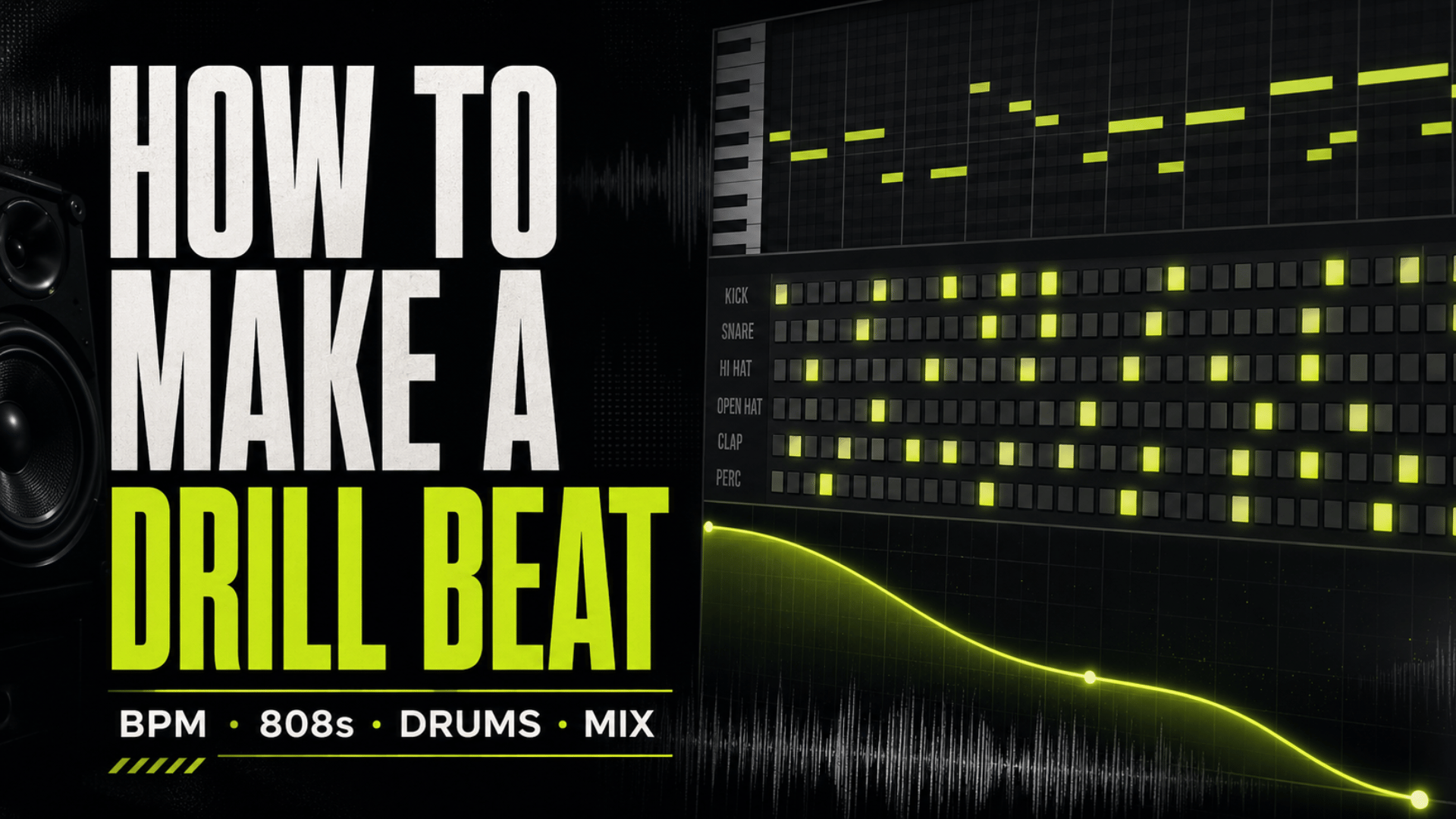
A convincing drill beat is not just a trap loop with a darker piano preset. Its identity comes from the way four elements interact: a broken two-bar drum pocket, controlled low-end movement, a sparse minor-key atmosphere and enough empty space for a rapper to control the record.
Quick answer: To make a modern UK or New York drill beat, start around 140–150 BPM and work in 4/4 with a heavy half-time feel. Build the snare and hi-hat rhythm across two bars, tune an 808 to the song key, add a few deliberate slides, then write a short dark melody that leaves room for vocals. Arrange the beat by changing one element every four or eight bars, and mix the kick and 808 as one low-end system instead of two competing sounds.
If you want to hear those choices in finished records before opening your DAW, compare the instrumentals in the BTR drill collection with the tracks moving on the live Drill Power Charts. Listen for where the snare lands, when the bass slides, how little the main melody changes and what disappears when the verse begins.
Drill beat settings at a glance
| Element | Reliable starting point | What to listen for |
|---|---|---|
| Tempo | 140–150 BPM for modern UK and New York drill | A fast grid with a slow, heavy half-time feel |
| Time signature | 4/4 | Syncopation inside the bar rather than a different time signature |
| Phrase length | Two-bar drum foundation; four- or eight-bar musical phrases | Small changes that stop the loop becoming static |
| Harmony | Minor key, minor mode or a deliberately tense modal colour | A short motif rather than a crowded chord progression |
| 808 | Mono, tuned, rhythmically sparse, with selective glide | Slides that lead into important notes instead of running constantly |
| Drums | Displaced snare, syncopated hats, selective counter-snare and kick | Push and pull across two bars |
| Melody | Piano, bell, string, choir, pad, pluck or transformed sample | Cold atmosphere, a memorable shape and clear vocal space |
These are starting points, not rules. Drill has travelled from Chicago through London and New York, and each scene developed a different rhythmic accent. A useful production guide must separate those lanes before showing you how to combine them.
Choose the drill lane before choosing the sounds
Drill began in Chicago, but the sliding 808 language most producers now associate with the genre was sharpened in the UK and carried into Brooklyn. Pitchfork’s account of producer AXL Beats traces how London production connected with New York artists, while The Guardian’s reporting on UK drill producers explains how internet collaboration helped that sound cross the Atlantic. That history matters because “drill” does not describe one fixed drum kit or tempo.
| Lane | Tempo starting point | Rhythmic character | Low end and melody |
|---|---|---|---|
| Chicago drill | Often felt around 60–75 BPM or programmed at double-time | Heavy, direct and closer to early trap-derived patterns | Punchy bass, fewer long slides, stark synth or piano ideas |
| UK drill | Usually around 140–150 BPM | Broken two-bar pocket, syncopated hats and restless kick placement | Longer controlled slides, cold minor-key motifs and negative space |
| New York or Brooklyn drill | Commonly around 140–148 BPM | Harder impact, more direct momentum and hook-ready repetition | Heavy tuned slides, punchy drums and cinematic or sample-led melodies |
| Sample drill | Often around 130–145 BPM | A drill pocket built to support a recognisable melodic flip | The sample carries the hook while the bass movement stays selective |
| Afro-drill | Set from the chosen reference and groove | Drill tension combined with more fluid, layered percussion | Sliding bass and dark texture balanced by rhythmic or melodic warmth |
For closer references, compare BTR’s dedicated New York drill instrumentals with its Afro-drill collection. The bass vocabulary may overlap, but the percussion, melodic density and space for the vocal do not behave in the same way.
Step 1: Set the BPM, key and reference
For a modern UK or Brooklyn-style beat, 140 BPM is a practical first setting. Move upward if the pocket needs more urgency, or downward if a sample or melodic vocal needs more room. Do not choose 140 simply because it appears in tutorials; choose it because the rapper’s cadence, the snare displacement and the 808 movement work together there.
If you are analysing a reference you own or have permission to use, the free Song Key and BPM Finder can identify its tempo and estimated key. For a deeper explanation of double-time and half-time perception, read the guide to beats per minute, tempo and metronomes.
Use the reference to answer five questions:
- Is the beat closer to Chicago, UK, Brooklyn, sample drill or a hybrid?
- Does the main snare feel early, centred or delayed across the two-bar phrase?
- How many times does the 808 genuinely slide in eight bars?
- Which sound owns the hook: melody, sample, bass movement or vocal rhythm?
- What changes when the arrangement moves from hook to verse?
Write down the answers, then close the reference. You are borrowing a production framework, not copying somebody else’s notes, sample or arrangement.
Step 2: Write a dark melody without filling every gap
Start with one sound and one short idea. A two- to four-note motif can carry more tension than a full chord progression when its rhythm and tone are strong. Piano, music-box plucks, bells, strings, choirs, filtered pads and manipulated vocal textures all work, but the preset matters less than the shape of the phrase.
A reliable process is:
- Choose a minor key that sits well under the intended vocal range.
- Write a four-bar motif using the root, minor third, fifth and one tension note.
- Leave at least one clear gap in every bar.
- Repeat the motif, then alter one note, octave or ending in bar four or eight.
- Add only one supporting layer: a low string, distant pad, counter-pluck or texture.
The flattened second degree can create a colder, more unstable colour when used carefully, but no scale choice automatically produces drill. Rhythm, register and sound selection still have to create the tension. Try moving the motif up an octave, reversing its last note, filtering it or printing it to audio and pitching it down before adding more notes.
If you use a sample, identify its key before writing the bass and confirm that your licence covers the intended release. The music sampling guide explains the creative workflow and the clearance questions that should be resolved before distribution.
Step 3: Build the drill drum pattern across two bars
The fastest way to lose the drill pocket is to complete a generic one-bar trap loop and add slides afterward. Build the rhythmic identity across two bars from the beginning.
Place the primary snare first
A useful UK-drill starting pattern places the main snare on beat 3 of bar one and delays the next main snare to beat 4 of bar two. That displaced second hit creates the lurching two-bar motion. It is a starting grid, not a requirement: move the second snare earlier or later once the flow demands it.
| Bar | Starter placement | Purpose |
|---|---|---|
| Bar 1 | Primary snare on beat 3 | Establishes the half-time anchor |
| Bar 2 | Primary snare on beat 4 | Delays the resolution and creates the drill pull |
Use a short, hard snare or clap with enough midrange to remain clear when the 808 arrives. Add a different rim, clap or counter-snare for pickups, but keep it quieter or thinner than the primary hit so the backbeat hierarchy stays obvious.
Make the hi-hats move, not chatter
Begin with a simple eighth-note hat pattern. Remove a few hits, change velocities and add short sixteenth-note or triplet bursts at the end of selected phrases. The roll should create direction into a snare, kick, bass slide or section change. If every beat contains a roll, none of them creates emphasis.
Try this order:
- Program plain eighth notes for two bars.
- Delete two or three hats to create holes.
- Lower alternate velocities rather than making every hit equal.
- Add one short roll before a main snare.
- Add a different roll near the end of bar two.
- Use one open hat or percussion accent to answer the main pattern.
DJ Mag’s profile of UK drill producers describes the style through its sliding low end, nervous kick movement and bass-heavy impact. That combination is the point: the hats should contribute to the instability, not sit on top as unrelated decoration.
Add the kick after the bass rhythm begins
You do not need a kick under every 808 note. First sketch the bass rhythm, then place kicks where the low end needs a harder front edge. Let some 808 notes speak alone and use extra kicks as pickups or phrase-ending accents. This keeps the low end mobile instead of turning it into one continuous block.
Step 4: Tune the 808 before adding slides
A slide cannot rescue an out-of-tune bassline. Before programming the final pattern:
- Load the 808 into a sampler and identify its fundamental pitch with a tuner or spectrum display.
- Set the sampler’s root note correctly.
- Switch the instrument to mono so only one bass note plays at a time.
- Write a simple bass rhythm using stable notes from the song key.
- Check that the note lengths stop cleanly and do not overlap by accident.
- Add slides only after the unsliding bassline already supports the drums.
The best first slide is often a transition into a root note, fifth or octave near the end of a bar. Start with one short upward slide and one longer downward or returning motion in an eight-bar loop. Audition the line an octave higher while editing if your speakers cannot reproduce the sub clearly, then return it to the intended register.
How to make drill 808 slides in FL Studio
With an FL Studio-native instrument, place a normal bass note, activate slide-note mode and add the destination slide note above or below it. The official FL Studio Piano Roll manual explains that a slide note moves an overlapping note to the slide note’s pitch, while the slide note’s length controls the transition time. Some third-party instruments use their own portamento controls instead, so check the instrument rather than assuming every plugin responds to FL Studio slide notes.
How to make drill 808 slides in Ableton Live
Use a mono instrument or sampler with legato and glide enabled, then overlap the source and destination MIDI notes. The Ableton Live instrument reference describes glide as the time overlapping legato notes take to move to the incoming pitch. The exact switch location depends on the instrument, but the underlying method is the same: mono voice, legato behaviour, intentional note overlap and a glide time that fits the rhythm.
Keep the kick and 808 working as one system
Decide which sound supplies the deepest weight. If the 808 owns the sub, shorten or filter the kick so its low tail does not mask the bass. If the kick supplies the deepest punch, reduce the 808’s initial transient or choose a bass sample with less attack. Check polarity, phase and timing before reaching for heavy sidechain compression. Often a small timing or envelope correction fixes more than another plugin.
Step 5: Create bounce with silence, velocity and timing
Drill bounce is not produced by one swing percentage. It comes from the relationship between the late or displaced snare, the hat accents, the start and stop of the 808, and the holes between them.
Use these controls deliberately:
- Silence: Mute a kick, hat or bass note where the listener expects one.
- Velocity: Make secondary hats and percussion clearly softer than the anchors.
- Note length: End an 808 before the next snare or let it cross the bar only when the overlap adds tension.
- Microtiming: Move a supporting percussion hit slightly off the grid only after the quantised pattern works.
- Register: Move a bass destination note or melody response by an octave to create motion without adding density.
Do not apply global swing and hope for the correct result. Build the pocket by ear at the note level, then test it with a rough vocal cadence. The beat should suggest where the rapper can pause, accelerate and land.
Step 6: Arrange the drill beat for a rapper
A loop proves the sound; an arrangement proves the record. The structure below is a flexible starting template, not a mandatory drill formula.
| Bars | Section | Production move |
|---|---|---|
| 1–8 | Intro | Main motif with filtering, texture or no full drums |
| 9–16 | Hook | Full drum identity, strongest bass pattern and clearest motif |
| 17–32 | Verse 1 | Remove one melodic layer and simplify selected bass or hat phrases |
| 33–40 | Hook | Restore the full pattern and add one small lift |
| 41–56 | Verse 2 | Introduce a counter-melody, alternate 808 ending or drum variation |
| 57–64 | Bridge or breakdown | Drop the bass, filter the sample or expose a vocal transition |
| 65–72 | Final hook | Bring back the strongest version without overcrowding it |
| 73–80 | Outro | Remove elements quickly and leave a clean ending |
Make one noticeable change every four or eight bars: mute the kick for half a bar, shorten the melody, remove the hats, reverse a tail, change the final 808 slide or add a short impact. The listener should feel movement without hearing a new beat every section.
Leave the verse less dense than the hook. A rapper needs space for consonants, breath and rhythmic variation, not just a gap in the centre of the stereo image. The guide to improving rap flow and delivery is useful when testing whether the arrangement gives the voice enough places to switch cadence.
Step 7: Mix the drill beat without flattening its impact
Start with balance, not the master chain
Turn the master processing off and lower every channel. Build the mix from the 808 and kick, add the primary snare, then bring in hats, melody and texture. If the beat only feels powerful when a limiter is working hard, the internal balance is not finished.
Make the 808 audible beyond the subwoofer
A clean sub fundamental can disappear on a phone. Gentle saturation or controlled distortion can create upper harmonics that make the bass line perceptible on smaller speakers. Add only enough to reveal the notes, then compare on headphones, a phone, small speakers and a mono playback check. Keep the deepest bass information centred unless a specific sound-design decision has been tested for compatibility.
Protect the vocal range
Do not automatically scoop the entire midrange. Instead, identify which melody or texture masks the intended vocal and reduce that element through arrangement, octave choice, filtering or small dynamic cuts. A sparse beat with a strong midrange character can support a vocal better than a wide but hollow instrumental.
Control hats and counter-snares
Fast hats become tiring when every transient is equally bright. Vary velocity before compressing, shorten samples that ring into the next hit and reduce harsh resonances only where they are genuinely audible. Keep counter-snares behind the main snare so the groove remains readable.
Master for translation, not a magic number
Leave enough headroom for the final stage and compare against level-matched references. Do not force the beat toward a single loudness target at the expense of bass movement and drum transients. The rap, trap and R&B mastering settings guide covers delivery choices in more depth, while the guide to LUFS and loudness measurement explains what the meters can and cannot tell you. You can also test a finished bounce through BTR AI Mastering and compare it with your own master at matched playback level.
Common drill production mistakes
1. Adding slides before the bass rhythm works
Mute every slide. If the remaining bass notes do not create a strong conversation with the drums, rewrite the rhythm first.
2. Leaving the 808 out of key
A sample labelled “C” is not always mapped correctly in your sampler. Verify the fundamental, set the root note and listen to the bass line an octave higher while checking pitch.
3. Reusing a one-bar trap pattern
Drill’s broken momentum usually needs a two-bar rhythmic thought. Move the second main snare, change the hat ending and let the bass answer across the bar line.
4. Sliding into every note
Constant glide removes contrast and can blur the key. Use straight notes to establish stability, then make selected transitions feel dangerous.
5. Filling the vocal pocket with melodies
One memorable motif, one support layer and one texture are often enough. If a new sound does not strengthen the hook or mark a section, remove it.
6. Making the kick and 808 fight for the same space
Choose their roles, adjust envelopes and timing, then use EQ or dynamics only where needed. More low end is not the same as more impact.
7. Copying the surface of the wrong drill lane
A Chicago pattern, UK slide language, Afro percussion loop and sample-drill hook can coexist, but the hybrid needs a clear centre. Choose one rhythmic identity and let the other influences support it.
8. Treating an extracted stem as automatically cleared
Separating audio does not create permission to release it. A tool such as an AI stem splitter can help you study arrangement, isolate an authorised source or work with your own recordings, but usage rights still come from the underlying material and its licence.
A final drill beat checklist
- The chosen drill lane is clear.
- The tempo supports the intended flow rather than following a number blindly.
- The drum pocket develops across at least two bars.
- The 808 sample is tuned and mapped correctly.
- The bassline works before any glide is added.
- Every slide has a rhythmic destination.
- The kick reinforces selected bass notes rather than duplicating all of them.
- The melody has an identifiable motif and deliberate gaps.
- The hook is fuller than the verse.
- Something changes every four or eight bars.
- The mix translates on headphones, small speakers, a phone and mono playback.
- Every sample and loop has appropriate usage rights for the planned release.
If you are new to production, the broader hip-hop beatmaking guide covers the foundations that sit underneath this workflow. If you want a faster sketching setup, the free online beat maker guide explains how to develop rhythm and arrangement ideas before moving into a full DAW.
The final test is simple: mute the producer tag, visualise a rapper entering after the intro and play the beat without touching the session. If the pocket suggests a flow, the hook arrives with more force than the verse and the low end still feels controlled at quiet volume, the production is doing its job.
Frequently asked questions
What BPM should a drill beat be?
Modern UK and New York drill commonly sits around 140–150 BPM with a heavy half-time feel. Chicago drill is often felt around 60–75 BPM or represented at double that tempo in a DAW. Sample-led drill may run slightly slower. Use the range as a starting point and choose the final tempo around the vocal cadence and reference lane.
What key is best for drill beats?
Minor keys are a reliable starting point because they support the tense, dark sound common in drill. The best key is the one that keeps the 808 audible, suits the melody and leaves the intended vocalist in a comfortable range. A flattened second or other modal tension can add colour, but it is not required.
Where does the snare go in a drill beat?
A useful UK-drill starter places the main snare on beat 3 of the first bar and beat 4 of the second bar. That delayed second backbeat creates a broken two-bar pull. Producers vary the placement, add quieter counter-snares and reshape the pattern around the rapper, so treat it as a foundation rather than a fixed rule.
How do you make an 808 slide?
Tune the 808, set the instrument to mono, enable legato or portamento and overlap the source and destination notes. In FL Studio-native instruments, Piano Roll slide notes can define the destination pitch and transition length. In Ableton Live, a mono legato instrument with glide enabled can slide between overlapping MIDI notes.
Should every 808 note have a kick?
No. A kick can add attack to selected 808 notes, but placing one under every bass note often makes the pattern rigid and the low end crowded. Let some bass notes and slides move without a kick, then use kick accents where the groove needs more impact.
What is the difference between UK drill and New York drill beats?
Both commonly use fast project tempos, syncopated drums and sliding 808s. UK drill usually leans further into a broken, rhythmically restless pocket and colder negative space. New York drill often pushes harder drum impact, more direct hook repetition and sample-led variations while retaining the bass language developed in the UK.
Is drill the same as trap?
No. They share 808-based low end, programmed drums and some melodic vocabulary, but modern drill is distinguished by its displaced two-bar rhythm, selective sliding bass movement and different relationship between snare, hats and kicks. A trap beat can be dark without having a drill pocket.
Can you make a drill beat with free software?
Yes. The essential requirements are a sequencer or DAW, usable one-shot drums, a tunable bass instrument or 808 sample and a way to program pitch glide. Paid plugins can expand the sound palette, but they do not replace tuning, rhythm, arrangement or mix decisions.