
Trap is no longer one sound. It is a modular production system built from 808 sub-bass, half-time drum placement, fast hi-hat motion, dark harmonic language, and regional bounce. What began in the Southern United States during the 1990s, with early roots in the Memphis rap scene and later definition in Atlanta, has become one of the dominant rhythmic frameworks in global popular music, as outlined in the broader history of trap music and its evolution from Atlanta streets into a global phenomenon
The commercial explosion of trap production was strongly shaped by Lex Luger’s work on Waka Flocka Flame’s Flockaveli, which helped establish the maximalist blueprint of heavy sub-bass, rapid hi-hats, and dark orchestral synthesis, again reflected in historical accounts of trap music’s development
Today, the trap aesthetic has fractured into specialized subgenres, each defined by distinct tempo ranges, harmonic vocabularies, drum programming techniques, and engineering standards. At the same time, the digital type beat economy has made these sounds more accessible to bedroom producers and helped them influence global pop, K-pop, reggaeton, and contemporary rap production.
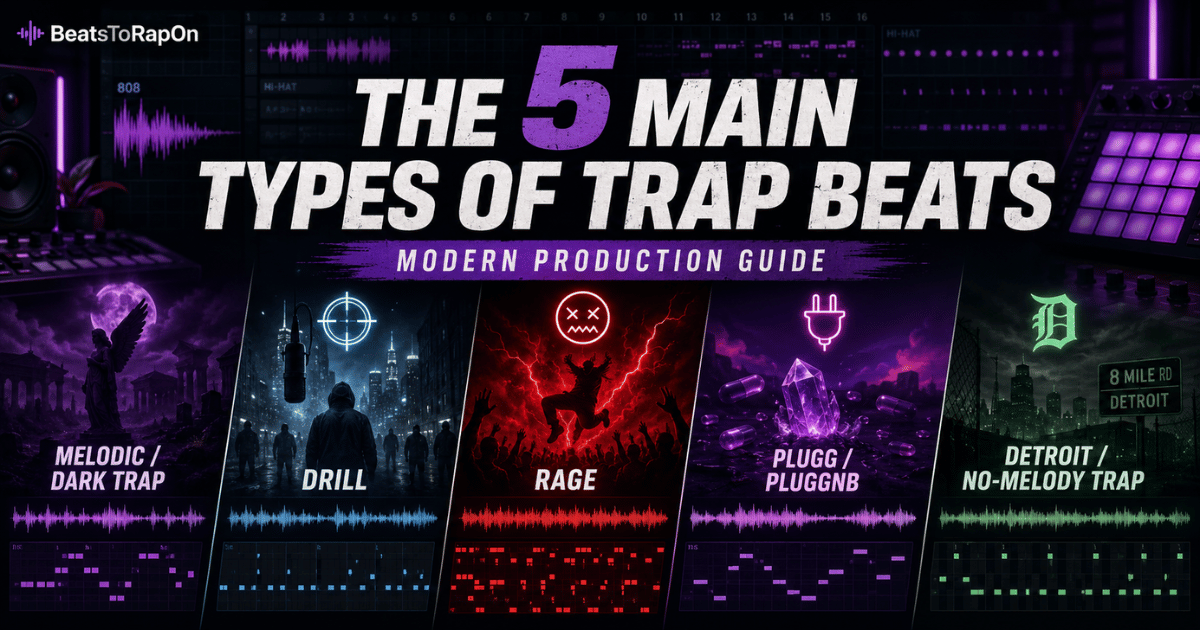
For contemporary producers, beatmakers, and audio engineers, mastering the nuances of these subgenres is critical for commercial viability and artistic relevance. This guide breaks down five prominent and highly used types of trap beats in modern music production: Mainstream Melodic and Dark Trap, Drill, Rage, Plugg and Pluggnb, and Detroit or No-Melody Trap.
The Foundational Mechanics of Trap Beats
Before examining the specialized subgenres, it is important to understand the universal mechanics that govern the trap aesthetic. Across its sub-classifications, trap beats share a core structural DNA rooted in tempo manipulation, low-end dominance, and rhythmic syncopation based on the synthesized percussion of the Roland TR-808 drum machine, a foundation described in the broader history of trap music
Tempo Manipulation and the Half-Time Illusion in Trap Music
The tempo of a standard trap beat typically falls between 130 and 170 beats per minute, with a heavy concentration in the 138 to 145 BPM range. However, the defining characteristic of the trap groove is its psychological half-time feel. While the digital audio workstation grid may be set to a rapid tempo such as 140 BPM, the fundamental rhythmic anchors, especially the kick and snare, are programmed to operate at half that perceived speed, creating a listener experience closer to 70 BPM.
In this framework, the snare drum or clap is placed on beat three of every measure, rather than the traditional beats two and four found in boom-bap, rock, or house music. This half-time illusion creates a spacious, dragging, and menacing crawl, giving vocalists physical and rhythmic space to operate with complex, syncopated cadences.
Rhythmic Momentum Through Hi-Hats
Within this spacious half-time framework, forward rhythmic momentum is generated almost entirely by the hi-hats. Trap hi-hats execute rapid subdivisions, frequently using 16th notes, 32nd notes, 64th notes, and triplet rolls, creating a skittering, waterfall-like acoustic effect, a characteristic widely associated with trap percussion and central to trap genre music’s modern sound.
The contrast between the slow snare placement and the frantic high-frequency velocity of the hi-hats generates the genre’s signature rhythmic tension. Producers frequently manipulate the velocity of these hi-hat rolls to create a more humanized, dynamic groove, while pitch-shifting specific rolls downward to create cascading transitional fills.
The 808 Sub-Bass as Harmonic Anchor
The foundation of the frequency spectrum is ruled by the 808 sub-bass. Unlike traditional acoustic or electric bass guitars, the trap 808 functions simultaneously as a primary percussive element and the core harmonic anchor. Tuned to the root notes of the track’s key signature, the 808 provides a droning, sustained low-end that is often manipulated with portamento, or glide, to slide between pitches and create a secondary melody beneath the drums.
Harmonic structures across the genre predominantly favor minor keys, especially Natural Minor, Harmonic Minor, and Phrygian modes, which evoke dark, tense, and emotive atmospheres. The careful tuning and envelope shaping of the 808, including attack, decay, sustain, and release, dictates whether the track feels punchy and urgent or heavy and submerged.
Archetype 1: Mainstream Melodic and Dark Trap
Mainstream Melodic Trap, alongside its moodier sibling Dark Trap, represents the quintessential and most widely commercialized iteration of the genre. This style forms the backbone of multi-platinum releases from artists such as Future, Travis Scott, Drake, Lil Baby, and Gunna, and relies heavily on sonic blueprints associated with production collectives such as 808 Mafia and producers including Metro Boomin and Tay Keith, within the wider lineage of modern trap music.
Harmonic Architecture and Guitar Trap
The tempo for this archetype typically sits in the standard 130 to 150 BPM range. Harmonically, Melodic Trap relies on minor-key progressions that are intentionally simple, hypnotic, and repetitive. The instrumentation often features lush atmospheric synth pads, eerie bells, or detuned grand pianos that loop consistently throughout the arrangement.
In recent years, Guitar Trap, a lucrative sub-niche associated with producers such as Nick Mira and the Internet Money collective and frequently connected with Juice WRLD-style production, has become a major staple within this archetype.
The guitar stems are processed with heavy reverberation, chorus, and delay to create melancholic, weeping riffs that sit over hard-hitting trap drums. The melodic palette is kept sparse; a progression consisting of two to four notes per bar is often sufficient, ensuring the instrumental does not cause listener fatigue or compete with the lead vocal for mid-range frequency space.
The Nardo Wick, Trap Artists, and Dark Trap Influence
The darker, more ominous iteration of this sound, often categorized as Dark Trap or the Nardo Wick type beat, is defined by an aggressive, dark atmosphere, minimalist melody, and a melodic, sad tone that strips away lush guitars in favor of brooding tension. Using keys such as F minor, G minor, and A minor, which correspond to effective resonant sub-bass frequencies, these tracks rely on short plucky leads, detuned bells, and low-pass filtered synthesizers.
The tonal environment is strictly restricted to the natural minor scale to avoid major intervals that might brighten the mood. In this lane, darkness comes not from adding more elements, but from removing anything that weakens the tension.
Drum Programming and Vocal Pocket
The drum programming in Melodic and Dark Trap is designed to leave a wide vocal pocket. Professional instrumentals in this lane feature sparse, deliberate kick drum patterns that lock tightly with the 808, using heavy use of bass-driven spacing and rhythmic complexity rather than a steady four-on-the-floor pulse.
The snare drum provides crisp snares and a cutting transient on the third beat when the bar is programmed in double time, often layered with a secondary clap or sharp rimshot. Hi-hats use roughly 10 to 15 percent swing, keeping the groove humanized while maintaining a locked, rigid sub-bass foundation.
Melodic and Dark Trap Parameters
- Tempo range: 130 to 150 BPM, programmed in double-time.
- Key signatures: F minor, G minor, A minor, and Harmonic Minor.
- Primary instrumentation: Distorted 808s, acoustic or electric guitars, eerie bells, and detuned pads.
- Hi-hat phrasing: 16th notes, 32nd triplet rolls, and 10 to 15 percent swing.
- Vocal pocket: Extremely open, with mid-range frequencies aggressively carved out.
Archetype 2: Drill
Drill music is a specialized, highly rhythmic, and often controversial mutation of trap, with T.I., Young Jeezy, and Gucci Mane among the key early trap artists from its parent style, that originated on the South Side of Chicago in the early 2010s and was shaped by rappers. It was later exported to the United Kingdom, where it underwent a radical rhythmic transformation, before returning to the United States and becoming central to Brooklyn and Bronx rap scenes for a new generation of trap artists, as outlined in histories of trap and drill’s relationship and broader discussions of trap music’s revolutionary, rebellious spirit.
The Evolution of the Drill Groove
Early Chicago drill, associated with producers such as Young Chop and artists such as Chief Keef, operated at slower tempos around 60 to 75 BPM, often felt in double-time, with straightforward hard-hitting trap drums, ominous brass, and cinematic strings. Modern UK and NY variants changed the rhythmic grid significantly.
Modern Drill typically operates at faster tempos between 138 and 150 BPM. The defining feature of this archetype is highly syncopated and off-kilter drum programming. Unlike standard trap, which places the snare cleanly on beat three, Drill beats frequently shift the snare placement.
The quintessential UK and NY Drill pattern places the snare or rimshot on the third and eighth eighth-notes of a two-bar measure. This creates a disjointed, rebounding bounce that constantly pulls against the primary tempo.
Hi-hat programming in Drill abandons the continuous rolling sequences of mainstream trap. Instead, it uses sparse, stuttering, and highly syncopated patterns, frequently punctuated by metallic counter-snares, rimshots, and foley textures.
The Portamento 808 and Sub-Bass Dominance
The 808 bass in Drill is exceptionally aggressive and heavily distorted. The defining characteristic of the Drill 808 is extreme use of portamento, or pitch glides. Bass lines glide rapidly across multiple octaves in a single measure, creating a twisting, elastic low-end that functions as the track’s primary musical motif rather than only its rhythmic anchor.
This requires careful sidechain compression so the kick drum can punch cleanly through the continuous, sweeping sub-frequencies.
Sexy Drill and Jersey Drill
A recent commercial evolution of this archetype is Sexy Drill. This subgenre retains the aggressive sliding 808s and syncopated percussion of UK and NY Drill but softens the thematic and sonic palette. Where traditional Drill often uses menacing, horror-inspired soundscapes to reflect raw street narratives, Sexy Drill uses lush R&B chord progressions, pitched-up vocal chops, and smooth synthesizer pads to accompany flirtatious and romantic lyricism.
Similarly, Jersey Drill fuses the aggressive sliding 808s of New York Drill with the 130 to 145 BPM tempo and specific foley samples associated with the New Jersey Club dance scene, including bed-squeaks, brake stops, and rapid kick drum triplets.
The juxtaposition of aggressive syncopated rhythm with sensual, dance-floor-oriented harmony has made these Drill variants a dominant force in club environments and on short-form video platforms.
Archetype 3: Rage
Rage, or Rage Trap, emerged in the late 2010s and solidified in the early 2020s as a hyper-energetic, chaotic fusion of trap rhythms and electronic dance music synthesizers. Popularized by artists such as Playboi Carti, Yeat, Ken Carson, and SoFaygo, and by producers associated with the Opium label and the Working on Dying collective, including F1LTHY and BNYX, Rage represents one of the most abrasive and intentionally overwhelming evolutions of mainstream trap genre, with much of its appeal coming more from rhythm and sound texture than from elaborate chord progressions.
Synthetic Chaos and EDM Integration
Rage beats typically operate at the faster end of the trap spectrum, frequently sitting between 150 and 160 BPM, with roots adjacent to the broader edm trap crossover tradition, though Rage keeps its own identity. The rhythm is relentless, driven by rapid hi-hats and a constant barrage of punchy kicks. However, the defining characteristic of the Rage archetype lies in synthesizer sound design and harmonic philosophy.
Producers move away from the organic instruments, such as pianos and guitars, found in melodic trap, instead using wavetable synthesis to generate buzzing sawtooth-like leads and massive euphoric chord stacks. These synth patches draw heavily from EDM subgenres such as Future Bass, Dubstep, and Hyperpop, reflecting a bass-heavy trap offshoot that blends EDM and trap influences.
To achieve this sound, producers use complex digital synthesizers such as Xfer Serum, Phase Plant, or Native Instruments Massive X, designing patches with wide stereo panning, heavy saturation, and extreme detuning to create an immersive, chaotic spatial experience. This combination gives the genre a futuristic edge, while traces of dub energy still come through in the low-end weight and festival-scale sound design.
Extreme Low-End Processing and Auditory Overload
In Rage production, the 808 is pushed to the limits of digital clipping. The sub-bass is intentionally overdriven through multi-stage distortion and hard-clipping algorithms, creating blistering, chest-thumping tones that occupy a large portion of the frequency spectrum. The goal is a visceral, punchy impact designed for mosh-pit energy at live performances.
To prevent the mix from collapsing under this weight, audio engineers must apply extreme high-frequency boosts to the synthesizers and hi-hats so they cut through the dense wall of distorted bass. Song structures in Rage are often minimalist and concise, frequently clocking in under two and a half minutes. This compressed format prioritizes repetition, intensity, and auditory overload over traditional narrative development, fitting fast-paced consumption habits on streaming and social platforms.
Archetype 4: Plugg and Pluggnb
In contrast to the maximalist, distorted aggression of Rage, Plugg and its contemporary offshoot Pluggnb offer a dreamy, minimalist, and deeply harmonic approach to trap production. Originating in the mid-2010s through the Beatpluggz producer collective, including figures such as MexikoDro, and influenced by the gospel- and jazz-tinged work of Atlanta pioneer Zaytoven, Plugg is characterized by lush atmosphere, airy pads, and highly specific percussive quirks.
Polyrhythmic Minimalism and Sound Selection
Plugg beats generally sit in the slower 120 to 140 BPM range. The drum programming is inherently polyrhythmic and highly sparse. Rather than dense continuous hi-hat rolls, Plugg uses sporadic hi-hat clumps that come and go, leaving large amounts of empty space in the rhythmic grid.
A defining hallmark of the genre is the absence of a traditional sharp snare drum. Instead, producers use heavily muffled, low-pass filtered claps falling on the second and fourth pulses of a measure, a feature reflected in descriptions of Plugg production. The rhythm also frequently features beat skips or beat cuts, where all percussion drops out momentarily to emphasize a vocal inflection or deep 808 bass slide.
The melodic content of original Plugg draws inspiration from retro video game soundtracks, including the Super Nintendo era, using xylophones, soft synthesizer pads, and warm electric pianos.
Pluggnb and Advanced Harmonic Complexity
Pluggnb represents a sophisticated fusion of the Plugg aesthetic with contemporary R&B and Neo-Soul. This subgenre elevates the musicality of the beat by incorporating complex jazz harmony.
Producers use extended chord voicings, including Major 7ths, Minor 9ths, 11ths, and 13ths, played on ROMpler-style workstation patches that evoke late-80s and early-90s digital synthesizers, similar to the lush textures found in many royalty-free hip-hop beats and instrumentals. A standard Pluggnb chord progression might cycle through dissonant, bittersweet voicings such as Fmaj9 to Cmaj9/B to Dmin9 to Cmaj9/E. The use of parallel chords and borrowed chords from other scales creates a buttery, nostalgic, and melancholic soundscape.
The 808s in this style are less distorted than in standard trap, focusing instead on deep, clean sub-bass tones with pronounced octave jumps to generate a smooth bounce. A darker variant, known as Dark Plugg, retains this polyrhythmic drum structure but replaces warm R&B chords with eerie choirs, cold bells, and heavily saturated 808s, establishing an occult or noir atmosphere while maintaining the genre’s trademark swing.
Plugg and Pluggnb Elements
- Tempo range: 120 to 140 BPM.
- Harmonic structure: Jazz extensions, including 7ths, 9ths, and 11ths, plus parallel scale borrowing.
- Percussive signature: Muffled or low-pass filtered claps on beats two and four, plus beat skips.
- Hi-hat patterns: Sparse, polyrhythmic clumps that avoid continuous 16th-note rolls.
- Synthesis and timbre: Retro video game tones, electric pianos, 90s ROMpler strings, and soft sine leads.
Archetype 5: Detroit Trap, No-Melody Trap, and Regional Bounce
The final major archetype covers the rapid, percussion-forward styles originating from the American Midwest, especially Detroit and Flint, Michigan, along with specific West Coast iterations. These regional styles frequently converge into what is colloquially known as No-Melody Trap, an aesthetic that is utilitarian, starkly stripped-back, and designed to serve complex, rapid-fire, and often unorthodox vocal cadences, often carrying themes rooted in street life and survival.
The 808 as the Primary Melodic Hook in a Trap Beat
Detroit and No-Melody Trap beats are fast, often produced at 140 to 160 BPM or programmed in extreme double-time above 200 BPM. As the name implies, No-Melody Trap intentionally avoids traditional synth leads, sustained chord progressions, or prominent tonal hooks.
If melodic elements exist, they are restricted to dark, sparse piano arpeggios, brief string stabs, or heavily processed, pitched-down soul vocal chops buried deep in the mix.
In the deliberate absence of traditional melody, the 808 bass steps forward to act as the song’s primary hook. Detroit-style 808s are heavily saturated and feature extreme continuous pitch bends and portamento glides. This constant gliding gives the bass a fluid, almost vocal quality that moves dynamically beneath the rapper’s voice and carries the melodic weight of the track.
Percussive Momentum, Jerk Trap, and West Coast Variations
The drum programming in this archetype is relentless and forward-leaning. Kicks are placed in rapid syncopated clusters, accompanied by sharp snares and emphatic claps. Negative space is used aggressively: drums frequently drop out entirely at the end of four-bar phrases, leaving only the rapper’s voice and a sliding 808 to carry momentum into the next section.
This regional style has cross-pollinated with Jerk Trap. Jerk Trap integrates the bouncy, syncopated dance rhythms of California’s late-2000s Jerk movement with modern trap bass. Running at 140 to 160 BPM, Jerk Trap uses triplet hi-hats, short punchy kicks, and specific foley samples, including bed-squeaks, cowbells, or vocal stabs, on the off-beats.
Meanwhile, standard West Coast Trap often sits at a slower 90 to 105 BPM, characterized by skipper hi-hats, a three-count 808 pattern, and clapping percussion instead of high-pitched snares. These regional bounces offer an elastic, dance-floor-oriented rhythm that feels distinct from the heavy, dragging feel of traditional Atlanta trap, and pair well with diverse catalogs of rap beats and hip-hop instrumentals.
Sound Selection, Drum Kits, and the Sample Economy
The execution of these five archetypes is closely linked to sound selection. The modern producer’s workflow relies heavily on curated drum kits, sample libraries, producer-branded drum kits, and carefully selected 808s, often sourced from specialized catalogs of royalty-free trap beats and 808 instrumentals.
The Three Foundational 808s
Almost all modern trap music uses variations of a few foundational 808 samples, which are endlessly recycled, distorted, and re-synthesized.
- The Spinz 808: Created by producer DJ Spinz and refined by B Wheezy, this is one of the most widely used 808s in trap history. It is known for punchy low-end, distinct mid-range character, and crisp attack, making it a default bass for Mainstream Melodic Trap.
- The Zay 808: Named after Zaytoven, this 808 has a shorter decay and deep, thumping low-end. It is less aggressive than the Spinz, making it useful for the bouncy, sparse rhythms of Plugg and Pluggnb.
- The Luger 808: Popularized by Lex Luger, this is a long, sustained, heavily distorted sub-bass associated with Dark Trap, Drill, and early aggressive trap styles.
Modern sound design frequently bypasses static WAV samples entirely, even as many artists still build ideas from premium trap beats and exclusive type instrumentals. Advanced producers use VST synthesizers such as Xfer Serum, Output Thermal, or dedicated bass plugins such as SubLab to synthesize 808s from raw sine waves, applying ADSR envelopes and harmonic distortion in real time.
Advanced Audio Engineering for Trap Production
Executing these five archetypes at a professional, commercial level requires specialized audio engineering techniques. Modern trap production demands a mix that hits with physical low-end power on large club systems while remaining articulate, punchy, and intelligible on mobile devices, Bluetooth speakers, and laptop monitors.
Low-End Management and Phase Alignment
The relationship between the kick drum and the 808 is the most critical mixing decision in trap music. Because both elements occupy the sub-bass frequency range, typically 20 Hz to 60 Hz, they can clash and cause phase cancellation, resulting in a weak, muddy mix. To resolve this, engineers use precise sidechain compression.
By routing the kick drum signal to trigger a compressor on the 808 channel, the volume of the 808 is ducked for a few milliseconds every time the kick hits. This allows the sharp transient of the kick to punch through the mix, followed by the sustained sub-bass body of the 808.
Frequencies below 100 Hz to 150 Hz must be summed entirely to mono. Applying stereo widening effects to sub-bass frequencies can cause severe phase alignment issues, especially on club sound systems. By keeping the sub-bass strictly mono, the producer ensures maximum impact and focus. Stereo width is then achieved by panning hi-hats, percussive accents, and spreading synth pads across the stereo field.
Psychoacoustic Saturation and Transient Shaping
In subgenres such as No-Melody Trap, Drill, and Rage, where percussive transients and bass aggression are central, tools such as transient shapers, multiband distortion, and soft clippers are used heavily.
Applying saturation to the 808 generates harmonic distortion. By adding artificial overtones in the 200 Hz to 500 Hz range, the human brain is encouraged to perceive the presence of sub-bass even on small speakers that cannot physically reproduce frequencies below 60 Hz. Plugins such as Output Thermal or FabFilter Saturn 2 are frequently used to apply this distortion specifically to upper harmonics through band-splitting, leaving the fundamental sub-frequencies clean and undistorted.
Soft clipping the drum bus allows the engineer to shave off the absolute peak transients of kicks and snares. This reduces dynamic range without inducing the audible pumping effect associated with heavy traditional compression, allowing the beat to be pushed louder into the limiter.
Mastering Targets for Modern Trap Music Streaming
The mastering phase for trap often requires a compromise between maximum club loudness and the normalization algorithms of modern streaming platforms such as Spotify, Apple Music, and YouTube.
While streaming platforms generally normalize audio to roughly -14 LUFS, trap and drill masters are frequently pushed much hotter, deliberately targeting -8 to -6 LUFS for creative impact, aggressive saturation, and perceived energy, as discussed in BeatsToRapOn’s guide to rap mastering settings and platform delivery. To prevent severe encoding distortion when audio is converted to compressed formats such as MP3 or AAC, engineers must use True Peak limiting so the highest inter-sample peak does not exceed -1 dBTP.
For softer, jazz-influenced subgenres such as Pluggnb or Ambient Trap, a warmer and less aggressive R&B or Soul mastering target is often used. This preserves dynamic range and highlights the lush midrange of extended chord voicings, avoiding the harshness of a heavily limited EDM-style master.
Trap Mixing and Mastering Targets
- Sub-bass width: Summed to absolute mono below 100 to 150 Hz to prevent phase cancellation.
- Kick and 808 interaction: Fast-attack sidechain compression or dynamic EQ dipping, often around 2 to 5 milliseconds attack with fast release.
- 808 perception: Multiband saturation or distortion on upper harmonics in the 200 Hz to 500 Hz range.
- Aggressive loudness: Heavy limiting and soft clipping for Drill, Rage, and Mainstream Trap, often around -8 to -6 LUFS.
- True Peak limiting: Ceiling applied to prevent codec clipping on streaming, with -1 dBTP used as a maximum target.
The Future of Trap Production
The available empirical and acoustic evidence indicates that trap music is no longer a monolithic genre, a term T.I. coined with his 2003 album Trap Muzik. It is a highly adaptable, modular rhythmic framework. The five archetypes covered here, Mainstream Melodic and Dark Trap, Drill, Rage, Plugg and Pluggnb, and Detroit or No-Melody Trap, show how shifts in tempo, drum syncopation, harmonic vocabulary, or engineering approach can alter the emotional and cultural resonance of a beat.
Moving into 2026 and beyond, trend analysis suggests that rigid genre boundaries will continue to dissolve into hybridized micro-genres. In 2015, Fetty Wap’s “Trap Queen” peaked at number two on Billboard, underscoring trap’s mainstream crossover. The emergence of styles such as Sexy Drill, Ambient Plugg, and Phonk-Trap crossovers points toward a future defined by sonic cross-pollination.
Producers are increasingly combining the distorted wavetable synthesis of Rage with the polyrhythmic muffled claps of Plugg, or applying the rapid syncopated kick clusters of Jerk Trap to the melancholic minor-key guitars of Mainstream Trap. Global influences such as South African Amapiano, with its signature log drum basslines, and Latin Reggaeton are also increasingly sequenced over half-time trap rhythms to create crossover global pop records.
For the contemporary audio producer, versatility is paramount. Mastery of trap music production no longer means simply dropping an 808 on a grid and programming fast hi-hats. It requires a nuanced theoretical understanding of regional bounce, advanced jazz harmonic extensions, synthesizer sound design, and aggressive digital saturation techniques.
By understanding the rhythmic codes, cultural histories, and engineering principles of these five core archetypes, producers can construct instrumentals that meet current industry standards while pushing the sonic boundaries of modern hip-hop and electronic music. Many royalty free trap beats are available for free download and can be used across different creative projects, especially when drawing from curated libraries of royalty-free rap, trap, and hip hop beats.