
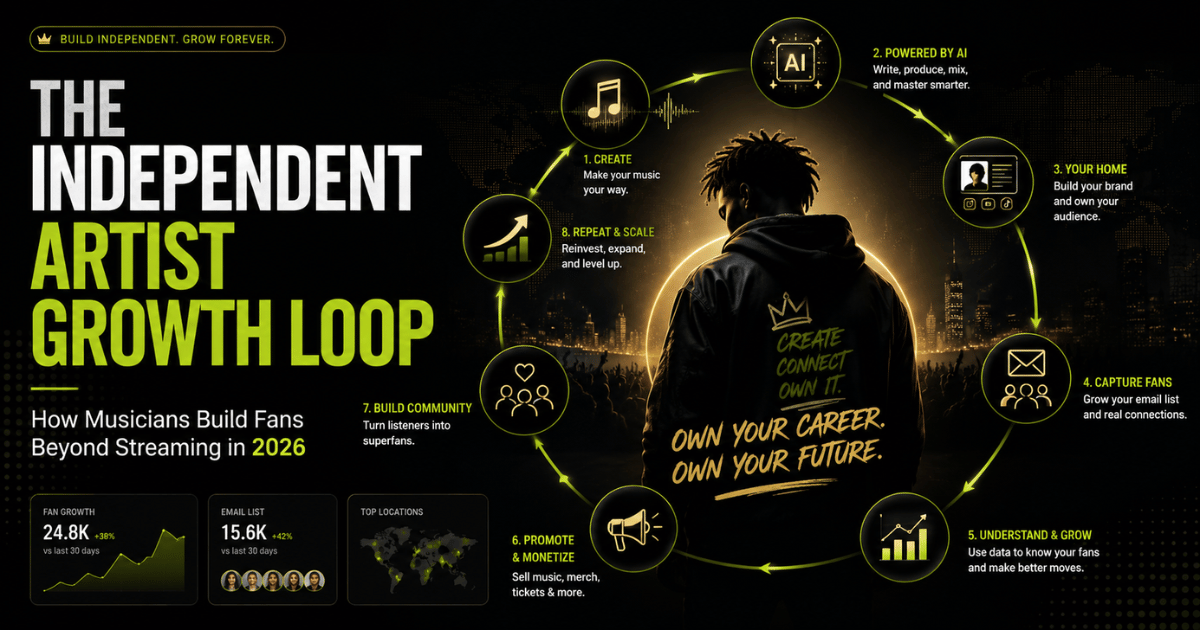
The Independent Artist Growth Loop: How Musicians Build Fans Beyond Streaming in 2026
The recorded music industry has never been bigger, but the path for independent artists has rarely been more crowded. Global recorded music revenues reached an all-time high of US$31.7 billion in 2025, according to the IFPI Global Music Report 2026 announcement, yet independent artists are competing inside a market where discovery is fragmented, uploads are constant, and attention is controlled by platforms they do not own.
This is the central paradox defining independent artist growth in 2026. Streaming has scaled globally. Artificial intelligence has lowered production barriers. Direct-to-fan infrastructure has moved from a useful extra to a strategic necessity. But the older model of uploading music and hoping for algorithmic streams is structurally obsolete.
In its place, successful independent artists are building a repeatable, closed-loop growth system. That system involves creating assets, improving them with AI automation, publishing through a centralized identity, capturing direct fan data, analyzing algorithmic signals, promoting through decentralized marketplaces, and repeating the cycle with better information.
This article explains that model as the Independent Artist Growth Loop. It uses BeatsToRapOn, also known as BTR, as a primary architectural case study of an integrated artist stack built around creation tools, identity management, fan capture, analytics, marketplace support, discovery, and genre-specific music infrastructure for independent hip-hop, rap, trap, R&B, Afrobeats, dancehall, reggae, amapiano, and global music creators.
The End of the Streaming-Only Artist Strategy
The old artist growth model
For the past decade, the dominant playbook for independent artist growth was built around a linear, highly fragmented sequence of events. An artist would create music, distribute it to digital service providers, chase editorial playlist placements, broadcast promotional links across rented social media feeds, and hope that passive discovery would eventually convert into a sustainable, monetizable fan base.
During the early maturation of music streaming, when platform catalogs were smaller and algorithmic recommendations were still a novelty, that model possessed a degree of viability. It was not perfect, but it had enough oxygen for some independent artists to build momentum from distribution alone.
Why that model is no longer enough
The architecture of the modern streaming economy no longer supports that passive, linear methodology. While the streaming market represents an enormous global economy, consumer attention is severely fragmented. The IFPI Global Music Report 2026 state of the industry report reported that global recorded music revenues reached an all-time high of US$31.7 billion in 2025.
Underneath that macroeconomic success, artists are forced to compete against the entire digitized history of recorded music, with over 100,000 new tracks uploaded to streaming platforms every single day, a figure discussed in Spotify’s artist-facing material on what Spotify is building for artists in 2026.
In this hyper-saturated environment, streaming growth does not automatically equal artist sustainability. A stream is only a preliminary behavioral signal. It does not automatically give an artist an email address, a merchandise customer, a ticket buyer, or a direct fan relationship.
The core weakness of the legacy strategy is its total reliance on rented attention. Social media reach is platform-controlled. Streaming listeners are ultimately owned by the DSPs. That leaves the artist exposed to algorithmic volatility, platform changes, and sudden shifts in discovery mechanics they cannot control.
The new model: the Independent Artist Growth Loop
The strategic failure of the streaming-only playbook requires a different model. The modern independent artist needs to convert scattered streaming attention into a repeatable growth system.
The Independent Artist Growth Loop abandons the linear approach in favor of a cyclical, systems-engineered workflow. The artist creates the track, improves it with AI tools, publishes it through a credible centralized artist page, captures fan data directly, tracks engagement metrics, promotes through vetted marketplace services, converts interest into deeper fan relationships, and repeats the sequence with better data.
That shift matters because modern artists increasingly operate as system builders, not just content creators.
Industry Context: Streaming Growth, Artist Pressure, and the Fan Economy
Streaming remains the economic centre
To understand why the Independent Artist Growth Loop matters, the macroeconomic state of recorded music in 2026 has to be addressed first. Global music revenues grew by 6.4% in 2025, marking the eleventh consecutive year of growth, according to IFPI news and industry reporting.
Streaming remains the engine of this ecosystem. Total streaming revenues surpassed US$22 billion, accounting for 69.6% of total global recorded music income, with paid subscription streaming alone driving 52.4% of all revenue, according to the IFPI Global Music Report 2026. Global paid subscription accounts reached 837 million by the end of 2025, showing that the model no longer relies on novelty but on deep global scale, a trend also discussed in analysis of what changed between IFPI’s 2025 and 2026 Global Music Reports.
Platform-specific data reinforces that scale. Spotify’s Loud & Clear 2026 highlights covering 2025 economics stated that the platform paid over US$11 billion to the music industry in 2025 and over US$70 billion historically.
The distribution of that revenue also shows that global ubiquity is no longer the only path to financial traction. Spotify’s Loud & Clear data, discussed by Andrew Southworth’s analysis of Spotify Loud & Clear 2026 and Spotify’s own Loud & Clear takeaways, indicates that more than 13,800 artists generated at least US$50,000 in royalties on Spotify in 2025, while nearly 1,500 artists generated over US$1 million. Approximately half of Spotify’s royalty pool was paid to independent artists and labels, and 85% of the artists generating over US$100,000 were based outside the United States.
That points toward a decentralized, globalized middle class. The opportunity is real. But it is uneven.
The opportunity is real, but uneven
Despite encouraging macroeconomic indicators, the streaming distribution reveals a difficult reality for the independent long-tail. The financial gap between top-tier streaming success and emerging artist discovery remains large.
In 2025, the 100,000th highest-earning artist on Spotify generated approximately US$7,300. That is a meaningful improvement compared with the approximately US$600 generated by the 100,000th artist in 2015, based on Spotify Loud & Clear reporting discussed in Relix’s report on Spotify’s record royalty payouts. But an annual gross royalty figure of US$7,300 is not enough to sustain a professional career, fund high-fidelity production, or finance comprehensive marketing campaigns.
Why more streams is not a full strategy
The mathematical realities of streaming mean that one million streams may generate roughly US$3,000 to US$5,000 in gross royalties, depending on territory, platform, rights splits, and other variables. This point is reflected in BTR’s existing research on artist growth strategy in 2026.
The pursuit of “more streams” is incomplete because it treats a behavioral signal as the final economic destination. A stream signifies curiosity. It does not guarantee a repeatable launch system for the artist’s next release.
The rise of the superfan economy
The music industry’s strategic response to streaming micro-transactions has been a structural pivot toward the superfan economy. Superfans are valuable because their spending and engagement are disproportionately high.
According to reporting on the superfan market, including Hypebot’s analysis of what may replace the superfan subscription model, superfans constitute approximately 15% to 20% of the US music listening audience but spend 66% more on live events and 105% more on physical products than casual listeners.
Goldman Sachs previously estimated that superfan segmentation could represent an additional US$4.3 billion in annual incremental revenue for the music industry by 2030, a figure discussed in wider superfan economy analysis including Larrosa Club’s discussion of why the superfan subscription model no longer works.
While early financial models focused narrowly on convincing streaming subscribers to pay higher monthly tiers, the industry has recognized that true superfan monetization occurs off-platform through merchandise, vinyl, community engagement, direct sales, and fan-owned relationships. The direct-to-fan logic is also central to Songtrust’s discussion of streams, superfans, and community building for independent artists.
Universal Music Group Chairman and CEO Sir Lucian Grainge has described the superfan segment as “massively under-monetized,” making it a primary strategic focus for major labels in 2026, according to Music Business Worldwide’s reporting on superfan strategy.
AI Tools as the New Production Equaliser
The first active node in the Independent Artist Growth Loop is the accelerated creation and refinement of audio assets. To satisfy algorithmic demands, modern release strategies often require an artist to release a new mastered track every four to six weeks, a cadence discussed in BTR’s artist growth strategy research.
The production gap for independent artists
Historically, high-fidelity music production was restricted by capital and technical bottlenecks. Studio time required significant financial investment. Mixing and mastering demanded specialized acoustic environments and years of engineering expertise. Release assets such as synchronized music videos and visualizers required outside production teams, slowing down an artist’s release cadence.
In an algorithmically driven ecosystem, those traditional friction points are fatal to career momentum.
How AI changes the workflow
Artificial intelligence has become a major mechanism for closing this production gap. It acts as a technical equalizer for creators who need to move quickly without losing quality.
While 29% of respondents use song generators for components such as drum loops or background vocals, only 13% use AI to generate full, completed songs. This suggests independent artists are using AI to remove workflow bottlenecks, not necessarily to surrender their artistic voice.
BTR case-study layer: AI tools inside the artist ecosystem
BeatsToRapOn demonstrates how AI tools can sit directly inside the artist publication ecosystem. The platform positions itself as an environment where artists can clean, finish, and prepare music rapidly without leaving the browser.
The BTR suite includes AI mastering tools tuned for hip-hop, trap, Afrobeats, and R&B. These tools analyze tracks for loudness, clarity, bass control, and stereo width so artists can prepare cleaner masters for streaming environments and release workflows.
BTR also includes an AI stem splitter and AI vocal remover for separating audio elements in the browser. The report describes a GPU-powered system offering 4-stem Pro Mode or 6-stem Studio Mode separation in approximately 15 seconds, trained on large multitrack datasets, with the goal of producing stems clean enough for serious remixing, editing, and professional audio workflows. BTR also supports related utilities such as AI vocal cleaning, online pitch correction, guitar removal, and piano removal.
Beyond audio, BTR’s AI Music Promo Maker and AI Reel Maker extend the release workflow into visual content. The report describes the use of Google Veo 3-style technology for cinematic vertical short-form video content synchronized to track stems, including virtual lip-syncing avatars based on uploaded reference photos. The strategic purpose is to reduce the cost and friction of producing visual assets for a release.
BTR also supports pre-release analysis through tools such as the song key and BPM finder, free online BPM analyzer, AI song checker, and AI music detector. These utilities matter because modern release preparation is not only creative; it is also technical, metadata-driven, and platform-aware.
Why AI tools are not enough alone
AI significantly reduces release friction, but a crucial third-order point remains: finishing a track is not the same as building an audience.
The democratization of high-fidelity production tools raises the baseline quality of the 100,000 tracks uploaded daily. In a landscape where clean mastering, stem separation, pitch correction, and high-definition visuals are widely accessible, audio quality becomes a prerequisite rather than a differentiator.
AI production only gains commercial value when it connects to distribution, identity management, fan capture, analytics, promotion, and repeatable audience development.
Artist Identity Infrastructure: The Artist Page as the New EPK
Once a high-fidelity asset is produced, it must be placed inside a credible brand environment. In 2026, the Electronic Press Kit has evolved from a static PDF into a dynamic, centralized digital identity that supports immediate consumer conversion.
Why scattered links weaken conversion
A persistent architectural error in independent music marketing is the reliance on scattered, decentralized link ecosystems. Artists often send inbound traffic to isolated Spotify links, fragmented Instagram profiles, temporary TikTok sounds, or generic link-in-bio pages.
This fragmentation weakens the fan journey. When a listener discovers an artist through a viral short-form video, any friction between that video’s aesthetic promise and the artist’s profile page can cause immediate drop-off. Modern listeners expect fast visual confirmation of an artist’s identity.
The modern artist page
To reduce that friction, artists need a cohesive home base. Brand building in 2026 sits at the intersection of artistic identity, visual identity, and narrative identity. Artistic identity includes sonic DNA and emotional resonance. Visual identity includes color palettes, typography, photography, artwork, and motion language. Narrative identity includes the artist’s origin story, values, and cultural position.
The report states that artists with consistent visual identity and sonic branding see 28% to 45% higher save rates on DSPs compared with artists using inconsistent profiles, based on BTR’s existing artist growth strategy research.
The modern artist page acts as a centralized aggregation point. It unifies the music catalog, narrative biography, high-definition visual assets, live event ticketing integrations, merchandise portals, and direct fan signup forms into one digital environment.
BTR Artist Pro case study
BTR Artist Pro models this need directly. The report describes Artist Pro as a monthly subscription that gives artists access to Brand Studio tools, customizable digital identity, and a clean professional shortlink such as btr.ink/yourname.
Rather than functioning as a static link tree, the Artist Pro profile operates as a brand page, fan capture funnel, release hub, and analytics dashboard at the same time. By anchoring music to a specific visual and narrative context, with moving video headers and integrated smartlinks, the artist can convert anonymous streaming curiosity into a more tangible cultural brand.
This is especially relevant for artists using BTR’s genre infrastructure around hip-hop beats, trap beats, rap beats, freestyle rap beats, reggae beats, lofi hip-hop, and instrumental hip-hop beats. The artist page becomes the identity layer that connects music discovery to the person behind the sound.
Research angle
Future empirical research should investigate the statistical relationship between artist profile completeness and algorithmic performance. Specifically, researchers should test whether profiles with complete biographies, synchronized visuals, and embedded fan capture mechanisms produce higher DSP save rates, increased share card clicks, and better paid campaign conversion rates than fragmented digital footprints.
Fan Capture: Why Direct Audience Data Matters
The pivot from rented algorithms to owned audiences is one of the most important economic shifts in the 2026 music business.
The weakness of rented attention
A stream on a digital service provider is fundamentally a rented interaction. The platform controls the user data, dictates the recommendation algorithm, and owns the point of contact.
Social media reach is also platform-controlled. An artist can have a large follower count and still reach only a fraction of that audience because of algorithmic feed suppression, content format changes, or paid reach constraints. Artists become dependent on third-party corporations to communicate with their own listeners.
Email and direct fan systems
Capturing a fan’s email address or SMS number gives the artist a more durable point of contact. BTR addresses this structural need through integrated fan capture and Email Studio-style tools inside its artist ecosystem.
The platform positions fan capture as a way to bypass algorithms by integrating direct signup mechanisms into the Brand Studio page. When profile traffic signs up, the artist can view subscribers, filter by geographic location, and deploy branded campaigns from the workspace. When an artist releases new music, announces a tour, promotes a limited merch drop, or pushes a live show through BTR events or the event ticketing platform, they can communicate with high-intent fans without paying a social network for every reach event.
Direct-to-fan is now a major industry direction
Direct-to-fan infrastructure is not only an independent strategy. It is now a major-label direction.
In February 2026, Universal Music Group announced a multi-year strategic agreement with EVEN, a platform providing turnkey direct-to-fan infrastructure. According to Universal Music Group’s announcement of its EVEN agreement, the partnership enables UMG artists to engage superfans through early access to music, exclusive content, and artist-led experiences before standard streaming distribution.
Reporting from New Industry Focus on UMG’s partnership with EVEN, Music Business Worldwide on Universal Music’s direct-to-consumer deal with EVEN, and Patchwerk Radio’s analysis of the superfan economy and EVEN shows how direct fan infrastructure is being treated as core music business infrastructure.
High-profile UMG artists including J. Cole and Wale have used this kind of white-label direct-to-fan infrastructure to sell digital albums directly to fans, expand owned audiences during release windows, and still participate in the Billboard 200 ecosystem. The UMG-EVEN integration signals a structural realization: direct, artist-owned fan relationships are infrastructure, not optional marketing.
Key research argument
The most valuable action an independent artist can trigger in 2026 is not one more passive stream. It is converting an anonymous algorithmic listener into a reachable, owned fan.
The Independent Artist Growth Loop is designed around that conversion mechanism.
Marketplace Services: Label-Like Capabilities Without Label Dependency
Independent artists routinely face a capability gap. Major labels employ in-house departments for public relations, radio plugging, digital advertising, playlist pitching, content production, graphic design, and campaign management. Independent artists are often forced to execute these tasks themselves or hire fragmented, unvetted external providers.
The capability gap
To scale effectively, independent artists need ongoing support in playlist pitching, social media UGC creation, cover art design, specialized mixing and mastering, video editing, PR blog outreach, paid ad management, live show promotion, fan funnel optimization, and sometimes even interview placement through platforms like music artist interviews.
Sourcing these services individually exposes the artist to serious financial risk, especially when the market includes bot-driven playlisting, inflated vanity metrics, vague “exposure” promises, and low-accountability promotional vendors.
BTR marketplace case study
Decentralized artist marketplaces have emerged to provide flexible, on-demand access to specialized label infrastructure. The BTR music promotion marketplace functions as an open ecosystem connecting artists with independent curators, digital marketers, PR specialists, creators, producers, and music-focused service providers.
The marketplace allows artists to unbundle traditional label services. An artist can purchase targeted song submissions to independent Spotify curators, book a TikTok UGC campaign where creators respond to a track, or hire a publicist to pursue blog features and podcast interviews. Because artists interact directly with service providers, they can start with smaller budgets, test several promotional lanes, and scale the strategies that produce the strongest return.
Promotion categories and marketplace applications
- Playlist pitching: The strategic objective is to trigger algorithmic DSP momentum. Marketplace applications include cross-platform targeting across Spotify, Apple Music, and TIDAL based on genre and mood.
- Social and viral campaigns: The strategic objective is to drive organic discovery and social proof. Marketplace applications include TikTok trends, Instagram Reels, and niche community seeding through Discord or Reddit.
- Press and radio: The strategic objective is to build authority and an SEO footprint. Marketplace applications include blog features, podcast interviews, and regional radio plugging.
- Digital ads: The strategic objective is to capture fan data and support retargeting. Marketplace applications include Meta ads and TikTok Spark Ads directed toward artist pages and fan funnels.
For sellers, BTR also provides a pathway to sell music promotion services, become a seller, monetize playlists, or monetize a Facebook community. That matters because the artist growth loop does not only depend on tools; it also depends on reliable support services around the artist.
Research angle
The growth of these platforms warrants deeper academic research into whether decentralized artist marketplaces can replace some promotional functions of traditional mid-tier record labels, giving independent artists access to label-like leverage without requiring the loss of master ownership.
Risk section
The music promotion sector carries serious risks. These include bot-driven playlisting, vanity metrics, fraudulent agencies, misleading promises of virality, and artificial streaming violations that can result in catalog removal from DSPs.
This is where the marketplace model introduces trust infrastructure. BTR’s marketplace model, described in the platform’s analysis of playlist promotion alternatives, uses escrow protection. When an artist books a campaign, funds are held by the platform and released to the seller only once the work is delivered as promised and accepted by the artist.
Transparent community ratings, success scores out of 10, and tiered seller levels such as Rising, Established, Premier, and Top Rated are designed to enforce accountability and reduce low-quality provider risk.
The Independent Artist Growth Loop Model
Combining AI tools, centralized profiles, direct fan capture, analytics, and marketplace promotion produces the Independent Artist Growth Loop.
Stage 1 — Create
The artist writes, produces, or records the foundational track. This may begin with original production, collaboration with producers, beat discovery through genre pages such as hip-hop rap music, trap music, drill music, R&B and soul, Afrobeats, amapiano, dancehall, reggae, or specialized beat categories such as trap instrumentals, drill instrumentals, and boom bap instrumentals.
Stage 2 — Improve
The artist uses AI workflows such as stem splitting, mastering, vocal cleanup, key detection, BPM analysis, and pre-release checking to polish the audio and prepare metadata for DSP distribution.
Stage 3 — Publish
The track is uploaded to a public track page and artist profile. In environments like BTR, uploading can trigger an initial algorithmic launch window, giving the track early ecosystem visibility.
Stage 4 — Package
The release is contextualized inside the living EPK. The artist updates profile branding, synchronizes shortlinks, adds cover art, builds share assets, and embeds generated video content.
Stage 5 — Capture
Top-of-funnel traffic is directed to the artist page. Visitors are encouraged to submit their email or contact data, turning algorithmic curiosity into an owned fan relationship.
Stage 6 — Analyse
The artist studies deep funnel metrics including listen-through rates, profile views, share card clicks, fan capture conversion rates, and campaign performance. This is where vanity metrics start giving way to decision metrics.
Stage 7 — Promote
Using insights from the analytics phase, the artist reinvests into marketplace promotion, playlisting, press, social campaigns, creator campaigns, or ads to amplify proven organic traction.
Stage 8 — Repeat
With a larger owned audience, more capital, and better data about what triggered engagement, the artist returns to Stage 1 and improves the next release.
Diagram idea for the paper
The cyclical nature of this strategy can be visualized as a continuous feed-forward mechanism:
AI Tools → Track Page → Artist Profile → Fan Capture → Analytics → Marketplace Promotion → Events/Community → Next Release
Why this model is useful
The model shifts the artist’s psychological framework. It replaces vague motivational concepts with systems engineering. A release is not the final destination. It is a data-gathering mechanism inside a repeatable system.
That mindset helps independent artists build career resilience because each campaign improves the next one.
Proposed Methodology for the Research Paper
To validate the Independent Artist Growth Loop empirically, subsequent research should use a mixed-methods approach combining public industry macro-data with anonymized platform micro-data.
Public industry research
The foundational context of the research should synthesize established industry reports and market data, including:
- The IFPI Global Music Report 2026 for macroeconomic streaming data.
- Spotify Loud & Clear 2025 economics data for artist payout distribution.
- Luminate and Goldman Sachs research on superfan valuation and market penetration.
- The LANDR 2025 survey on AI artist workflows.
- Corporate strategy announcements such as the UMG and EVEN direct-to-fan partnership.
BTR internal data: strongest possible version
The strongest academic value would come from analyzing anonymized internal data from an integrated ecosystem like BeatsToRapOn. The following metrics would help determine whether the Growth Loop produces statistically significant advantages:
- AI tool usage before upload: Tests whether access to finishing tools drives higher publishing frequency.
- Profile completion rate: Tests whether comprehensive identity setup affects listener engagement.
- Track listens and profile views: Measures raw consumption versus artist-level interest.
- Share card clicks: Measures social spread and word-of-mouth momentum.
- Fan email captures: Measures the conversion rate of rented traffic into an owned audience.
- Marketplace campaign purchases: Measures artist investment behavior and promotional scaling.
- Repeat upload rate: Measures overall artist retention and career stamina within the ecosystem.
Suggested hypotheses
- H1: Artists who complete their profiles, including bio, links, and visuals, receive higher sustained engagement than artists with incomplete profiles.
- H2: Artists who use AI finishing tools immediately before upload demonstrate higher publishing completion rates and faster release cadences.
- H3: Tracks attached to fully branded artist profiles produce a statistically higher volume of fan signups than standalone track pages.
- H4: Artists with email fan capture enabled show stronger repeat-release engagement on subsequent track drops.
- H5: Paid marketplace promotion yields a higher return on investment, measured in fan retention, when paired with a complete artist profile and direct fan capture mechanism.
Suggested research design
- Quantitative platform data analysis tracking the user journey from track upload to fan signup.
- Funnel analysis isolating conversion differences between free-tier users and Artist Pro users.
- Case studies of selected artist journeys showing the transition from zero audience to sustained momentum.
- Short qualitative artist surveys measuring psychological shifts in release strategy.
BeatsToRapOn as an Artist Growth Ecosystem
The difference between isolated music technology tools and an integrated artist ecosystem is central to the BTR case study. The broader market contains standalone AI stem splitters, link-in-bio services, generic beat pages, and promotional agencies. BTR aggregates these functions into a singular architecture designed specifically for urban and global music genres.
What BTR currently combines
- Creation and finishing: AI mastering, stem splitting, vocal removal, vocal cleaning, key detection, BPM detection, pitch correction, guitar removal, piano removal, and track checking.
- Publishing and identity: Music uploads, Artist Pro branded profiles, artist shortlinks, artist directory visibility, and event integrations.
- Fan capture: Email Studio, analytics, fan routing, branded pages, and direct audience systems.
- Discovery and gamification: Freestyle Battle Arena, Power Charts, genre charts, weekly leaderboards, monthly leaderboards, and monthly winner showcases.
- Scaling: Escrow-protected music promotion services, seller marketplace infrastructure, playlist promotion, UGC campaigns, press, interviews, and creator networks.
Why that matters
Most artist tools operate in isolation. That creates friction because artists have to manually connect separate software solutions. An integrated model reduces this friction by moving the asset from creation to publication to discovery to fan capture without forcing the artist to leave the ecosystem.
When a user uploads a track to BTR, it can be routed into discovery surfaces such as the Power Charts, genre Power Charts, monthly leaderboard, and genre-specific weekly leaderboards such as weekly hip-hop rap leaderboard, weekly trap leaderboard, weekly drill leaderboard, weekly R&B soul leaderboard, weekly Afrobeats leaderboard, weekly amapiano leaderboard, weekly dancehall leaderboard, weekly reggae leaderboard, weekly Latin urban leaderboard, and weekly instrumentals leaderboard.
Gamification and algorithmic sorting
The BTR ecosystem uses community gamification to sort and surface talent organically.
The Global Power Charts operate as a monthly reset metric ranking tracks globally and by subgenre, including hip-hop rap, trap, drill, R&B soul, Afrobeats, amapiano, dancehall, reggae, Latin urban, club bangers, and instrumentals.
Rather than relying only on cumulative streams, which biases older catalog tracks, the Power Score algorithm weights recent, high-intent actions to measure real-time momentum. The report states that the algorithm calculates score based on 40% downloads, 30% streams, 20% likes, and 10% views. By heavily weighting downloads and streams, the chart prioritizes deeper listener engagement over passive scrolling.
The Freestyle Battle Arena operates as a crowd-ranked proving ground. MCs upload 60-second cyphers directly to the platform, and community reactions such as “Fire,” “Dope,” “Bars,” and “Skip” determine algorithmic placement. Artists advance through tiered classifications from Rookie to Contender, Elite, and GOAT, creating an environment where community momentum shapes visibility.
This connects naturally with BTR’s broader freestyle infrastructure, including freestyle tools, freestyle rap discovery, battle rap, cypher music, street cypher, and freestyle with beat categories.
Findings Section Structure for the Research Paper
After executing the proposed methodology, the findings should answer how integration affects career sustainability.
Finding 1: AI tools reduce release friction
This section should detail the statistical impact of AI integration on release cadence. It should test whether artists who use automated mastering, vocal tools, stem separation, and pre-release analysis upload music more frequently and with higher completion rates than artists relying only on traditional engineering workflows.
Finding 2: Profile completeness improves trust
This finding should quantify the friction of fragmented identities. It should measure the percentage increase in listener conversion rates for profiles featuring cohesive biographies, synchronized visual assets, and embedded video headers compared with default or incomplete profiles.
Finding 3: Fan capture is the key conversion layer
This section should analyze the top-of-funnel to bottom-of-funnel conversion process, measuring the percentage of anonymous profile visitors who submit contact information and become reachable, owned fans.
Finding 4: Marketplace support works best after the foundation is built
This finding should evaluate the efficiency of promotional capital. It should test whether paid playlist pitching, PR campaigns, creator campaigns, and digital ads produce stronger retention metrics when inbound traffic goes to an optimized, fan-capturing artist profile rather than a standard DSP link.
Finding 5: The highest-value artists behave like systems builders
The concluding finding should analyze the behavioral patterns of the most successful artists on the platform. The central question is whether top performers use multiple layers of the ecosystem at the same time, including tools, uploads, profiles, fan capture, analytics, and promotion, rather than relying on one isolated tactic.
Strategic Implications for Independent Artists
The synthesis of industry trends and ecosystem mechanics requires a sharp departure from conventional independent marketing advice.
Stop treating every release as a lottery ticket
Independent artists should abandon the mindset that a release is an isolated attempt at viral fame. A song is a data-gathering mechanism inside a repeatable system. The objective of a release is to test audio quality, gather algorithmic data, capture new emails, measure fan response, and apply those learnings to the next drop.
Understand DSP algorithm differences
Artists need to understand how major DSPs process engagement so they can optimize release strategy without relying on vague assumptions.
Spotify and the retention shift: The report states that Spotify’s recommendation engines, including Discover Weekly and Release Radar, penalize passive listening and prioritize retention quality. To trigger algorithmic expansion, a track should aim for a save rate above 20% from cold listeners. The report also states that a track with 2,000 saves from 8,000 listeners can outperform a track with 50,000 passive streams and 400 saves, while artists should maintain a stream-to-listener ratio above 2.5 and keep early skip rates below 30% in the first 30 seconds to avoid algorithmic throttling.
Apple Music and human curation: The report states that Apple Music operates with an editorial-first philosophy and caters to a demographic that often uses iPhones and has higher purchasing power. Because Apple relies heavily on human editors, artists should upload assets 3 to 4 weeks in advance to meet the 10-day lead time required for the Apple Music Pitch tool. The report also states that Apple prioritizes premium technical deliverables such as Spatial Audio, motion artwork, and synchronized lyrics, and weights high-intent actions such as Library Adds and Shazam discovery more heavily than passive streams.
Build one home base
Artists should stop routing fans to dozens of rented platforms. Every promotional effort, short-form video, ad campaign, interview, event listing, and track share should lead back to a singular owned destination where the artist controls the narrative, the aesthetic environment, and the fan data.
For BTR artists, that home base may connect to the artist directory, artist account creation, Artist Pro pages, track pages, music discovery pages, event listings, and fan capture tools.
Use AI to move faster, not to become generic
AI should be used pragmatically to execute technical finishing, polish audio, speed up visual production, and remove bottlenecks. It should not replace the artist’s unique sonic identity or worldview. Generic, fully AI-generated tracks are less likely to build the emotional resonance required to cultivate superfans.
Capture fans early and measure the full funnel
Anonymous reach on social media is weaker than owned audience growth. Artists should offer clear incentives to capture email addresses early in the discovery phase.
That also requires a shift from vanity metrics to conversion metrics. Artists should measure plays, profile views, link clicks, fan signups, repeat visitors, share card generation, merchandise clicks, ticket clicks, and campaign return on investment.
Strategic Implications for BTR
The artist growth loop also creates strategic requirements for integrated music technology platforms.
Position BTR as artist infrastructure
BTR should position itself as comprehensive artist infrastructure rather than a fragmented utility. The strongest market position is not “AI tools” alone, “music uploads” alone, or “marketplace services” alone. The defensible position is BTR as an independent artist growth system for finishing music, publishing professionally, capturing fans, tracking momentum, and promoting smarter.
Create a proprietary benchmark
To build industry authority, BTR should aggregate anonymized internal data into an annual report, tentatively titled The BTR Independent Artist Growth Report. The report could establish recurring benchmarks such as average fan capture rates by genre, the statistical impact of AI tool usage before upload, Artist Pro versus free-tier engagement differences, marketplace campaign conversion benchmarks, and genre-specific growth patterns across hip-hop, trap, drill, R&B, Afrobeats, amapiano, reggae, dancehall, Latin urban, instrumentals, and gospel.
SEO advantage
Publishing deep, data-driven research creates a strong SEO advantage. Proprietary data about independent artist growth metrics is much harder for competitors to replicate than generic articles offering basic music marketing tips.
This also supports BTR’s existing research footprint across topics such as music distribution for independent artists, music promotion services, Spotify song promotion, the Spotify music algorithm, the Apple Music algorithm, the TikTok algorithm in 2026, and Brand Studio, Email Studio, and the new living EPK.
Recommended Paper Sections for Publication
For academic rigor and clean publication structure, the final research paper should use the following framework:
- Abstract
- Introduction
- The Problem With Streaming-Only Growth
- The Rise of AI-Assisted Independent Production
- The Return of Direct Fan Ownership
- Artist Profiles as Modern Living EPKs
- Marketplace Services as Flexible Label Infrastructure
- The Independent Artist Growth Loop Model
- BTR Case Study
- Research Methodology
- Findings
- Discussion
- Recommendations for Independent Artists
- Recommendations for Music Platforms
- Limitations
- Conclusion
- Appendix: Funnel Metrics and Survey Questions
Limitations
The Independent Artist Growth Loop provides a robust empirical framework, but the model has structural limitations.
First, reliance on AI for production and visual generation, including systems such as Veo 3, risks homogenizing the sonic and visual landscape if artists fail to input unique, human-centered creative direction.
Second, the effectiveness of marketplace promotion is highly contingent on the underlying quality of the music. No amount of escrow-protected PR, playlist pitching, or creator promotion will generate sustained algorithmic engagement for a fundamentally uncompelling track with a high skip rate.
Third, building an owned audience through email capture requires ongoing community management, clear writing, consistent messaging, and campaign discipline. Many musically gifted artists may not yet have that specialized skill set.
Conclusion
The recorded music industry in 2026 is defined by unprecedented global scale and paralyzing digital noise. As global recorded music revenues surpass US$31.7 billion, the independent artist’s primary challenge is no longer distribution. It is signal extraction and long-term audience retention.
The evidence suggests that streaming alone is an incomplete measure of success. It functions as a top-of-funnel awareness mechanism rather than a sustainable business model by itself.
To survive and scale through the middle-class gap, independent musicians need a systems-engineering approach to their careers. The Independent Artist Growth Loop provides that architecture. It uses AI tools to reduce technical friction, centralized artist pages to create a credible living EPK, fan capture to reduce dependence on algorithmic gatekeepers, analytics to understand behavior, and verified promotional marketplaces to deploy capital more intelligently.
Platforms like BeatsToRapOn show that the future of music technology is not only unbundled software. It is integrated ecosystems that connect every node of the artist growth loop in one friction-reduced environment.
The artists with the best chance of durable financial and cultural success in the latter half of this decade will not be those who merely chase viral streams. They will be the artists who systematically construct, manage, and monetize an owned audience without losing the creative identity that made people care in the first place.
Appendix: Funnel Metrics and Survey Questions
To support ongoing research and help independent artists audit their own growth systems, the following funnel metrics and qualitative survey questions provide a standardized framework.
Standardized funnel metrics
- Top-of-funnel awareness: Total track streams in the first 7 days, algorithmic reach through Discover Weekly and Release Radar impressions, social media UGC impressions, and marketplace campaign impressions.
- Mid-funnel consideration: Profile visit rate, stream-to-listener ratio, save rate with a target above 20%, and track completion rate with a target above 60%.
- Bottom-of-funnel conversion: Email or SMS capture rate, share card generation rate, merchandise click-through rate, and ticket link click-through rate.
Qualitative artist survey questions
- Before using an integrated ecosystem such as BTR, how many separate software platforms did you use to finish, publish, and promote a single release?
- What percentage of your current creative workflow relies on AI-assisted tools such as mastering, stem splitting, or visual generation?
- Do you currently possess direct contact information, such as email or SMS, for more than 10% of your monthly streaming audience?
- Has the ability to use escrow-protected marketplace services changed your willingness to invest financial capital into your releases?
- How has the transition from tracking total streams to tracking save rates and fan captures changed your approach to songwriting and release cadence?