
RapCaviar is not just a Spotify playlist. It is a digital gatekeeper, a cultural barometer, and one of the clearest examples of how hip-hop discovery has shifted from terrestrial radio to algorithmic and editorial streaming systems.
The transition from traditional physical media and terrestrial radio to digital streaming platforms has fundamentally restructured the economic and promotional power dynamics of the global music industry. Historically, physical gatekeepers and regional radio stations—most notably Hot 97 in New York City—held the exclusive, unilateral power to confer superstar status upon emerging hip-hop artists, acting as the primary conduits for mass cultural distribution, as described in this Spotify business strategy case study. Today, that kingmaking authority has been consolidated within digital streaming algorithms and proprietary editorial curation teams, predominantly centralized at Spotify, as the same analysis of Spotify’s platform strategy explains. At the absolute pinnacle of this new digital ecosystem sits RapCaviar, Spotify’s flagship editorial hip-hop playlist, which has effectively replaced terrestrial radio as the definitive barometer of contemporary urban music, as discussed in this guide to RapCaviar and independent hip-hop artists.
The Digital Transformation of Hip-Hop Curation and the Rise of the Editorial Gatekeeper
Launched in 2015, RapCaviar has evolved from a simple algorithmic audio compilation into a digital kingmaker, a cultural institution, and a massive branding multiverse, according to this overview of RapCaviar’s playlist power. With a highly engaged audience ranging from 14 million to 15.8 million dedicated followers, it operates as the second or third most-followed playlist on the entire Spotify platform, making it widely regarded as one of the most influential playlists in the global music industry, as described by Music Gateway’s analysis of RapCaviar placement. A placement on RapCaviar possesses the capability to transform an independent artist’s career trajectory literally overnight. Such an inclusion can generate millions of verified streams, trigger lucrative industry visibility, and provide direct access to a demographic that would have previously required major capital-intensive radio promotion and marketing, according to Music Gateway’s RapCaviar placement guide.
The foundational architecture of the playlist was originally conceptualized and revolutionized by Tuma Basa, Spotify’s former Global Programming Head of Hip-Hop, as outlined in Music Gateway’s discussion of RapCaviar’s history. Under Basa’s initial guidance, the playlist struck a delicate, highly lucrative balance between established global superstars—such as Drake and Kendrick Lamar—and entirely unknown, independent breakout acts making their first major playlist appearance. Following Basa’s high-profile departure to assume the role of Director of Black Music and Culture at YouTube Music, the curatorial mantle at Spotify was passed to Carl Chery, the Creative Director and Head of Urban Music, as covered in this RapCaviar history and strategy article. Chery, a veteran industry executive whose career spans journalism at XXL Magazine and algorithmic curation at Apple Music, has systematically expanded the playlist’s cultural footprint far beyond simple audio streaming, according to this interview on Carl Chery and the Hulu docuseries RapCaviar Presents. Under his stewardship, RapCaviar has evolved into live concert series, cultural hubs, and even a six-episode Hulu documentary series titled RapCaviar Presents, which chronicles the sociopolitical and economic trajectories of defining artists such as Tyler, the Creator, City Girls, Roddy Ricch, Coi Leray, and Polo G, as described in the same Carl Chery interview on RapCaviar Presents.
However, the stakes for securing a placement on this specific playlist are exceptionally high, and the competition is mathematically daunting. Spotify ingest rates indicate that over 20,000 new musical compositions are uploaded to the platform every single day, creating an unprecedented bottleneck for editorial attention, according to Music Business Worldwide’s coverage of Spotify playlist pitching. To contextualize the scale of this ecosystem, Spotify currently hosts over 53 million user-generated and editorially curated playlists that explicitly mention hip-hop or rap in their titles, with an additional 2 billion playlists containing at least one hip-hop track, according to Spotify Newsroom’s reflection on hip-hop’s growth. Furthermore, hip-hop as a macro-genre now accounts for nearly a quarter of all streams generated on the platform globally, as reported by Spotify Newsroom’s Hip-Hop Turns 50 project.
To navigate this hyper-competitive, oversaturated landscape, independent hip-hop artists, their management teams, and their distribution partners must execute highly sophisticated, data-driven strategies. Achieving placement on RapCaviar is never accidental; it requires a systematic manipulation of listener behavioral data, extreme metadata optimization, algorithmic triggering, and strategic digital networking. The following report details the primary strategic methodologies utilized by successful independent artists to penetrate Spotify’s algorithmic defenses, navigate the editorial hierarchy, and ultimately secure a placement on RapCaviar.
The Algorithmic Hierarchy and the Playlist Feeder System
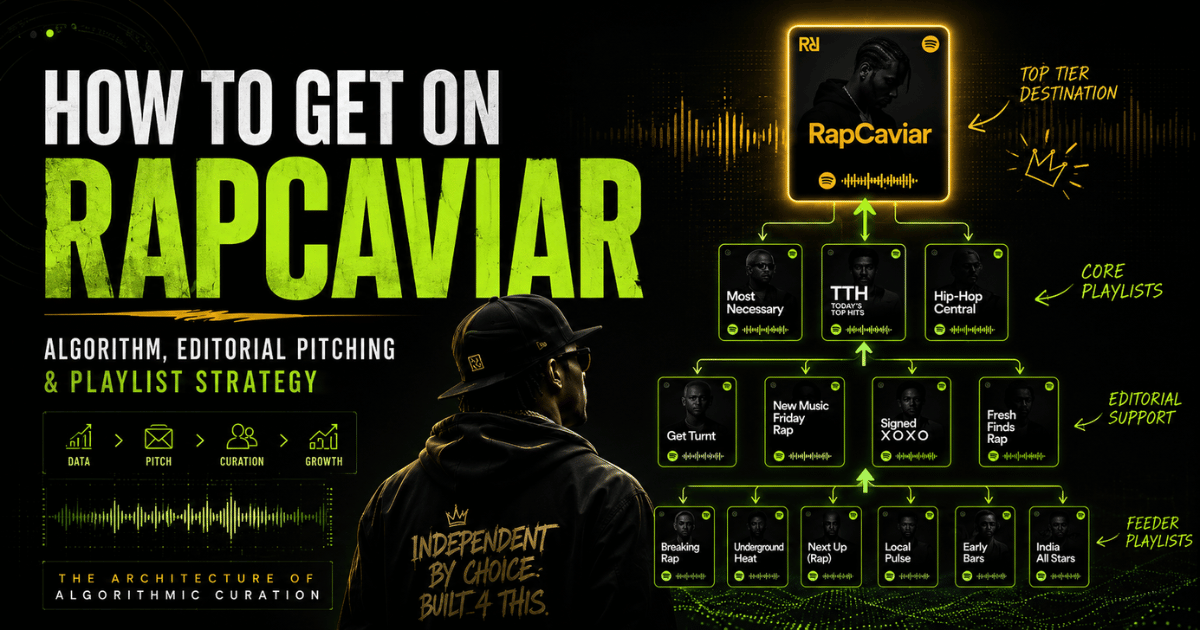
Before an artist can execute specific promotional strategies, it is absolutely critical to understand the underlying architecture and taxonomy of Spotify’s playlist ecosystem. Playlists on the platform are not isolated entities; they exist within a strictly defined, interdependent hierarchical structure. Smaller playlists act as “feeder” systems, where tracks that generate superior engagement metrics graduate from niche placements to larger, macro-level cultural aggregators.
Spotify’s playlist categorization is fundamentally divided into three primary functional typologies, each serving a distinct purpose in the user journey and the artist discovery process, as described in Spotify for Artists’ playlisting guidance:
- Algorithmic Playlists: These are fully automated lists personalized for individual listeners based on real-time machine-learning data analysis of their past listening behavior. Prominent examples include Discover Weekly, Release Radar, and Daily Mixes. These lists are pure reflections of listener data.
- Personalized Editorial Playlists: A hybrid distribution model curated initially by human editorial teams to establish a pool of culturally relevant tracks, but subsequently algorithmically sorted and served in an order specifically tailored to the individual user’s acoustic profile.
- Editorial Playlists: These are the apex properties on the platform. Hand-curated by Spotify’s internal team of over 100 global music experts, these playlists are dictated by emerging cultural trends, demographic streaming data, and executive editorial vision, according to Music Business Worldwide’s reporting on Spotify playlist editors.
The pathway to RapCaviar is almost always non-linear. Compositions rarely jump directly from an independent artist’s profile to an editorial playlist with 15 million followers. Instead, Spotify’s editorial team and their internal data scientists actively monitor the algorithmic performance of tracks within mid-tier “feeder” playlists. According to internal financial documents cited by Music Business Worldwide, curated playlists account for approximately 15% of the platform’s total monthly content consumption hours, making the migration between these lists a massive driver of revenue and visibility.
The most vital feeder playlist in the entire hip-hop ecosystem is Most Necessary. This playlist boasts between 2.5 million and 5 million followers and is editorially positioned by Spotify as the “official voice of generation next”, according to Ditto Music’s guide to getting on RapCaviar and Spotify’s biggest playlists. Tracks that generate significant, sustained engagement metrics on Most Necessary are routinely flagged by the algorithm and manually promoted by editors like Carl Chery to RapCaviar, according to the same Ditto Music analysis of RapCaviar feeder playlists. Beyond Most Necessary, the platform maintains a highly segmented array of specialized mid-tier stepping stones.
Primary Macro, Mid-Tier, and Regional Feeder Playlists
To map this ecosystem, the following list details the primary macro, mid-tier, and regional feeder playlists that dictate the flow of hip-hop streaming traffic toward RapCaviar:
- RapCaviar: Approximately 14M–15.8M followers. Premier mainstream hip-hop, contemporary trap, melodic rap, and drill. Apex destination; global cultural kingmaker, according to Music Gateway’s RapCaviar guide.
- Get Turnt: Approximately 5.9M–6M followers. High-energy, party-centric, and heavy bass club trap music. Macro-tier feeder; critical for aggressive Southern hip-hop, according to Playlist Push’s guide to getting on RapCaviar.
- Most Necessary: Approximately 2.5M–5M followers. Emerging independent artists, underground rap, and rapid-growth trends. The primary, direct feeder path and testing ground for RapCaviar graduation, according to Ditto Music’s breakdown of Spotify’s biggest playlists.
- Feelin’ Myself: Approximately 4M followers. Confident, flex-oriented hip-hop emphasizing lyrical braggadocio. Mid-tier niche feeder; heavily favors established aesthetic trends, according to Chartlex’s Spotify promotion guide for hip-hop and rap artists.
- Modus: Approximately 3M followers. Introspective, moody, and highly emotional hip-hop/R&B fusions. Mid-tier niche feeder; critical for alternative and lyrical artists, according to Chartlex’s hip-hop playlist promotion analysis.
- Rap Workout: Approximately 3M followers. High-BPM, aggressive rap specifically curated for gym environments. Algorithmic contextual feeder driven by specific user activity, according to Chartlex’s guide to Spotify promotion for rap artists.
- SignedXOXO: Follower count not available. Pop-rap, melodic crossovers, and mainstream commercial fusions. Emerging crossover feeder for tracks with high commercial radio viability, according to Playlist Push’s RapCaviar strategy article.
- Who We Be: Approximately 2M followers. UK rap, grime, Afrobeat crossovers, and European urban music. The definitive regional feeder for artists operating in the UK and European ecosystems, according to Spotify Newsroom’s Hip-Hop Turns 50 project.
- Plus Ultra: Follower count not available. Italian urban music, local hip-hop, and Mediterranean trap scenes. Primary regional feeder for the rapidly expanding Italian hip-hop market, according to Spotify Newsroom’s global hip-hop coverage.
- Rap 91: Follower count not available. Indian hip-hop, localized subcontinent rap, and Desi hip-hop fusions. Primary regional feeder for the massive emerging Indian streaming market, according to Spotify Newsroom’s Hip-Hop Turns 50 coverage.
- KrOWN: Follower count not available. K-hip hop, South Korean rap, and East Asian urban fusions. Primary regional feeder for the highly engaged Asian demographic, according to Spotify Newsroom’s global hip-hop editorial coverage.
Understanding this rigorous, data-driven hierarchy underscores the fundamental reality of the platform: independent artists must trigger micro-level machine learning algorithms to capture macro-level human editorial attention. Placement on RapCaviar is not an isolated event, but rather the culmination of a song’s successful journey through this labyrinth of feeder playlists.
Strategic Methodology 1: Exploiting Micro-Genres and Acoustic Niche Isolation
The first and arguably most critical strategic pillar for achieving RapCaviar placement is the deliberate targeting and isolation of micro-genres. Spotify’s internal acoustic classification system, mapped extensively on analytical platforms like everynoise.com, recognizes over 100 distinct sub-genres strictly within the broader hip-hop category, according to Playlist Push’s RapCaviar playlist strategy guide.
A common, often fatal error committed by independent and emerging rappers is sonic inconsistency, according to Playlist Push’s analysis of playlist strategy. Driven by a desire to showcase versatility, an artist might release a highly melodic, emotionally introspective track heavily inspired by Drake, only to follow it immediately with an aggressive, scream-heavy, high-BPM track mirroring the polarizing aesthetic of Tekashi 6ix9ine. This acoustic whiplash severely confuses Spotify’s back-end classification algorithms, according to Playlist Push’s guide to RapCaviar and Spotify playlist placement. When a machine-learning model cannot confidently categorize an artist’s acoustic signature, it fails to segment the artist into a specific behavioral data cluster, thereby preventing the music from being served to highly targeted, niche audiences.
By strictly defining their sonic architecture and honing in on a highly specific “rap niche,” artists drastically increase their mathematical probability of landing on smaller, official micro-genre lists, according to Ditto Music’s Spotify playlist strategy guidance. Securing a foundational position on these smaller, highly specialized playlists increases the chances of graduating to a macro list like RapCaviar by an estimated tenfold, according to the same Ditto Music RapCaviar guide. The fragmentation of contemporary hip-hop allows for this hyper-specific targeting. As noted by Carl Chery during discussions surrounding the 50th anniversary of hip-hop, the genre has simultaneously become hyper-regional and region-less, according to Spotify Newsroom’s reporting on hip-hop at 50. Sonic styles like trap are no longer exclusively confined to the geographic borders of Atlanta, just as drill music has transcended its origins in Chicago and London to become a truly globalized sound, according to the same Spotify Newsroom reflection on hip-hop’s global growth. Therefore, artists must meticulously align their metadata, lyrical themes, and acoustic profiles with established algorithmic micro-cultures.
The Conscious Hip-Hop Ecosystem
For artists focusing on complex lyrical dexterity, dense political themes, and traditional boom-bap or neo-soul production, the “Conscious Hip Hop” scene offers a highly defined and loyal algorithmic lane. This particular subgenre is intrinsically linked by the algorithm to neighboring historical and regional tags such as Political Hip Hop, East Coast Hip Hop, Golden Age Hip Hop, Hardcore Hip Hop, New Jersey Rap, and Alternative Hip Hop, according to Ditto Music’s guide to rap playlist positioning.
To successfully penetrate this specific algorithmic cluster, an independent artist’s listener data must mathematically overlap with established foundational acts, according to Ditto Music’s RapCaviar strategy article. The Spotify recommendation engines actively search for listener associations with classic, genre-defining tracks and artists. A user who regularly streams Mos Def’s “Ms. Fat Booty,” Talib Kweli’s “Get By,” KRS-One’s “Sound of da Police,” Common’s “GO!,” or Public Enemy’s “Harder Than You Think” forms the core demographic for this niche. Modern artists seeking to operate within this lane must therefore build algorithmic proximity to contemporary standard-bearers of the conscious sound, such as Kendrick Lamar, Vince Staples, Aesop Rock, JID, Ab-Soul, and Brother Ali. By ensuring their production style and lyrical content resonate with the fans of these artists, an independent rapper trains the algorithm to place their tracks alongside these heavyweights in automated mixes.
The UK Hip Hop and Drill Ecosystem
Conversely, the UK Hip Hop scene operates on a vastly different acoustic architecture, heavily influenced by the syncopated rhythms of Grime, the melodic structures of Afroswing, and highly localized regional variants such as Birmingham Hip Hop and London Rap, according to Ditto Music’s breakdown of RapCaviar playlist pathways. Artists attempting to bridge the gap into the UK feeder playlists—most notably the Who We Be playlist—must strictly align with the specific 140-BPM tempo, localized slang, and unique rhythmic cadences associated with this geographic cluster.
The algorithmic network for the UK scene relies exceptionally heavily on collaborative data and cross-pollination between artists. Key nodes within this specific machine-learning network include artists such as Hardy Caprio, One Acen, WSTRN, Sneakbo, MIST, Fredo, MoStack, AJ Tracey, Not3s, Mabel, Krept & Konan, DigDat, Ambush Buzzworl, and T MULLA, according to Ditto Music’s Spotify playlist guidance. An artist operating in this lane must trigger associations with these specific algorithmic entities to demonstrate both regional authenticity and stylistic relevance to the curation algorithms. A track that sounds like it belongs in Atlanta will be immediately rejected by the algorithmic models governing the UK Drill ecosystem.
The Pop Rap and Commercial Crossover Ecosystem
The “Pop Rap” subgenre represents a highly lucrative, heavily streamed pathway that serves as a direct pipeline to crossover playlists like SignedXOXO, and eventually, mainstream global pop rotations, according to Ditto Music’s analysis of Spotify’s rap playlist ecosystem. This category is algorithmically intertwined with high-commercial-viability genres such as Dance Pop, Hip Pop, Southern Hip Hop, ATL Hip Hop, and Dirty South Rap.
Succeeding in this niche requires high-fidelity, polished production, infectious melodic hooks, and a crossover aesthetic. The foundational acoustic blueprint for this algorithm is mapped by historical crossover hits, including B.o.B and Bruno Mars’s “Nothin’ on You,” T-Pain’s “Buy U a Drank,” Wiz Khalifa’s “See You Again,” and Flo Rida’s “Wild Ones”, according to Ditto Music’s RapCaviar positioning guide. Contemporary artists must align their sound with modern trap-pop fusions such as Fetty Wap’s “Trap Queen,” Tyga’s “Taste,” DJ Khaled’s “Wild Thoughts,” and the melodic sensibilities of artists like Drake and 6LACK.
By isolating one of these specific acoustic lanes—be it conscious boom-bap, aggressive UK drill, or melodic pop-rap—artists ensure their metadata feeds cleanly and without contradiction into the Spotify recommendation engine. This disciplined approach to sonic branding primes the artist’s profile for targeted independent playlists, which ultimately serve as the algorithmic foundation for editorial visibility on RapCaviar.
Strategic Methodology 2: Precision in Profile Optimization and the Algorithmic Pitch
Once a highly specific sonic niche has been established, the artist must formalize their digital presence through rigorous platform optimization and aggressively utilize the proprietary Spotify for Artists direct pitching mechanism, according to Ditto Music’s RapCaviar and Spotify playlist guidance.
The Pre-Release Editorial Pitching Timeline
In a move designed to theoretically democratize the playlist consideration process, Spotify introduced a beta feature that allows any artist, label, or management team to pitch unreleased music directly to their global team of over 100 editors, according to Music Business Worldwide’s reporting on Spotify’s playlist pitching queue. This tool, accessible via the Spotify for Artists platform for independent creators and Spotify Analytics for major labels, completely altered the mechanics of music promotion.
However, to leverage this tool effectively, timing and extreme data precision are paramount. While Spotify’s internal guidelines state that the absolute minimum requirement to trigger automated inclusion in followers’ Release Radar playlists is a 7-day advance submission, industry standard best practices dictate a much more aggressive timeline, according to this realistic guide to Spotify editorial playlist pitching. To maximize the mathematical odds of editorial review, tracks must be pitched 3 to 4 weeks prior to the official release date, according to the same Spotify editorial pitching guide for indie artists. The global editorial ecosystem operates on highly synchronized, localized schedules, predominantly culminating in major curation decisions made on Fridays, according to this SubmitHub guide to Spotify editorial pitching. Submitting a pitch merely seven days prior fails to afford human curators the requisite bandwidth to properly evaluate the composition amidst the daily influx of 20,000 new tracks, according to Music Business Worldwide’s reporting on Spotify upload volume. Once a track is officially live on the platform, the window for editorial pitching permanently closes; editors strictly review unreleased material for premier placements, according to Spotify’s official support guidance on pitching music to playlist editors. Furthermore, artists are restricted to pitching only one unreleased track at a time, strictly forbidding the submission of EP compilations or tracks where they are merely credited as a featured guest rather than the primary artist, according to Spotify’s official playlist pitching support page.
Drafting the Algorithmic Pitch Architecture
The written pitch submitted through the Spotify for Artists portal is not merely a venue for creative biographical writing; it is a highly structured data entry mechanism designed to feed the internal search queries of Spotify editors, according to Ditto Music’s guide to getting on RapCaviar. The platform requires artists to select specific metadata options accurately reflecting the style, genre, vibe, and cultural background of the track.
A common, critical error made by emerging artists is submitting broad, emotional pleas or utilizing scattershot genre tagging in an attempt to cast a wide net, such as submitting a pitch that reads, “This is my track and I deserve an audience.” Spotify editors actively advise against this; fewer, highly precise tags are significantly more effective at routing the song to the correct regional or genre-specific editorial desk, according to Spotify for Artists’ guidance on sharing new music for playlist consideration.
A highly optimized pitch must be remarkably concise—typically restricted to three to five lines of text—and structured explicitly around algorithmic search tags, according to this Spotify editorial playlist pitching guide. The optimal pitch architecture must include:
- Mood and Tempo: Defining the specific emotional state and BPM, such as high-energy, introspective, chill, or aggressive, rather than just the macro-genre, according to Spotify for Artists’ playlist consideration guidance.
- Activity and Context: Contextualizing the intended listening experience for the user, such as driving, gym, late-night focus, or party, according to this Spotify editorial pitch guide discussed by artists.
- Acoustic Equivalents: Identifying two to three highly comparable, established artists to instantly ground the editor’s acoustic expectations and provide a frame of reference, according to this indie artist guide to Spotify editorial pitching.
- Instrumentation and Cultural Localization: Specifying the primary instruments used, noting whether the track is a remix or cover, and explicitly detailing the cultural or regional background of the track, such as Atlanta trap scene, Colombian street rap, or London grime. This localization is critical, as curators actively search for tracks created by artists from specific corners of the world to feed regional playlists, according to Spotify Newsroom’s reporting on hip-hop’s global and regional growth.
- Proof of Traction: Highlighting verifiable external momentum, such as social media virality, press quotes, TikTok trends, or pre-save data volume, according to this realistic Spotify editorial pitching guide.
Visual Branding and Digital Asset Optimization
Algorithmic optimization extends far beyond audio metadata and text; it requires a cohesive, high-fidelity visual brand across the entire internet, according to Ditto Music’s guide to RapCaviar and Spotify playlist placement. Spotify’s editors consider the overall professionalism, aesthetic cohesion, and market readiness of an artist’s profile when deciding whether to invest valuable RapCaviar real estate in their career.
This professionalization begins with securing profile verification—the coveted blue checkmark—which serves as a critical badge of authenticity and legitimizes the artist to both fans and Spotify’s internal curators, according to Ditto Music’s Spotify playlist guidance. For artists utilizing distributors like Ditto Music, this verification can be acquired instantly by connecting their distribution dashboard to Spotify for Artists. Furthermore, the artist must utilize the 1500-character allowance in their Spotify bio to tell a compelling narrative story, actively avoiding the generic, automated bios pulled from databases like AllMusic or Rovi, according to LALAL.AI’s guide to getting on Spotify RapCaviar.
Crucially, artists must optimize their imagery across the entire digital ecosystem, as off-platform branding heavily influences on-platform editorial perception, according to LALAL.AI’s RapCaviar playlist guide. Editors look for crisp, high-resolution background photos, impactful track artwork devoid of excessive text clutter, and moving Spotify Canvas assets, according to Ditto Music’s guidance on Spotify playlist readiness. To maintain this strict professionalism, artists must adhere to the dimensional architecture required for a modern digital music release campaign across all touchpoints.
Recommended Digital Asset Specifications
- Instagram Square Post / Grid Thumbnail: 1080 x 1080 pixels, 1:1 aspect ratio. The primary visual standard for release announcements, according to Ditto Music’s playlist promotion guidance.
- Instagram Portrait Post: 1080 x 1350 pixels, 4:5 aspect ratio. Statistically yields higher engagement rates on feeds, according to Ditto Music’s RapCaviar guide.
- Instagram / Snapchat Stories / Vertical Video: 1080 x 1920 pixels, 9:16 aspect ratio. Maximum 15 seconds for Instagram and 10 seconds for Snapchat; minimum width 600px. Buffer zones required to avoid UI overlap, according to Ditto Music’s Spotify playlist strategy article.
- TikTok Standard Short-Form Video: 1080 x 1920 pixels, 16:9 aspect ratio. Optimal length around 15 seconds; maximum file size 287.6MB on iOS, according to Ditto Music’s guidance for playlist-ready release assets.
- Twitter (X) Profile Banner / Header: 1500 x 500 pixels, 3:1 aspect ratio. Maximum file size 5MB; significant cropping variables apply across mobile versus desktop, according to Ditto Music’s release asset recommendations.
- Twitter (X) In-stream Image Post: 1600 x 1900 pixels. Scales to a 1200 x 675 preview; maximum file size 5MB, according to Ditto Music’s RapCaviar promotion guide.
- Facebook Page Cover Image: 851 x 315 pixels, 2.63:1 aspect ratio. Desktop standard; automatically scales to 640 x 360 on mobile devices, according to Ditto Music’s playlist promotion guidance.
- YouTube Channel Cover Art: 2560 x 1440 pixels, 16:9 aspect ratio. Critical safe area for text and logos: 1546 x 423 to prevent mobile cropping, according to Ditto Music’s digital asset guidance.
- YouTube Video Thumbnail: 1280 x 720 pixels, 16:9 aspect ratio. Minimum width 640px; arguably the most important asset for click-through rates, according to Ditto Music’s Spotify promotion guidance.
- Spotify Track Artwork / Canvas: 300 x 300 pixels minimum for artwork, with vertical format for Canvas. Must be crisp, impactful, and fundamentally devoid of excessive text clutter, according to this Spotify editorial playlist pitching guide.
Maintaining strict adherence to these visual standards signals to Spotify’s editorial team that the artist possesses the necessary commercial infrastructure, aesthetic awareness, and marketing competence to support a macro-level placement on a playlist as culturally significant as RapCaviar.
Strategic Methodology 3: Triggering the Machine Learning Recommender System via Listener Data
The third methodology shifts the focus away from qualitative editorial pitching and toward quantitative algorithmic manipulation. Spotify’s recommender systems—the engines that power Discover Weekly and dictate which songs are promoted up the playlist hierarchy—are essentially massive machine-learning models trained entirely on user behavior, according to this discussion of getting on RapCaviar and Spotify playlists. Editors rely heavily on these algorithms to filter the daily noise of 20,000 track uploads and highlight compositions demonstrating organic, grass-roots momentum, according to Ditto Music’s Spotify playlist strategy guide.
The Mathematics of Playlist Selection and Key Performance Indicators
To trigger the algorithm and successfully flag a song for RapCaviar consideration, artists must optimize specific key performance indicators within the critical first 72 hours of a release, according to this Spotify editorial playlist pitching guide. Spotify data scientists and editorial curators monitor these early listener metrics obsessively to determine if a track deserves an extended stay on a playlist, or if it warrants promotion to a higher tier, according to the same indie artist guide to Spotify editorial playlists.
The primary engagement metrics scrutinized by the system include:
- Saves-to-Listeners Ratio: The algorithm calculates the percentage of unique listeners who actively save the track to their personal library. A high save rate is the single strongest indicator of long-term listener retention and heavily influences the track’s automated inclusion in algorithmic Radio surfaces, according to this Spotify editorial playlist pitching guide.
- Skip Rate Velocity: The machine learning model actively monitors listener abandonment, paying particular attention to the crucial first 30 seconds of playback. A low early skip rate is a critical signal to both algorithms and human editors that the track possesses high initial quality and is relevant to the listener’s specific contextual mood, according to Songlifty’s Spotify editorial playlist guide.
- Completion Rate: This metric measures the volume of listeners who stream the track from the first second to the absolute finish, rather than abandoning it mid-way. High completion rates signal deep engagement, according to this guide to landing Spotify editorial playlists.
- Follow Conversion: The rate at which a single stream of a track converts a passive listener into a long-term profile follower. Follows are mathematically critical because they directly prime automated algorithmic surfaces, ensuring the artist’s future releases automatically populate the Release Radar playlists of those newly acquired users, according to Songlifty’s Spotify editorial playlist guide.
The Role of Independent Curators and Data Seeding
Because a new or emerging independent artist inherently lacks the initial massive audience required to generate these metrics organically, they must artificially stimulate the algorithm by securing placements on independent, user-curated playlists, according to Ditto Music’s RapCaviar playlist strategy guide. These independent playlists act as the foundational engine that feeds positive streaming data back into the central Spotify algorithm.
To execute this, artists must systematically hunt down the contact information of independent curators whose playlists perfectly match their exact micro-genre, according to Ditto Music’s guidance on Spotify playlist outreach. Utilizing sophisticated digital platforms like Playlist Push, SoundCampaign, or PlaylistSupply allows artists to scale this outreach efficiently.
For example, platforms like Playlist Push employ an AI-driven genre-matching system to deliver unreleased tracks to rigorously vetted, real-human curators, according to Playlist Push’s guide to getting on RapCaviar. By running a pre-release campaign, which typically requires a minimum budget of approximately $280 to ensure the track reaches a critical mass of curators, artists can secure playlist commitments ahead of time. Every curator in this specific network is vetted to ensure their followers and streams are organic, with over 99% of curator applications rejected to prevent bot-driven data corruption, according to Playlist Push’s description of its curator vetting process.
When the artist’s track finally goes live on Spotify, it is immediately injected into dozens of targeted independent lists. This generates a highly concentrated surge of saves, low-skip plays, and track completions within the vital 72-hour launch window, according to Playlist Push’s RapCaviar strategy guide. Furthermore, artists are protected by an “Artist Protection Program,” ensuring that if a curator fails to provide a qualitative review, the submission cost is refunded. This synchronized, purchased influx of positive organic data forces the Spotify algorithm to recognize the track, frequently resulting in secondary, automated placements on algorithmic lists like Discover Weekly, according to Ditto Music’s playlist promotion guide. This algorithmic heat acts as a digital flare, signaling the human editorial team managing RapCaviar that a track is mathematically over-performing its current placement, as the role of recommender systems is discussed in this RapCaviar playlist strategy video.
Strategic Methodology 4: The Aggressive Release Cadence and Supply Chain Leverage
A pervasive and economically damaging misconception among independent hip-hop artists is the reliance on the “single hit” theory—the outdated belief that a single, perfectly crafted track is sufficient to break into the mainstream and secure editorial placement, according to Playlist Push’s guide to RapCaviar strategy. In the modern streaming era, playlist placement is undeniably a volume-based numbers game, according to Ditto Music’s Spotify playlist guidance.
To maintain continuous algorithmic visibility and secure editorial attention, artists must establish and meticulously execute a highly aggressive, yet quality-controlled, release schedule, according to Ditto Music’s RapCaviar placement guide. The Spotify algorithm inherently favors consistency; every new release presents a fresh mathematical opportunity to trigger Release Radar, re-engage current followers, and generate the data spikes required to alert editorial curators, according to Playlist Push’s RapCaviar strategy analysis. Having a deep catalog of releases proves to Spotify’s editorial team that the artist is a reliable, consistent supplier of high-quality content, rather than a transient viral anomaly, according to MusicPromoToday’s guide to getting music on RapCaviar.
The Six-Week Algorithmic Release Framework
Executing this aggressive schedule requires meticulous logistical planning and supply chain management. Industry standards suggest that independent artists should operate on a rolling, highly structured six-week lifecycle for every single or EP release, according to this guide to Spotify editorial playlist pitching for indie artists.
The following timeline outlines the required schedule to maximize both algorithmic triggering and editorial visibility:
- Weeks -6 to -4: Preparation. Lock all audio metadata and ISRC codes. Generate high-resolution cover art, minimizing text clutter. Finalize the distribution schedule with the aggregator. Draft the concise, data-driven editorial pitch story, according to Songlifty’s Spotify editorial playlist guide.
- Week -4: The Pitch. Execute the Spotify for Artists pitch. Submit the single unreleased track, strictly adhering to highly specific genre, mood, instrumentation, and cultural localization tags, according to Songlifty’s Spotify pitching guidance.
- Week -3: Early Networking. Distribute private, secure streaming links, such as via SoundCloud, to niche press outlets, blogs, and targeted independent user-curators. Aggregate early quotes and feedback. Launch pre-save marketing campaigns and smart links, according to this Spotify editorial playlist guide.
- Week -2: Visual Priming. Deploy visual teasers across TikTok, Instagram Reels, and YouTube Shorts. Secure at least one blog premiere. Finalize short-form video content commitments from digital creators to prepare for viral trends, according to Songlifty’s Spotify release planning guidance.
- Week -1: Audience Activation. Prime the core audience. Execute targeted email and SMS fan marketing to ensure a massive Day-1 response for Release Radar optimization. Finalize the looping Spotify Canvas video asset, according to Songlifty’s editorial playlist pitching framework.
- Release Week: The 72-Hour Sprint. Push all external traffic aggressively toward Spotify to drive immediate saves, track completions, and profile follows. Update the profile’s “Artist Pick” to highlight the new release, according to Songlifty’s Spotify editorial playlist guide.
- Weeks +1 to +4: Momentum Maintenance. Sustain the algorithmic momentum by rolling out secondary content drops, such as acoustic renditions, official remixes, or live performance sessions, designed to re-trigger algorithms, according to Songlifty’s Spotify playlist pitching guidance.
By continuously overlapping these strict six-week cycles, an artist ensures that they are a persistent, inescapable presence in the algorithm, according to Songlifty’s Spotify editorial playlist guide. If a track successfully lands on an editorial list, its average lifespan on that playlist is approximately 28 days, though high performers can remain longer or be re-contextualized into new lists, according to the same Spotify playlist lifecycle guidance. An aggressive, overlapping release schedule ensures that as one track cycles out of editorial rotation, another is already primed, pitched, and generating data to take its place.
Leveraging Well-Connected Distribution Networks
To sustain this volume, independent artists must view their digital distributor not merely as a passive delivery pipe, but as a strategic industry partner, according to Ditto Music’s guide to Spotify playlist strategy. Well-connected distribution networks such as Ditto Music, CD Baby, The Orchard, EmuBands, DistroKid, and FUGA maintain direct lines of communication with digital service providers and often operate their own internal promotional teams, according to Playlist Push’s RapCaviar strategy guide.
For example, Ditto Music maintains a robust portfolio of in-house Spotify playlists designed specifically to break emerging artists within their ecosystem before pitching them to Spotify proper, according to Ditto Music’s own RapCaviar guide. These include macro-level multi-genre lists like Chartbreaker Playlist, with 40.5K followers, and Ditto Discovered, with 6.2K followers, as well as highly specific regional and genre-focused lists such as Patterned, with 42.8K followers and a focus on UK Rap, Drill, and Afrobeats; HEADPHONES, with 52.4K followers and a focus on independent R&B and Hip-Hop; and African Glow, with 41.9K followers and a focus on Afrobeats. Securing placement on a distributor’s proprietary playlist generates the verified streaming data necessary to legitimize an artist when that distributor ultimately advocates on their behalf to Spotify’s editorial board for RapCaviar inclusion.
Strategic Methodology 5: Collaborative Synergy, the Crossover Effect, and Off-Platform Advocacy
The final strategic methodology involves leveraging established industry networks, mathematically exploiting the “crossover effect,” and acting as an aggressive off-platform advocate for the Spotify brand.
The Crossover Effect and Feature Acquisitions
Collaboration is a historically proven mechanism for audience expansion, but in the algorithmic streaming era, it serves a highly specific, mathematically measurable technical purpose. Spotify’s internal data scientists refer to this phenomenon as the “Crossover Effect”, according to Music Tomorrow’s analysis of artist collaborations on Spotify recommender algorithms. According to a proprietary algorithmic analysis report released by Spotify and analyzed by Music Tomorrow, blending musical styles and fusing diverse fan bases through artistic collaboration can yield up to a 50% immediate uplift in listenership, search volumes, and overall engagement metrics, as discussed in Music Tomorrow’s case study on the crossover effect.
For an independent rapper seeking RapCaviar placement, purchasing or negotiating a feature from an artist who has already graduated to RapCaviar is one of the fastest, most effective ways to manipulate the algorithm, according to Playlist Push’s RapCaviar strategy guide. Collaborating with RapCaviar alumni—such as Mustard, Rich The Kid, Calboy, Lil Tjay, Gucci Mane, or Quavo—instantly links the independent artist’s profile to the massive, pre-existing data clusters associated with those superstars. When the collaborative track drops, it automatically triggers the Release Radar algorithms of the established artist’s millions of followers, guaranteeing massive day-one stream velocity and immediate editorial attention. Even if a feature verse from a mainstream act is financially out of reach for an independent artist, networking with these artists can provide invaluable intelligence regarding preferred distributors, label connections, and marketing agency recommendations.
Off-Platform Advocacy and “Team Spotify” Visibility
Finally, an artist must actively demonstrate their commercial value to Spotify as a corporate entity. Spotify’s marketing and editorial teams actively monitor social media platforms for brand advocacy, according to Playlist Push’s guide to getting on RapCaviar. Artists who consistently shout out Spotify on platforms like Twitter (X) and Instagram, utilizing unique, diverse, and engaging commentary, regularly catch the attention of the platform’s marketing staff. In several instances, consistent social media advocacy has led to independent artists being directly invited to visit Spotify’s corporate headquarters in New York City, according to the same Playlist Push RapCaviar guide.
This “Team Spotify” marketing approach includes always embedding direct Spotify links in digital calls-to-action across websites, YouTube descriptions, and email newsletters, deliberately driving external internet traffic directly into the Spotify application, according to Ditto Music’s Spotify playlist strategy guide. Furthermore, whenever an artist is added to any playlist—regardless of whether it is a massive editorial list or a minor user-generated independent list with fifty followers—they must share it on their social channels, explicitly tagging both the platform and the specific curator. This behavior mathematically proves to Spotify that the artist is actively working to bring off-platform attention, such as viral TikTok traffic, back into the Spotify ecosystem, creating a symbiotic economic relationship that Spotify is eager to reward with premium playlist placement.
Additionally, artists can bypass the algorithmic wall by engaging in direct human networking. RapCaviar is managed by Spotify’s Shows & Editorial team, consisting of specific music experts and genre specialists, according to Ditto Music’s guide to getting on Spotify’s biggest playlists. By utilizing professional networking platforms like LinkedIn to identify and politely connect with these specific editorial team members, artists can generate genuine, professional awareness about their music without resorting to spam tactics.
Empirical Evidence: Case Studies in Algorithmic Graduation
The efficacy of these five strategic pillars is continuously validated by the rapid ascension of artists who successfully navigate the pipeline from digital obscurity to RapCaviar dominance.
A premier empirical example of this methodology is the rise of Lil Tecca. His breakout record, “Ranom” generated intense, highly focused listener data, according to this DJBooth interview with Lil Tecca. This data triggered the algorithms, eventually landing Tecca on the actual cover of RapCaviar and pushing the track to peak at No. 8 on the Billboard Hot 100, according to the same DJBooth feature on Lil Tecca. The RapCaviar placement transformed Tecca into a global entity, allowing him to generate 1.4 million Instagram followers and nearly twice the monthly streams of established heritage acts like Frank Ocean, as reported by DJBooth’s Lil Tecca interview.
Similarly, the strategic networking and precision pitching model was utilized to break the artist 6LACK. His management team executed a direct, targeted pitch to leading hip-hop programmers, specifically emailing Carl Chery, who was operating at Apple Music prior to his tenure at Spotify, according to this DJBooth interview with Carl Chery. This direct industry networking resulted in the track “PRBLMS” receiving massive institutional championing across streaming platforms, proving that human connection still supplements the algorithm.
The collaborative “Crossover Effect” is also continually exploited at the absolute highest levels of the playlist ecosystem to maintain dominance. For instance, the highly anticipated collaboration between RapCaviar stalwarts Lil Baby and Future—facilitated conceptually by Young Thug while he was incarcerated—demonstrates how established artists utilize joint mixtape projects to cross-pollinate their massive algorithmic followings, as reported by XXL’s coverage of the Lil Baby and Future mixtape. By merging their listener data, they ensure absolute dominance over the top positions of playlists like RapCaviar, making it even harder for independent artists to break through without employing the exact same collaborative strategies, according to this broader discussion of hip-hop, economics, and cultural power.
Furthermore, RapCaviar serves as a global epistemological operator, actively shaping the worldwide definition of hip-hop and taxonomizing musical culture, as examined in this academic work on genre in post-millennial popular music. As highlighted by Spotify’s global editors reflecting on the 50th anniversary of hip-hop, the genre has expanded vastly beyond American borders, according to Spotify Newsroom’s Hip-Hop Turns 50 coverage. The curation strategies and sonic trends validated by RapCaviar in the United States directly influence localized editorial lists worldwide. Playlists ranging from Plus Ultra in Italy to KrOWN in South Korea, and Colombian hip-hop festivals drawing 150,000 attendees, all operate downstream from the algorithmic precedents set by RapCaviar, according to Spotify Newsroom’s reporting on hip-hop’s global expansion. This proves that the data generated by these five strategies reverberates across the entire global music industry, dictating cultural consumption on a planetary scale.
Strategic Synthesis
Securing a placement on Spotify’s RapCaviar is no longer a matter of sheer artistic luck, nor does it rely solely on the subjective tastes of traditional industry gatekeepers. It is the direct result of a highly calculated, algorithmic, and logistical campaign. Independent artists and their management teams must fundamentally understand that Spotify is, at its core, a data-driven technology company with a passion for music, rather than a traditional record label, as suggested by this case study of Spotify’s business strategy and value compounding.
Success in this environment requires treating the entire release cycle as a rigorous exercise in data generation and behavioral manipulation. By strictly isolating a sonic micro-genre, artists prevent algorithmic confusion and allow their acoustic metadata to route efficiently to targeted independent playlists. Utilizing extreme precision in editorial pitching—executing the pitch up to four weeks in advance with highly specific search tags—ensures human curators have the necessary contextual bandwidth to place a track. Furthermore, maintaining an aggressive, high-volume, six-week release schedule guarantees continuous engagement with the Release Radar ecosystem, while strategic feature collaborations and off-platform brand advocacy drive the critical first-72-hour engagement metrics—low skip rates, high saves, and track completions—that the machine-learning algorithm demands.
Ultimately, graduating from mid-tier feeder playlists like Most Necessary to the 15-million-strong apex of RapCaviar is an intricate numbers game governed by consistency, metadata manipulation, and relentless execution across the entire digital ecosystem. Artists who master this architecture do not merely secure a transient playlist placement; they construct a sustainable, mathematically sound, and highly lucrative independent career in the modern music industry.