
Imagine creating a product that 44,000 people actively consume — only to discover that the economic value flowing back to you is measured in hundreds of dollars.
For independent musicians, that is not a theoretical problem.
It is the central problem of the modern streaming economy.
Using a rough illustrative streaming rate of around $0.004 per stream, more than 44,000 streams would generate only around $176. That is a lot of listening, a lot of discovery and potentially thousands of people interacting with an artist’s work for a comparatively small direct return.
And that exposes the deeper issue.
Streaming became extraordinarily good at distributing music.
It did not necessarily become extraordinarily good at building sustainable independent artist businesses.
That distinction is important, because BTR is not simply trying to create another place where people can press play.
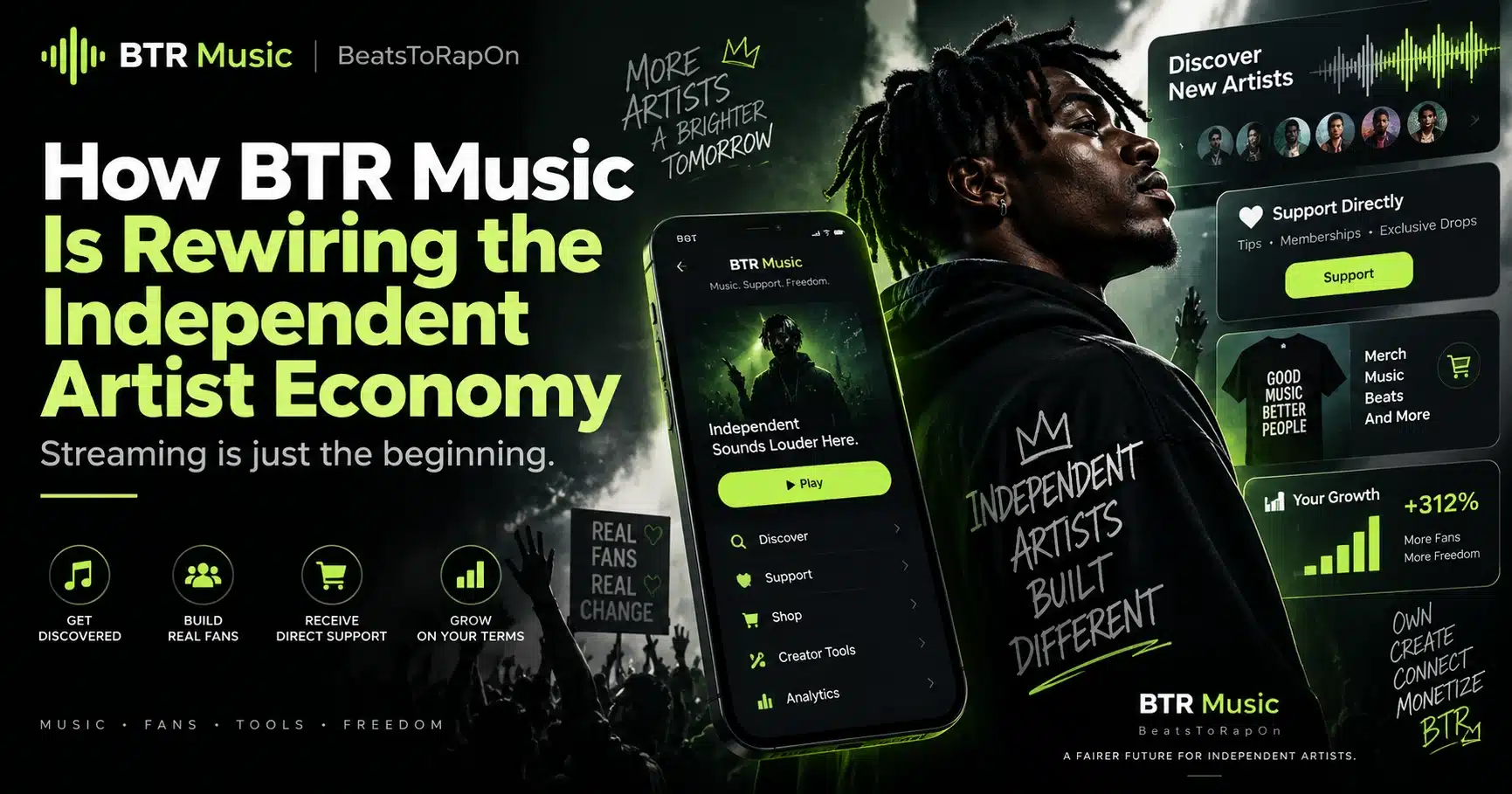
The larger idea behind BTR Music and the artist platform at BeatsToRapOn is to change what happens after somebody presses play.
A stream can be the beginning of the relationship rather than the entire business model.
That changes everything.
The Problem Isn’t Only the Streaming Rate
Most debates about artist economics eventually arrive at the same question:
How much does a stream pay?
It is an important question, but it may also be too narrow.
If an independent artist’s entire business depends on converting every interaction into a fraction-of-a-cent royalty, then even an improvement in the rate leaves the fundamental structure largely unchanged.
The artist still needs enormous scale.
The listener is still largely anonymous.
The relationship is still controlled by an intermediary.
And once the song ends, the artist may have no meaningful way to convert that listener into a customer, supporter, subscriber or long-term member of their community.
BTR approaches the problem differently.
Instead of asking only:
How do we make the stream worth slightly more?
The more interesting question becomes:
How many different kinds of value can exist between an artist and a fan once that first stream happens?
That is the foundation of the BTR model.
Streaming remains part of the ecosystem.
But it becomes the top of the funnel rather than the end of it.
Two Sides of the Same Music Economy
BTR is deliberately split into two connected experiences.
BeatsToRapOn is the artist side.
It is where artists can build and manage their presence, upload music, work on their catalogue, use artist tools, develop their brand, manage audience activity and build the commercial infrastructure around their music.
BTR Music is the listener side.
It is where fans discover artists, play music, follow emerging talent, interact with scenes and support the artists they care about.
That distinction matters.
A lot of music technology has historically built one side extremely well while leaving the other side fragmented.
Artists might create in one service, distribute through another, build landing pages somewhere else, run email through another platform, sell merchandise somewhere else again and then attempt to move listeners between all of them.
Meanwhile, the fan sees only the final audio file.
BTR is trying to collapse that distance.
The creator infrastructure and the fan experience are designed to feed each other.
The artist gets discovered.
The listener becomes interested.
The artist has tools to capture that interest.
The fan can support the artist without leaving the ecosystem.
And that support can go far beyond simply generating another stream.
Solving the “Upload and Vanish” Problem
Every independent artist knows the feeling.
You finish a track.
You upload it.
You publish it.
Then…
Nothing.
The song technically exists online, but existence and discovery are not the same thing.
There are millions of tracks competing for attention, and simply adding another file to a catalogue does not automatically create an audience.
BTR’s approach starts by trying to give new artists an initial opportunity to be heard rather than expecting them to immediately fight their way through an enormous catalogue.
That matters because early momentum has an outsized psychological and commercial impact.
An artist who sees listeners arriving can begin learning.
Which tracks hold attention?
Where are listeners located?
Who is returning?
Who follows?
Who becomes a supporter?
Who shares the track?
The point of an initial discovery window is not simply to manufacture a temporary spike.
A spike by itself is almost worthless.
The important part is what the artist can do with the attention while it exists.
Discovery Is the Spark. Audience Ownership Is the Engine.
There is an uncomfortable truth about building an audience entirely on social media:
You do not fully control access to that audience.
An artist might spend years accumulating followers, only to discover that a change in ranking systems, recommendation algorithms or platform priorities can dramatically alter how many of those followers actually see a post.
The follower count may belong to the artist aesthetically.
The distribution channel does not.
That is why direct audience infrastructure matters.
BTR is designed around the idea that artists should be able to turn discovery into a more durable relationship.
A listener discovers a song.
They visit the artist.
They follow.
They can become part of the artist’s direct audience.
They can support the artist.
They can buy products.
They can become a recurring member.
They can potentially move from anonymous listener to identifiable fan.
That progression is where the economics start to become fundamentally different.
The objective is not simply more impressions.
It is more relationships.
The Artist Is More Than a Catalogue
One of the biggest limitations in conventional streaming is that an artist is frequently represented primarily as a collection of audio files.
Albums.
Singles.
Playlists.
Monthly listeners.
That is useful for consumption, but it leaves a huge amount of artist value outside the product.
An independent musician is also a brand.
A performer.
A community builder.
A personality.
A creator.
A seller.
A storyteller.
A service provider.
A cultural identity.
A local scene participant.
And, increasingly, a small business.
BTR’s artist platform is built around that broader definition.
An artist can begin building that side of their operation at BeatsToRapOn.com.
The objective is to give independent musicians more of the infrastructure traditionally associated with larger teams: discovery, audience building, promotional tools, creative utilities and monetization surfaces.
That is a very different proposition from simply giving an artist another upload button.
Creation Tools Are Part of the Economics Too
Independent artist economics are not only affected by revenue.
They are also affected by cost.
Recording.
Mixing.
Mastering.
Promotion.
Video creation.
Artwork.
Editing.
Marketing.
Distribution.
Every expense increases the amount an artist must earn before a release becomes economically sustainable.
That is why creator tooling matters.
The BTR ecosystem includes AI-assisted tools designed for music workflows — including audio separation and cleanup, creative tools and content-generation utilities.
The strategic value is straightforward:
If an artist can reduce the cost or complexity of producing, preparing and promoting music, they improve the economics before the fan has spent a dollar.
This is another reason BTR is better understood as an artist ecosystem rather than simply a streaming service.
The economic equation is being attacked from both directions:
reduce friction and cost on the creation side; increase monetization opportunities on the fan side.
The Real Shift: From Listeners to Supporters
This is where the model becomes significantly different.
A traditional streaming relationship is usually binary.
Someone listens.
The artist receives whatever economic value the streaming system assigns to that play.
BTR creates multiple possible relationships between the same fan and artist.
A listener can remain a listener.
Or they can become something more.
They can tip.
They can become a Superfan.
They can become an Artist Backer.
They can back an individual track.
They can unlock rewards.
They can buy a personalised video shoutout.
They can collect Vault items.
They can buy merchandise.
They can participate in the artist’s community.
The important concept is not any individual product.
It is the ladder.
Different fans have radically different levels of affinity.
One person might like a song enough to play it twice.
Another might follow the artist.
Another might happily spend $4.99 every month to stay close to their work.
Another might want to be permanently recognised as someone who supported the artist early.
Another might spend substantially more for something personal.
Traditional streaming tends to compress all of those people into one metric:
plays.
BTR attempts to let each level of fandom express itself differently.
Tips: The Simplest Form of Direct Support
Sometimes a fan does not want another subscription.
They just heard something they genuinely liked and want to say:
That was worth something to me.
Tips are the simplest possible bridge between appreciation and money.
A small transaction might appear insignificant when considered individually.
At scale, however, it changes the nature of the relationship.
The artist is no longer waiting for thousands of additional plays to accumulate enough fractional royalties to equal a few dollars.
The fan can make the decision directly.
That sense of agency matters.
Superfans: Recurring Revenue From the People Who Care Most
The next level is recurring support.
A casual listener might appear once.
A true fan comes back.
A Superfan relationship allows an artist to turn some of that deeper affinity into predictable monthly revenue while giving supporters access to content and experiences beyond the public catalogue.
Unreleased material.
Studio moments.
Behind-the-scenes content.
Voice notes.
Early access.
Exclusive updates.
The exact content can vary by artist.
The underlying principle does not.
Recurring revenue can change how an independent creative business works because the artist is no longer starting every month at zero.
And the relationship becomes deeper than a streaming statistic.
Backers: Turning “I Was Here Early” Into Something Real
Music culture has always rewarded discovery.
People love saying:
I knew that artist before everyone else.
That instinct becomes especially powerful in hip-hop, rap, drill, Afrobeats and other scene-driven genres where discovering what is coming next is part of participating in the culture.
BTR’s Backer model turns that social behaviour into something visible.
Artist Backers allow supporters to claim a limited position around an artist.
Track Backers apply the same principle at the individual song level.
The important part is scarcity.
Digital music itself is infinitely reproducible.
A song can be streamed by ten people or ten million people without exhausting the supply.
A numbered supporter position is different.
There can only be so many.
That turns early support into a form of digital cultural real estate.
The fan is not buying ownership of the music.
They are buying a permanent place in the story surrounding it.
For emerging artists, that opens a completely different economic layer around a catalogue.
Why Digital Scarcity Works Differently From Streaming
Streaming maximises availability.
Scarcity maximises distinction.
Those concepts can coexist.
The song remains available for listeners.
But specific experiences, supporter positions or collectible items can remain limited.
That distinction is important because the scarce asset is not necessarily the audio file.
It is the relationship to the artist and the moment.
Being Backer #4 on an emerging track means something different if that track later becomes culturally significant.
The value is social.
Emotional.
Historical.
Community-driven.
It gives fans a reason to participate earlier rather than waiting until everybody else has already discovered the artist.
And it gives artists a way to monetise their rise while it is happening.
Personalised Video: Monetising the Artist, Not Just the Audio
Fans do not only value songs.
They value artists.
That sounds obvious, but conventional streaming products rarely monetise that distinction.
A personalised video shoutout changes the economic unit from:
How many times did somebody play the recording?
to:
How valuable is a personal interaction between this particular artist and this particular fan?
That value can be dramatically higher.
For an artist with a deeply engaged fanbase, personalised content can become a meaningful high-value product without requiring millions of streams.
The artist’s personality, time and relationship with their audience become monetisable assets.
Rewards and The Vault: Creating Layers of Fandom
BTR also introduces individual rewards and collectible digital experiences.
These can give artists another way to monetise the material surrounding the finished song:
early demos, creative fragments, behind-the-scenes material, exclusive content and other pieces of the artistic process.
Then there is The Vault.
The important idea behind a Vault is not simply selling another digital file.
It is progression.
Certain experiences exist because the fan has moved deeper into the artist’s world.
The fan is not treated identically at every level of engagement.
That creates something streaming platforms generally struggle to produce:
a sense of membership.
And membership is economically powerful because people support communities differently from the way they consume utilities.
Merch Should Stay the Artist’s Business
Physical merchandise remains one of the clearest ways artists can turn identity into revenue.
But every additional intermediary can reduce margins.
BTR’s Shopify integration is designed around a straightforward principle: let the artist connect their store and keep the underlying commerce relationship through Shopify rather than forcing merchandise through another closed marketplace.
That means the music profile can become a discovery surface for merchandise while the artist retains control over the store itself.
Again, the pattern is consistent.
BTR does not need every commercial interaction to become a closed BTR transaction.
It needs the artist ecosystem to become more economically useful.
But None of This Works Without Fans
An artist platform can have hundreds of tools and still fail if nobody is listening.
That is why the second side of the system matters just as much.
BTR Music has to give listeners a reason to open it.
Not because they feel sorry for independent artists.
Not because supporting musicians is virtuous.
Because the product itself is entertaining.
That is a much harder — and much more important — problem.
The answer BTR is pursuing is culture.
Music Discovery Should Feel Like Discovery
A lot of modern music discovery is not really discovery.
It is prediction.
An algorithm studies what you have already consumed and gives you something statistically adjacent to it.
That can be convenient.
It can also become incredibly repetitive.
BTR experiments with a more active form of discovery.
Features such as blind music discovery deliberately remove some of the signals people normally use to pre-judge a track.
No famous artist name.
No status cue.
No marketing budget staring back at you.
The listener has to react to the music.
That creates a very different opportunity for an unknown artist.
Instead of competing with an established artist’s reputation before the first second of audio has even played, the track gets a moment to compete on sound.
For independent music, that is significant.
Local Scenes Matter Again
Music rarely emerges from nowhere.
Drill belongs to scenes.
Hip-hop belongs to scenes.
Afrobeats belongs to scenes.
Amapiano belongs to scenes.
Electronic music has always been built around scenes, clubs, cities, DJs and communities.
Yet giant streaming platforms tend to flatten geography.
Millions of tracks are poured into one enormous global database.
BTR’s scene-driven approach tries to bring location and community back into the discovery experience.
What is moving in your city?
What is gaining heat nearby?
Who is emerging before the global playlists notice?
What events are happening around the culture?
That matters because musical movements historically grow through social density.
A few people hear something.
They tell friends.
It appears at events.
It becomes part of local identity.
Then it escapes the scene and travels.
Technology should be capable of accelerating that process without stripping the culture out of it.
Discovery Becomes a Form of Status
There is another important piece of fan psychology here.
People do not only enjoy music.
They enjoy being good at finding music.
Every friend group has someone who insists they discovered an artist first.
Usually, there is no evidence.
BTR turns that behaviour into part of the product.
Early discovery can leave a visible record.
Backing can leave a visible record.
Participation can leave a visible record.
That changes discovery from passive consumption into a game of cultural foresight.
The fan gets status from discovering the artist.
The artist gets attention from the fan.
The fan has an incentive to tell other people.
The artist potentially makes money as that support deepens.
The incentives begin to align.
The Fan and the Artist Can Finally Want the Same Thing
This may be the most important part of the model.
Traditional platforms often have three different incentives operating simultaneously.
The artist wants committed fans.
The listener wants great music.
The platform wants maximum engagement.
Those objectives overlap, but they are not always identical.
A direct-support ecosystem can bring them closer together.
The fan who discovers an emerging artist has a reason to help that artist grow.
Their early support becomes part of their identity.
The artist has a reason to recognise and reward that fan.
The platform benefits when both sides deepen the relationship.
That creates a loop:
Discovery → engagement → support → recognition → stronger fandom → more discovery.
A stream still matters.
It is simply no longer expected to carry the entire economic burden.
Streaming Should Be the Floor, Not the Ceiling
That is ultimately the argument behind BTR.
The future of independent music does not necessarily require abandoning streaming.
It requires putting streaming back in its proper place.
A play is incredibly valuable as a discovery event.
It means somebody gave an artist their attention.
But attention has many possible outcomes.
A follow.
A share.
A fan relationship.
A tip.
A recurring membership.
A Backer position.
A personalised video.
A reward.
A collectible.
A merchandise purchase.
An event attendee.
A person who tells five friends.
When a platform allows those outcomes to exist around the stream, the economics change.
The artist no longer needs every listener to be worth the same tiny fraction.
Some listeners will remain casual.
That is fine.
Others will become fans.
A smaller number will become serious supporters.
And an even smaller number may become extremely valuable long-term members of the artist’s community.
That distribution is how almost every healthy creator business already works.
Music should be no different.
A Different Vision for Independent Music
The biggest idea behind BTR is not any individual feature.
It is the decision to connect them.
Creation tools without discovery are incomplete.
Discovery without audience ownership is temporary.
Audience ownership without monetization leaves artists with attention but no business.
Monetization without community becomes transactional.
Community without great music has no reason to exist.
BTR is attempting to connect all of those pieces.
The artist creates and manages their business through BeatsToRapOn.
The fan discovers and experiences the culture through BTR Music.
The relationship between them can evolve far beyond a single stream.
That is the bet.
Not that streaming disappears.
Not that every listener suddenly becomes a paying Superfan.
And not that every independent artist instantly becomes financially successful.
The bet is simpler:
If artists are given more ways to turn genuine attention into genuine relationships, and more ways to turn those relationships into revenue, they have a better chance of building sustainable careers.
For independent music, that could be a far more important innovation than arguing over another fraction of a cent.
Explore BTR
If you’re a listener who wants to discover independent artists earlier, explore BTR Music.
If you’re an artist who wants to upload music, build your profile, develop your audience and access the wider artist ecosystem, start at BeatsToRapOn.
And if you want BTR Music on your phone, get the BTR Music app here.
The stream is only the beginning.