
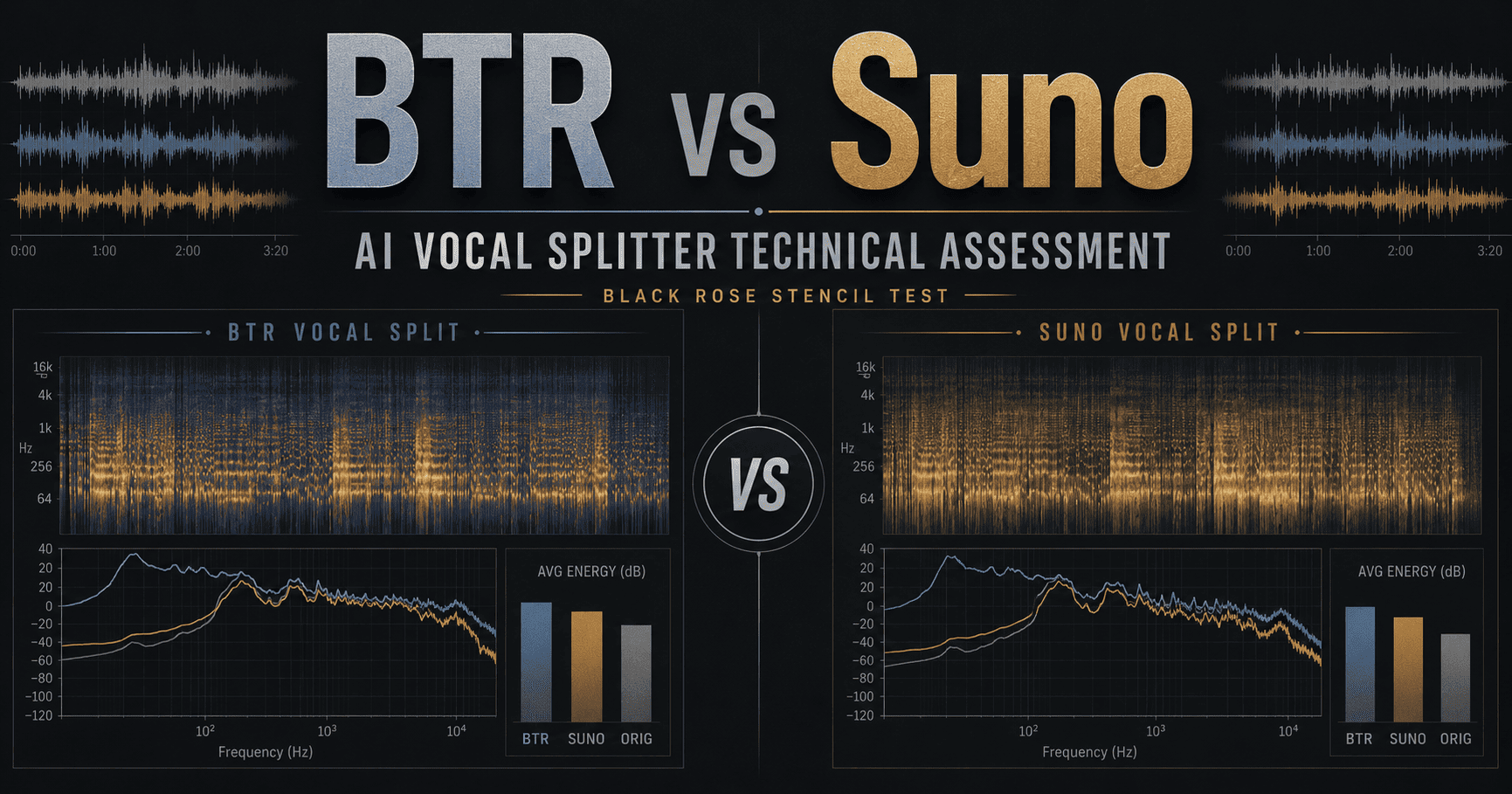
We tested BeatsToRapOn’s AI Vocal Splitter against Suno’s vocal split using waveform analysis, spectrograms, frequency-band data, residual testing and estimated vocal-gap leakage.
The result: BTR retained more usable vocal information across the core vocal bands, while Suno was slightly quieter in low-vocal gaps.
Black Rose Stencil Original Track From Suno
Suno Vocal Split: Black-Rose-Stencil-Vocals-Suno-Split.wav
BTR Vocal Split: Black-Rose-Stencil-Vocals-BTR-Split.wav
Download the full technical data pack
Download the full technical data pack here: waveform panels, spectrograms, mel spectrograms, average frequency-energy graph, residual spectrograms, CSV metrics, estimated vocal-gap leakage JSON and full technical report.
There is a big difference between a vocal stem that sounds clean for ten seconds and a vocal stem an engineer can actually use.
That difference matters.
A clean-looking AI vocal split can be thin. It can suppress background sound well, but also remove breath, consonants, body, upper harmonics, reverb tails and the small performance details that make a vocal feel human. On the other side, a fuller vocal split may carry more useful voice, but it may also need more post-processing.
That is the real engineering trade-off in AI vocal splitting.
So we tested it directly.
For this technical assessment, we compared three files:
| File | Role |
|---|---|
| Black-Rose-Stencil-Original.wav | Original full mix |
| Black-Rose-Stencil-Vocals-Suno-Split.wav | Suno vocal split |
| Black-Rose-Stencil-Vocals-BTR-Split.wav | BeatsToRapOn / BTR vocal split |
The goal was not to write a vague “which one sounds better” review. The goal was to measure what actually matters to artists, producers and engineers:
- Which splitter preserves more usable vocal information?
- Which one leaves less low-end bleed?
- Which one suppresses quiet sections better?
- Which result gives an engineer the stronger source stem?
The result on this track was clear.
BTR produced the more complete vocal extraction. Suno produced slightly quieter low-vocal gaps, but BTR retained more vocal-band information across the body, midrange, presence, sibilance and air bands.
That does not mean every BTR split will beat every Suno split on every song. That would be too broad. This is a track-level technical assessment of Black Rose Stencil using the supplied original mix, Suno vocal split and BTR vocal split.
But on this test, the data points strongly in BTR’s favour.
The Verdict
| Category | Winner | Why |
|---|---|---|
| Vocal fullness | BTR | BTR retained more energy through the vocal body and midrange |
| Vocal body | BTR | Stronger 160 Hz to 350 Hz region |
| Main vocal tone | BTR | Stronger 350 Hz to 1 kHz range |
| Presence and intelligibility | BTR | More 1 kHz to 4 kHz vocal-presence energy |
| Consonants and sibilance | BTR | More 4 kHz to 8 kHz information |
| Air and high-frequency detail | BTR, with caveat | More 8 kHz to 16 kHz information, but this range must be checked for artifact |
| Sub and bass cleanup | BTR | Lower energy in the lowest low-frequency bands |
| Quiet-gap suppression | Suno | Suno was around 1.55 dB quieter in estimated low-vocal gap frames |
| Mono-centred vocal image | Suno | Higher left-right correlation and more centred output |
| Best source stem for an engineer | BTR | More recoverable vocal information |
| Overall result on this track | BTR | Stronger vocal-band retention and better engineering usability |
The engineering conclusion is simple:
BTR gives the engineer more actual vocal to work with. Suno is slightly quieter in low-vocal sections, but it appears more aggressively filtered and less complete through the main vocal bands.
What Was Tested
This assessment was built around three source files:
| File | Description |
|---|---|
| Black-Rose-Stencil-Original.wav | The full original track |
| Black-Rose-Stencil-Vocals-Suno-Split.wav | Vocal stem generated by Suno split |
| Black-Rose-Stencil-Vocals-BTR-Split.wav | Vocal stem generated by BeatsToRapOn AI Vocal Splitter |
The test looked at:
- File integrity
- Duration alignment
- Sample rate
- Stereo structure
- Waveform density
- Integrated loudness
- RMS level
- Peak and true peak
- Clipping
- Log-frequency spectrograms
- Mel spectrograms
- Average frequency energy
- Band-by-band energy
- Estimated vocal-gap leakage
- Residual subtraction proxies
- BTR-minus-Suno difference analysis
- Artifact and texture proxies
- Engineering usability
This matters because vocal splitting is not one metric.
A splitter can win one category and lose another. A tool can sound cleaner by throwing away too much vocal information. Another tool can sound fuller but require more cleanup.
The useful question is not simply “which one is louder?” or “which one sounds more isolated at first listen?”
The useful question is this:
Which stem gives a producer or engineer the most usable vocal with the least destructive loss? if you need the full guide to stem splitting you can read about it here.
Methodology and Limitations
This assessment was run as a comparative technical analysis, not a formal SDR, SIR or SAR benchmark.
That distinction matters.
To run SDR, SIR or SAR properly, we would need a true clean studio vocal stem. We did not have that. We had the original mixed track, the Suno vocal split and the BTR vocal split. Without the true isolated vocal reference, it would be dishonest to claim absolute source-separation scores.
So this analysis uses reference-free and proxy-based evidence:
- Loudness and RMS comparison
- Spectral-energy comparison
- Band-energy comparison
- Vocal-gap energy estimation
- Residual subtraction proxy
- Direct BTR-minus-Suno difference analysis
- Stereo mid-side behaviour
- Artifact indicators
- Texture indicators
The residual proxy means subtracting each vocal stem from the original mix. That gives an estimated view of what remains after the vocal split is removed. It is not perfect source-separation truth, because AI stems are not guaranteed to sum perfectly back into the original. Still, residuals are useful for seeing whether vocal-like material remains behind after subtraction.
There are five important caveats.
- First, no true clean vocal reference was available. That means this is not a formal SDR, SIR or SAR benchmark.
- Second, BTR and Suno were not exported at the same sample rate. The original and Suno files were 48 kHz. The BTR file was 44.1 kHz. For direct comparison, the files were aligned and resampled where necessary.
- Third, BTR is louder than Suno. BTR measured roughly 2 dB louder by RMS and around 2 LUFS louder depending on the loudness measurement method. Raw listening tests must be loudness-matched.
- Fourth, residual subtraction is diagnostic, not absolute truth. It is still useful, but it should not be presented as a perfect reconstruction test.
- Fifth, higher high-frequency detail can be good or bad. More 8 kHz to 16 kHz information may mean more vocal air, consonants and reverb detail. It may also include AI shimmer or artifact. Listening review is required.
These caveats do not weaken the result. They make the result more credible.
Data Transparency
This article is based on the following technical outputs:
| Asset | Purpose |
|---|---|
| 01-waveform-panel.png | Shows level, duration, amplitude and broad waveform density |
| 02-log-frequency-spectrogram-panel.png | Shows detailed frequency content across time |
| 03-mel-spectrogram-panel.png | Shows perceptual energy distribution closer to human hearing |
| 04-average-frequency-energy.png | Shows average energy by frequency across the full file |
| 05-residual-difference-spectrograms.png | Shows original-minus-vocal residuals and direct BTR-minus-Suno differences |
| file-and-audio-metrics.csv | File-level metrics: duration, sample rate, RMS, LUFS, peaks, clipping and spectral features |
| band-energy-summary.csv | Frequency-band energy comparison |
| average-frequency-energy.csv | Full frequency-energy CSV |
| estimated-gap-leakage.json | Estimated low-vocal and quiet-gap leakage analysis |
| extended-technical-report.md | Full engineering notes and additional measurements |
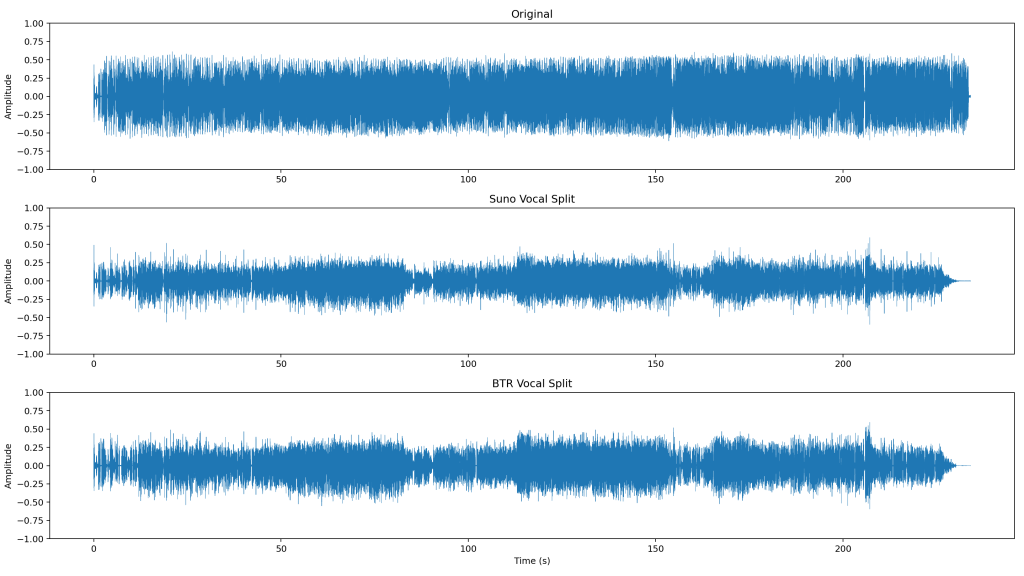
First Visual Check: Waveform Comparison
The waveform comparison confirms that all three files align over the same track duration. The original full mix is naturally much denser than either vocal stem. Both vocal splits preserve the same overall song structure, including the ending fade.
The important visible difference is stem density. BTR is visibly more active across much of the song. Suno is more suppressed, especially in lower-energy sections.
That does not automatically mean BTR is better. A louder or denser vocal stem can contain more useful vocal information, more bleed, or more artifact. The waveform alone cannot answer that.
- But it tells us where to look next.
- Is BTR fuller because it preserved more voice?
- Is Suno quieter because it removed more noise?
- Did Suno also remove useful vocal tone?
- Did BTR retain more vocal detail or more residual instrumental bleed?
Those questions require spectral and band-energy analysis.
File-Level Measurements
| Metric | Original | Suno Vocal Split | BTR Vocal Split | Interpretation |
|---|---|---|---|---|
| Duration | 234.08 sec | 234.08 sec | 234.08 sec | All files align in duration |
| Sample rate | 48 kHz | 48 kHz | 44.1 kHz | Export settings differ |
| Channels | Stereo | Stereo | Stereo | All files are stereo |
| Mono RMS | -15.92 dBFS | -24.40 dBFS | -22.39 dBFS | BTR is about 2.0 dB louder than Suno by RMS |
| Peak | -4.23 dBFS | -4.42 dBFS | -4.51 dBFS | Similar peak headroom |
| 4x true peak | -4.22 dBFS | -4.42 dBFS | -4.47 dBFS | No true-peak clipping issue |
| Clipped samples | 0 | 0 | 0 | No clipping detected |
| Spectral centroid | 4181 Hz | 4474 Hz | 4466 Hz | Vocal stems are similarly bright on average |
| Spectral flatness | 0.00476 | 0.00370 | 0.01104 | BTR has more noise-like or airy texture |
| Zero-crossing rate | 0.0726 | 0.1187 | 0.1285 | BTR has slightly more high-frequency or transient activity |
BTR is not winning because of clipping, limiting or fake peak loudness. Both vocal splits have safe peak levels and no detected clipping.
- The core difference is that BTR carries more signal energy in the vocal stem.
- That can be good or bad depending on where the energy is.
If the extra energy is in the 20 Hz to 160 Hz range, it may indicate kick, bass or low-end instrumental bleed.
If the extra energy is in the 160 Hz to 16 kHz range, it is more likely to be vocal body, vocal presence, consonants, breath, air, ambience or vocal-like upper harmonics.
The band-energy data answers that.
Band-Energy Analysis: Where BTR Actually Beats Suno
This is the most important data in the test.
Positive numbers mean BTR retained more energy than Suno. Negative numbers mean BTR retained less energy than Suno.
| Frequency Band | BTR vs Suno | Engineering Interpretation |
|---|---|---|
| 20 Hz to 80 Hz | -5.31 dB | BTR has less sub and kick rumble in this analysis view |
| 80 Hz to 160 Hz | -3.37 dB | BTR has less bass and low-end leakage |
| 160 Hz to 350 Hz | +2.23 dB | BTR retains more vocal body and warmth |
| 350 Hz to 1 kHz | +1.95 dB | BTR retains more lower and mid vocal tone |
| 1 kHz to 4 kHz | +1.81 dB | BTR retains more intelligibility and vocal presence |
| 4 kHz to 8 kHz | +1.62 dB | BTR retains more consonant and sibilance detail |
| 8 kHz to 16 kHz | +1.38 dB | BTR retains more air and high-frequency vocal detail |
This is the clearest technical win for BTR.
BTR is not simply louder across the whole spectrum. It is lower in the lowest sub and bass bands, but higher across the vocal-relevant bands.
That matters because engineers usually want vocal stems that remove kick and bass while keeping chest tone, vowel body, formants, upper harmonics, consonants, breath, sibilance, reverb tails and vocal air.
On this track, BTR better matches that profile.
Average Frequency-Energy Graph
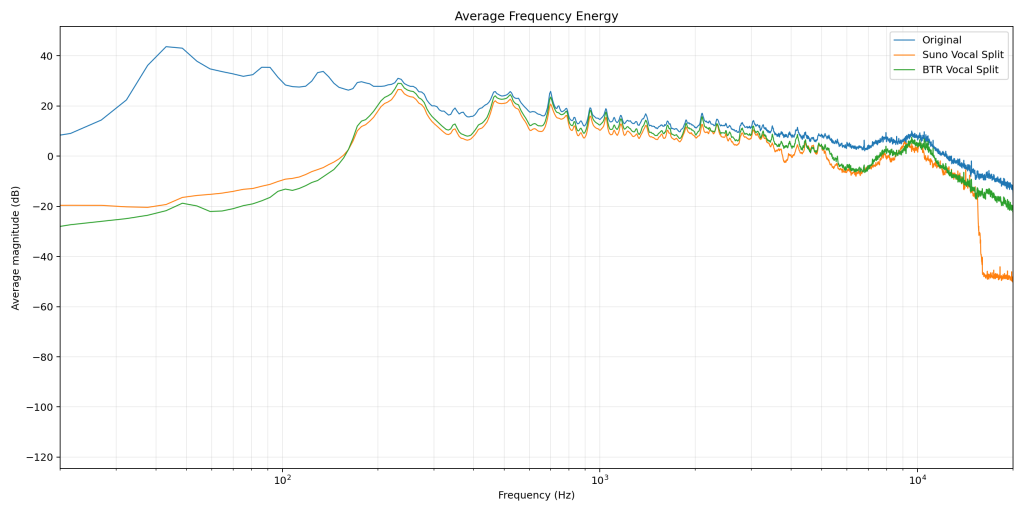
The average frequency-energy graph visually confirms the band-energy result.
The original mix has strong low-frequency energy, as expected from a full production. Both vocal splitters reduce much of that low-end content. But the BTR vocal stem sits above Suno through much of the vocal range, especially from the low mids into the upper vocal spectrum.
The critical engineering read is this:
- In the lowest bass range, BTR is not obviously carrying more unwanted low-end.
- In the vocal body and presence ranges, BTR retains more material.
- In the high end, BTR retains more air and detail, while Suno drops away more aggressively.
That makes BTR the more complete extraction, with the caveat that high-frequency retention must always be checked for artifact.
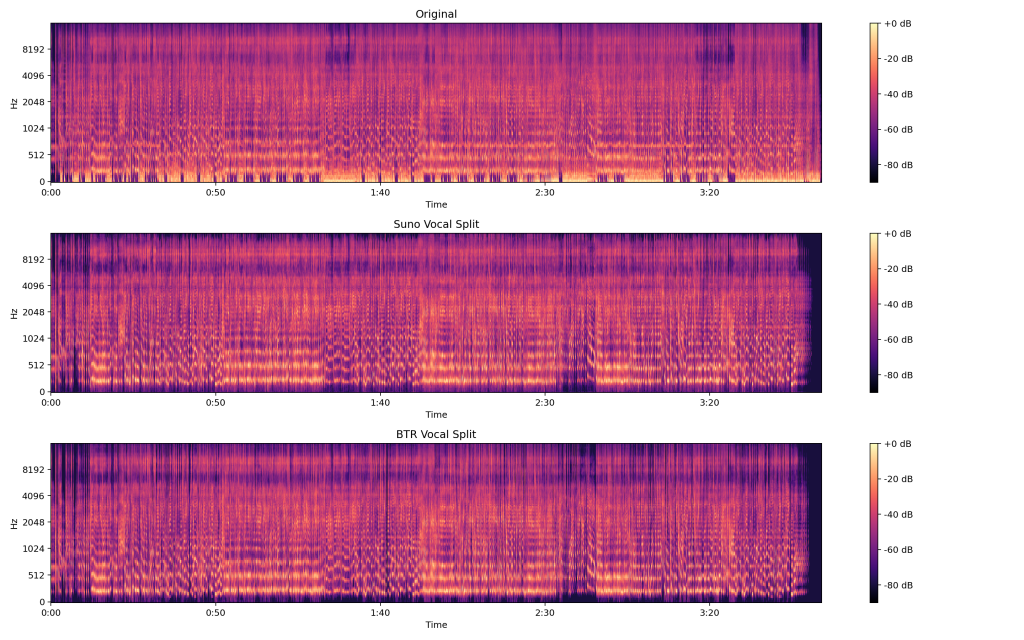
Log-Frequency Spectrogram: The Real Separation Picture
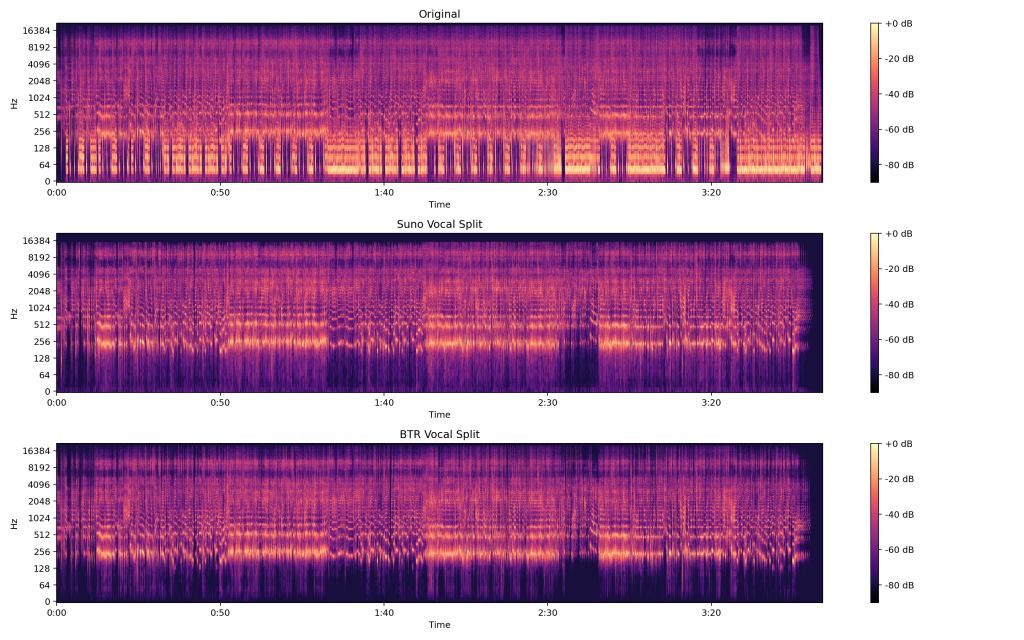
The log-frequency spectrogram shows how energy is distributed over time and frequency. This is more useful than a waveform because it shows whether the stem is preserving vocal structures or simply carrying broadband noise.
In the original, the full mix shows strong energy across bass, low mids, mids and highs. That is expected.
In the Suno vocal split, the output is more suppressed. It appears cleaner in some darker sections, but the vocal bands also look thinner in several areas.
In the BTR vocal split, the vocal structure is more continuous and fuller. Harmonic content is more visible across the vocal-relevant frequency range. BTR appears to retain more of the vocal’s body and upper structure rather than carving the signal as aggressively.
This supports the band-energy result.
BTR extracted a fuller stem.
Mel Spectrogram: The Perceptual View
The mel spectrogram is useful because it compresses frequency information closer to how humans perceive sound. It is not a replacement for listening, but it is a strong visual companion for a vocal-splitting assessment.
- The mel view shows the same pattern.
- Suno looks more suppressed.
- BTR looks fuller and more continuous.
- BTR carries more energy through the zones associated with vocal tone, presence and top-end detail.
For a singer, rapper, producer or engineer, this is important. A vocal stem that loses too much midrange or presence can become hard to mix. You can EQ a vocal, but you cannot fully restore missing vocal harmonics that were removed during separation.
That is why BTR’s fuller result is valuable.
Estimated Quiet-Gap Leakage: Where Suno Performs Better
No technical test should only report the data that favours one side. Suno does win one meaningful category here.
The estimated vocal-gap analysis looked at the quietest 25% of frames where the vocal stems had the lowest activity. This is a proxy for low-vocal or vocal-gap sections. It is not ground truth, because we do not have the true clean vocal stem.
| Metric | Result |
|---|---|
| Estimated gap frames | 2,521 |
| Original energy during estimated gaps | -15.90 dB |
| BTR vocal energy during estimated gaps | -30.62 dB |
| Suno vocal energy during estimated gaps | -32.16 dB |
| BTR minus Suno gap energy | +1.55 dB |
Suno is about 1.55 dB quieter than BTR during the estimated vocal-gap frames.
That suggests Suno is more aggressive in quiet-section suppression. This may be useful if someone wants a cleaner demo vocal quickly. But it also fits the broader pattern: Suno appears to suppress more material overall, including useful vocal-band material.
- For engineers, this is the trade-off.
- Suno gives slightly quieter gaps, but a thinner vocal stem.
- BTR gives a fuller vocal stem, but slightly more low-vocal or gap activity.
A professional engineer will usually prefer the fuller stem if the extra material is manageable. It is easier to clean a full vocal than to restore a thin one.
Residual Analysis: What Gets Left Behind After Subtracting the Vocal Stem
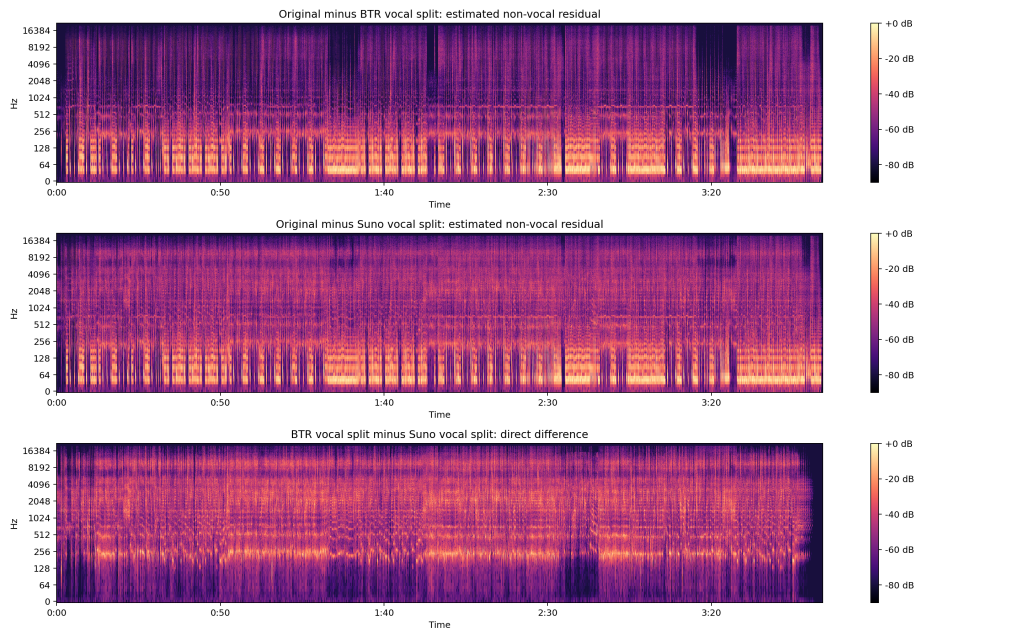
Residual analysis subtracts each vocal stem from the original.
- The first residual is Original minus BTR vocal split.
- The second residual is Original minus Suno vocal split.
- The third comparison is BTR vocal split minus Suno vocal split.
This is not perfect source-separation truth, because AI stems are not guaranteed to sum perfectly back into the original mix. But it is a useful diagnostic. If subtracting one vocal stem leaves less vocal-band material behind, that stem likely extracted more vocal-like content from the original.
The extended residual proxy showed the following:
| Residual Signal | Full Vocal Band | Presence Band, 1 kHz to 4 kHz | Air Band, 8 kHz to 16 kHz |
|---|---|---|---|
| Original minus Suno vocal | -23.57 dBFS | -28.69 dBFS | -32.10 dBFS |
| Original minus BTR vocal | -26.29 dBFS | -34.13 dBFS | -39.12 dBFS |
Lower residual energy in these bands means less vocal-like material remains after subtraction.
The read is direct.
- After subtracting BTR’s vocal stem, less vocal-band energy remains.
- After subtracting Suno’s vocal stem, more vocal-band energy remains.
- This indicates BTR extracted more mid and high vocal-like content from the original.
- The biggest differences are especially important.
- BTR’s residual was about 2.72 dB lower in the full vocal band.
- BTR’s residual was about 5.44 dB lower in the 1 kHz to 4 kHz presence band.
- BTR’s residual was about 7.01 dB lower in the 8 kHz to 16 kHz air band.
That supports the main conclusion: BTR pulled more vocal-relevant information into the vocal stem.
Artifact and Texture Proxies
A fuller stem is not automatically better. If the extra information is noise-like artifact, metallic shimmer or smeared instrumental bleed, the fuller stem can be harder to use.
That is why artifact and texture indicators matter.
| Metric | Original | Suno | BTR | Interpretation |
|---|---|---|---|---|
| Spectral flatness mean | 0.00925 | 0.00490 | 0.01071 | BTR has more noise-like or airy texture |
| Spectral flatness median | 0.00374 | 0.00101 | 0.00208 | BTR remains less suppressed |
| Zero-crossing rate | 0.0782 | 0.1291 | 0.1286 | Both vocal stems have similar high-frequency activity |
| Onset strength mean | 2.81 | 2.97 | 3.16 | BTR has more transient activity |
| RMS frame movement | 0.98 dB | 1.40 dB | 1.50 dB | BTR is less smoothed and more active |
The spectral-flatness result is the main caution. BTR has higher flatness than Suno.
- That can mean several things.
- It can mean more breath detail.
- It can mean more vocal air.
- It can mean more reverb tail.
- It can mean more stereo ambience.
- It can mean more consonants.
- It can also mean more high-frequency noise, AI separation texture, or residual instrumental shimmer.
The metric alone cannot label it. Listening is required.
But the data does not show a simple “BTR has more junk” result. The stronger band-energy and residual findings suggest BTR is preserving more vocal-relevant content, not merely adding random broadband energy.
The correct conclusion is this:
BTR retains more detail, but its retained high-frequency and texture content should be checked by ear for artifact.
That is a fair, engineer-safe statement.
Stereo Behaviour: Suno Is More Centred, BTR Keeps More Width
Stereo structure matters because lead vocals are often centred, while reverb, doubles, backing vocals and instrumental bleed may live wider in the stereo field.
| Metric | Original | Suno | BTR | Interpretation |
|---|---|---|---|---|
| L/R correlation | 0.934 | 0.943 | 0.875 | Suno is more mono-centred |
| Overall side-to-mid | -14.64 dB | -15.34 dB | -11.77 dB | BTR keeps more side energy |
| Vocal-core side-to-mid | -11.44 dB | -15.15 dB | -11.85 dB | BTR preserves more width in vocal-core bands |
| Presence side-to-mid | -8.57 dB | -15.49 dB | -9.00 dB | BTR keeps more stereo presence information |
| Air side-to-mid | -11.47 dB | -22.23 dB | -14.78 dB | Suno strips more side and top information |
Suno is more mono-centred. That may sound cleaner, and it may be useful if the desired output is a dry lead-vocal stem.
BTR retains more stereo content. That can be good if the vocal includes doubles, backing layers, stereo vocal effects, reverb, delay, room tone or performance ambience.
- But it can also mean BTR keeps more stereo instrumental bleed.
- Again, the right interpretation is not hype. It is engineering trade-off.
- Suno gives a more centred and more suppressed stem.
- BTR gives a wider and more complete stem.
For remixing, restoration and serious editing, BTR is usually the better source because it preserves more information. For quick demo isolation, Suno’s more suppressed output may require less cleanup.
Why Engineers Usually Prefer the BTR-Type Result
An engineer does not usually want the most aggressively stripped file. An engineer wants the file with the most recoverable vocal information.
That is the difference between clean and useful.
If a vocal splitter removes too much, missing consonants cannot be fully restored. Missing breath detail cannot be recreated naturally. Missing upper harmonics make the vocal dull. Missing low-mid body makes the vocal thin. Damaged sibilance sounds lisped or phasey. Chopped reverb tails sound artificial. Over-suppressed gaps can make phrases feel gated.
By contrast, if a stem is fuller but slightly less clean, an engineer has tools.
The engineer can use high-pass filtering, dynamic EQ, spectral de-noising, expansion, manual clip gain, de-bleed processing, transient shaping, de-essing, multiband gating, automation and spectral repair.
That is why BTR’s result is more attractive from an engineering standpoint.
BTR preserved more vocal-band material. The extra activity can be cleaned. Missing voice cannot be reliably brought back.
Practical Engineering Decision
If the question is “which split sounds cleaner straight away?” the answer may depend on the listener and section of the song. Suno’s more suppressed output may sound cleaner in certain quiet moments.
If the question is “which split would an engineer prefer as the source stem?” the answer is clearer.
BTR is the better engineering source stem on this track.
Why?
- BTR has more vocal body.
- BTR has more midrange tone.
- BTR has more presence.
- BTR has more upper vocal detail.
- BTR has stronger residual evidence of extracted vocal-like content.
- BTR has less low-frequency energy in the lowest bands in the initial band-energy analysis.
- BTR has no clipping issue.
- BTR has enough headroom for processing.
Suno’s main advantage is quiet-gap suppression. That matters, but it is a smaller win than losing vocal-band completeness.
Detailed Interpretation by Frequency Range
20 Hz to 80 Hz: Sub and Kick Region
BTR measured lower than Suno in the 20 Hz to 80 Hz band.
This is good for a vocal stem. Vocals rarely need meaningful sub-20-to-80 Hz content unless there is proximity rumble or special effect material. Most of what lives here in a full mix is kick, sub bass, 808 energy, low-end movement or mechanical rumble.
A cleaner vocal split should reduce this band aggressively.
Winner: BTR.
80 Hz to 160 Hz: Bass and Low Vocal Proximity
BTR also measured lower than Suno in the 80 Hz to 160 Hz region.
This range can include low male vocal fundamentals, but it is also a common zone for bass bleed, low drums and mix weight. Lower energy here can mean less instrumental leakage, provided the vocal itself is not being thinned too much.
Because BTR is stronger above 160 Hz, the lower 80 Hz to 160 Hz result looks positive rather than destructive.
Winner: BTR.
160 Hz to 350 Hz: Vocal Body
BTR measured about 2.23 dB higher than Suno in this range.
This is one of the most important areas for vocal body. Remove too much here and a vocal sounds hollow, papery or disconnected from the chest.
Suno’s lower result suggests a thinner vocal body. BTR retains more weight.
Winner: BTR.
350 Hz to 1 kHz: Lower Mids and Vocal Tone
BTR measured about 1.95 dB higher than Suno.
This range carries a large amount of vocal tone and intelligibility foundation. It is also where many AI separation tools can create hollow or phasey results if they over-remove.
BTR’s stronger retention here is a meaningful result.
Winner: BTR.
1 kHz to 4 kHz: Presence and Intelligibility
BTR measured about 1.81 dB higher than Suno in the 1 kHz to 4 kHz band.
This is the zone where vocals cut through a mix. It includes clarity, forwardness, diction and much of what makes a lyric readable.
For rap, pop and sung vocal extraction, this band is critical. A splitter that weakens this range can produce a vocal that sounds technically isolated but emotionally reduced.
Winner: BTR.
4 kHz to 8 kHz: Consonants and Sibilance
BTR measured about 1.62 dB higher than Suno.
This area includes sibilance, consonant edges and breath articulation. It is also a danger zone for harshness or metallic artifact.
The fact that BTR retains more here is useful, but it requires listening. If the energy is consonant detail, BTR wins strongly. If it is shimmer or artifact, it may need de-essing or repair.
Winner: BTR, with artifact check.
8 kHz to 16 kHz: Air and Separation Texture
BTR measured about 1.38 dB higher than Suno.
This can be desirable. Air, breath, reverb and top-end detail help a vocal feel alive. But this is also where AI separation artifacts often show up.
The correct read is not “more high end is always better.” The correct read is this: BTR keeps more top-end information, and that information should be checked by ear.
Winner: BTR, with caveat.
What the BTR-Minus-Suno Difference Means
The direct difference file, difference_btr_minus_suno.wav, represents what is different between the two vocal splits.
The difference analysis showed that the two outputs are correlated but materially different. That means BTR is not just a level-adjusted version of Suno. Even after RMS matching, the difference remains meaningful.
The extended report found the following:
| Measurement | Result |
|---|---|
| BTR and Suno waveform correlation | 0.8009 |
| BTR-to-original waveform correlation | 0.4831 |
| Suno-to-original waveform correlation | 0.3909 |
| Suno gain needed to match BTR RMS | +2.01 dB |
| BTR-minus-Suno direct RMS | -26.85 dBFS |
| RMS-matched BTR-minus-Suno direct RMS | -26.39 dBFS |
That means the difference is not just volume. BTR is carrying different source material, and the spectral evidence shows much of that difference lives in vocal-relevant frequency regions.
Time-Window Findings
The extended analysis also looked at 10-second windows across the track.
The biggest BTR vocal-core advantages occurred around these sections:
| Time Window | Finding |
|---|---|
| 160 to 170 seconds | BTR had one of its strongest vocal-core advantages |
| 80 to 90 seconds | BTR retained substantially more vocal-core and presence-air energy |
| 130 to 140 seconds | BTR retained more vocal-core content |
| 140 to 150 seconds | BTR retained more vocal-core content |
| 110 to 120 seconds | BTR retained more vocal-core content |
The strongest low-end reductions for BTR appeared early and near the ending:
| Time Window | Finding |
|---|---|
| 0 to 10 seconds | BTR had much lower sub and bass energy than Suno |
| 10 to 20 seconds | BTR had much lower sub and bass energy than Suno |
| 230 to 234 seconds | BTR had lower sub and bass energy near the ending |
This matters because it shows the result is not isolated to one moment. BTR’s vocal-core advantage appears across multiple sections of the track.
What This Means for Artists
For an artist, the difference is practical.
If you upload a song and want a vocal stem for remixing, acapella sharing, vocal cleanup, performance analysis, reworking a track, making alternate edits, social content, DJ tools, sync prep or collaboration, then the best split is usually the one that keeps the vocal intact.
A thin vocal stem can sound impressive for a second because the background is reduced. But when you try to use it, the problems appear.
- The vocal feels small.
- Syllables vanish.
- Endings sound chopped.
- Sibilance gets damaged.
- Emotional texture disappears.
- Reverb and breath feel unnatural.
- The vocal does not sit well in a new mix.
BTR’s result is stronger because it keeps more of the material that makes the vocal usable.
What This Means for Engineers
For an engineer, the winner is BTR.
- The reason is not brand preference. It is workflow logic.
- Engineers can clean excess material. They cannot reliably recreate removed vocal information.
- A fuller stem with manageable bleed gives the engineer options. A cleaner but thinner stem locks the engineer into a damaged source. Once presence, consonants, vocal body and air are gone, they are gone.
That is why the BTR output is the better source stem here.
Recommended post-processing chain for BTR’s vocal stem:
- High-pass around 70 Hz to 100 Hz depending on the vocal tone.
- Use dynamic low-mid cleanup around 120 Hz to 250 Hz if residual rumble appears.
- Control resonance between 300 Hz and 900 Hz if the stem feels boxy.
- Shape presence around 1 kHz to 4 kHz only after loudness matching.
- De-ess around 5 kHz to 8 kHz if retained sibilance is sharp.
- Use spectral repair or light de-noise above 8 kHz if shimmer is audible.
- Automate quiet gaps manually rather than applying heavy global gating.
Recommended post-processing chain for Suno’s vocal stem:
- Check for missing body around 160 Hz to 350 Hz.
- Add low-mid warmth carefully, but avoid boosting artifacts.
- Check consonants and word endings for damage.
- Avoid over-brightening if the high end is already separated unnaturally.
- Use parallel enhancement only if the stem is too thin.
The BTR stem gives more room to work. The Suno stem may need less cleanup, but it also gives less vocal material back.
What This Means for BeatsToRapOn AI Vocal Splitter
This test supports a specific and defensible product claim:
On Black Rose Stencil, BeatsToRapOn’s AI Vocal Splitter retained more usable vocal-band information than the Suno vocal split while also reducing more low-frequency content in the vocal stem.
That is a strong claim because it is backed by waveform comparison, spectrogram comparison, mel spectrogram comparison, average frequency-energy analysis, band-energy tables, residual proxy analysis, gap-leakage estimate and stereo behaviour analysis.
It is also narrow enough to be honest.
The article should not claim that BTR is always better than Suno. It should not claim that BTR beats Suno on every track. It should not claim this is a formal SDR benchmark. It should not claim BTR produced a perfect vocal stem. It should not claim Suno failed.
The better claim is sharper and more credible:
In this track-level technical assessment, BTR produced the more complete vocal extraction. Suno produced slightly quieter estimated vocal gaps, but BTR preserved more vocal body, midrange, presence, sibilance and air.
That is the kind of claim that can survive scrutiny.
Final Verdict
This test shows a clear technical pattern.
Suno’s vocal split is slightly quieter in estimated vocal-gap sections. It is more centred and more suppressed. For a quick demo, that may sound cleaner in certain moments.
But BTR’s vocal split is the stronger engineering result. It retains more vocal body, more midrange tone, more intelligibility, more consonant detail and more high-frequency vocal information. It also measures lower in the lowest sub and bass bands in the initial band-energy analysis, which is exactly what you want from a vocal stem.
The residual analysis strengthens the conclusion. After subtracting BTR’s vocal stem from the original, less vocal-band material remains than after subtracting Suno’s vocal stem. That indicates BTR extracted more of the vocal-like signal.
The only real caution is artifact checking. BTR retains more top-end and more texture, so an engineer should listen closely for shimmer, breath handling, reverb tails and consonant quality. But that is a professional cleanup question, not a reason to prefer a thinner extraction.
The final technical verdict is this:
BTR beat Suno on this Black Rose Stencil vocal-splitting test for vocal completeness, vocal-band retention and engineering usability. Suno was slightly better at quiet-gap suppression, but BTR produced the more useful vocal stem.
If you are wanting to find out how the craft excellent beats using a leading AI Stem Splitter, check out our comprehensive guide on How to Craft Professional Rap Beats Using AI Stem Splitter Tools: A Step-by-Step Guide
FAQ
Is this a formal SDR benchmark?
No. A formal SDR, SIR or SAR benchmark requires a true clean vocal reference stem. This test did not have that. It is a comparative technical assessment using measurable proxies: spectral energy, band energy, loudness, residual subtraction, gap-energy estimates and stereo analysis.
Did BTR simply win because it was louder?
No. BTR was louder overall, so loudness matching is important for listening tests. But the frequency-band data shows the difference was not just level. BTR measured lower in the lowest sub and bass bands while measuring higher across the main vocal-relevant bands.
Where did Suno perform better?
Suno performed better in estimated quiet-gap suppression. It was about 1.55 dB quieter than BTR during the estimated low-vocal or gap frames.
Where did BTR perform better?
BTR performed better in vocal completeness. It retained more energy across the vocal body, midrange, presence, sibilance and air bands. It also left less vocal-band material behind in residual proxy analysis.
Which stem would an engineer choose?
An engineer would usually choose BTR for this track because it preserves more usable vocal material. Engineers can clean a fuller stem. They cannot reliably restore vocal information that has already been removed.
Can this result be generalized to every song?
No. This result applies to this Black Rose Stencil test. Different songs, arrangements, vocals, mixes and export settings can produce different results. The correct claim is that BTR won this specific technical comparison.