
If you’re a musician in 2026 and you haven’t explored AI yet, you’re leaving an entire dimension of creative possibility on the table. From generating full tracks with realistic vocals to isolating stems, auto-mastering demos, and even writing press release copy for your next single, artificial intelligence has become the Swiss Army knife of modern music production. This guide walks you through exactly how to use it – practically, ethically, and strategically – so you can create more, release faster, and keep your artistry front and center.
Key Takeaways
- AI music generators like Suno, Udio, and ElevenLabs Music now let musicians create studio quality audio tracks, including vocals, from text prompts or rough demos. Suno alone has nearly 100 million users as of 2026.
- The best AI music generator for most musicians right now is Suno, thanks to its natural vocals, stem editing (up to 12 stems), MIDI export, and a DAW-like workflow for finishing full songs.
- AI tools can help at every stage of the creative process: breaking writer’s block, generating background music, separating stems, auto-mixing and mastering, organizing samples, and handling lyrics. In fact, 87% of musicians use AI tools for song creation.
- AI is not “taking over” music but amplifying human creativity, taste, and entrepreneurial opportunities for independent artists and content creators.
- Musicians must still consider copyright laws, licensing, and ethical questions when using AI music generation and deepfake vocals in 2026.
What Is AI Music in 2026?
AI music refers to audio created or assisted by artificial intelligence systems that learn from large datasets of existing music and sound. In 2026, the field splits into two broad categories: AI music generators that create full tracks from scratch, and AI tools that assist with specific tasks like mixing, mastering, stem separation, and transcription.
The generative AI breakthroughs since 2023 – particularly diffusion models, transformer-based audio models, and neural networks trained on massive catalogs – have pushed quality to the point where AI can generate music indistinguishable from human-made sounds in many contexts. AI music generation platforms are expected to continue improving sound quality as models grow in scale and sophistication.
Here are the core concepts worth knowing:
- AI music generator: a platform that produces complete tracks (instrumentals, vocals, or both) from text prompts or audio references.
- AI music generation: the broader process of using machine learning to produce audio, whether full songs or individual elements.
- Text-to-music: generating music by describing what you want in natural language (“lo fi hip hop beat, rainy mood, 85 BPM”).
- Symbolic vs audio-based generation: symbolic systems output MIDI or notation; audio-based systems generate waveforms directly.
- Background music engines: tools optimized for royalty free music used in videos, podcasts, games, and ads.
- Stem separation: splitting a mixed track into individual components like vocals, drums, bass, and instruments.
- Inpainting: regenerating or editing a specific section of a track while keeping the rest intact.
Best AI Music Generators for Musicians Right Now
Not all AI music generators are built the same. Here’s a quick at-a-glance guide to the most mature, widely-used options in 2026:
- Suno – best for full songs with vocals, arrangement control, stem editing (up to 12 stems), and MIDI export. Ideal for songwriters, producers, and musicians who want to finish songs end-to-end. Free plan available with limited generations per month; Pro and Premier tiers unlock multi-stem exports and studio-level editing.
- Udio – strong vocal realism and genre diversity, though web traffic has declined relative to Suno in the last few years. Good for quick idea sketches and vocal-heavy experiments.
- ElevenLabs Music – excellent prompt adherence, multilingual vocal output, and fine tuning on your own audio to capture your own style. Over 8 million songs created by its community by late 2025. Ideal for producers who want stylistic consistency and API-level integration.
- Beatoven.ai – optimized for royalty-free background music for YouTube, podcasts, and games. Simple mood and genre controls, adjustable duration. Great for content creators who need quick, licensable tracks.
- MusicGPT – an emerging option for musicians who want conversational control over composition, including structure, melody, and lyrics in one interface.
Suno stands out as the best AI music generator in 2026 for musicians who want studio-quality tracks with vocals, granular arrangement control, and flexible export options. With nearly 100 million users, it has become the default starting point for most creators exploring AI music.
Newcomers appear every year, but as of September 2026, this list covers the tools with the most traction and the deepest feature sets.
How to Choose the Best AI Music Generator for Your Goals
“Best AI” depends entirely on what you’re trying to accomplish. A rapper drafting verses needs different capabilities than a YouTube creator layering background music under a travel vlog.
Here are the criteria that matter most:
- Sound quality and vocal realism – Can the tool produce vocals that don’t sound robotic? Suno and ElevenLabs lead here; Beatoven.ai focuses on instrumentals.
- Control over stems and structure – Can you edit verse by verse, swap instruments, or regenerate just the bridge? Suno’s Song Editor allows section-level control.
- Genre coverage – Some tools excel at pop, hip hop, and electronic but struggle with jazz or classical music. Test your preferred genres before committing.
- Licensing terms – Does the platform allow you to monetize on YouTube, TikTok, or Spotify? ElevenLabs claims its Music model is cleared for nearly all commercial uses. Suno grants commercial rights to paying subscribers. Always read the fine print.
- Export formats – WAV, MP3, MIDI, and multi-stem exports matter if you plan to import into a DAW for further production.
- Pricing and generation limits – Most platforms offer a free plan with daily or monthly caps. Token limits and generation quotas vary significantly between tiers.
Think of it as a decision tree: if you need full songs with vocals, start with Suno. If you need background music that’s royalty free and quick, try Beatoven.ai. If you want to fine-tune a model on your own recordings for a consistent sonic identity, ElevenLabs is worth the investment.
AI music generators can produce tracks in seconds, but the time you spend choosing the right tool and learning its controls will determine whether those tracks actually serve your art.

Getting Started: First Steps to Create Music With AI
Getting your first AI generated song is easier than setting up a new plugin in your DAW. Here’s a simple beginner workflow:
- Create an account on an AI music generator like Suno or ElevenLabs. Most platforms let you start on a free plan with no credit card required.
- Write a natural-language prompt describing the genre, mood, tempo, and instrumentation you want. Be specific – vague prompts yield generic results.
- Generate and listen to the output. Treat it as a sketch, not a master. Iterate on your prompt: adjust the style tags, change the tempo, specify instruments.
- Export and refine – download the audio, stems, or MIDI and bring them into your DAW for further editing if needed.
Here are example prompts to try:
- “2020s trap beat with dark piano chords, 140 BPM, no vocals”
- “Cinematic ambient background music for a sci-fi trailer, slow build, pads and orchestral strings”
- “Pop ballad in Spanish, 80 BPM, piano-led, include chorus with female voice and backing harmonies”
Most platforms in 2026 support these language-style prompts alongside style tags, and some (like ElevenLabs) accept reference audio uploads for arrangement or continuation. Suno allows users to upload audio clips for song creation, which is useful for building on existing demos.
Treat your early generations as creative sketches. The real art happens when you start shaping, layering, and personalizing those raw outputs.
Using AI to Break Writer’s Block and Spark Ideas
Every musician hits a wall. You sit down to write, and nothing comes. AI tools like BandLab Song Starter, BOOMY, and Soundraw serve as idea generators when you’re stuck on chords, melodies, or grooves.
Generative AI can produce many short variations of a riff, hook, or progression that you can then edit, replay, or re-record yourself. AI tools can rapidly prototype variations of chord progressions and melodies for songwriters, turning what used to be hours of noodling into minutes of curated options.
Here’s a concrete scenario: a pop songwriter in 2026 uses an AI music generator to quickly audition 10 chord progressions under an existing topline. Three of them spark something. She picks the best one, changes the voicings, and records her own piano part over it. The AI never wrote the song – it acted as an interactive sounding board for composition and ideation.
Creative prompts to try when you’re stuck:
- “Generate an 8-bar intro only in a minor key, acoustic guitar and light percussion”
- “Give me modulation ideas for a bridge transitioning from G major to B-flat major”
- “Create five different chorus melodies over this chord progression” (upload your chords as reference audio)
- “Produce a groove pattern inspired by lo fi hip hop at 75 BPM”
Machine learning models enhance the creative process by offering variations and suggestions you might not have considered. The point isn’t to let AI compose your catalog on autopilot – it’s to use it as a creative input tool that breaks the silence and gets you moving.
AI for Full Song Creation: From Prompt to Release-Ready Track
Here’s a realistic end-to-end workflow in 2026 for taking an AI-generated idea all the way to release:
- Generate a demo in Suno or ElevenLabs Music using a detailed prompt. Let the AI produce a full arrangement with vocals, drums, bass, and keys.
- Refine sections using the platform’s song editor. Rewrite lyrics for the second verse. Regenerate the bridge. Swap the guitar tone. Suno’s editor lets you reorder, rewrite, and remake parts of tracks with inpainting.
- Export stems or MIDI. Suno supports exporting up to 12 stems plus MIDI; ElevenLabs offers 2, 4, or 6 stem splits. Download everything.
- Import into your DAW (Ableton Live, Logic Pro, FL Studio, etc.). Layer your own vocals, guitars, or synth parts on top of the AI stems.
- Mix and master using AI-assisted tools (more on this below) or your own engineering skills.
AI assists in the music production process by speeding up idea generation and arrangement. It can generate complementary instrumental arrangements for your tracks – think auto-generated string pads under your acoustic demo, or a drum pattern that locks into your bassline, which you can later refine using an AI stem splitter and vocal remover to rebalance or replace individual parts.
Some artists use AI only for the instrumental, then record human vocals on top. Others experiment with AI-sung leads and backing voices. Either approach is valid – the key is deciding the structure and emotional arc yourself.
- Use tempo and key changes within the AI platform to fine-tune arrangements before exporting; exploring the best AI tools for rappers and music producers can also reveal generators and plugins that fit your workflow.
- Experiment with genre tags mid-song to create unexpected transitions (e.g., shifting from pop verse to electronic chorus).
- AI music generators can produce tracks in various genres, so don’t be afraid to push beyond your comfort zone.
AI can hand you the building blocks. Your job is to be the architect.
Background Music for Content Creators and Brands
If you’re a YouTube creator, podcaster, game developer, or marketer, AI music generators are now the fastest path to royalty free music that doesn’t sound like stock audio.
AI music tools are increasingly used for royalty-free music across content platforms. Here are concrete use cases:
- A 2026 YouTuber generating 10 different lo fi tracks for travel vlogs – each with slightly different mood and tempo – in under an hour.
- A marketer creating 30-second bumpers for a branded podcast series, matched to the brand’s sonic identity using style tags.
- A game developer prototyping level themes for a platformer, generating cinematic, groovy, and tense variations to test with playtesters.
The main advantages are instant generation, style matching (lo fi, cinematic, ambient, upbeat), adjustable duration and intensity, and licensing tailored for online monetization.
Before using any AI-generated track commercially, check the platform’s license:
- Beatoven.ai offers a non-exclusive perpetual license for paying users.
- Suno grants commercial rights to Pro and Premier subscribers.
- Some tools restrict direct upload to streaming platforms like Apple Music and Spotify, allowing only sync use in videos or podcasts.
Always read both your AI provider’s license and your distributor’s terms before releasing content commercially.
AI-Assisted Mixing, Mastering, and Sound Quality
Mixing and mastering used to be the domain of experienced engineers with expensive gear. AI hasn’t replaced them, but it has made professional-sounding results accessible to everyone.
LANDR is a leading AI-assisted mastering solution that analyzes your track and applies EQ, compression, and loudness optimization tuned for streaming platforms. iZotope’s Ozone uses AI for mastering assistance, offering intelligent suggestions based on reference tracks you provide, and a new wave of AI-powered automated audio mastering services offers fast, affordable options for independent artists.
Here’s a practical workflow:
- Export your AI-generated or hybrid stems from Suno or your DAW.
- Run them through AI-assisted mixing tools that can quickly evaluate audio quality elements like frequency balance and compression; recent advances in AI for audio mastering focus on smarter, genre-aware processing.
- Use AI mastering for a competitive loudness level matched to Spotify, Apple Music, or YouTube standards.
- AI systems can level, equalize, and compress audio tracks, handling the tedious technical work so you can focus on creative decisions.
AI-powered plugins automate tedious technical tasks in mixing and mastering. AI technology streamlines mixing and mastering for musicians who don’t have years of engineering experience, and understanding how AI mastering algorithms work — or diving into a definitive guide to AI mastering in 2025 — can help you use these tools more intentionally. AI tools can provide insights into mixing decisions and dynamics that would otherwise require trained ears.
AI can improve sound quality through machine learning techniques – but there are limits. For high-stakes releases (singles, EPs, sync placements), experienced engineers still bring nuance that algorithms miss. Treat AI suggestions as starting points, not gospel.

Stem Separation and Sampling With AI
Stem separation is the process of using AI to split a mixed track into individual components – vocals, drums, bass, guitars, keys, and more. AI can help musicians separate individual musical components from mixed recordings with increasing precision, whether you need a general splitter or a dedicated AI piano stem splitter for isolating keys, and there are now numerous free and freemium AI stem splitters and vocal removers that make this accessible to beginners.
LALAL.AI and MOISES.AI are leading vocal separation tools. LALAL.AI’s Andromeda model, trained on 4× more data than its predecessor, processes audio approximately 40% faster and improves signal-to-distortion ratio by about 10%, illustrating how modern AI stem splitters and vocal removers and free, browser-based AI vocal remover tools can radically speed up remix workflows. Their Lyra model runs entirely on-device for offline processing via a VST plugin, outputting up to seven stems directly inside your DAW session.
Advanced source separation software allows producers to isolate musical elements from stereo mixes with minimal bleed, and dedicated AI stem splitter and vocal remover tools make it simple to pull apart complex mixes entirely in the browser. Stem splitting technology in DAWs allows for audio element isolation that opens up remixing, sampling, and creative layering possibilities.
Here’s a production example: a hip hop producer in 2026 isolates a 1970s soul vocal from a vinyl rip using LALAL.AI, chops it into a chorus hook, and layers AI-generated drums and bass underneath, while another creator uses an AI workflow to remove backing vocals cleanly before recording their own harmonies. The result is a hybrid track that blends vintage soul with modern beats.
Legal cautions:
- Sampling from copyrighted recordings still requires clearance, even if stems were extracted with AI.
- AI-powered tools can streamline audio restoration and remixing processes, but they don’t clear legal rights automatically.
- Experiment freely with stems from your own rehearsals, live recordings, and original sessions – that’s where the creative risk is lowest.
Organizing Sample Libraries and Generating Patterns
If you’re a producer sitting on 20 GB of drum samples and loops, AI can turn that chaos into a browsable, inspiring resource, especially when paired with an AI-powered stem splitter and vocal remover that feeds your library with clean, labeled parts.
AI tools like Atlas analyze and cluster large sample libraries, enabling producers to browse sounds visually on a 2D map organized by timbre and genre. Playbeat learns a producer’s rhythmic style and generates custom patterns, offering fresh grooves that match your aesthetic without the tedium of manual programming.
AI-driven sampling tools are rapidly evolving by 2025 and into 2026, with features like automatic tagging, similarity search, and pattern generation becoming standard, and dedicated AI audio stem splitter and vocal remover workflows make preparing source material far more efficient. Melody and chord generation tools analyze musical data to suggest progressions or patterns that fit your project.
A concrete workflow: a producer loads a massive drum library, lets AI tag every sample by timbre, genre, and character, then generates hundreds of usable grooves from those tagged samples. What used to take an afternoon of auditioning now takes minutes.
This connects to a bigger theme: AI reduces tedious processes so musicians can focus on composing, performing, and producing music that actually matters to them.
Lyrics, Toplines, and AI-Assisted Songwriting
Transformer-based language models – descendants of the GPT-3 era – now assist with lyric generation, rhyme schemes, syllable counts, and structural suggestions. Creative AI tools help musicians generate ideas and structures for lyrics and song formats, turning a blank page into a working draft in minutes.
But here’s the critical habit: use AI-generated lyrics as drafts to refine, not final products to publish. The best songs come from personal experiences, specific imagery, and emotional honesty that no model can fabricate.
Concrete prompt ideas to try:
- “Write a chorus about stage fright in the style of 2010s pop-rock”
- “Generate 10 alternative bridge concepts for a breakup song”
- “Give me three verses about leaving a small town, with internal rhyme schemes”
- “Suggest metaphors for loneliness that avoid clichés”
Some AI music generators integrate lyrics and melody creation in a single interface, allowing toplines to be created from text descriptions. This is useful for producers who hear the instrumental but struggle to write melodies and words simultaneously.
AI helps in collaborative music creation environments for shared projects – multiple songwriters can use AI-generated drafts as a common starting point, then personalize from there.
Best practices: check for originality (search key phrases), avoid overly generic language, and always rewrite at least 50% of any AI draft to inject your voice and perspective.
Using AI Music in Live Performance and Jam Sessions
Live performance is where AI gets genuinely exciting – and genuinely weird.
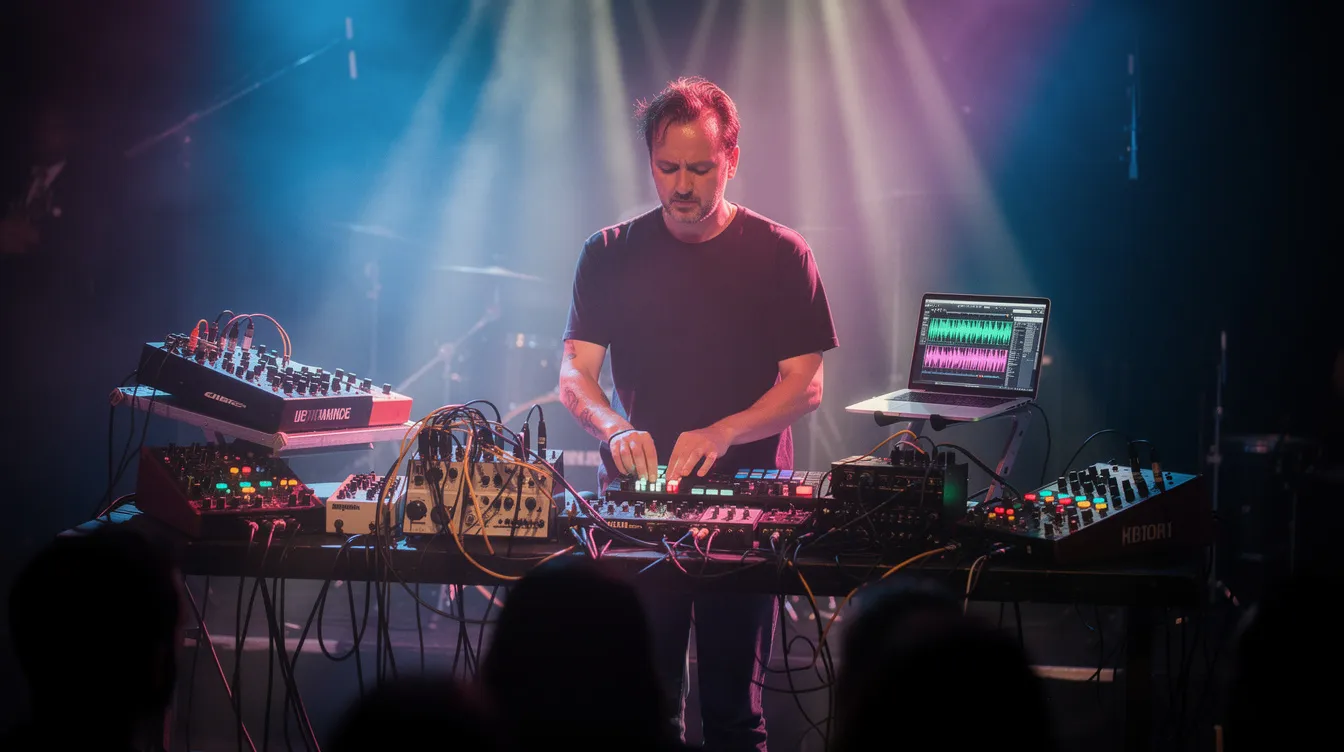
Interactive AI systems and hybrid setups now let live musicians trigger AI loops, generative backing tracks, or adaptive soundscapes on stage. A solo guitarist can use AI-generated backing bands that follow tempo changes in real time. An electronic act can improvise over AI-driven drum and bass patterns that react to their MIDI input.
By 2026, some DAWs and performance tools support real-time generative AI instruments that respond to audio or MIDI signals. Moises has released Studio environments embedding stem generation and voice transformation for live DJ and producer workflows, shaped in partnership with artists like Armin van Buuren and Laidback Luke, while experiments in AI for immersive and spatial audio mastering are beginning to influence live and installation work.
Modern AI tools serve as digital assistants rather than replacing human artistry. Think of AI as an extra band member – one whose parts can be muted, replaced, or remixed on the fly during a set.
The audience impact is real: performers who integrate AI intelligently can deliver richer, more dynamic shows without needing to hire a full band. The art is in the curation and interaction, not the automation.
AI for Practice, Education, and Ear Training
AI isn’t just for creating – it’s for learning. AI-driven apps now provide customized practice routines, tempo-adjusted play-alongs, and automatic feedback on pitch and rhythm accuracy.
AI technology aids in transcription and indexing tasks in music, approximating chord charts and melodies from recordings. A jazz student can feed a classic recording into an AI transcription tool and get a working lead sheet in seconds, then practice along at half speed with an AI-generated backing track, or use an AI tool to remove guitar from a track so they can comp or solo in that space themselves.
AI can help musicians analyze their music to improve structure and arrangement – useful for students reviewing their own compositions and identifying weak transitions or repetitive sections.
A 2026 music student might use AI to generate practice etudes in specific modes, tempos, or difficulty levels – essentially creating an infinite library of exercises tailored to their current ability, especially when combined with tools like an AI guitar stem remover for creating custom play-alongs.
These tools support, not replace, human teachers. They offer more repetitions, instant feedback, and diverse backing tracks that make practice sessions more productive for both self-taught bedroom producers and conservatory-trained musicians.
AI and the Business Side: Marketing, Releases, and Strategy
Musicians in 2026 leverage AI for tasks well beyond the studio: social media captions, press release drafts, ad copy, email campaigns, and content calendars for releases.
AI can analyze streaming data and listener behavior to suggest release dates, playlist pitches, and even tour routing possibilities. An independent artist might use AI to test different track orders for an EP, or to segment their audience by listening habits and engagement patterns.
Musicians can leverage artificial intelligence across every stage of the music lifecycle – from the first spark of an idea to the marketing campaign that puts it in front of an audience. AI tools streamline workflow in music production and beyond, handling repetitive tasks so you can focus on strategic decisions and artistic branding.
While AI can write your Instagram captions, it can’t decide what your brand stands for. That’s still your job.
Ethical and Legal Issues: Copyright, Consent, and AI Taking Over?
This is the section you can’t afford to skip.
Key controversies in 2026 include AI taking jobs from session musicians and composers, unauthorized training on artists’ catalogs, and voice cloning that mimics famous singers without consent. Major artists criticize AI for diminishing human creativity, and the debate is far from settled.
Here’s where the law stands:
- Copyright: The U.S. Copyright Office has issued multi-part reports clarifying that works created solely by AI with no meaningful human input may not qualify for copyright protection. AI-generated music lacks copyright protection in the US unless substantial human creative contribution is demonstrated.
- Training data lawsuits: Suno faced copyright lawsuits for allegedly copying songs – the RIAA and major labels sued Suno and Udio in 2024 claiming unauthorized use of copyrighted recordings. By late 2025, Suno negotiated licensing deals with Warner, BMG, and Believe for its v6 models.
- Voice cloning and deepfakes: The “Heart on My Sleeve” case in 2023 involved AI vocals resembling Drake and The Weeknd, prompting takedowns and label claims. The NO FAKES Act (2025) creates a legal framework for “digital replicas,” making it risky to generate vocals that mimic identifiable artists without consent.
- Copyright claims: Some AI tools explicitly block prompts that try to replicate a known artist’s voice or style. Copyright claims can arise when outputs too closely resemble existing recordings.
AI music tools may homogenize music by following existing trends, producing outputs that sound polished but lack the quirks and risks that make art interesting. This is worth thinking about every time you hit “generate.”
Use fairly trained AI music generators with transparent licensing. Avoid training personal models on pirated stems. Keep documentation of your human creative input.
Case Studies: Musicians Using AI Creatively
AI isn’t just theoretical. Here are real examples of artists navigating this terrain:
- Holly Herndon – pioneered the use of AI “voice twins” and neural synthesis in her music, treating AI as a collaborative instrument rather than a replacement. Her work demonstrates how AI enhances creativity in music production when guided by strong artistic intent.
- Randy Travis – in 2024, the country legend, unable to sing after a stroke, released music using AI-assisted vocal technology that reconstructed his voice from earlier recordings. A powerful example of AI enabling disabled or retired artists to create again.
- Arca – has openly experimented with AI-generated textures, beats, and vocal processing, blending generative outputs with live performance art. Her work pushes the boundaries of what genres and styles AI can contribute to.
- Independent bedroom producers – thousands of unsigned artists now use AI for orchestral arrangements they could never afford to record. A hip hop producer layers AI-generated string sections under their beats. A singer-songwriter gets a full band arrangement from a solo acoustic demo. These are the stories that don’t make headlines but represent the majority of AI music use.
The pattern across all these cases: the artist brought the vision, taste, and emotional intention. AI provided the raw material and expanded possibilities.
Human Taste vs. Infinite AI Output
In an era when AI can generate endless beats, loops, melodies, and lyric variations, a musician’s taste becomes the real differentiator. MuseNet generates 4-minute compositions with 10 different instruments. Suno can produce dozens of full songs in an afternoon. The bottleneck is no longer creation – it’s curation.
Mastery still comes from not skipping the steps: practicing instruments, studying songs across genres, refining critical listening skills. AI can surface thousands of options, but only the artist can choose which feel emotionally honest and on-brand.
Set constraints for your AI-assisted creative process:
- Limit yourself to three generations per idea before committing to one direction.
- Always rewrite, re-record, or rearrange at least one major element.
- Ask yourself: would I be proud to play this live?
Your ability to say “no” to 99 AI outputs and “yes” to the one that matters is what separates you from everyone else with the same tool.
Generative AI for Sound Design and New Instruments
Beyond music generation, AI can create entirely new sounds and instruments. Google’s Magenta project, which started in 2016 focusing on AI music tools, pioneered the neural synthesizer concept with NSynth – a deep learning system that interpolates between existing instrument timbres to create hybrid sounds that never existed before.
AI enhances sound design by creating unique patches and audio textures. Producers can feed short samples into generative models to morph timbres or synthesize instruments that blend, say, trumpet attack with synth pad sustain and choir release.
An electronic musician designing a signature lead sound might interpolate between three source timbres using a neural synthesizer, producing something that’s recognizably “theirs” – not a preset anyone else can pull up. Sound designers can treat AI as a laboratory for textures, risers, impacts, and atmospheres that go beyond conventional synthesis.
This is where AI moves from “tool” to “instrument” in the truest sense.
Handling Data, Training Sets, and Fairness
AI music quality and ethics both depend on how training data was sourced, licensed, and balanced across genres and cultures. Understanding this history helps you make informed choices about which tools to support.
The roots of algorithmic music composition go back further than most people realize:
- Algorithmic music composition began in 1957 with the Illiac Suite, one of the first computer-generated musical works.
- R.Kh. Zaripov published the first paper on algorithmic music in 1960.
- David Cope developed EMI in 1980 for generative music composition, one of the first systems to analyze and recombine musical styles.
- Jukedeck launched in 2015, generating royalty-free music using AI for commercial use.
- AIVA was created in February 2016 to produce soundtracks using AI, becoming one of the first AI composers recognized by a performing rights organization.
In 2026, “fairly trained” certifications and transparent data sourcing are becoming competitive differentiators. Suno’s v6 models were developed in partnership with major labels, and ElevenLabs allows fine-tuning only on non-copyrighted tracks.
Favor AI tools that pay or credit musicians whose work powers the model. The debate over opt-out vs opt-in models for artists is ongoing, and policies will likely evolve over the next few years. But as a user, you can vote with your subscription dollars.
Building a Hybrid Workflow: AI Plus Your DAW
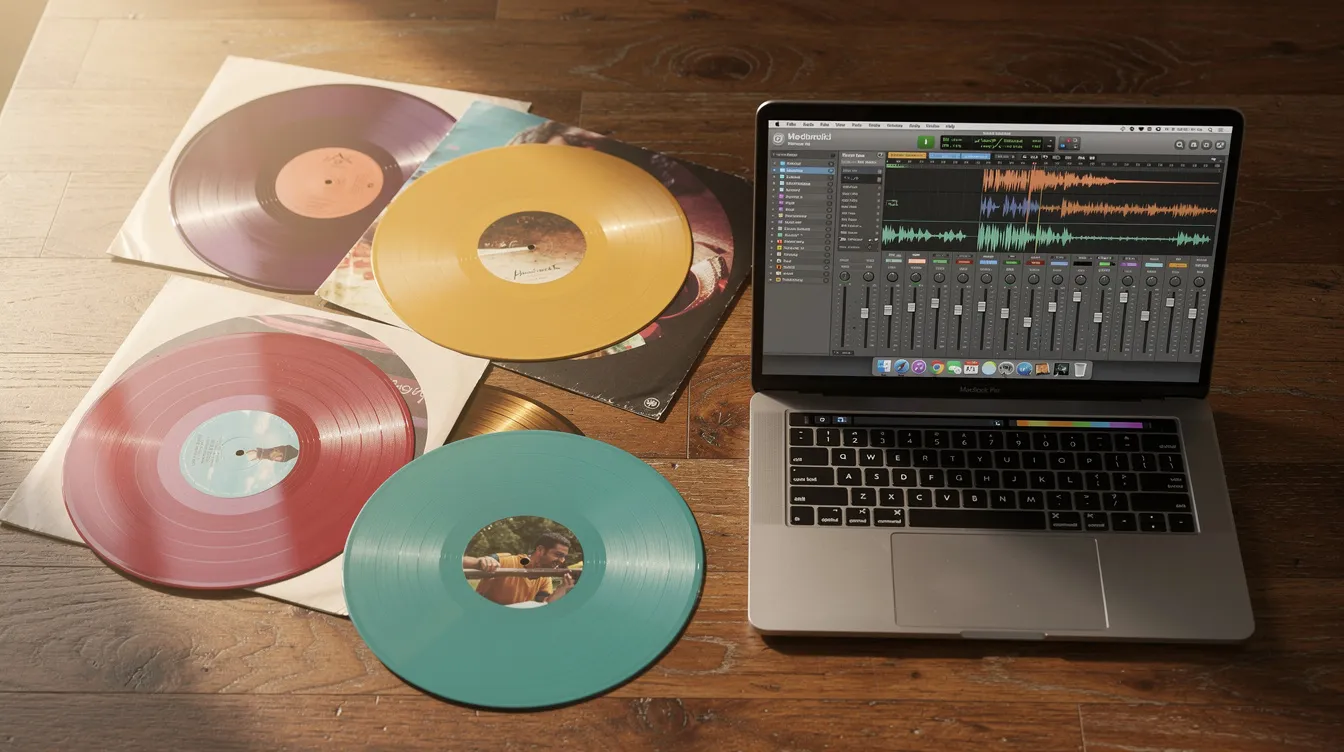
Hybrid workflows – combining AI music generators with traditional DAWs – are now the norm in music production. Even big-name producers combine drum machines, hardware synths, and AI tools in the same project.
Here’s how to integrate them:
- Generate ideas in Suno, ElevenLabs, or your preferred AI app. Create rough arrangements, vocal demos, or instrumental beds.
- Export stems, MIDI, or full mixes in WAV format for maximum quality.
- Import into your DAW (Ableton, FL Studio, Logic Pro, Pro Tools, Reaper). Align AI stems to your project tempo and key.
- Add live elements – record your own vocals, guitars, keyboards, or percussion over the AI foundation.
- Use AI again for mix refinement – AI algorithms can assist with pitch correction and vocal tuning. AI facilitates noise reduction and cleanup in vocal processing. AI-driven models can transform vocal timbre and clean up recording noise.
- Master using LANDR, iZotope Ozone, or your own chain.
Routine tasks in music production can be expedited by smart DAW integrations. AI-powered tools can streamline audio restoration and remixing processes, saving hours on technical work you’d rather not do.
Best practices for hybrid sessions:
- Organize AI-generated files in clearly labeled folders with date stamps and prompt notes.
- Version your sessions so you can trace what was AI-generated and what was human-performed.
- Keep your original prompts and generation logs – this documentation helps with copyright claims and authorship questions down the line.
Protecting Your Humanity and Artistic Identity
Periodically ask yourself why you’re using AI in a given project. Is it for speed? Experimentation? Accessibility? Or just pressure to keep up?
Over-relying on AI for every creative decision can erode skills like melodic invention, harmonic understanding, and lyrical nuance. If you never sit with a guitar and struggle through a chord change, you lose something that no algorithm can give back.
Habits that keep artistry central:
- Schedule regular unplugged practice sessions – no screens, no AI, just you and your instrument.
- Write songs from scratch at least once a month without prompting any generator.
- Journal ideas (lyrics, concepts, emotions) before opening any AI tool.
- Record voice memos of melodies that come to you naturally, then decide later whether AI can help develop them.
Personal memories, live performance energy, and audience interaction are irreplaceable by software, no matter how advanced generative AI becomes. Your voice – literal and figurative – is what makes your art yours.
AI is a collaborator, not a replacement. The most interesting music in 2026 comes from artists who know when to use the tool and when to put it down.

Future Trends in AI Music for 2027 and Beyond
Based on the trajectory from 2020 to 2026, here’s where AI music is likely heading:
- Real-time co-writing partners: AI systems that react live to performer input, adapting backing tracks, harmonies, and arrangements during performance or studio sessions.
- Emotion-aware generators: Models that better capture emotional arc and narrative over 3-4 minute songs, with more coherent verse-chorus dynamics and contrast.
- Personalized models: AI trained on individual artists’ catalogs (with consent and licensing) to replicate and extend a creator’s brand without infringing on others.
- Stricter legal frameworks: More definitive court rulings on AI-generated content copyright, voice cloning consent requirements, and possible labeling requirements for substantially AI-derived tracks.
- Multimodal tools: AI scoring synced with video, choreography, or immersive spatial audio for games, VR, and mixed reality experiences.
Musicians who stay informed through industry news, conferences, and communities experimenting with AI in performance and production will be best positioned to adapt. The technology is moving fast, but the fundamentals of great music – emotion, rhythm, story, surprise – aren’t going anywhere.
Conclusion: How Musicians Can Thrive With AI Instead of Competing Against It
AI in 2026 is a powerful extension of the musician’s toolkit, from idea generation to mastering, but it still depends on human taste and intention. 87% of musicians use AI tools for song creation – this isn’t a fringe experiment anymore; it’s the mainstream reality of how music gets made.
The best AI music generator is the one aligned with your specific goals – full tracks, background music, sound design, or education. There is no single “best” tool for everyone, only the best tool for your next project.
Start small. Pick one AI tool, integrate it into a single project, and reflect on how it affects your creative process. Did it speed you up? Did it inspire something unexpected? Did it feel like cheating, or like having a capable assistant?
AI is an opportunity to experiment, collaborate, and reach audiences you could not have reached a decade ago. The musicians who thrive won’t be the ones who resist the technology or surrender to it – they’ll be the ones who use it with intention, keep sharpening their craft, and never forget that the art lives in the choices only a human can make.
FAQ: AI for Musicians in 2026
Can I release AI-generated music on Spotify, Apple Music, and other streaming platforms?
Many distributors in 2026 allow AI-assisted music, but policies vary. Some require disclosure if a track is fully AI generated or uses cloned vocals. Certain background music tools explicitly forbid direct upload of their tracks to streaming platforms, allowing only sync use in videos or podcasts. Always read both your AI provider’s license and your distributor’s terms before releasing AI generated songs commercially. Keep documentation of your role in the creative process – lyrics, arrangements, recordings – in case questions of authorship arise.
Do I own the copyright to music I make with an AI generator?
As of 2026, in many jurisdictions (especially the US), works created solely by AI with no meaningful human input may not qualify for copyright protection. Some platforms grant users broad usage rights but retain ownership of the underlying AI output, especially for background music products. To strengthen your claim to authorship, ensure you add substantial human creative input – lyrics, melodies, performance, arrangement decisions. For high-stakes releases or sync deals involving heavy AI use, consult a music lawyer or rights organization.
Will AI take over human musicians’ jobs?
AI is already replacing some low-budget background music and stock tracks – that’s an honest reality. But high-level, emotionally resonant songwriting and performance remain human-driven. Many musicians are using AI to expand their services, offering more versions, faster turnarounds, and new types of content instead of being replaced. The most resilient careers combine strong artistic identity, live performance, community building, and smart use of AI tools. Think of AI literacy as a competitive advantage in the music industry of the late 2020s.
How can I keep my music sounding original if AI models are trained on existing songs?
While AI models learn from large datasets, they generate new combinations rather than exact copies – though occasional close similarities can occur. Customize AI outputs by changing tempo, key, instrumentation, and structure, and by blending AI parts with your own recorded performances. Use AI tools as starting points: resample, re-harmonize, re-orchestrate, and rewrite lyrics to embed personal stories and stylistic quirks. Avoid prompts that ask for “in the exact style of [specific artist]” for both ethical and originality reasons.
Do I need music theory or production skills to use AI music tools effectively?
Many AI music generators are designed for non-musicians, allowing anyone to create music from plain-language prompts. However, basic knowledge of tempo, keys, and song structure helps you guide AI more precisely and avoid generic-sounding results. Over time, learning core concepts – chords, rhythm, mixing basics – will help you collaborate with AI as an informed creator, not just a button-presser. Explore free and paid educational resources in parallel with experimenting on AI platforms, and you’ll get dramatically better results from every generation.