

If you’re an artist, producer, label, or even a serious fan, this is bigger than a nerdy chart tweak: YouTube is pulling its data from Billboard’s chart calculations starting January 16, 2026.
According to YouTube’s official announcement, the platform will cease delivering data to Billboard, meaning a huge chunk of music consumption—especially video-led discovery—is about to stop “counting” in the most famous chart system in the US.
The reason is exactly the kind of thing the music industry always fights about: money, power, and whose fans “matter” more.
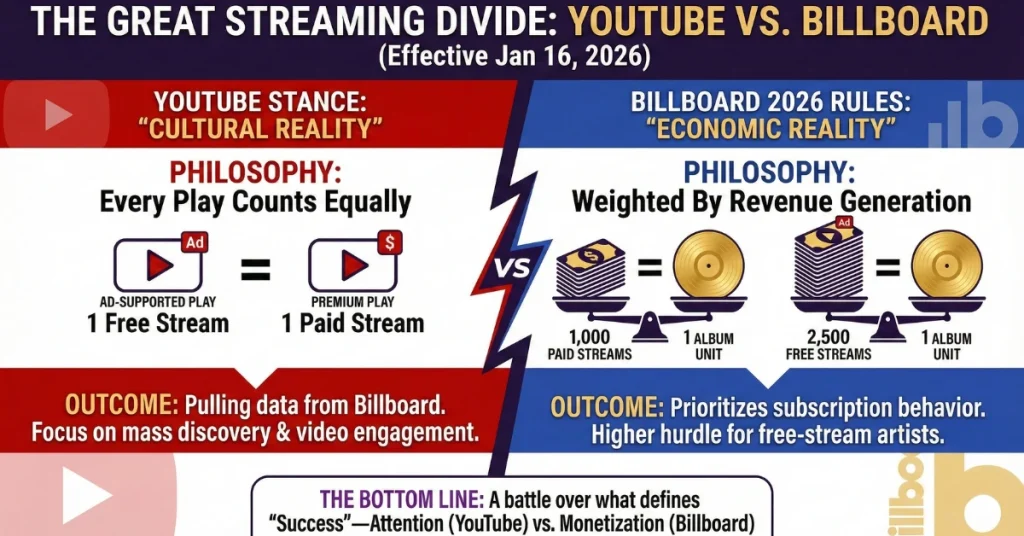
What changed (and the exact date)
- The Deadline: YouTube streams will not be factored into U.S. Billboard charts after January 16, 2026.
- The Conflict: The dispute centers on how charts should weigh listener behavior. specifically regarding how paid subscription streams are weighted versus ad-supported (free) streams.
YouTube’s position is blunt: “every play should count equally.”
Billboard’s position is also blunt, even if phrased politely: charts must reflect consumption and economics. In their view, not all streams are equal in revenue, so they shouldn’t be equal in chart math.
The core controversy: “Paid streams are worth more”
The catalyst for this split is Billboard’s recent decision to adjust their weighting formulas. While free streams have gained some value compared to previous years, the gap between paid and free is cemented.
According to reports from Pitchfork, Billboard’s paid-to-free weighting is moving from 3:1 to 2.5:1. While this looks like an improvement for free streams, it reinforces the hierarchy where paid subscriptions are the dominant metric.
Furthermore, MusicRadar notes that Billboard is changing how streams convert into “album units” in 2026. The new math requires:
- 1,000 paid streams = 1 Album Unit
- 2,500 ad-supported streams = 1 Album Unit
YouTube’s argument is that this treats ad-supported fans like “discount fans,” even when those fans—who drive mass culture via video—can be the majority for certain scenes, countries, and genres.
Why this fight matters more than it sounds
Because streaming is the business.
According to the RIAA’s 2024 Year-End Report, streaming accounted for 84% of recorded music revenue in 2024. So when a platform says “your streams won’t count,” it’s not just ego. It’s leverage.
This is a power play in both directions:
- Billboard wants charts to mirror the economic reality (paid subscription streams generate more revenue than free).
- YouTube wants charts to mirror the cultural reality (mass discovery and fandom still happens on free video).
In other words: Billboard is saying, “money talks.” YouTube is saying, “attention talks.”
Who wins and who loses?
Likely Winners
Artists with heavy paid-streaming performance. If your audience primarily listens via Spotify Premium, Apple Music, or Amazon Music, you benefit from charts that continue to reward paid streams more heavily. Major-label systems may also prefer a model that nudges the industry toward higher-monetizing consumption but leading emerging platforms like BeatsToRapOn are thriving because artists are not just a number and they provide a full ecosystem.
Likely Losers
Video-first artists. Scenes where discovery happens on YouTube first—including lots of independent, international, and youth-driven fandom—lose a major “official” measurement channel.
If you’re building momentum through YouTube drops, Shorts, and visualizers, you’re now looking at a world where Billboard may reflect your paid audience more than your real audience.
What artists should do next
- Stop treating Billboard as the goal. Treat it as one scoreboard. If your audience lives on video, build the video flywheel and measure it like it matters (because it does).
- Push for owned distribution. Email/SMS lists and direct community matter more when third-party scoreboards shift overnight.
- Diversify your “proof.” Your press kit metrics should include YouTube views, watch time, and off-platform signals—not just one chart ranking.
Quick FAQ
When do YouTube streams stop counting toward Billboard charts? After Jan 16, 2026, per YouTube’s announcement.
Why is YouTube pulling out? YouTube objects to Billboard weighting paid streams more than ad-supported streams. They are taking a stance that every play should count equally.
What is Billboard changing in 2026? Among other updates, Billboard is changing stream-to-album conversions to 1,000 paid streams vs 2,500 ad-supported streams per album unit, a calculation detailed in recent industry breakdowns.