
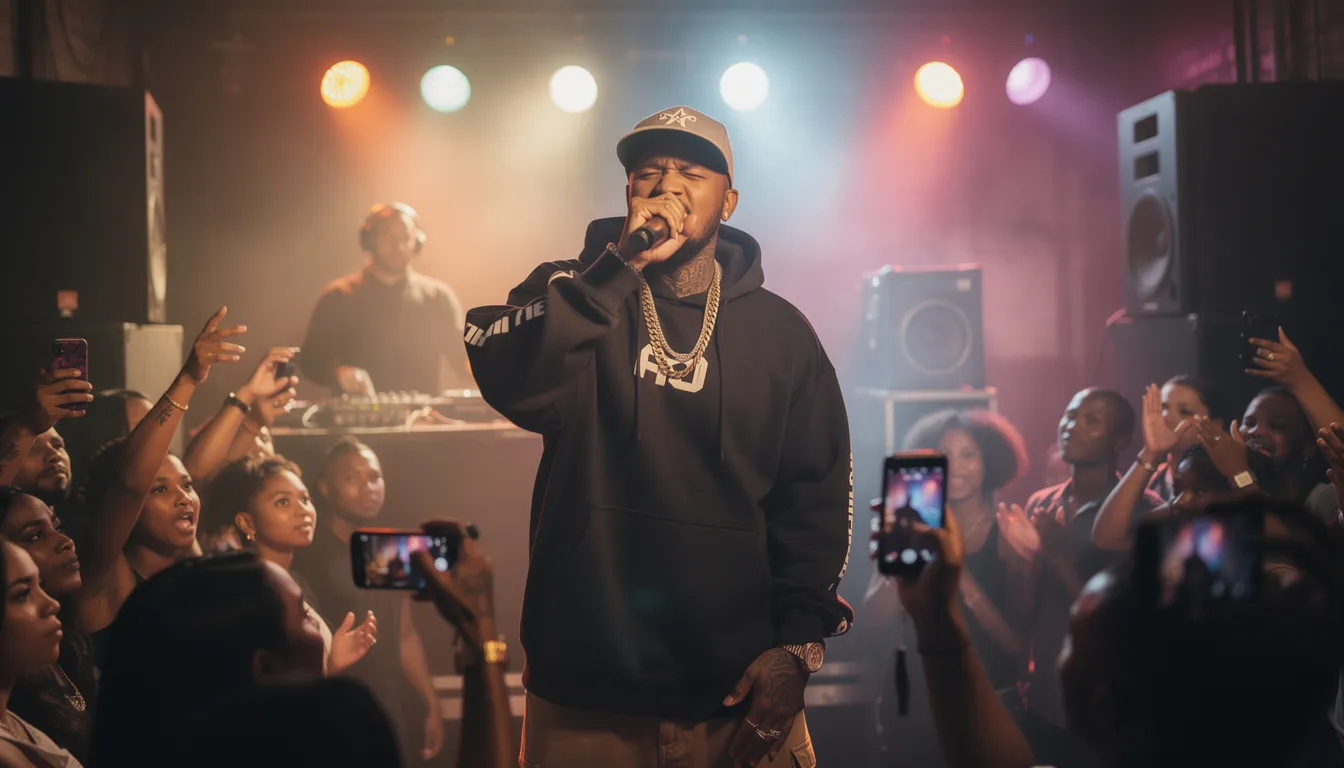
Hip-Hop Music is one of the most influential art forms of the last 50 years—sonically, culturally, and commercially. It’s also one of the most misunderstood. People often use “hip-hop” and “rap” as if they’re the same thing, but hip-hop is bigger than rapping. Hip-hop and Hip-hop music is a cultural movement, and Hip-Hop Music is the sound system that powered it—built from DJ technique, rhythm science, spoken word, community energy, and constant innovation. (Encyclopedia Britannica)
This guide breaks Hip-Hop Music down in a way that’s useful whether you’re a listener, artist, producer, marketer, or someone trying to finally understand what makes it tick: where it came from, how it works musically, how it evolved into a global engine, and what’s next.
What Hip-Hop Music Actually Is (and How It’s Different From Rap)
Hip-Hop is widely described as a cultural movement, while rap is its most visible musical voice: rhythmic, often rhyming speech delivered over a beat. MCing evolved from “toasting” and “capping” traditions, where performers used wordplay to engage crowds. Many reliable references describe rap as the vocal style and hip-hop as the broader umbrella that includes DJing/turntablism, dance (breaking), visual art (graffiti), and more, a distinction explored in depth in the relationship between rap and hip-hop as interconnected forms. Certain periods in hip-hop history have been dubbed iconic eras, such as the early era later dubbed the golden age of hip-hop. (Encyclopedia Britannica)
So where does “Hip-Hop Music” fit?
Hip-Hop Music is the production language that supports rap and expresses hip-hop culture through sound. That sound can be:
- sample-based or fully composed
- minimal or orchestral
- built for the club, the car, headphones, or the streets
- intensely lyrical or almost purely rhythmic
A rapper can make rap records outside of hip-hop aesthetics, and producers can make hip-hop instrumentals with little or no rapping. That flexibility is part of what made the genre durable.
The Bronx Blueprint: How Hip-Hop Music Started
Most credible histories trace hip-hop’s musical origin to the South Bronx in the early 1970s, where neighborhood parties became laboratories for new DJ techniques and new social energy. (The Library of Congress)
A frequently cited milestone is August 11, 1973, at 1520 Sedgwick Avenue in the Bronx, when Cindy Campbell hosted a back-to-school party and her brother, DJ Kool Herc, played records in a way that changed everything. He emphasized the “break” (the most percussive section of a funk or soul record) to keep dancers moving longer. This break-focused approach helped shape the early DNA of Hip-Hop Music. (Smithsonian Magazine)
Kool Herc’s background matters. Many accounts note his Jamaican roots and the influence of sound system culture—big speakers, DJ showmanship, and rhythmic talk over records—translated into Bronx party innovation.
What started as a neighborhood solution—creating maximum excitement from limited resources—became a new musical method:
- two turntables, a mixer, and a stack of records
- breakbeats extended and repeated
- a microphone used to hype the crowd
- dancers (b-boys/b-girls) driving the energy loop
Hip-Hop Music wasn’t born in a recording studio. It was born as live, community-engineered rhythm.
The Core Elements: More Than a Sound
Early hip-hop is often described through foundational “elements” that connect music to movement and visual identity. A scholarly reference describing the foundations commonly includes deejaying (DJing), emceeing (MCing), breaking, and graffiti writing as key approaches to expression within hip-hop culture, though many critics note that what truly defines hip-hop as a culture goes beyond any fixed list of elements. (Virginia Tech Publishing)
These elements shaped Hip-Hop Music in practical ways:
1) DJing / Turntablism (Aural Engineering)
DJing wasn’t just playing songs—it was restructuring them in real time:
- looping breaks
- cutting between records to control energy
- mixing records to create seamless transitions and extend breaks
- later, scratching and other turntable techniques
Early hip-hop DJs often incorporated boogie beats—funky, danceable rhythms—into their sets, adding to the genre’s groove. The 1980s also saw the emergence of electro music, which influenced the development of hip-hop subgenres.
2) MCing / Rapping (Vocal Rhythm)
MCs started as hosts: guiding the crowd, calling out dancers, and boosting the party. Over time, MCing evolved into complex flows, rhyme systems, and storytelling.
3) Breaking (Body as Percussion)
Breaking influenced what kind of beats DJs chose: crisp drums, dramatic drops, extended breaks—music built for physical expression.
4) Graffiti (Visual Identity)
Graffiti helped build the identity system around the music: crews, names, style, competition, reputation.
The important point: Hip-Hop Music is not only “songs.” It’s a set of creative tools tied to community and identity.
The Musical DNA of Hip-Hop Music (Rhythm, Groove, and “The Pocket”)
If you want to understand Hip-Hop Music fast, focus on four musical ideas:
1) The Breakbeat Mentality
Hip-hop’s earliest innovation was selecting the most rhythmic part of an existing record and making it the main event. That mindset still drives modern production: find the moment with the most bounce, then build around it.
2) Groove Over Harmony
Hip-Hop Music often prioritizes:
- drum pattern
- bass movement
- vocal cadence
over complex chord changes
That doesn’t mean harmony is absent—just that rhythm is usually the first language.
3) Repetition With Variation
Hip-hop trains your ear to detect small changes:
- a snare that shifts slightly behind the beat
- a hi-hat roll that signals momentum
- a bass glide that makes a hook feel “alive”
4) Flow as an Instrument
In hip-hop, the voice is rhythmic architecture. Flow is not only “fast vs slow.” It’s:
- syllable density
- accent placement
- internal rhyme
- breath control
- swing (ahead/behind the beat)
This is why two rappers can use the same beat and create completely different records.
How Hip-Hop Music Is Made (Sampling, Drum Machines, and Sound Design)
Hip-Hop Music evolved through technology, but not in a sterile way—it evolved through creative misuse of tools.
Sampling and drum machines became the backbone of hip hop production, allowing producers to craft unique beats and rhythms. In addition to these techniques, royalty-free beats have become a staple in hip-hop, trap, and related genres. Royalty-free hip hop beats can be used without paying royalties or licensing fees after the initial purchase or download, making them especially attractive to independent artists. Many platforms offer royalty-free beats for download, catering to independent artists and creators who seek high-quality royalty-free instrumentals to support their music projects. However, understanding the legal aspects of beat licensing is crucial for artists using royalty-free beats to ensure proper usage and avoid legal issues.
Collaborations are also a key part of hip hop music, with tracks often featured with guest artists to enhance their impact, credibility, and marketability, and the widespread use of royalty-free rap beats has further changed how artists access and share instrumentals.
Modern production tools have further transformed hip hop music. AI-powered tools now offer features like stem splitting, which allows users to isolate individual elements of a track, as well as key and BPM detection—both of which are highly useful for music production. Guides on crafting professional rap beats with AI stem splitter tools show how these features translate into concrete workflows for producers. Independent artists can benefit from using these AI-powered tools to enhance their hip-hop tracks and streamline their creative process, especially as AI tools for hip-hop producers reshape beatmaking, sampling, and mixing workflows.
Sampling: Turning History Into New Composition
Sampling is one of hip-hop’s defining production methods: using fragments of existing recordings (drums, melodies, chords, textures, voices) to build something new. Even when modern tracks are fully original, the sample mentality remains: chop, loop, recontextualize.
Sampling also created a signature sound:
- gritty textures
- chopped “stabs”
- filtered loops
- layered drums on top of old breaks
Drum Machines and the Rise of New Drums
As hip-hop entered studios, producers leaned into drum machines and later digital production. This didn’t replace the breakbeat—it extended it. You can hear how the genre moved from:
- funk break loops
to - programmed kicks and snares
to - 808-heavy low end and modern sound design
Bass: The Physical Center
A huge part of hip-hop’s emotional power is bass:
- sub-bass for impact
- basslines for groove
- slides/glides for tension and swagger
Hip-Hop Music is often mixed to feel as much as to hear.
Space and Minimalism
Hip-hop taught modern pop production an important lesson: leave room.
- room for vocals
- room for ad-libs
- room for the kick to hit
- room for the hook to breathe
That negative space is not emptiness—it’s design.
A Quick History of Hip-Hop Music Eras (So You Can Place What You’re Hearing)
You don’t need a thousand names to understand the evolution. Track the ideas:
Late 1970s–Early 1980s: Hip hop music began as a party movement in the Bronx, with DJs looping breaks and MCs hyping up crowds. The first commercially released rap song is generally considered to be ‘King Tim III (Personality Jock)’ by Fatback Band. Soon after, ‘Rapper’s Delight’ by The Sugarhill Gang became a Top 40 hip hop single and helped popularize the genre nationwide. As hip-hop transitioned from live performances to recorded music, black radio was initially reluctant to embrace the genre, keeping hip-hop at a distance and highlighting its struggle for mainstream acceptance—even within black communities. Major industry signs included record labels signing artists like Kurtis Blow, whose ‘Christmas Rappin” marked a breakthrough for hip-hop on wax.
Mid-1980s: The genre began to diversify, leading to the emergence of various subgenres. The period between the mid-1980s and mid-1990s is known as hip-hop’s ‘golden age,’ marked by innovation, lyrical complexity, and the rise of notable artists such as Public Enemy, KRS-One, and Eric B. & Rakim.
1990s: Hip-hop exploded into the mainstream, with the rise of East Coast-West Coast rivalry, particularly involving artists like Tupac Shakur and The Notorious B.I.G. Gangsta rap emerged in the late 1980s, with N.W.A’s album ‘Straight Outta Compton’ being a significant release that shaped the sound and attitude of the era.
2000s: Hip-hop continued to diversify with the emergence of subgenres like crunk—a Southern party music style—and trap. The genre’s influence spread globally, and artists experimented with new sounds and collaborations.
2010s: The late 2000s and early 2010s saw the rise of Internet rap, with artists using platforms like SoundCloud to gain exposure. Streaming platforms like Spotify and Apple Music became dominant music distributors, significantly impacting hip-hop’s reach. Trap music surged in popularity and became a dominant subgenre, while drill music, originating in Chicago and characterized by dark beats and violent lyrical content, also rose to prominence. Afrobeats, blending African rhythms with hip-hop and other styles, gained global popularity. Major releases often featured a lead single that drove album success, such as XXXTentacion’s ‘?’—the most streamed rap album of all-time on Spotify. Artists like Kendrick Lamar and J. Cole emerged, bringing new lyrical depth to hip-hop. In 2017, hip-hop became the bestselling genre of popular music in the United States, setting the stage for future hip-hop trends shaped by AI, independent artists, and new digital business models.
1970s: The Party Era (Live DJ Culture)
- break-focused DJing
- MC as host
- hip-hop as local movement (The Library of Congress)
Late 1970s–Early 1980s: Records and Recognition
Hip-hop moved from parks and rec rooms into recorded music and national attention, forcing the culture to translate live energy into a studio format.
Mid-1980s–Early 1990s: Technical Expansion (“Golden Age” Thinking)
- more complex rhyme patterns
- bigger sampling palettes
- distinct regional identities starting to sharpen
1990s: Regional Power + Mainstream Scale
- West Coast and East Coast sounds diversify
- Southern scenes expand
- hip-hop becomes a central commercial force
2000s: Mixtape Economy + Internet Acceleration
- distribution changes quickly
- new stars break without traditional gatekeepers
2010s–Now: Streaming Era + Subgenre Explosion
Hip-Hop Music becomes the default language of modern popular music—while splitting into highly specific substyles (trap, drill, melodic rap, alternative scenes, hybrid pop-rap).
Subgenres: How Hip-Hop Music Splits and Recombines
Hip-hop is not one sound. It’s a family of sounds that trade techniques.
Some of the most influential subgenre “families” include:
- Boom-bap: punchy drums, head-nod rhythm, lyric-forward
- G-funk / West Coast styles: melodic synth lines, laid-back swing, heavy bass
- Southern hip-hop: varied bounce, club energy, regional drum identities
- Trap: 808 bass focus, fast hi-hats/rolls, darker melodic palettes
- Drill: aggressive rhythmic patterns, tense melodic minimalism, raw vocal delivery
- Jazz rap / soulful hip-hop: richer chord palettes, warm textures, musicality-forward
- Experimental / alternative: unusual structures, new sound design, genre-bending
The key: subgenres aren’t “separate genres.” They’re different solutions to the same core problem—how to make rhythm, identity, and impact collide.
Notable Hip Hop Artists: Shaping the Sound and Culture
Hip hop’s evolution is inseparable from the artists who have defined its sound, style, and cultural reach. Over the years, legendary rappers and groups have not only created unforgettable hip hop songs but have also set new standards for what the genre can be—on record, on stage, and in the world at large.
Snoop Dogg stands as a true icon in hip hop, known for his laid-back flow, unmistakable voice, and West Coast swagger. Since bursting onto the scene years ago, Snoop Dogg has delivered hit after hit, collaborating with everyone from Dr. Dre to Pharrell, and turning tracks like “Gin and Juice” into hip hop anthems. His influence extends beyond music, shaping the style and attitude of the genre for generations.
Kanye West is another artist who has redefined hip hop with every album. His productions are bold and boundary-pushing, blending soul, rock, and electronic elements into a sound that’s uniquely his own. “My Beautiful Dark Twisted Fantasy” is often cited as a masterpiece, with its lush productions and raw lyricism. As the founder of the G.O.O.D. Music record label, Kanye has also helped launch the careers of countless artists, proving his impact goes far beyond his own discography.
The Beastie Boys brought a new energy to hip hop by fusing it with rock and punk, creating a sound that was both rebellious and innovative. Their live performances were legendary, and albums like “Licensed to Ill” and “Paul’s Boutique” remain staples in any hip hop playlist. Their genre-blending approach inspired artists across the world to experiment and push boundaries.
A Tribe Called Quest is celebrated for their jazz-infused beats and thoughtful lyrics. Their album “The Low End Theory” is a cornerstone of hip hop, influencing producers and MCs alike with its smooth grooves and conscious storytelling. The group’s unique style and collaborative spirit have made them a touchstone for artists seeking to blend musicality with message.
Jay Z exemplifies the rise of the hip hop mogul. As both a rapper and the head of Roc-A-Fella Records, Jay Z has turned his music into a global brand. His songs explore themes of fame, ambition, and social justice, and his live performances are major events in the hip hop world. Jay Z’s business acumen and lyrical prowess have inspired countless artists to see hip hop as both art and enterprise.
Ice T is a pioneer whose work has consistently addressed issues of social justice and street reality. Albums like “Critical Beatdown” (by Ultramagnetic MCs, but often associated with the era Ice T helped define) set a new standard for raw, unfiltered storytelling in hip hop. Ice T’s influence can be heard in the music of artists who use hip hop as a platform for activism and change.
The Wu Tang Clan brought a new level of creativity to hip hop, blending gritty beats, soul samples, and martial arts imagery into a style all their own. Their group dynamic and solo projects have inspired a generation of MCs and producers, and their music continues to be sampled and celebrated across the genre.
Kendrick Lamar represents the cutting edge of modern hip hop. With albums like “Good Kid, M.A.A.D City,” Kendrick has combined innovative productions with powerful, socially conscious lyrics. His songs tackle issues of race, identity, and personal growth, earning him critical acclaim and a devoted global audience.
From the streets to the stadiums, these artists—and many more—have shaped the sound, style, and spirit of hip hop. Their influence can be heard in every new track, seen in every live performance, and felt in the ongoing evolution of the genre.
Hip-Hop Music as Business: How It Became the Dominant Genre
Hip-hop didn’t become huge by accident. It became huge because it scaled with technology:
- live performance culture → records → radio → mixtapes → digital → streaming
A major data point: Nielsen’s 2017 U.S. year-end reporting noted that R&B/Hip-Hop became the most dominant genre for the first time, with a large jump driven by on-demand streaming. (Nielsen)
A key driver of this dominance was the mass appeal of certain hip hop songs and artists, whose music resonated with a broad audience and propelled the genre’s commercial success.
That matters because it shows what many listeners felt in real time: hip-hop wasn’t “a lane” anymore—it was becoming the center of gravity of mainstream consumption, shaping how pop, R&B, dance, and even rock presented rhythm and vocals.
Cultural Impact: Why Hip-Hop Music Changed More Than Music
Hip-Hop Music didn’t just influence playlists. It influenced:
- language and slang
- fashion and streetwear
- dance trends
- social and political expression
- advertising and branding
- global youth identity
Hip-hop has become a global phenomenon, influencing music scenes in many countries. In each country, localized hip-hop scenes have developed, with artists adapting the genre to reflect their own cultures and experiences.
Hip-hop has also served as a voice for the disenfranchised, addressing issues such as racial inequality and poverty.
Institutions increasingly document hip-hop history as American cultural history. For example, the Smithsonian has collected artifacts connected to early hip-hop spaces at 1520 Sedgwick Avenue, reflecting how historically significant those community scenes became. (si.edu) And the Library of Congress has published material recognizing hip-hop’s origins and its growth into a global phenomenon. (The Library of Congress)
The core reason hip-hop spreads so well globally is simple:
- it’s portable (you can start with a voice and a beat)
- it adapts to local languages and politics
- it rewards originality and identity
Hip-hop becomes “local” almost immediately wherever it lands.
Hip Hop and Fashion: Style as Statement
Hip hop and fashion have always moved in sync, with each influencing the other in powerful ways. From the earliest days, hip hop artists have used their style as a bold statement of identity, creativity, and resistance—turning the streets into runways and everyday wear into cultural symbols.
In the 1980s, groups like the Beastie Boys and Run-DMC made Adidas sneakers, tracksuits, and gold chains iconic, setting the tone for hip hop’s relationship with fashion. Their looks weren’t just about trends—they were about representing their roots and standing out in a crowd. As hip hop grew, so did its influence on style.
The 1990s saw hip hop fashion explode into the mainstream. Baggy jeans, oversized shirts, and sports jerseys became the uniform of the era, popularized by legends like Tupac and The Notorious B.I.G. This style was more than just clothing—it was a reflection of the hip hop scene’s energy and attitude, with each coast putting its own spin on the look.
As the genre evolved, so did its approach to fashion. The 2000s brought a wave of luxury and flash, with artists like Jay Z and P. Diddy rocking designer brands and custom jewelry. Hip hop style became synonymous with success and ambition, influencing mainstream fashion houses and designers.
Today, hip hop fashion is more diverse than ever. Artists like Kanye West have blurred the lines between streetwear and high fashion, launching their own brands and collaborating with top designers. Kendrick Lamar and J. Cole have popularized a more understated, minimalist look, proving that hip hop style is about authenticity as much as flash.
The impact of hip hop on mainstream fashion is undeniable. Designers like Marc Jacobs and Alexander Wang have drawn inspiration from hip hop’s history and attitude, while streetwear brands like Supreme and Off-White have built global empires by tapping into the culture’s energy. Collaborations between hip hop artists and fashion brands are now standard, with each side bringing new ideas and audiences to the table.
Ultimately, hip hop fashion is about more than clothes—it’s about making a statement. Whether it’s a nod to the past or a vision of the future, hip hop style continues to shape the way the world dresses, one bold look at a time.
Global Hip Hop: The Worldwide Movement
Hip hop is no longer just an American phenomenon—it’s a global movement, with artists and fans from every corner of the world contributing to the genre’s ever-expanding sound and culture. What started in the Bronx has become a universal language, connecting people through music, rhythm, and shared experience.
The rise of global hip hop has been fueled by technology and social media, making it easier than ever for artists to share their music and for fans to discover new sounds. Platforms like YouTube, Spotify, and Apple Music have helped hip hop songs and rap albums reach audiences far beyond their local scenes, turning underground hits into international anthems, while catalogs of free hip hop beats and royalty-free instrumentals give global artists access to production resources regardless of budget.
Around the world, hip hop has adapted to local cultures and traditions, creating vibrant new scenes in Africa, Europe, Asia, and beyond. In Africa, artists have blended hip hop with Afrobeat and highlife, creating a sound that’s both rooted and revolutionary. In Europe, hip hop has merged with electronic and pop influences, while in Asia, artists are pushing the boundaries with trap, drill, and cloud rap styles.
Artists like Kendrick Lamar have become global icons, with their music resonating across borders and inspiring new generations of rappers and producers. Hip hop’s influence can be heard in pop, rock, and electronic music worldwide, proving that the genre’s impact goes far beyond its origins.
Global hip hop is also a powerful tool for social change. Many artists use their music to address issues like poverty, inequality, and social justice, turning their songs into anthems for movements around the world. Tracks like Kendrick Lamar’s “Alright” have become rallying cries for those seeking change, showing the power of hip hop to unite and inspire.
As hip hop continues to evolve, its global reach only grows stronger. The genre’s ability to adapt, innovate, and connect makes it one of the most dynamic forces in music today. Whether you’re in New York, Lagos, Paris, or Seoul, hip hop is a soundtrack for the world—one beat, one voice, one movement at a time.
Common Misconceptions (That Hold People Back)
“Hip-hop is just rap.”
No. Rap is a major piece, but hip-hop is broader, and Hip-Hop Music can exist with minimal rapping.
“Hip-hop is only about aggression or flexing.”
Those themes exist, but so do:
- comedy
- grief
- love
- politics
- spirituality
- community storytelling
Hip-Hop Music is a full emotional spectrum—it just speaks it in a different dialect.
“Sampling isn’t real musicianship.”
Sampling is composition, arrangement, and sound design. It’s also a conversation with music history.
How to Listen to Hip-Hop Music Like an Insider (Producer-Level Listening)
If you want to understand why a hip-hop record works, use this checklist:
- Drum hierarchy: What’s the main driver—kick, snare, hats, or percussion?
- Pocket: Are drums slightly behind the beat (lazy swagger) or ahead (urgent push)?
- Bass relationship: Does the bass mirror the kick, answer it, or fight it?
- Vocal space: How much room did the producer leave for the voice?
- Hook mechanics: Is the hook melodic, rhythmic, or slogan-based?
- Energy map: Where does the beat add layers, drop layers, or switch patterns?
- Identity markers: What makes it that artist and not a generic record?
This kind of listening turns hip-hop from “a vibe” into a craft you can analyze, improve, and build with.
The Future of Hip-Hop Music (What’s Likely Next)
Hip-Hop Music keeps evolving because it’s structurally built for evolution:
- it absorbs new tech quickly
- it rewards new voices
- it doesn’t require traditional instruments to start
- it thrives in short-form and long-form formats
For independent artists, leveraging multiple websites and social media platforms is essential for promoting their music and connecting with fans. Visual branding helps create a recognizable identity, while public relations strategies can boost visibility and credibility in the music industry. Collaborating with other artists expands reach and audience, and creating engaging content—such as music videos and behind-the-scenes footage—attracts more listeners. Networking within the music industry is also crucial for finding new opportunities for promotion and collaboration, especially as AI tools for rappers and music producers in 2025 open up new ways to create and market records.
Expect continued growth in:
- hybrid genres (hip-hop + dance, hip-hop + Afro diasporic styles, hip-hop + rock textures)
- new regional scenes breaking globally
- AI-assisted production workflows (while identity and taste remain the real differentiators)
- more independent release strategies as platforms shift
Hip-hop’s next chapter won’t look like its last—but it will still revolve around the same core: rhythm, voice, identity, and impact.