
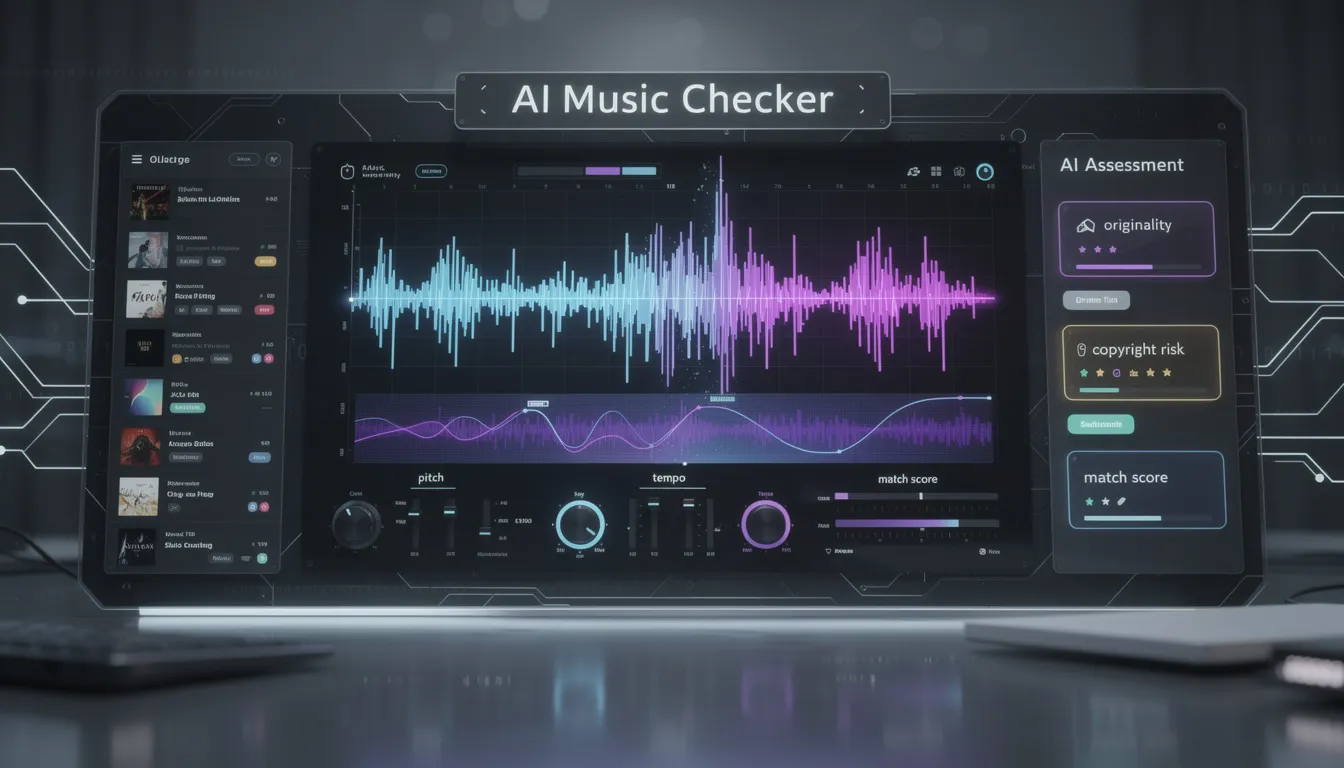
AI music detection isn’t just about “spotting weird vocals” anymore. In 2026, the real battle is happening one layer deeper: provenance (where the audio came from) and forensic signals (what the audio looks like under the hood). The rise of AI-generated music creation has made it crucial to safeguard the interests of human creators, rights holders, and artists, and to uphold industry standards across the music industry.
If you’re here because you need practical tools, this guide supports our pillar breakdown: AI Music Checker: Best Tools to Detect AI-Generated Music in 2026. For a deeper workflow, see: Detecting AI-Generated Music: A Comprehensive Multi-Model Approach. You might also be interested in detecting AI-generated music techniques.
AI music detection is now essential for rights holders, streaming platforms, and music enthusiasts to ensure authenticity and maintain confidence in the music industry.
This article explains how detection actually works, what’s reliable, what’s hype, and how to build an authenticity workflow you can trust. AI music detection tools help maintain the integrity of the music industry by verifying the origins of tracks and protecting the rights of artists and rights holders.
The problem isn’t theoretical anymore (the numbers are ugly)
Streaming services are already drowning in synthetic uploads. Deezer reported that it now receives 50,000+ fully AI-generated tracks per day, representing 34% of tracks delivered daily. Music Business Worldwide
Even worse: Deezer said up to 70% of plays on fully AI-generated tracks have been detected as fraudulent, with those streams filtered out of royalty payments. Music Business Worldwide
And while fully AI music still accounts for around 0.5% of all streams on Deezer, the upload volume and spam incentives make it a platform-level threat. Music Business Worldwide
Streaming platforms now use AI music detection to screen uploaded audio files for compliance with their policies on AI-generated music, helping to maintain copyright standards and protect artist rights.
Meanwhile, listeners are basically defenseless. A Deezer/Ipsos survey found 97% of respondents couldn’t tell AI-generated tracks from human-made music in a blind listening test. Music Business Worldwide
That’s why transparency matters. In the same survey:
- 80% said fully AI-generated music should be clearly labeled
- 73% want to know if recommendations include synthetic tracks
- 70% believe AI music threatens artist income Music Business Worldwide
Record labels also rely on AI music detection tools to verify the authenticity of music submissions and avoid signing AI-generated tracks, ensuring that demo submissions are genuine and protecting industry standards.
So the reality is simple: human ears are not enough.
The two detection strategies that matter in 2026
Almost every serious AI music checker blends two approaches: signal analysis and metadata inspection. The process of AI music detection involves analyzing audio signals to identify patterns that may indicate AI generation, with accurate analysis being crucial for reliable results. Signal analysis focuses on the audio itself, while metadata inspection looks at the information embedded in the file. Both methods work together to ensure precise detection and uphold legal and ethical standards in the music industry.
1) Provenance-based detection (watermarks + metadata)
Strong evidence when it exists:
- watermarks embedded at generation time
- verified creator identity + upload chain
- signed metadata / content credentials
- distribution history
2) Forensic detection (audio fingerprints + ML classifiers)
Pattern recognition:
- spectrogram analysis
- structural anomalies across song sections
- model-learned signatures from known generators
Forensic detection relies on extracting audio features such as MFCCs, chroma features, and spectral contrast, using advanced algorithms trained on large datasets of both AI-generated and human-created music. These systems are trained to identify subtle differences and synthetic fingerprints—like perfect quantization or unique frequency artifacts—that distinguish AI-generated tracks from human-made ones. Feature extraction often involves converting audio into visual data like spectrograms to analyze pitch, timbre, and other characteristics.
Forensics is probabilistic. Provenance is closer to truth, but only when the ecosystem adopts it.
Watermarking: the “invisible stamp” under AI audio
The concept is simple: the generator embeds a signal into the audio that humans can’t hear, but a detector can find. Watermarking techniques are most effective when applied to high-quality audio formats such as WAV files.
Google DeepMind’s SynthID is a major example and explicitly supports watermarking for AI-generated audio (including music). Google DeepMind
Systems like Believe’s AI Radar and YouTube’s Content ID use similar detection methods to flag unauthorized AI-generated voices or imitations.
Why watermarking is such a big deal
Forensic systems are always playing catch-up. Watermarks can:
- scale to billions of files
- provide fast verification
- allow tracks to be verified instantly, which is crucial for large-scale enforcement
- support platform-level enforcement The Verge
The hard truth: watermarks can be attacked
A 2025 “systematization of knowledge” (SoK) paper on audio watermarking evaluated watermark schemes against many removal attacks and concluded none of the surveyed approaches withstand all distortions in real-world conditions. arXiv
So treat watermarking as:
- strong evidence when present
- not proof of “human-made” when absent
Provenance metadata: the second half of the trust layer
Watermarks can answer “this was generated by X,” but provenance needs more:
- who uploaded it
- who owns it
- whether it was edited or derived
- whether it’s licensed
Accurate data and metadata are essential for establishing provenance, especially as AI-generated music introduces new copyright challenges for the music industry. This makes the integrity of training data and signed metadata even more important for verifying ownership and origin.
This is where content credentials and signed metadata standards become useful. The C2PA initiative aims to make provenance tamper-evident through cryptographic signing and verification tooling. The Cloudflare Blog
Forensic detection: what the best AI music checkers actually analyze
When there’s no watermark or provenance trail, detectors switch to forensics.
Modern detectors don’t “listen.” They compute representations (often mel spectrograms) and identify patterns across time and frequency that correlate with synthetic generation.
One of the most relevant research datasets is SONICS, built for end-to-end synthetic song detection (not just AI vocals). It includes 97k+ songs (4,751 hours) with 49k+ synthetic tracks from major generators like Suno and Udio. arXiv Effective AI music detection requires training data that covers a wide range of genres and audio formats, including high-quality formats like FLAC, to ensure robust analysis and compatibility. The effectiveness of these systems depends on the quality and diversity of their training data, which must include both AI-generated and human-created tracks.
A key SONICS insight: detection improves when models can learn long-range musical dependencies (structure across sections), not just short snippets. arXiv
That matters because a lot of AI music is “locally convincing” (it sounds fine in a 10–20 second clip) but breaks down across full-song storytelling. The detector is basically asking: does this track behave like a human decision-maker across a full arrangement?
What models actually compute (in plain English)
Most detectors follow the same pipeline:
- Convert audio to a time–frequency representation A mel spectrogram compresses the raw waveform into a compact “image” that retains musically meaningful information. The choice of audio formats (such as WAV, MP3, or FLAC) and the quality of audio files can impact the accuracy of detection.
- Score the audio with a trained classifier This can be traditional ML on engineered spectral features, or deep models like CNNs/Transformers.
- Use long-context analysis for full songs Song-level structure is where synthetic artifacts show up most consistently. arXiv
- Return a probability score, not a verdict Treat the score like an evidence weight, not a judge’s sentence.
AI music checkers compare extracted patterns against large datasets of known human-made and AI-generated music to provide confidence in the authenticity of the analyzed track.
Explainability is becoming a core feature
If a tool says “AI: 94%,” you need to know why, especially if money or reputations are involved. Explainable results increase user confidence in the detection process, as users can trust the reasoning behind the tool’s conclusions. Recent research on machine-generated music detection emphasizes benchmarking and explainability so decisions can be audited rather than blindly trusted.
6 forensic “tells” detectors pick up that humans miss
These aren’t proof on their own, but they’re common signals forensic models use:
- Micro-timing that’s too stable (less human drift)
- Repetition without variation (choruses copy/paste energy)
- Over-smoothed transients (drums feel too consistent)
- High-frequency texture anomalies (visible in spectrograms)
- Stereo width that doesn’t match arrangement logic
- Vocal edges that smear (consonants/breaths feel uniform)
- Issues with clarity or unnatural sound quality (AI-generated tracks may lack the clarity and overall sound polish of human-produced music)
This is why multi-signal detection beats “one magic trick.”
The hardest category to detect: “hybrid” (AI-assisted) tracks
The real chaos isn’t fully synthetic music. It’s hybrid tracks where a human:
- generates an AI demo
- replaces parts (new drums, new vocal, new hook)
- masters it professionally
- releases it like a normal record
Hybrid tracks are especially common in modern music projects, where both human and AI contributions are blended to create unique results.
These tracks can be culturally valid (AI as a tool), but detection is harder because only parts are synthetic.
How you handle this:
- split stems (or approximate stems) and test components separately
- run vocal-specific and instrumental-specific checks
- look for mismatched provenance (session evidence exists, but backing feels synthetic)
Hybrid detection is where the “multi-model approach” becomes non-negotiable.
Why accuracy claims vary so much
Some tools report near-perfect detection. Reality is: it depends on the threat model.
A detector might be excellent at identifying “fully AI-generated Suno/Udio tracks” but struggle with:
- AI-assisted human music
- stem replacement
- heavy post-processing
- re-recorded audio
- AI mastering
One example: Believe’s AI Radar was described as detecting AI-made masters with 98% accuracy and “deepfakes” with **93% accuracy.” Some systems can detect Suno-generated tracks using methods like frequency domain analysis and artifact detection, and can flag potential AI hits before they become widely popular.
Probabilistic scoring is often used to indicate the likelihood of AI origin, and can specifically flag tracks generated by models like Suno or Udio.
Strong results, but accuracy will move as generators and attackers evolve.
A repeatable authenticity workflow (labels, curators, marketplaces)
Step 1: Check provenance first
- verified identity
- consistent metadata
- release history makes sense
Step 2: Run multi-tool detection
Use at least:
- one platform-grade checker
- one independent forensic checker
- optional vocal-deepfake detector
- for developers, consider integrating an ai music detection api such as the AI Music Checker API, which allows you to add AI music detection capabilities directly into your own applications for content verification and deepfake audio detection
(Our pillar article lists strong tool stacks.)
Step 3: Inspect structure + spectrogram
Look for repeated patterns, odd high-frequency texture, and “too-perfect” dynamics. When analyzing complex tracks, it can be challenging to draw a clear line between AI-generated and human-created music, as advanced production techniques often blur this distinction.
Step 4: Request evidence when it’s high stakes
Ask for stems/session exports or raw vocal takes. You’re not trying to “catch” people — you’re building a defensible chain of trust.
Step 5: Decide policy outcome
Typical outcomes:
- label as AI
- reduce visibility (exclude from playlists/recs)
- require disclosure for payouts
Deezer has removed fully AI-generated tracks from algorithmic recommendations and editorial playlists to reduce royalty pool distortion.
Creator checklist: how to prove your track is legit
If you’re a real artist, musician, or even a fan who wants to ensure the authenticity of music, this checklist is valuable for you. AI music checkers can assist musicians in verifying authenticity and detecting potential plagiarism before release. To avoid false positives ruining your release, keep a simple “proof pack” ready today:
- export stems and a session bounce
- keep a dated project file / screenshot of your DAW timeline
- save raw vocal takes (dry + unedited) for the hook/verse
- keep notes on collaborators, sample licenses, and split sheets
- if you used AI at any stage, disclose it (don’t let a detector “reveal” it)
This doesn’t kill creativity. It just protects your catalog when platforms start enforcing authenticity at scale.
The economic stakes are massive
A CISAC/PMP Strategy study estimated that by 2028:
- GenAI music outputs could reach €16B annually
- creators’ revenues at risk could be 24% (about €4B per year) CISAC
As AI-generated music becomes more accessible, robust detection tools are needed to protect royalty distribution and ensure content authenticity. In 2026, AI music checkers are essential for streaming platforms, record labels, and royalty collection organizations to manage copyright and maintain fair distribution.
Once the royalty math breaks, enforcement becomes inevitable.
The future: detection becomes a trust stack, not a single tool
The endgame isn’t “one detector.” It’s layers:
- watermark verification
- provenance / content credentials
- forensic ML detection
- platform policies + economic incentives
As AI music generators continue to evolve, the future of AI music detection will require ongoing upgrades and the creation of new detection models to keep pace. Regularly updating the training data is crucial for minimizing false positives and maintaining detection accuracy. These advancements will benefit not only industry professionals but also music enthusiasts who seek free and reliable AI music checker tools.
If you want the best AI music checkers and workflows available right now, start here: AI Music Checker: Best Tools to Detect AI-Generated Music in 2026.
Because in 2026, the game isn’t “can AI make music.” It’s “can we still trust what we’re hearing—and pay the right people for it.”